
Victoria, Plunkett and Wilde1900 CE
In 1900, Ireland remained under the Union, but competing imperial, nationalist, economic and cultural forces markedly intensified. Queen Victoria’s final Dublin visit and creation of the Irish Guards highlighted Irish participation in the Boer War, while nationalists opposed British rule and sympathised with the Boers. John Redmond reunited the Irish Parliamentary Party, which won most Irish seats, though restricted voting, uncontested constituencies and unionist government limited its effect. Horace Plunkett’s new agricultural department promoted rural improvement and co-operation. Nationalist women, Gaelic League activists and theatre practitioners expanded cultural organisation. Oscar Wilde died in Paris, a Dublin-born writer of global stature.
Dateline
In 1900 Ireland entered the twentieth century without entering a new constitutional order. The whole island remained within the United Kingdom of Great Britain and Ireland, administered locally through Dublin Castle and represented at Westminster. Yet the year brought a cluster of sharply revealing events: Queen Victoria’s last Irish visit, a general election after the reunification of the principal Home Rule party, the working commencement of a new department for agriculture and technical instruction, and the death in exile of Oscar Wilde. Together they exposed an Ireland whose political allegiance, cultural confidence and economic ambitions could not be reduced to a single story.
An Imperial April
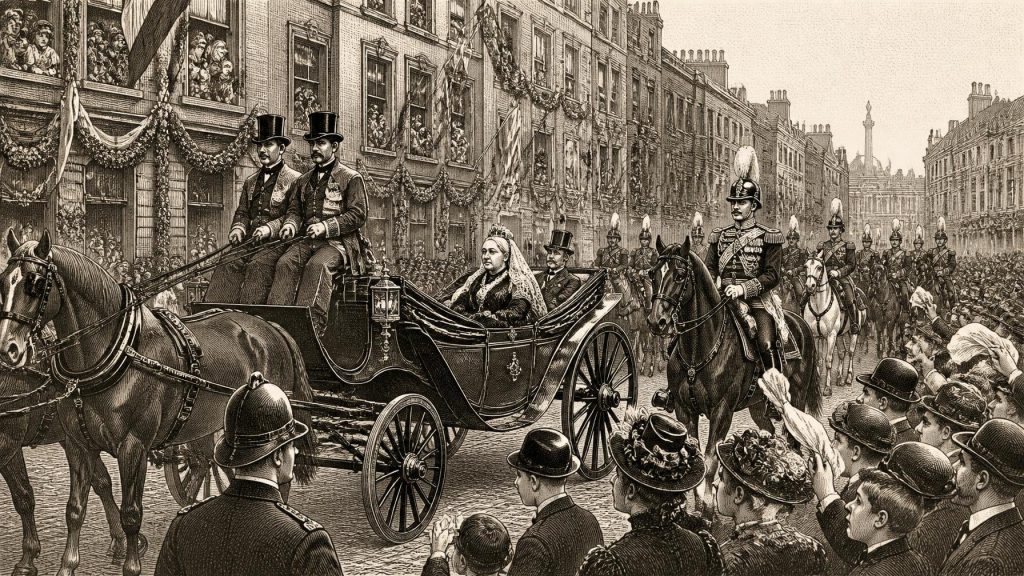
On 1 April, Queen Victoria ordered the formation of the Irish Guards, explicitly recognising Irish soldiers’ service in the South African War, then generally called the Boer War. Three days later, on 4 April, the Queen made her public arrival at Kingstown and travelled into Dublin. It was her final visit to Ireland, and its pageantry was emphatically imperial: decorated streets, official receptions, troops and police, crowds gathered along the route, and ceremonies centred on Dublin Castle and the Phoenix Park. Film survives of her carriage procession in the city, an unusually immediate visual record of a political occasion otherwise filtered through official speeches and partisan newspapers.
The visit was intended in part to acknowledge Irish military contribution to Britain’s war in southern Africa. That contribution was real, and news from the war reached Irish households with particular force. On 5 July, the War Office published the names of 473 men of the 1st Battalion, Royal Irish Fusiliers held prisoner by the Boers. Families, regimental communities and unionist supporters could read the conflict as a shared imperial ordeal. The new Irish Guards gave that reading a lasting ceremonial form.
But the Dublin welcome did not settle the meaning of the occasion. Nationalists hostile to British rule associated Victoria with the Famine and regarded the war as an imperial aggression against the Boer republics. In the House of Commons on 7 February, nationalist MPs declared their sympathy for the Boers and called for the war to end. Unionists countered that Irish enlistment, military reputation and relief subscriptions showed widespread attachment to the Empire. Neither claim can responsibly stand for every Irish person. The debate itself is the important evidence: Ireland’s relationship with Britain in 1900 was publicly contested, even while Irish people served in the British forces and the monarch was ceremonially received in Dublin.
Redmond’s Reunited Party
Constitutional nationalism attempted to recover from the damage done by the split that followed Charles Stewart Parnell’s fall in 1890–91. On 6 February 1900, the Irish National League and Irish National Federation reunited within the Irish Parliamentary Party, and John Redmond became its compromise chairman. The reunion did not erase every personal rivalry or settle all questions of political strategy, but it restored a single major parliamentary organisation committed to Home Rule.
The United Kingdom general election followed between 29 September and 12 October. In Ireland, Redmond’s party won 77 of the island’s 103 Westminster seats. Tim Healy’s nationalist group took three, while one independent nationalist was returned. The Irish Unionists retained 18 seats and Liberal Unionists won three; one Liberal also won a seat. The distribution confirmed the contrasting political geographies of the island: nationalist representation predominated over much of the country, whereas unionism was concentrated especially in the north-east and in particular urban and property-owning constituencies.
Yet the result was not a simple referendum conducted under modern democratic conditions. Seventy Irish seats were uncontested, and voting rights remained restricted by the franchise of the period. Nor did electoral strength give Redmond control over Irish government: the Conservative–Liberal Unionist coalition under Lord Salisbury remained in office at Westminster. The election therefore renewed the Home Rule party’s parliamentary authority but did not bring self-government nearer in any immediate, practical sense. It did, however, establish Redmond as the figure through whom constitutional Irish nationalism would chiefly speak in the first years of the new century.
Plunkett’s Practical Department
A quieter but far-reaching development began on 1 April, when the Agriculture and Technical Instruction (Ireland) Act 1899 came into operation. It created the Department of Agriculture and Technical Instruction for Ireland, commonly known as DATI. The measure was closely associated with Horace Plunkett, the co-operative organiser who served as the department’s vice-president. Its arrival mattered because it joined national policy to the newly elected local authorities created by the Local Government (Ireland) Act 1898.
The department’s remit was broad. The Act covered agriculture, horticulture, forestry, dairying, livestock breeding, poultry, cottage and home industries, flax preparation, inland fisheries, sea fisheries and technical instruction. County and urban councils could raise limited local rates for approved schemes. This was not simply an agricultural ministry in the later sense. It was an attempt to make practical knowledge, scientific advice, industrial education and rural improvement available through institutions located in Ireland rather than directed entirely from London.
For rural families, such ambitions answered immediate problems. Farm incomes depended heavily on livestock and on access to the British market. In 1900, shipments from Ireland to Great Britain included 745,519 cattle, 862,263 sheep, 715,202 pigs and 35,606 horses. The figures demonstrate both the scale of the trade and its dependence upon sea crossings, sale yards and purchasers across the channel. A temporary Irish suspension of livestock imports from Great Britain, prompted by the return of foot-and-mouth disease there early in the year, also showed how animal disease could interrupt the connected agricultural economy.
Plunkett hoped that co-operation could give producers a stronger position within that economy. His 1900 diary’s annual summary recorded 447 societies affiliated to the Irish Agricultural Organisation Society, with a combined turnover of £1 million. Creameries, agricultural societies, credit societies and home-industry groups did not transform every district alike, and many farmers remained tied to small holdings, middlemen, seasonal work and emigration networks. Still, the department and the co-operative movement shared a confidence that better organisation, training and marketing could improve rural life without waiting for a constitutional settlement.
Children, Language and the Stage
The royal visit also produced a revealing act of counter-public culture. On 1 July, a committee associated with Maud Gonne organised the Patriotic Children’s Treat at Clonturk Park, Drumcondra. Contemporary nationalist organisers claimed that about 30,000 children attended. It was conceived as an alternative to the loyalist children’s festivities connected with Victoria’s visit: a deliberately Irish occasion of food, recreation and political education. Later in 1900, the women involved formed Inghinidhe na hÉireann, the Daughters of Ireland. Its programme linked political independence with Irish-language study, history, music, art and support for Irish manufacture. The organisation was small beside the parliamentary parties, but its foundation gave women an institutional place in advanced nationalist cultural work.
The Gaelic League was likewise active enough in 1900 to publish its report for 1899–1900 and the proceedings of its Oireachtas. Such records do not mean that Irish had ceased to decline as a community language; they show instead the increasing organisation of those determined to teach, collect, perform and dignify it. The cultural revival was not separate from politics, but neither was it confined to party politics. Classes, festivals, publications and local branches made language and tradition matters of ordinary association as well as national argument.
Dublin’s Irish Literary Theatre supplied another public arena. At the Gaiety Theatre in February, an English company staged George Moore’s The Bending of the Bough, Alice Milligan’s The Last Feast of the Fianna and Edward Martyn’s Maeve. The choice of an English company underlined a weakness in the project’s early years, but the plays also demonstrated an insistence that Irish subjects, myths and contemporary public questions belonged on a serious stage. The venture would be short-lived, yet it formed part of the institutional path that led towards the Abbey Theatre.
Wilde’s Last Day
On 30 November, Oscar Wilde died at the Hôtel d’Alsace in Paris, aged forty-six. Dublin-born, educated at Trinity College and the son of the nationalist writer Jane “Speranza” Wilde, he had become internationally famous before imprisonment and social ruin drove him into exile. His death did not belong to the organised cultural revival in Dublin, and it would be misleading to make him its representative. Nonetheless, the end of Wilde’s life in 1900 marked the loss of an Irish writer whose work had already achieved a global reach that few contemporaries could match.
Thus 1900 was not merely the threshold of a new century. It was a year in which monarchy, war, parliamentary nationalism, agricultural reform, women’s political culture and literary ambition appeared side by side. Ireland remained under the Union, but its institutions and arguments were multiplying. The country’s future was still undecided; the means by which Irish people would debate, organise and imagine that future were becoming more numerous and more distinct.
Primary Sources
- Agriculture and Technical Instruction (Ireland) Act 1899
- 1900 Diary of Sir Horace Curzon Plunkett (1854–1932)
- Teagasc Past – Training
- Farming Since the Famine: General Details
- Agricultural Statistics (Ireland), 1900
- The Trade in Live Stock between Ireland and Great Britain
- Store Cattle Imported from Ireland
- The Irish Guards
- Recruiting Poster Issued on the Formation of the Irish Guards, 1900
- Queen Victoria in Dublin 1900
- Queen Victoria’s Visit to Dublin
- Oireachtas L&RS Display Case: Queen Victoria’s Visits to Ireland
- Seventh Day’s Debate, House of Commons, 7 February 1900
- Parliamentary Election Results in Ireland, 1801–1922
- 1900 United Kingdom General Election in Ireland
- Inghinidhe na hÉireann/Daughters of Ireland
- Inghinídhe na hÉireann
- Young Ireland and The Nation: Nationalist Children’s Culture in the Late Nineteenth Century
- Conradh na Gaeilge Ard-Fheis Books & Reports
- Imtheachta: Proceedings, 1900
- Theatre in the Making
- Irish Plays and Playwrights: Appendix
- The Life and Court Trials of Oscar Wilde
- Wilde, Oscar Fingal O’Flahertie
- Oscar Wilde: Chronology