Herbert Park, York Dock1907 CE
In 1907 Ireland displayed contrasting modernities. Dublin’s Irish International Exhibition at Herbert Park celebrated industry, art and entertainment, while Belfast labour unrest, led by James Larkin, brought transport and docks near paralysis, prompted military intervention and police mutiny. Synge’s Playboy riots exposed disputes over national culture. Birrell’s limited Irish Council Bill collapsed after nationalist rejection, encouraging separatist alternatives. The Evicted Tenants Act and cooperative movement addressed rural hardship, though poverty persisted. Dublin Castle’s Crown Jewels vanished. Marconi’s Clifden station opened wireless links to Canada, illustrating Ireland’s role in technology. Overall, the year revealed stalled constitutional reform, competing visions of progress.
Dateline
Ireland in 1907 offered strikingly different pictures of modern life. In Dublin, the Irish International Exhibition turned Herbert Park into a bright temporary city of pavilions, machinery, galleries and amusements. In Belfast, dockers, carters and other poorly paid workers brought a major industrial city close to paralysis. Between those poles lay a constitutional disappointment, a land measure aimed at the unresolved aftermath of the Land War, artistic controversy at the Abbey Theatre, and new technologies connecting the west of Ireland to North America. The year did not decide Ireland’s political future, but it exposed the inadequacy of old arrangements and the variety of forces pressing for change.
Synge’s Troubled Premiere
On 26 January, J. M. Synge’s The Playboy of the Western World premiered at Dublin’s Abbey Theatre. The play’s young protagonist, Christy Mahon, arrives in a Mayo shebeen claiming to have killed his father; instead of receiving the expected condemnation, he becomes an object of fascination. Its language, comic treatment of violence, portrayal of rural life and perceived offence to Irish womanhood provoked protests from part of the audience. Disorder interrupted performances during the first week.
The dispute was not merely a theatrical curiosity. The Abbey had been created as a national theatre, and its supporters and opponents contested what a national stage ought to show: idealised patriotic types, or difficult, comic and sometimes unflattering human beings. Synge’s defenders insisted that artistic independence mattered; opponents saw the play as supplying hostile stereotypes of Ireland. The episode made the Abbey a national talking point and showed that cultural revival could generate argument as well as agreement. It also demonstrated that the public meaning of Irishness was being fought over in auditoriums, newspapers and streets, not only at Westminster.
An Administrative Scheme Fails
Constitutional politics produced an equally sharp disappointment. Augustine Birrell, who had become Chief Secretary for Ireland early in the year, introduced the Irish Council Bill in the House of Commons on 7 May. It was deliberately more modest than Home Rule. The proposed body would have had elected and nominated members and would have supervised aspects of Irish administration through committees, but it would not have possessed legislative power. For the Liberal government, it was a possible instalment of self-government and a means of making administration more responsive. For many Irish nationalists, it was an inadequate substitute for an Irish parliament.
The Irish Parliamentary Party, led by John Redmond, had to weigh the value of administrative authority against the danger that accepting it would postpone the larger demand for Home Rule. A Nationalist convention rejected the scheme on 21 May. The government withdrew it in early June. The rapid failure mattered because it revealed how narrow the ground for compromise had become: unionists feared even administrative devolution, while constitutional nationalists would not accept a measure that left Westminster sovereign and Ireland without law-making powers.
The setback also gave advanced nationalists an opportunity to argue that parliamentary tactics had reached a dead end. In April, the Dungannon Clubs associated with Bulmer Hobson had joined Cumann na nGaedheal activists in forming the Sinn Féin League. Arthur Griffith’s National Council came into the new alignment later in the year. These organisations were still small and their structures were evolving; they should not be mistaken for the mass Sinn Féin movement of a later decade. Yet 1907 helped create a more visible platform for abstentionist and self-reliant ideas. In November, the Fenian veteran Tom Clarke returned from the United States, arriving in an Ireland where republican networks were weak but younger activists were seeking to revive them.
Land, Cooperation and Rural Repair
For much of rural Ireland, land remained more immediate than constitutional theory. The Evicted Tenants (Ireland) Act received royal assent on 28 August. It addressed people who had lost holdings during the agrarian conflicts of preceding decades and enabled the Congested Districts Board to assist reinstated tenants with grants for rebuilding, repairs, stock or seed. It did not settle every contested claim, nor did it remove the wider problems of small holdings, migration and poverty in the west. Nevertheless, it acknowledged that land purchase alone had not repaired the human consequences of eviction.
Another strand of rural development was cooperative organisation. Sir Horace Plunkett’s Irish Agricultural Organisation Society reported 913 affiliated cooperative societies in 1907, with a combined turnover of about £2 million. Creameries, credit societies and agricultural cooperation sought to improve the bargaining position and practical knowledge of farmers and rural communities. This was not a simple nationalist success story: Plunkett’s position in the Department of Agriculture and Technical Instruction was politically controversial, and he was forced to resign as its vice-president during the year. The dispute illustrated a larger tension. Even programmes presented as practical, non-party improvements in farming, education and industry could become entangled in arguments about who spoke for Ireland and how public money should be controlled.
A Fair in Ballsbridge
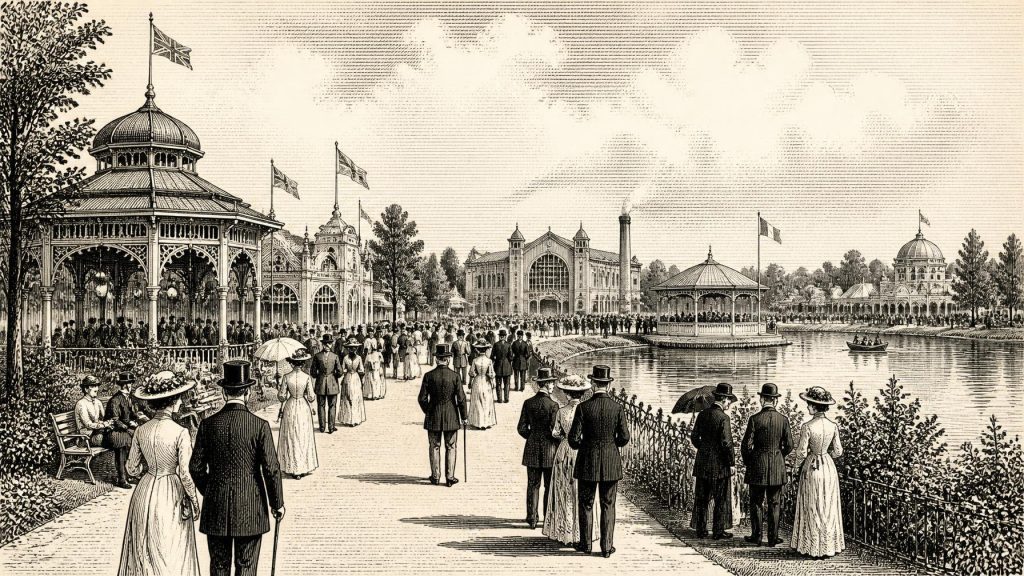
On 4 May the Irish International Exhibition opened at Herbert Park, Ballsbridge. It ran until 9 November and was Ireland’s most ambitious public exhibition of the period. Its displays brought together industry, agriculture, art, commerce and imperial connections; its grounds also provided popular entertainments, including rides and cinematic attractions. For visitors, it offered an experience of electric modernity and cosmopolitan consumption unusual in everyday Dublin. For organisers and exhibitors, it was a statement that Ireland could be represented as productive, inventive and culturally accomplished within the United Kingdom and international markets.
King Edward VII and Queen Alexandra visited Dublin and the exhibition on 10 and 11 July. The royal presence underlined the fair’s official and imperial character, but the exhibition could carry several meanings at once. A manufacturer promoting Irish goods, an artist exhibiting work, a family taking in an amusement, or a nationalist assessing the country’s economic possibilities need not have shared the same politics. By its close, the exhibition had recorded an estimated 2.75 million admissions. Its buildings were temporary, but the fair remains a vivid indication of the city’s confidence, commercial aspiration and appetite for public spectacle.
Dublin’s official world was embarrassed in the middle of this season of display. On 6 July it was discovered that the insignia of the Order of St Patrick, often called the Irish Crown Jewels, had disappeared from a safe in the Office of Arms at Dublin Castle. The regalia had a ceremonial role in the vice-regal order, making the loss more than an ordinary theft. No convincing public resolution followed. Rumour flourished, but the responsible historical point is simpler: a conspicuous breach of security at the heart of Castle administration became a lasting scandal.
Belfast’s Labour Revolt
The year’s gravest domestic confrontation unfolded in Belfast. James Larkin, an organiser for the National Union of Dock Labourers, had been sent to the city in January. From late April and through May, disputes involving dock labourers and carters widened into a major struggle over wages, conditions and union recognition. Belfast’s docks were essential to a city of shipbuilding, linen manufacture, engineering and trade. Workers whose employment was insecure and arduous found that stopping transport and port labour could exert formidable pressure.
Larkin’s campaign briefly crossed the entrenched religious and political divisions of the city. Protestant and Catholic workers could share the material interest of better pay, and large demonstrations showed the appeal of that unity. But it was fragile. Employers imported or protected replacement labour, violence accompanied picketing, and established sectarian loyalties remained available to opponents of the strike. In June the authorities deployed troops to maintain cordons and protect traffic. The intervention showed that a wage dispute in Ireland’s leading industrial centre could swiftly become a question of state power.
The most extraordinary development came within the Royal Irish Constabulary. Discontented Belfast policemen, resentful of pay and conditions and unhappy with their role in escorting strike-breakers, defied discipline in July and early August. Their action is conventionally remembered as the Belfast police mutiny. The administration responded by suspending and transferring men and by bringing in thousands of soldiers. During serious August rioting, troops fired in the Falls district; people were killed and others wounded. The strike was therefore never a simple story of class solidarity. It exposed solidarity’s potential, but also the coercive force of government and the speed with which Belfast’s social divisions could reassert themselves.
A settlement brought the dock dispute to an end on 28 August. Some workers secured gains in pay and hours, but union recognition was not won and many of the most militant workers paid a price. Larkin nonetheless emerged as a figure of national importance. The Belfast struggle supplied lessons in mass organisation, sympathetic action and the limits of relying on employers or the state that would resonate strongly in later Irish labour conflicts.
Signals Across the Atlantic
On 17 October, the Marconi station near Clifden in Connemara began a commercial wireless telegraph service with Glace Bay, Nova Scotia. Press messages crossed the Atlantic without a submarine cable, linking a remote Galway headland to Canada through powerful transmitting equipment, aerial masts and skilled operators. The service was initially limited and the technology remained technically demanding, but the opening was a real landmark. Ireland, often represented as peripheral and economically backward, was also a site from which a new global communications system operated.
Thus 1907 joined contrasts rather than resolving them. Herbert Park advertised progress; Clifden transmitted it. Belfast revealed the insecurity beneath industrial prosperity. The Irish Council Bill showed constitutional reform stalling, while land legislation and cooperation addressed particular rural needs without settling the national question. On stage, in dockland streets, in government offices and across the Atlantic airwaves, Ireland’s future was being argued over in practical and increasingly public ways.
Primary Sources
- Irish Council
- Irish Councils Bill
- Evicted Tenants (Ireland) Act 1907
- 1907 Diary of Sir Horace Curzon Plunkett
- Plunkett, Sir Horace Curzon
- Fletcher, George
- The Irish International Exhibition of 1907
- Irish International Exhibition, Dublin, 1907: Fine Art Section – British and Foreign Artists
- The Playboy of the Western World, Abbey Theatre Production Archive
- The Belfast Labour Dispute and Riots of 1907
- Belfast Dock Labourers' Strike
- Belfast Strike
- The Belfast Riots
- Larkin, James
- Vicars, Sir Arthur Edward
- Clarke, Thomas James (‘Tom’)
- Arthur Griffith
- Mac Diarmada (MacDermott), Seán
- Establishment, Emergent Forces and Municipal Politics: Dublin Corporation, 1899–1920
- Notes: Wireless Telegraphy Across the Atlantic
- Marconi Station
- Transatlantic Wireless National Historic Event
- Marconi National Historic Site of Canada