Curtain at Abbey Street1904 CE
In 1904, Ireland remained under Westminster rule, yet political, economic and cultural initiatives widened debate over its future. Dunraven’s Irish Reform Association advocated limited administrative devolution, while the Irish Parliamentary Party pursued Home Rule and Arthur Griffith promoted Hungarian-inspired national self-reliance. The 1903 Land Act began transferring estates to tenants, alongside co-operative schemes and continuing hardship in congested districts. Gaelic League activities, the first official public camogie match, and the Oireachtas advanced cultural revival. On 27 December the Abbey Theatre opened in Dublin, establishing a permanent national stage. Industrial Belfast contrasted sharply with the mainly agricultural south and west regions.
Dateline
In 1904 Ireland remained part of the United Kingdom, governed from Westminster and administered in Dublin Castle, but the year showed how many different answers Irish people were beginning to make to the question of the country’s future. The most firmly dated cultural landmark came at year’s end: on 27 December, the Abbey Theatre opened to the public in Dublin. Yet the significance of 1904 lies as much in the coexistence of competing projects as in that celebrated opening night. Land purchase was reshaping the countryside; moderate reformers proposed limited Irish self-government within the Union; Arthur Griffith argued for a more radical constitutional example; language, sport and theatre made national culture visible in new public forms. None settled Ireland’s political future. Together, they made the island’s public life more active, organised and self-consciously Irish.
Devolution Without Home Rule
Formal political power still rested outside Ireland. The Conservative government in London was led by Arthur Balfour, while George Wyndham served as Chief Secretary for Ireland. The lord lieutenant, the earl of Dudley, represented the Crown in Dublin. In this framework the Irish Parliamentary Party continued to seek Home Rule: a parliament in Dublin responsible for domestic affairs while remaining within the United Kingdom. Its demand commanded broad nationalist support, but it was not close to enactment in 1904.
That did not prevent a different constitutional experiment from being attempted. On 26 August, the fourth earl of Dunraven founded the Irish Reform Association. Dunraven had chaired the Land Conference of 1902, whose negotiations between landlords and tenant representatives helped produce the Irish Land Act of 1903. He hoped that the conciliatory methods employed over land could be extended into politics. Assisted in developing proposals by Sir Antony MacDonnell, the under-secretary at Dublin Castle, Dunraven’s association brought together moderate landlords and other reform-minded figures who sought a measure of Irish administrative devolution without breaking the parliamentary Union.
The association’s plans appeared in reports during August and September. They envisaged an Irish representative body with enlarged responsibility for domestic and financial business, but stopped far short of the legislature demanded by Home Rulers. This was neither a settled government programme nor a new Irish constitution. It was a politically consequential intervention: a group drawn substantially from the landed unionist world was now publicly suggesting that Ireland required more than routine Westminster administration.
The proposal exposed the limits of conciliation. Unionists, particularly in Ulster, feared that even limited devolution would become a route towards Home Rule. Many nationalists, meanwhile, regarded Dunraven’s scheme as an inadequate substitute for an elected parliament. Wyndham soon distanced himself from the initiative. The controversy would contribute to his resignation in 1905, but that later outcome should not be projected backwards as if it had already been decided in 1904. During this year, the Reform Association was an uncertain, contested attempt to make cooperation across political and religious divisions do constitutional work.
Land, Ownership and Rural Change
The immediate background to these political arguments was the great land settlement set in motion by the Irish Land Act of 1903. The Act had come into force on 1 November 1903. In 1904 its machinery of sale, purchase and state-backed finance was becoming part of rural life. It aimed to accelerate the voluntary transfer of estates from landlords to tenants. For tenants able to buy, the prospect was profound: rent paid to an owner could eventually become an annuity paid towards ownership of a family holding.
This did not mean that the Irish countryside had suddenly become prosperous or socially equal. Sales took time; legal conveyance, valuation and finance were complicated; and many agricultural labourers possessed no holding to purchase. The legislation itself recognised labourers as a distinct and poorly paid rural group. Small farms, seasonal work and dependence upon livestock and dairy markets remained central features of life across much of the island.
Conditions were especially difficult in parts of the west and north-west, where poor soils and tiny holdings had long been associated with poverty, migration and insecure livelihoods. The Congested Districts Board continued its work in these regions through schemes connected with agriculture, fisheries, industries and estate improvement. Its annual reports record an official effort to address structural rural hardship, but they also demonstrate that the problem was enduring rather than solved. In 1904, ownership reform, co-operative organisation and state-assisted development overlapped, without removing the disparities between relatively viable farming districts and marginal coastal communities.
Horace Plunkett’s Ireland in the New Century, published in 1904, supplied an influential statement of the constructive outlook behind such initiatives. Plunkett championed agricultural co-operation, practical education and local responsibility. Creameries, credit societies and agricultural associations offered farmers ways to market produce, obtain finance and share expertise. His language of ‘self-help’ could sound patronising to critics, and co-operation was never politically neutral. Nonetheless, it expressed a real change in rural organisation: economic improvement was increasingly imagined not only as an individual household matter, but as a collective undertaking.
A New Constitutional Nationalism
While Dunraven sought reform within the Union, Arthur Griffith was developing a more nationalist argument in the pages of the United Irishman. Between January and July 1904 he published a series of articles using Hungary’s constitutional relationship with Austria as his principal comparison. These essays were reissued at the end of the year as The Resurrection of Hungary. Griffith argued that Irish representatives should cease treating Westminster participation as the sole route to national advancement and should build Irish institutions and authority at home.
It would be misleading to describe 1904 as the year Sinn Féin became a mass force: the organisation associated with that name emerged in 1905, and Griffith’s influence remained limited. But the argument mattered because it redirected attention from parliamentary negotiation alone towards economic, cultural and institutional independence. His programme was not the later republican programme of armed separation. In 1904 it was a constitutional and political critique, shaped by an international analogy and expressed through journalism. It nevertheless helped create a vocabulary that would become far more important in the years ahead.
Language, Games and Women’s Public Sport
Cultural nationalism had a wider practical presence than any single political scheme. Conradh na Gaeilge, the Gaelic League, continued to organise classes, lectures, publications and annual gatherings in Irish. Its 1903–04 annual report and proceedings preserve the scale of this voluntary work: language revival depended on branches, teachers, local organisers, singers, readers and learners rather than on state policy. The Oireachtas, founded by the League in 1897 as a festival of Irish-language competitions, provided a national stage for recitation, music, song and dramatic performance.
A firmly dated sporting event illustrated how this cultural activism could create new opportunities for women. On 17 July 1904, teams from the Keatings branch of the Gaelic League and Cúchulainns played at the Meath agricultural showground in Navan. The Camogie Association recognises it as the first official public camogie match. It was not simply an athletic novelty. By adapting hurling for women and placing the game before a public audience at a feis, organisers made women participants in the visible culture of Irish national recreation. The later institutional growth of camogie should not obscure the modest scale of that afternoon, but its symbolic importance was genuine.
These developments also reveal the social character of revival activity. Irish-language societies and sporting clubs were often energetic places of sociability, discipline and local leadership. They brought together students, clerks, teachers, small farmers and urban workers, although access was uneven and Ireland’s population was not culturally or politically uniform. English remained the ordinary public language for most people; Irish survived most strongly in particular districts and was being learned anew elsewhere. Revivalists were not recovering a static past. They were selecting, adapting and organising cultural materials for a modern society.
The Abbey Opens
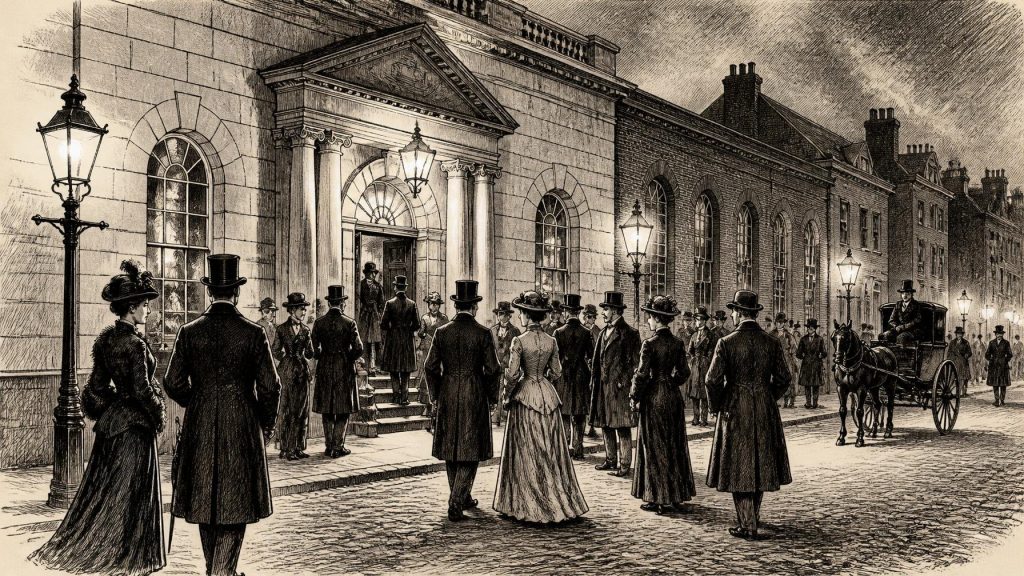
The clearest cultural event of the year occurred in Dublin on 27 December. With financial support from Annie Horniman, the former Mechanics’ Institute on Abbey Street and an adjoining building on Marlborough Street had been converted into a permanent theatre. The opening programme comprised W. B. Yeats’s On Baile’s Strand, Lady Gregory’s Spreading the News, and Yeats’s Kathleen ni Houlihan. Frank Fay spoke the first lines on stage, while Sara Allgood appeared in all three plays.
The evening joined markedly different theatrical modes. On Baile’s Strand drew on the Cúchulainn cycle; Spreading the News was a comedy of rumour, social pretension and provincial misunderstanding; Kathleen ni Houlihan, first performed in 1902, dramatised Ireland as an old woman calling a young man towards national sacrifice. Their juxtaposition made a statement about what an Irish national theatre might contain: myth, comedy, contemporary social observation and political feeling.
The Abbey’s opening should not be treated as the instant creation of a complete national culture, nor as a theatre universally representative of Ireland. Its founders, performers and patrons worked within particular literary, social and urban networks. But the establishment of a permanent public stage gave the dramatic revival an institution capable of regular production, professional development and controversy. In 1904, that capacity was still a promise. The later disputes and achievements associated with the Abbey lay ahead.
Uneven Modern Ireland
Outside Dublin’s cultural circles, industrial Belfast offered a sharply different image of the island’s modernity. Linen manufacture, engineering, shipbuilding, docks and associated trades made the city one of the United Kingdom’s major industrial centres. Its prosperity rested on wage labour, commercial networks and a port connected to Britain and the wider world. It also coexisted with hard working conditions, overcrowding and entrenched religious division. The contrast with the predominantly agricultural south and west was not absolute, but it was fundamental to how people experienced Ireland in 1904.
The year therefore belongs neither to a simple tale of national awakening nor to one of peaceful reform. Its most memorable date was a theatrical opening, but the deeper story was the multiplication of institutions: a reform association, land-purchase machinery, co-operative societies, language branches, sporting organisations and a permanent theatre. Each proposed, in its own way, that Irish society could be remade. Their ambitions differed sharply. Their shared consequence was to make the question of Ireland’s future harder to confine to Westminster alone.
Primary Sources
- Abbey Theatre opens its doors
- History
- Spreading The News
- The Abbey Theatre
- Griffith, Arthur Joseph
- Quin, Windham Thomas Wyndham-
- Wyndham, George
- The Irish unionist party and the devolution crisis of 1904–5
- Irish Reform Association Manifesto published 1904
- Government of Ireland
- Irish Land Act, 1903
- Tables Showing the Extent in Statute Acres and the Produce of the Crops for 1904
- Report of the Congested Districts Board for Ireland, of Proceedings under the Congested Districts Board (Ireland) Acts
- Congested Districts Board (Ireland) Act 1901
- Ireland in the New Century
- Ireland in the New Century: Chapter 8, The Recess Committee
- Plunkett, Sir Horace Curzon
- Conradh na Gaeilge Ard-Fheis Books & Reports
- Stair | An tOireachtas
- Remembering the Easter Rising 1916 – Bridget Foley
- Camogie Association Unveils Plaque in Navan’s Pairc Tailteann for 120th Anniversary
- What Was Belfast Like in the Early 20th Century?
- The History of Belfast Shipbuilding
- Culture, Conflict and Cooperation: Irish Dairying, 1897–1914