Church Street and the Rotunda1913 CE
In 1913, the Third Home Rule Bill intensified conflict between constitutional nationalism and Ulster unionism, whose Volunteer Force prepared to resist self-government. Dublin’s Lockout pitted James Larkin’s ITGWU against employers led by William Martin Murphy, bringing exclusion, Bloody Sunday violence, hunger and disputes over relief for children. The collapse of Church Street tenements, killing seven, highlighted urban housing failures. Labour activists formed the Irish Citizen Army, while nationalists founded the Irish Volunteers at the Rotunda in response to unionist militarisation. Cultural debates involving Yeats and the Gaelic League reflected public identities, leaving Ireland divided, mobilised and distrustful of parliamentary solutions.
Dateline
In 1913, Ireland’s constitutional future, the condition of its urban poor and the legitimacy of organised force became fiercely entangled. The Third Home Rule Bill still offered limited self-government within the United Kingdom, not independence, yet it had brought political argument to a point at which unionist and nationalist organisations increasingly prepared for conflict beyond Parliament. At the same time, Dublin’s great labour dispute exposed the precariousness of life in a capital where prosperous commerce, overcrowded tenements and casual employment existed side by side. Events in Dublin dominated the year, but their consequences were felt across the island.
Home Rule and Unionist Mobilisation
The parliamentary setting was the Home Rule crisis. The Government of Ireland Bill, introduced in 1912 by the Liberal government at Westminster, proposed an Irish legislature while reserving ultimate authority to the Parliament of the United Kingdom. John Redmond’s Irish Parliamentary Party remained committed to securing this constitutional settlement. Its prospects had improved because the Parliament Act of 1911 had curtailed the House of Lords’ absolute veto. Nevertheless, the bill had to survive repeated passage through the Commons before it could become law.
In 1913 the measure moved again through Westminster. The House of Commons passed it on 7 July, and the Lords rejected it shortly afterwards. This was not a final defeat, but it prolonged an atmosphere of apprehension. For many nationalists, Home Rule appeared to be approaching by lawful means. For unionists, especially in Ulster, a Dublin parliament was regarded as a threat to their place in the United Kingdom, their political influence and, for many Protestants, their civil and religious security.
That disagreement was no longer expressed only through speeches, petitions and elections. In January, the Ulster Volunteer Force was formed by bringing together unionist bodies already drilling and organising. Its purpose was to resist the implementation of Home Rule. The movement’s military structure, public demonstrations and disciplined local organisation made the prospect of armed resistance more concrete. It did not mean that war had begun in Ireland; it did mean that force had entered everyday political calculation in a new and visible way.
The consequences extended well beyond Belfast and the north-east. Nationalists who had trusted Westminster were compelled to ask whether a parliamentary majority could deliver Home Rule if its opponents threatened physical resistance. The fact that unionist preparations could proceed so openly was itself a potent political lesson. By the autumn, it helped create the conditions in which a nationalist volunteer movement could present itself not as an insurrectionary minority, but as a public civic response.
Dublin’s Employers and Workers
That same year brought the Dublin Lockout, the defining social conflict of pre-war Ireland. Its immediate setting was the struggle between James Larkin’s Irish Transport and General Workers’ Union (ITGWU) and William Martin Murphy, chairman of the Dublin United Tramways Company, president of the Dublin Chamber of Commerce and proprietor of influential newspapers. The larger issue was whether employers would recognise the ITGWU and permit workers to retain membership without forfeiting their jobs.
Murphy had already acted against union members at the Irish Independent. On 26 August, the opening day of the Dublin Horse Show, tramway drivers and conductors struck. The timing was calculated to disrupt the city at one of its busiest commercial occasions. The tram stoppage was rapidly contained, but the confrontation widened. By early September, more than 400 employers had combined to exclude workers who would not sign an undertaking to renounce the ITGWU. What began with particular workplaces thus became a lockout affecting roughly 20,000 people.
The conflict was not a simple contest between a uniformly affluent employer class and a single workforce. Dublin included skilled craft unions, small firms, casual labourers and workers with uneven attachments to Larkin’s union. Yet the employers’ concerted demand that workers disavow the ITGWU made union membership the central point of principle. For Larkin and James Connolly, the dispute concerned dignity and the right to organise; for Murphy and his allies, “Larkinism” represented a form of industrial militancy they believed could overturn established authority in the city.
On Sunday 31 August, serious disorder culminated in police baton charges on Sackville Street, now O’Connell Street. The day became known as Bloody Sunday. Crowds had assembled amid a ban on a planned address by Larkin, and violence had already occurred in working-class districts. Accounts differed sharply over the conduct and provocation of particular clashes, but the human result was plain: two men died after the disturbances and hundreds were injured, with contemporary estimates commonly placing the injured at between 400 and 600. The Dublin Metropolitan Police, reinforced by the Royal Irish Constabulary, became a symbol of the state’s intervention in a bitter class conflict.
Police records and newspaper arguments reveal another aspect of the dispute: a struggle over who constituted “the public”. Supporters of the employers often characterised the crowds as disorderly slum dwellers. The experience recorded in arrest books was more complicated, including many workers caught in an extraordinary confrontation. The language used about poverty was itself political, because it could either deny or recognise that families living in insecure work and overcrowded rooms had claims upon the city.
Hunger, Housing and Religious Authority
As the autumn advanced, the Lockout tested household survival. Relief arrived from British trade unionists in the form of money, food, fuel and clothing, while local charitable bodies, including the Society of St Vincent de Paul, also assisted distressed families. This practical solidarity linked Dublin workers to labour networks in Britain, even as the dispute heightened tensions between the Irish Parliamentary Party and elements of British Labour. Families nevertheless faced lost wages, debt, hunger and illness. Children were especially vulnerable in a city already burdened by poor housing and high mortality.
The proposed removal of strikers’ children to temporary homes in Britain showed how social relief could become a religious and national controversy. In October, organisers prepared a scheme under which children would be cared for by sympathetic families across the water. Some parents welcomed the prospect of food and safety; Catholic clergy and nationalist critics feared that Catholic children might be exposed to proselytising or separated from parental authority. Priests intervened at departure points and the scheme collapsed. The episode cannot be reduced to simple clerical hostility or simple humanitarianism: it exposed the genuine material desperation of families, while also demonstrating the authority of the Catholic Church in the social politics of Dublin.
On 2 September, only days after Bloody Sunday, two tenement houses at 66 and 67 Church Street collapsed, killing seven people. The disaster was not caused by the Lockout, but its timing made it impossible to ignore the relationship between public disorder and the older emergency of housing. Dublin Corporation had ordered work intended to make the buildings safe only months earlier. The collapse produced public anger and helped propel official investigation of Dublin housing conditions. For residents of the inner city, the danger lay not merely in police charges or unemployment but in the fabric of the rooms and buildings in which they slept.
Armed Citizenship
November brought two organisations whose later histories would overshadow their immediate origins. On 23 November, Larkin, Connolly and Captain Jack White established the Irish Citizen Army as a workers’ defence corps. Its initial purpose was to protect labour demonstrations and pickets after the violence of the Lockout. In 1913 it remained small and newly formed, rather than the developed force it would later become, but its creation marked a striking proposition: workers, too, could organise disciplined armed protection.
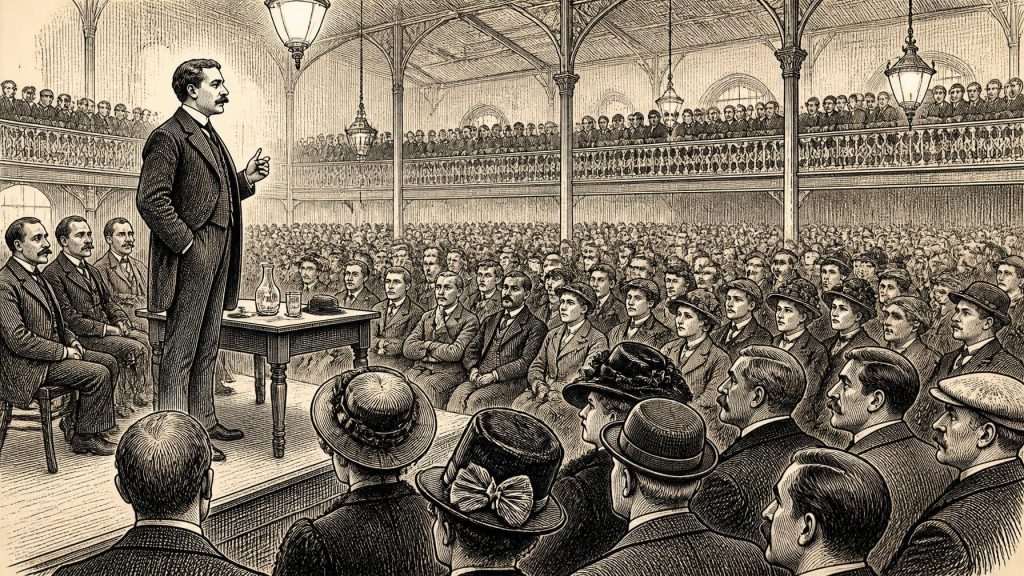
Two days later, on 25 November, thousands attended a meeting in the Rotunda Rink in Dublin at which the Irish Volunteers were publicly founded. The occasion followed Eoin MacNeill’s article, ‘The North Began’, published in the Gaelic League newspaper An Claidheamh Soluis on 1 November. MacNeill argued that nationalist Ireland should answer unionist militarisation with citizen forces of its own. The organisers included figures from cultural nationalism and the Irish Republican Brotherhood, but the public declaration was deliberately broad. Its undertaking spoke of securing rights and liberties for people without distinction of creed, class or politics.
That language mattered. The Volunteers were presented as defenders of Home Rule and national rights, not as an openly separatist army. Their foundation nevertheless changed the political landscape. By the end of the year, Ireland contained unionist, nationalist and labour bodies that each connected civic claims with drill, uniforms or armed preparedness. The constitutional question had not been settled; rather, its possible settlement had become entangled with rival ideas of who had the right to defend a community by force.
Culture in a Contested Public Sphere
Political tension did not extinguish cultural life. It sharpened debates about what a national public culture should value. On 8 September, The Irish Times printed W. B. Yeats’s poem later known as ‘September 1913’, under the title ‘Romance in Ireland’. It was written amid controversy over Hugh Lane’s proposed municipal gallery of modern art in Dublin. Yeats’s target was not the Lockout, though the poem was soon read against the year’s wider bitterness. Its publication showed how arguments over art, civic spending and national memory could become arguments about the moral character of Ireland itself.
The Gaelic League remained another important arena. Its language revival gave people throughout Ireland opportunities for classes, competitions, publications and cultural gatherings, while disagreements grew over whether such a body could remain politically non-partisan. Douglas Hyde publicly warned against turning the League into an instrument of political factions. Yet many people active in language and cultural work also participated in the nationalist networks from which the Volunteers emerged. In 1913, culture was not merely a backdrop to politics: it was one of the places where political loyalties, public identities and future leaders were formed.
By December, no decisive victory had been won. The Lockout continued into the following month; Home Rule remained unimplemented; and the new volunteer bodies had only begun to organise. But 1913 had changed the scale of Irish public life. A tenement collapse had forced housing into view, a labour confrontation had made class and hunger unavoidable, and the Rotunda meeting had shown that the language of constitutional rights could now be accompanied by organised force. Ireland entered 1914 with parliamentary hopes still alive, but with political society more divided, more mobilised and less certain that Parliament alone could command obedience.
Primary Sources
- Third home rule Bill
- Government of Ireland Bill, 7 July 1913
- 1912–1923 Timeline
- Ireland 1900–1925: Crisis, War and Revolution
- Decade of Centenaries Timeline
- The Dublin 1913 Lockout
- Policing the Lockout: the role of the DMP
- Dublin Metropolitan Police Prisoners Books: About
- Dublin in the Early Twentieth Century
- Poverty and Health
- Derelict Dublin: Images of the City from 1913
- Inquest Opens into the Seven Deaths on Church Street
- The Church Street Tenement Disaster (1913)
- The Children, the ITGWU and the Archbishop
- History of Organisations
- Irish Volunteers Founded in Dublin
- Manifesto of the Irish Volunteers
- The North Began
- A Pictorial History of Óglaigh na hÉireann
- James Connolly
- A Short History of the 1916 Rising
- A Poet Discouraged – Yeats, 1913
- W. B. Yeats and The Irish Times
- Douglas Hyde Denounces Use of Gaelic League for Political Purposes
- Ireland in 1913