Feidlimid Claims Caisel820 CE
In 820 Feidlimid mac Crimthainn of the Eóganacht Chaisil became king of Caisel, Munster’s overkingship. Recorded by the Annals of Inisfallen, despite difficulties in other annals, his accession began a twenty-seven-year reign. The circumstances of succession, amid rivalry between Eóganacht branches, remain unknown. His authority depended upon kinship, armed support, tribute, alliances and ecclesiastical recognition within politically fragmented Ireland. Caisel controlled a central Munster landscape, while churches supplied wealth, status and influence. Rural producers sustained ecclesiastical power. Scandinavian raiding was an established threat though no dated attack occurred in Ireland that year. Later military campaigns extended Feidlimid’s influence beyond Munster.
Dateline
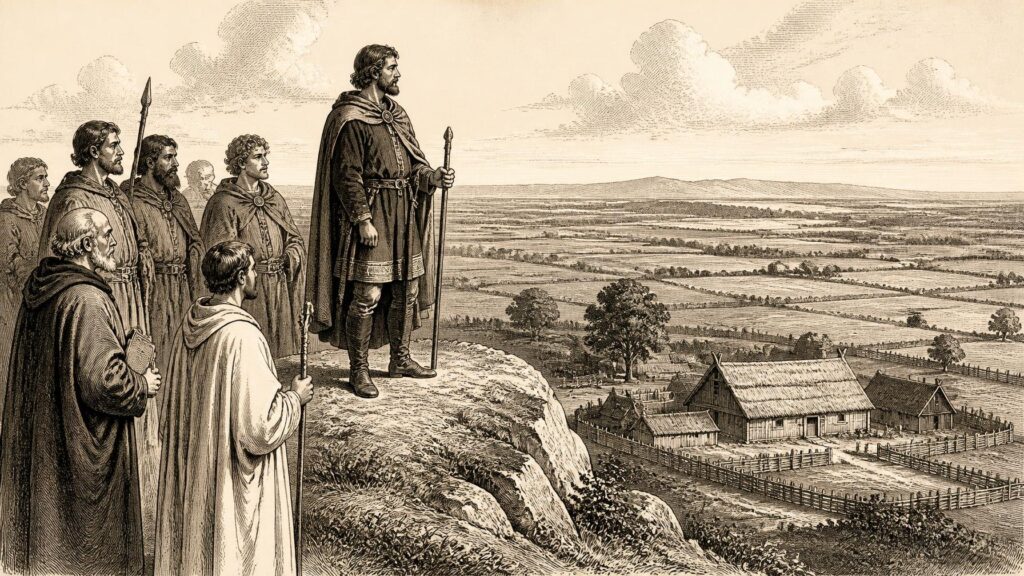
In 820, a brief annalistic notice recorded a change whose consequences would reach far beyond Munster: Feidlimid son of Crimthann took the kingship of Caisel. Caisel, modern Cashel in County Tipperary, was the royal centre associated with the overkingship of Munster. The entry offers no narrative of a coronation, assembly, battle or negotiated settlement. It nevertheless marks the beginning of the twenty-seven-year rule of Feidlimid mac Crimthainn, one of the most forceful and controversial Irish rulers of the ninth century.
The date deserves a little care. The Annals of Inisfallen place Feidlimid’s accession under 820. The Annals of Ulster preserve the same notice in an entry whose internal year-numbering is displaced, a familiar complication in early Irish annals. Modern reference works consequently treat 820 as the appropriate calendar year for his accession. That is firmer ground than attempting to reconstruct an inauguration ritual or the circumstances by which his rivals were removed: the sources simply do not provide them.
A New King at Cashel
Feidlimid belonged to the Eóganacht Chaisil, a branch of the wider Eóganacht dynasties that supplied many of Munster’s kings. His succession was not necessarily smooth. Artrí son of Cathal, associated with the rival Eóganacht Glendamnach line, appears as king of Cashel before Feidlimid and was recorded dead in 821. This does not prove that Feidlimid killed or forcibly deposed him. It does, however, reveal a transition made in a political world where competing branches of a royal kindred possessed plausible claims to rule.
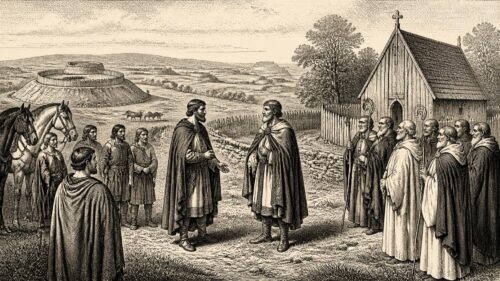
Irish kingship was not a single office passed automatically from father to eldest son. A ruler’s standing depended on descent, the backing of powerful kinsmen, control of clients and land, the capacity to gather an armed following, and recognition by ecclesiastical communities. The king of Caisel was an overking: he stood above lesser kings and lords within Munster, but his authority had to be exercised and renewed rather than assumed to be absolute. Hostages, tribute, food-renders, military service and personal alliances were the practical currencies of political power.
Thus Feidlimid’s accession was significant not because Ireland suddenly became a united kingdom, but because it placed an ambitious member of the Cashel dynasty at the head of one of the island’s great provincial powers. The later record shows him pressing Munster’s influence into Leinster, the midlands and Uí Néill territory. Those campaigns belong to later years, not to 820 itself; but his installation at Caisel is the indispensable starting point for them. It also began a long period in which the Cashel branch of the Eóganacht held particular prominence in Munster.
Ireland’s Divided Political Landscape
Feidlimid entered office in an Ireland of many kingdoms. In the north and midlands, branches of the Uí Néill dominated much of the political landscape. Conchobor son of Donnchad, ruler of the southern Uí Néill, was recognised in contemporary annals as king of Tara, a title carrying exceptional prestige. Northern Uí Néill dynasties, the kingdoms of Ulster, Leinster rulers, Connacht kings and Munster’s own internal lineages all pursued their interests independently. The phrase “king of Ireland”, sometimes used by later writers, should not be mistaken for rule over a centralised state.
Military movement was a normal instrument of politics. A hosting might demonstrate rank, demand hostages, punish a challenger, collect provisions or reinforce a claim over a borderland. Yet diplomacy mattered as much as fighting. Kings could make submissions, exchange guarantees and meet under church protection. The annals’ compressed notices do not tell us what Feidlimid promised his supporters in 820, or what obligations he accepted in return. They do show the sort of political environment in which a successful ruler had to convert kinship claims into active allegiance.
Caisel’s importance lay in this setting. It was a royal place commanding the productive lowlands of central Munster and connected by routes running towards the Shannon basin, the southern coast and Leinster. The impressive medieval buildings now associated with the Rock of Cashel are much later than Feidlimid’s day, and should not be projected back into 820. But the site was already a potent royal landscape, where authority could be displayed, followers assembled and relationships with churches cultivated.
Royal Power and the Church
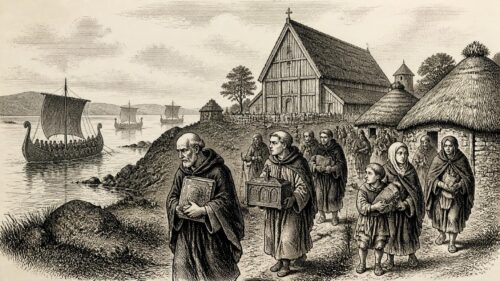
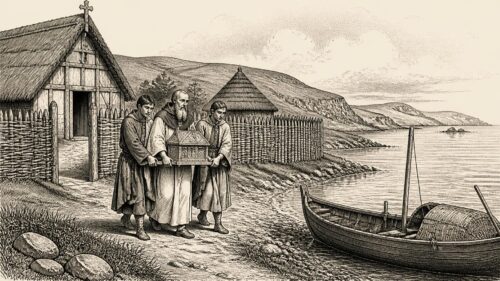
Feidlimid’s career is especially revealing because royal and ecclesiastical authority were deeply entangled in early medieval Ireland. Major churches were not isolated monasteries in the modern sense. They were communities with land, tenants, livestock, craftworkers, schools, burial grounds, legal privileges and links to powerful families. Abbots, bishops, scribes, priests and anchorites could be religious figures, learned specialists and political actors at once. A church’s saint, relics and inherited rights could also provide a language through which kings made claims and communities sought protection.
Nothing in the accession notice itself calls Feidlimid a cleric. Caution is necessary here. His obituary in 847 describes him as a scriba and an anchorita, terms suggesting learning and a religious vocation, while later records associate his kingship with intervention in ecclesiastical affairs. That later evidence makes it reasonable to see church connections as important to understanding his rule, but it cannot tell us precisely what office, training or spiritual practice he possessed in 820.
The ambiguity is historically useful. It warns against treating a king and a churchman as mutually exclusive identities. In ninth-century Ireland, elite families could seek influence through both royal and ecclesiastical office. Control of a major church could bring access to land, labour, hospitality, legal authority and prestige; royal patronage could in turn support a community’s security and claims. Feidlimid would later use this interwoven world with exceptional energy. In 820, however, the responsible conclusion is more limited: a king whose later reputation joined political ambition with religious and scholarly status had taken Cashel.
Work, Wealth and Vulnerability
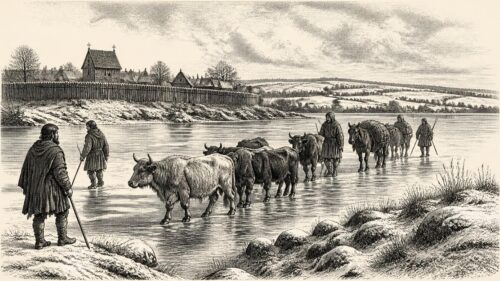
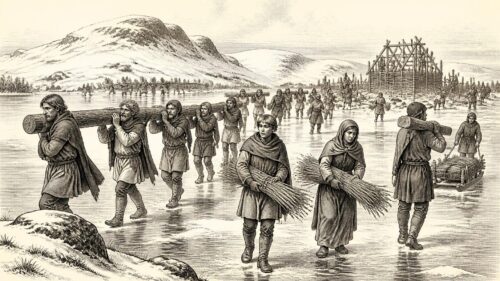
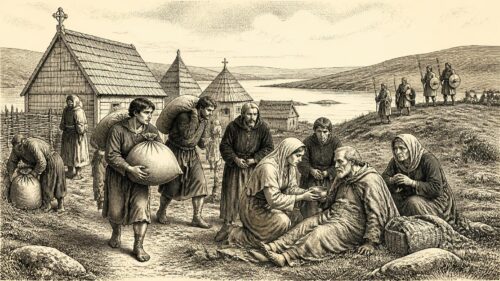
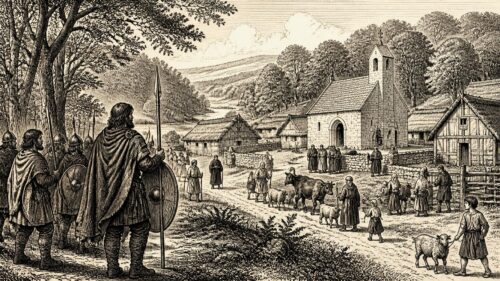
For most people in Munster, the accession of a new overking mattered through its effects on everyday obligations. Wealth was chiefly agricultural. Cattle were stores of value and a source of dairy produce, hides and status; grain and other crops were essential to subsistence; and pigs, sheep, horses and woodland resources sustained households. Farming settlements, enclosed homesteads and scattered church estates structured much of the inhabited landscape. Seasonal labour, food-renders and the movement of animals connected local production to royal households and ecclesiastical centres.
The sources do not permit a statistical picture of Munster’s harvest in 820, nor do they describe ordinary homes in that specific year. They do permit a broader conclusion: a change at Caisel could alter who received renders, who owed service, whose legal protection counted and which local dynasties could expect royal favour. Kingship was experienced not only in distant battles but in demands for food, livestock, escort and hospitality. Church communities, likewise, depended on surrounding rural producers and on the political security of their estates.
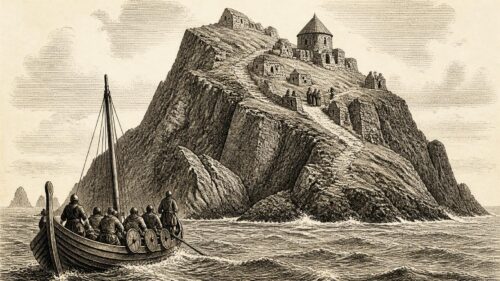
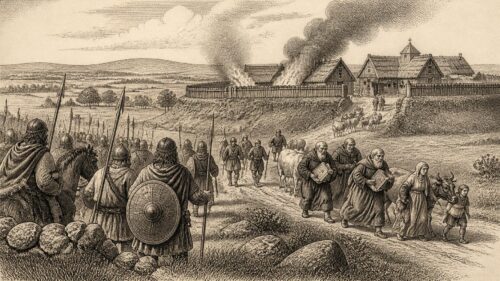
Women, men and children also lived in an island increasingly exposed to seaborne violence. Scandinavian raiding had struck Irish and Hebridean church sites from the late eighth century onwards. The surviving annals do not record a securely dated Viking attack in Ireland during 820 itself, and it would be wrong to invent one merely because the decade later became more dangerous. Yet the threat was already part of the recent past, especially for coastal and island communities. The next years would bring a marked sequence of raids on places including Étar, Cork, Bangor and Skellig Michael. Feidlimid’s accession therefore occurred before permanent Scandinavian settlements in Ireland, but amid a changing maritime world in which overseas raiders had become an established concern.
Learning, Memory and Limits of Evidence
The very survival of Feidlimid’s accession depends on literate ecclesiastical culture. Irish annals were maintained and recopied in religious centres, then preserved in manuscripts made centuries after some of the events they record. Their compact style is powerful but selective. A king’s accession could merit a line; the discussions, gifts, disputes and anxieties surrounding it could vanish altogether. Differences in year-numbering between chronicles are not a minor technical nuisance: they show why historical dating must be tested across texts rather than accepted mechanically.
In 820, then, the certain event is concise but important. Feidlimid mac Crimthainn became king of Caisel. The wider setting was a politically fragmented yet highly connected Ireland, where provincial rulers competed through kinship, armed followings, church patronage and negotiated submission; where rural production underwrote power; and where a growing pattern of maritime raiding added uncertainty to coastal life. The year did not announce all that Feidlimid would later do. It put him in the position from which he could do it.
Primary Sources
- The Annals of Ulster, Year U820
- Annals of Inisfallen, Annals AI819–AI829
- Fedelmid (Feidlimid), Dictionary of Irish Biography
- Feidlimid mac Crimthainn: (d. 847), king of Munster, Oxford Dictionary of National Biography
- The Annals of Ulster
- Annals of Inisfallen
- Annals of the Four Masters
- Chronicon Scotorum
- Chronicon Scotorum: Introduction and Chronological Notes
- Vikings in Irish Chronicles, 794–902: Data
- Vikings in Irish Chronicles, 794–902: Introduction
- Vikings in Scotland and Ireland in the Ninth Century
- Vikings in Early Medieval Ireland: Church-Raiding, Politics and Kingship
- Catalogue of Viking Raids on Irish Churches in the Annals, 795–1015
- The Vikings in Ninth-Century Ireland: Sources and Settlements
- The Beginning of the Viking Age in the West
- Landscapes of Kingship in Early Medieval Ireland, AD 400–1150
- Conversion and Consolidation in Leinster’s Royal Heartland
- Nation and Kingship in Medieval Ireland
- Narratives in Early Irish Law Tracts
- Marriage in Early Ireland
- Cáin Lánamna
- Early Irish Monasteries and their Dynastic Contexts
- Contributions Towards the Political History of Munster, 450–800 A.D. (concluded)