Port Láirge’s New Fleet914 CE
In 914, a great Scandinavian fleet entered Waterford harbour, raided northern Osraige, and inaugurated a renewed phase of Viking power in Ireland. The sheltered waterways offered access to south-eastern resources, while wider Irish Sea rivalries linked the newcomers to maritime politics. Meanwhile, Niall of Ailech defeated Ulaid forces, made peace with Áed of Ulaid, then suffered heavy losses when Mide men ambushed his foragers. Flann Sinna campaigned amid accusations of church profanation. Flaithbertach became king of Cashel and Eochu abbot of Emly. These events showed enduring Irish rivalries, institutions, and negotiated authority alongside Waterford’s growing strategic importance in subsequent decades.
Dateline
In 914, Ireland’s political map was still dominated by provincial dynasties and by the competing branches of the Uí Néill, but a new force arrived on the southern coast. The year is best remembered for the appearance of a large Scandinavian fleet in the Waterford harbour region, known in the Irish annals as Loch dá Caech and associated in other evidence with Port Láirge. Its arrival marked more than another passing raid. It opened the second major phase of Viking activity in Ireland after the long interruption that followed Dublin’s expulsion from the Irish record in 902.
A Fleet at Waterford Harbour
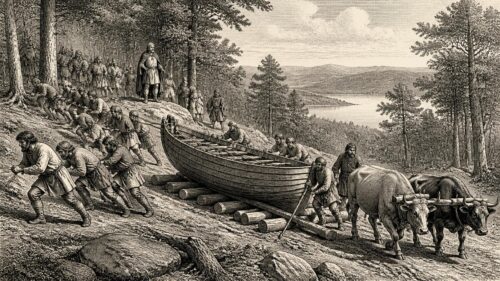
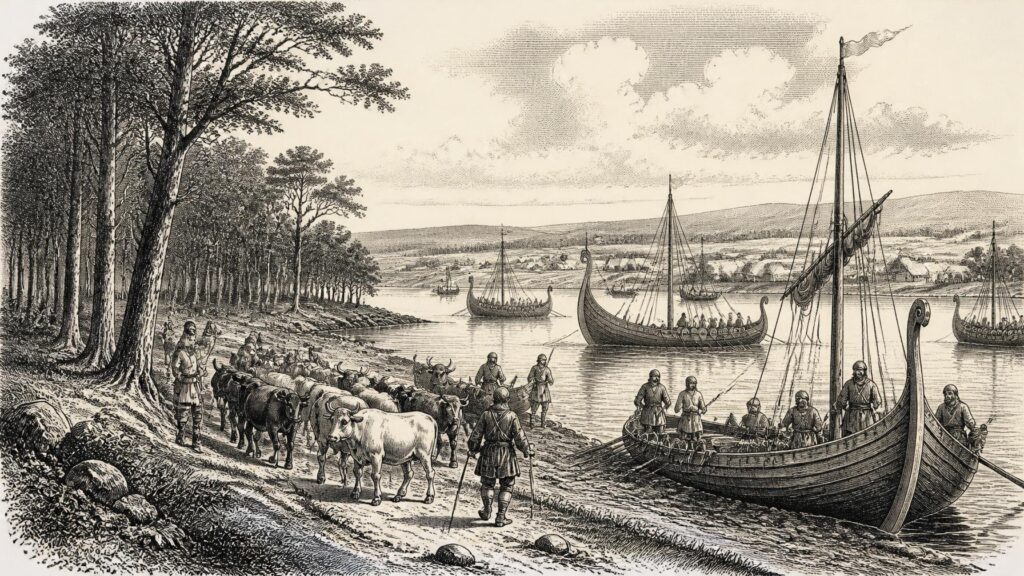
The Annals of Ulster record “a great new fleet of the heathens” at Loch dá Caech. The Fragmentary Annals of Ireland, whose narrative must be used cautiously but is especially vivid here, call it a great fleet of Norwegians which landed at Port Láirge. They raided northern Osraige and returned to their ships with substantial spoil, including cattle and other livestock. Whether every ethnic label in the later narrative is precise is less certain than the central fact: a powerful seaborne force had established itself in the Waterford area and was capable of penetrating inland.
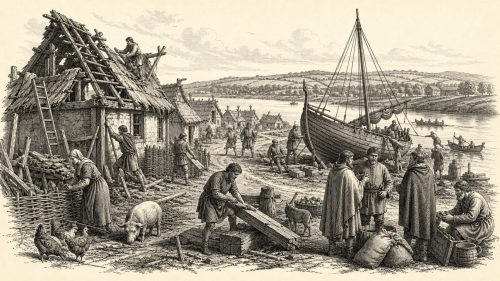
This was a strategically valuable location. The harbour gave vessels access to the Suir and to routes towards the rich lands of south-eastern Ireland, while the neighbouring river systems of the Barrow and Nore made Osraige and Leinster vulnerable to raiders travelling by water and then overland. The new arrivals did not necessarily create a town from nothing in a single year. Archaeology at Woodstown, upstream from Waterford, demonstrates earlier Scandinavian activity in the wider harbour landscape. Yet 914 is a responsible turning point: contemporary annalistic testimony places a major new fleet there, and subsequent events show the region becoming a durable centre of Viking power.
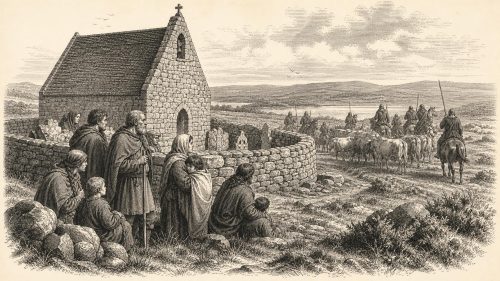
The raid on northern Osraige reveals the immediate human cost. Cattle were not incidental plunder. They were movable wealth, food, breeding stock and a means of paying dependants or purchasing political support. Taking them to ships deprived communities of resources at a stroke and converted local produce into portable wealth. For farming households, such a raid could mean the loss not merely of animals but of milk, hides, traction and the security needed to survive a poor season. Captives may also have formed part of Scandinavian raiding economies, although the annals do not specifically say so for this expedition and it should not be added as a fact for 914.
Sea-Rivalries and Wider Routes
Irish waters were connected to a wider maritime world. In the same year, the Annals of Ulster place a naval battle at Man between Bárid son of Óttir and Ragnall grandson of Ímar. Bárid and almost all his force were destroyed. The encounter occurred beyond Ireland, but it directly concerned the Scandinavian political networks that connected the Irish Sea, the Isles, northern Britain and Ireland. Ragnall was a member of the powerful Uí Ímair kindred, whose later interventions would be decisive in Ireland. The annal does not say that Ragnall personally led the fleet at Waterford in 914; that tempting identification should therefore remain unmade. What can safely be said is that the new Waterford force emerged amid fierce competition among sea-kings and warbands operating across the Irish Sea.
The return of major fleets mattered because Scandinavian activity was no longer confined to sudden coastal attacks. Ships supplied mobile armed groups, carried livestock and booty, linked bases on opposite shores, and could support bargaining with Irish rulers. The evidence for 914 still shows raiding more clearly than permanent settlement, but the harbour’s natural shelter and the scale of the fleet explain why Port Láirge became central to the political and commercial development of the south-east in the following decades.
Niall’s Ulster Campaign
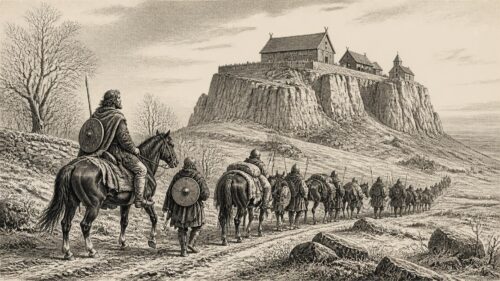
While the new fleet was transforming the southern horizon, Niall son of Áed, king of Ailech, was conducting a forceful campaign in Ulster. In June he led an expedition into Dál nAraidi, an important people of north-east Ireland. At Fregabal, probably near modern Glarryford in County Antrim, Niall defeated Loingsech grandson of Lethlobar, king of Dál nAraidi. A second confrontation followed at Carn Éirenn, where Áed son of Eochucán, overking of Ulaid, joined Loingsech against him. They too were defeated.
The annalist does not turn this into a simple triumph. Several named men were left dead in the retreat, while Áed returned with a small group, resisted fiercely and killed some of Niall’s soldiers. His son Dubgall was wounded but escaped. Such detail exposes the close, dangerous character of early medieval warfare: a campaign could bring victory in formal engagements yet still entail sharp losses in pursuit, withdrawal and local resistance. It also preserves the political geography often hidden by a modern map. Ulaid was not a unitary kingdom obedient to one ruler; its overking and the ruler of Dál nAraidi could act together, but they held distinct positions and commanded different interests.
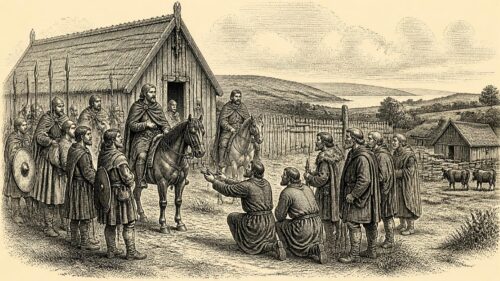
Conflict did not continue without restraint. On 1 November, the annals record a peace made at Telach Óc, generally identified with Tullyhogue in modern County Tyrone, between Niall of Ailech and Áed of Ulaid. The exact terms are unknown: no source lists hostages, tribute or territorial concessions. Nonetheless, the choice of a named ceremonial place and the precise calendrical date show that negotiated settlement mattered. Kingship was exercised not only through raids and battles, but through public agreements that recognised the standing of opponents and made renewed cooperation possible.
Grellach Eilte in December
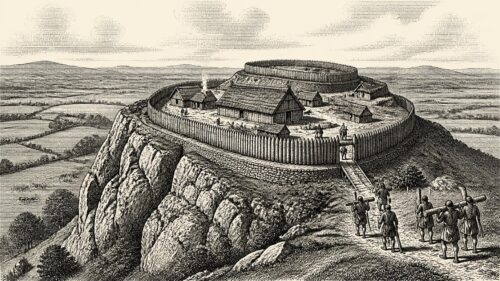
Niall’s ambitions also reached into the midlands. In December he brought a northern army into Mide and camped at Grellach Eilte, west of Crossakeel. The episode is unusually revealing because the annalist records the army’s practical needs. A sizeable detachment left camp on Niall’s orders to seek corn and firewood. Óengus son of Máel Sechnaill, supported by kinsmen and men of Mide, surprised it and killed forty-five men.
This was a serious reverse, not an incidental skirmish. Among the dead were leading figures from Cenél nÉogain and allied Airgialla, including Máel Muire son of Flannacán, heir apparent of Airgialla. The event demonstrates that an army depended on foraging, fuel and local knowledge, especially in winter. A camp could be militarily formidable but still expose detachments when it needed grain for people and fodder, and wood for warmth and cooking. The annal’s accompanying verse presents Grellach Eilte as a place of grief and cold: it is one of the rare flashes in which the logistical burden of warfare is allowed to interrupt the catalogue of rulers and casualties.
The confrontation also belonged to a wider struggle within the Uí Néill world. Flann Sinna, king of Tara and ruler of Mide, remained alive in 914, despite the misleading placement of his death under this year in some later annalistic compilations. The better-synchronised evidence places his death on 25 May 916. In 914, therefore, Niall was not yet high king but a powerful northern ruler testing his reach in Ulster and Mide. Óengus, Flann’s son, showed at Grellach Eilte that the dynasty of Clann Cholmáin could still punish such an intervention.
Churches, Kingship and Cashel
Flann himself campaigned in southern Brega and southern Cianachta during the year. The Annals of Ulster condemn the expedition because many churches were profaned. The terse wording does not explain whether this involved plunder, violence, seizure of sanctuary, or the passage and billeting of troops. It does show that ecclesiastical immunity was an acknowledged standard, even when a king claiming wide authority violated it. Churches were spiritual communities, but also landholders, places of refuge, centres of learning and repositories of movable wealth. To attack them was politically and morally significant.
In Munster, Flaithbertach son of Inmainén took the kingship of Cashel. The Annals of Inisfallen, a source with close Munster connections, records this transition plainly. It followed years in which Cashel had been destabilised by the death of Cormac mac Cuilennáin at Belach Mugna in 908 and by subsequent contests among Munster rulers. Flaithbertach’s accession did not settle the whole province, but it restored a named ruler to one of its foremost royal centres at precisely the moment when the Waterford fleet was threatening the south-east.
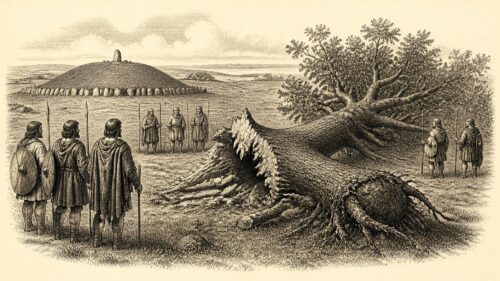
The same Inisfallen entry notes that Eochu son of Scandlán took the abbacy of Imlech Ibuir, Emly in County Tipperary. This modest notice is important. Monastic office was a major form of authority, embedded in kinship, patronage, landholding and regional politics as well as religious observance. In a year of Scandinavian arrival, war and raiding, Irish religious institutions continued their ordinary but consequential processes of succession, worship, education and estate management.
A Changed Horizon
Nothing in 914 made a single ruler master of Ireland, nor did the Scandinavian fleet immediately erase established political structures. Niall could defeat the Ulaid and then negotiate peace; he could march into Mide and lose a vital foraging party. Flann could lead an expedition and face moral reproach for the treatment of churches. Cashel and Emly could change hands through recognised successions even as insecurity spread along the southern waterways.
Yet the arrival at Port Láirge changed the horizon. It brought a new maritime concentration of armed power into a region of rivers, productive farmland and rival kingdoms. The annals let us see its first impact in cattle driven towards ships and in the alarmed language used for a “great new fleet”. In retrospect, 914 stands as the year in which the Waterford harbour region again became an active gateway between Ireland and the Viking world—and in which Irish kings had to reckon with that fact while continuing their own relentless contests for authority.
Primary Sources
- The Annals of Ulster: Year U914
- The Annals of Ulster: Year U914 (Irish text)
- The Annals of Ulster
- Fragmentary Annals of Ireland
- Chronicon Scotorum
- Annals of Inisfallen: Annals AI910–AI919
- Annals of Inisfallen
- Annals of the Four Masters, Volume 2
- Annals of the Four Masters, Volume 2 (Irish text)
- Niall Glúndub
- Flann Sinna
- Vikings in Early Medieval Ireland
- Vikings in Ireland and Scotland
- The Vikings in Munster
- Preliminary Report on the Archaeological Excavation and Finds Retrieval Strategy of the Hiberno-Scandinavian Site of Woodstown 6, County Waterford
- The Vikings in Ninth-Century Ireland: Sources and Settlements
- Decies 61
- Waterford
- The Exhibition: Waterford Virtual Museum
- Exploring the Irish Annals
- Annals of Tigernach