O’Connell Mayor1841 CE
In 1841, Ireland’s census recorded 8,175,124 people, revealing a populous, unequal society where most families occupied modest cottages or single-room cabins and depended heavily on agriculture and potatoes. The general election returned Peel’s Conservatives, while Daniel O’Connell maintained repeal agitation despite restricted franchises and sectarian political division. Dublin’s reformed council elected O’Connell Lord Mayor on 1 November, the first Catholic to hold the office for over 150 years, marking expanded but limited civic participation. Poor Law workhouses embedded institutional relief, inadequately serving widespread vulnerability. Belfast combined industrial growth with confessional cooperation, while the Irish Archaeological Society published texts, reflecting recovery.
Dateline
In 1841 Ireland was counted, contested and cautiously reconfigured. The year is often treated chiefly as the last calm vantage point before the Great Famine, but contemporaries did not know what lay ahead. They lived instead with immediate questions: who could exercise political power, how poverty should be managed, whether the Union could be undone, and how an island of rapidly growing population could sustain itself. The year’s most revealing evidence is the census taken on Sunday, 6 June. Its published results later gave Ireland a numerical portrait at the height of its nineteenth-century population; its local political events showed that Catholic and nationalist participation in public life was becoming harder to exclude.
A Count of Eight Million
The 1841 census was far more than a headcount. The commissioners intended it as a social survey, gathering information on houses, families, occupations, education, livestock and other aspects of life. Its detailed reports were published after the enumeration, so the figures should be understood as evidence collected in 1841 rather than knowledge available in full to people that summer. They nevertheless describe the Ireland in which they lived.
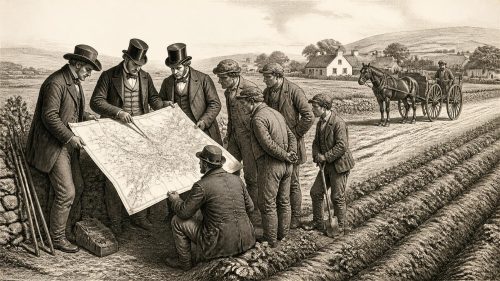
The census recorded 8,175,124 people, distributed through 1,472,787 families and 1,328,839 inhabited houses. This was an exceptionally large population for the island’s resources and for an economy in which rural work predominated. Yet the national total should not be mistaken for a uniformly crowded or uniformly poor landscape. Ireland contained the commercial cities of Dublin, Cork, Limerick, Waterford and Belfast; market towns, ports and mill districts; prosperous farms and grazing estates; and extensive districts where labourers and cottiers survived on minute holdings or rented patches of land.
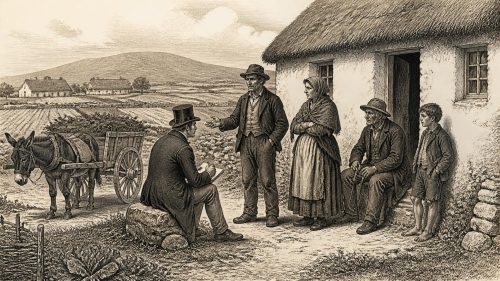
Housing statistics make the inequalities especially visible. The census placed 491,278 inhabited houses in its fourth, lowest class: single-room mud-walled cabins. A further 533,297 belonged to the third class, generally mud-walled cottages of two to four rooms with windows. Together these two categories accounted for more than three quarters of inhabited houses. At the other end of the scale were 40,080 first-class houses and 264,184 second-class houses. These classifications were imperfect and cannot reveal the circumstances of every household, but they show that insecure and cramped accommodation was a structural feature of pre-Famine Ireland, not an exceptional condition.
The figures did not foretell famine. No potato blight had struck Ireland in 1841, and it would be wrong to write catastrophe back into an ordinary census year. They do, however, identify the vulnerabilities that made later disaster so severe: many households depended on agricultural earnings, rented land and a crop capable of feeding a family from a small plot. The census was therefore a snapshot of a society with considerable productive activity and resilience, but little margin for failure among its poorest people.
Election, Repeal and Westminster
National politics were unsettled. The United Kingdom general election took place between 29 June and 22 July 1841 and brought Sir Robert Peel’s Conservatives to power after the defeat of the Whig ministry. Irish elections were fought within a restricted property franchise, and landlords, clergy, local interests and party organisations could all exert substantial influence. The result did not settle Ireland’s constitutional argument: the Act of Union remained in force, Irish representatives still sat at Westminster, and Daniel O’Connell’s campaign for repeal remained the major nationalist challenge to the Union.
O’Connell himself was returned for both Cork and Meath in 1841. He chose to sit for County Cork, prompting the later vacancy in Meath. His correspondence from the summer shows that he regarded repeal as the indispensable basis for future political action and was concerned by the intensity of popular feeling after the election. That language should not be confused with the later, more dramatic repeal mobilisation of 1843. In 1841 there were no monster meetings at Tara or Clontarf, no prosecution for the Clontarf campaign, and no repeal resolution yet carried by Dublin Corporation. Rather, the year preserved the cause through an election setback and helped to place O’Connell at the centre of an important civic advance.
The political atmosphere was also divided along religious and class lines. The Dublin Protestant Operatives Association was founded in 1841 in opposition to O’Connell and Liberal politics. Its appearance is a reminder that the extension of Catholic civic influence did not dissolve Protestant unionism, nor did it make “Irish” politics a simple contest of two unified communities. Dublin artisans, employers, ratepayers, clergy and professionals could share streets and economic interests while disagreeing deeply over the Union, municipal power and religious identity.
The First Reformed Dublin Council
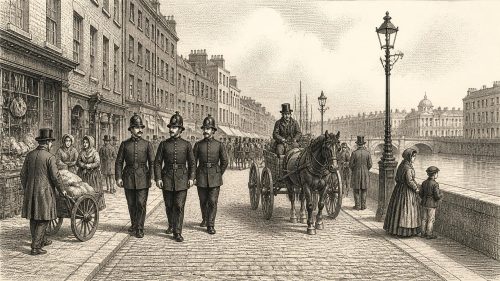
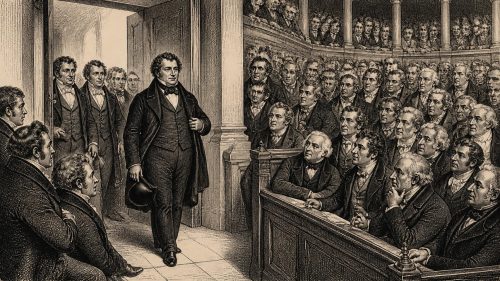
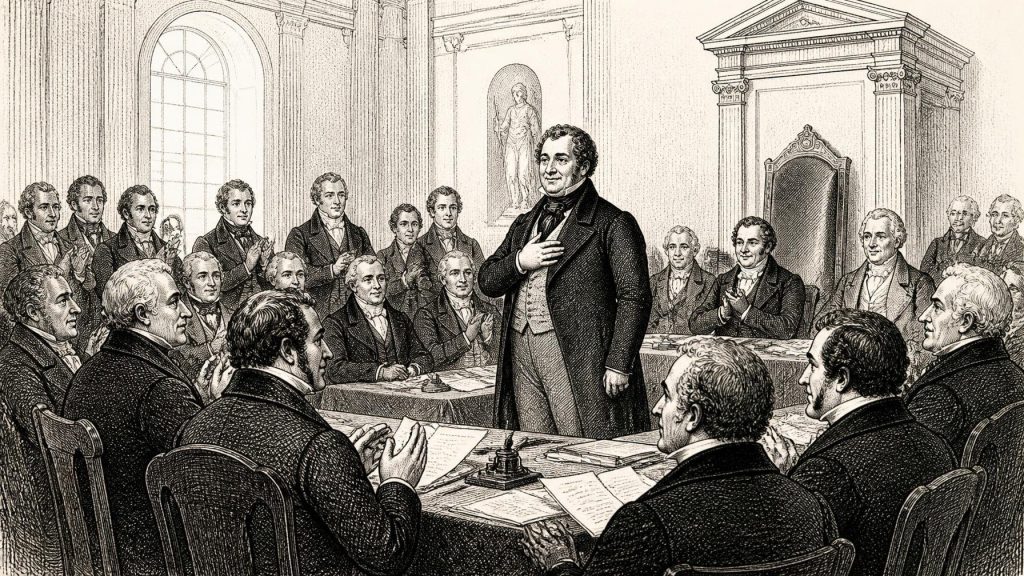
The most firmly dated civic landmark came in autumn. Following local elections in October, the newly reformed Dublin City Council met for the first time at noon on Monday, 1 November 1841, in the City Assembly House on South William Street. Its first business was the election of a Lord Mayor. Daniel O’Connell was chosen, becoming the first Catholic holder of the office in more than 150 years.
This was not an unrestricted democratic revolution. Under the reformed municipal franchise, voting was principally available to ratepayers with property valued at £10 a year. The electorate was therefore narrow by modern standards, excluding most working people, women and many of the poor. Nevertheless, it brought Catholic and Protestant small businessmen into the same municipal electorate and altered the balance of an office long associated with Protestant ascendancy. O’Connell’s election mattered because it made visible, in the capital’s civic headquarters, the political consequences of Catholic emancipation and municipal reform.
The council’s opening minutes also bring the change down to street level. Alongside the mayoral election came practical business, including a communication from engineer John Semple concerning the cleansing of Blessington Street Basin. Water, drainage, paving, markets and urban sanitation were not glamorous matters, but they shaped health, employment and daily comfort. O’Connell and his colleagues began what was intended to be a continuing city administration, not merely a symbolic nationalist platform. The close numerical balance of unionist and nationalist councillors encouraged a proposed alternation of the mayoralty between the two sides, later known as the Mayoralty Compact.
Poverty Under Administration
Across Ireland, another new form of government was becoming embedded: the Poor Law. The Irish Poor Law Act of 1838 had divided the country into 130 unions, each governed by a board of guardians and intended to centre on a workhouse. By 1841 workhouses and their bureaucracy were part of the institutional landscape, though the system was still developing and buildings were not everywhere complete or receiving applicants. The first Irish workhouse, at Cork, had opened only in March 1840.
The system was designed around institutional, rather than general outdoor, relief. Its planned capacity was approximately 80,000 people—about one per cent of the population recorded in 1841. That scale conveys its limits. It was a deterrent and last resort for destitution, separating inmates by category and regulating their lives through boards, officers and rules; it was not a broad guarantee against unemployment, low wages or harvest failure. For ratepayers, guardians and applicants alike, poor relief increasingly meant meetings, assessments, contracts, admissions and the imposing architecture of the workhouse.
Fields, Mills and Ports
The census also captured an economy more varied than the familiar image of an exclusively peasant Ireland, while confirming agriculture’s predominance. Only about 32 per cent of men were recorded in non-agricultural employment. Farmers, agricultural servants and labourers formed the largest occupational world, but women’s paid work and many forms of family labour were only partly visible in official classifications. Domestic service, spinning, sewing, seasonal fieldwork, petty trade, fishing and informal labour sustained households in ways that tables could not always measure.
For poorer rural families, potatoes were central to subsistence, while grain, cattle, butter, pigs and other produce connected farms and estates to regional and overseas markets. This was not a self-contained village economy: rents had to be met, provisions and manufactured goods were bought, and ports linked Irish producers and emigrants to Britain and North America. Nor was dependence on potatoes identical in every county or social class. The significance of 1841 lies in the coexistence of export-oriented agriculture and widespread smallholding, a combination that could sustain population growth in favourable years but exposed households with little cash or land to sudden hardship.
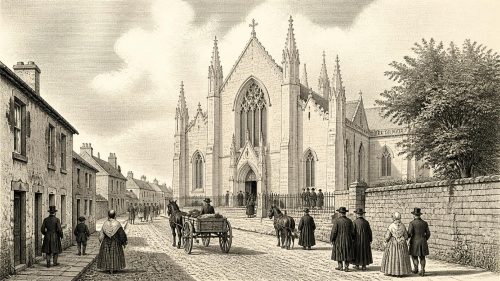
Ulster demonstrated another path. Belfast’s census return records a busy industrial and maritime town, with linen-related employment, manufacturing, domestic service, trades, labouring and port occupations. On 3 November, the feast day of St Malachy, the foundation stone of St Malachy’s Roman Catholic Church was laid in Belfast. The project was enabled by Captain Thomas Griffith’s £3,000 bequest and land transferred in trust for Catholics by the Presbyterian Adam McClean. That combination of Catholic need, Presbyterian property and mercantile wealth reveals a city in which industrial growth did not erase confessional boundaries but could produce practical co-operation across them.
Recovering Ireland’s Past
Political argument was accompanied by a quieter cultural enterprise. The Irish Archaeological Society, founded in 1840, issued its first publications in 1841, including Tracts Relating to Ireland, volume I, and James Grace of Kilkenny’s Annals of Ireland. Such editions brought manuscript historical material into print for subscribers and scholars. They did not yet constitute the later cultural nationalism associated with Young Ireland, but they showed an expanding appetite for the documentary record of Ireland’s past.
Thus 1841 joined civic reform, constitutional agitation, social investigation and historical recovery. Its outstanding date was 1 November, when O’Connell took the mayoral chair in a newly elected Dublin council. Its enduring record was the census of 6 June, which exposed both the scale of Ireland’s population and the unequal conditions under which that population lived. The year was not merely a prologue to disaster. It was a moment when Irish society, under the Union, was being counted with unusual care and claiming new, though still limited, spaces in which to govern itself.
Primary Sources
- Census of Ireland for the Year 1841
- Census 1841
- Oireachtas Library and Research Service Display Case: Census of Ireland 1841
- Census of Ireland, 1841: Report
- The 1841 Census
- Ireland Before the Great Famine
- Housing of the People of Ireland During 1841–1901
- Census 1841: General Table
- 1841 Irish Occupational Categories: Data Documentation
- Census of Ireland for the Year 1841: Town of Belfast
- Dublin City Council Manuscript Minutes 1841–1881
- 181 Years Later: Digitised Minutes of Dublin City Council Meetings
- Daniel O’Connell
- Mr Daniel O’Connell
- Commons Chamber, 8 September 1841
- The Correspondence of Daniel O’Connell, Volume VII, 1841–1845
- The Office of the Chief Secretary of Ireland: Chronology
- Poor Law Records
- A History of the Irish Poor Law
- Famine to 1916
- The Use of the Potato Crop in Pre-Famine Ireland
- St Malachy’s Roman Catholic Church, Belfast
- Belfast St Malachy
- Publications of the Irish Archaeological Society
- Minutes of Meetings of the Irish Archaeological Society
- Regional Industrial Structure and Labour Force Decline in Ireland Between 1841 and 1851