
Corn Exchange Repeal Launch1840 CE
In 1840 Daniel O’Connell relaunched the constitutional campaign to repeal the Act of Union through the National, later Loyal National, Repeal Association, seeking an Irish legislature within the Crown rather than separation. Though initially modest, it established subscriptions, committees and local mobilisation. Parliament’s Municipal Corporations (Ireland) Act replaced most old corporations and reformed ten boroughs, but retained restricted franchises and limited powers. The Poor Law entered operation, with Cork’s temporary workhouse admitting inmates, signalling a restrictive institutional response to poverty. Rural inequality, population pressure and regional contrasts persisted, alongside railway plans, church reforms and Father Mathew’s temperance movement across Ireland.
Dateline
In 1840 Ireland’s most important political development was not an election or an uprising but the rebuilding of a movement. Daniel O’Connell, already renowned for winning Catholic emancipation, reopened the constitutional campaign to repeal the Act of Union. At the same time, Parliament completed a long-delayed remodelling of Irish town government, while the new Poor Law began to admit destitute people to its first institutions. These developments did not resolve Ireland’s deep inequalities. They did, however, create organisations and habits of public action that would matter greatly in the troubled decade ahead.
A Repeal Organisation Takes Shape
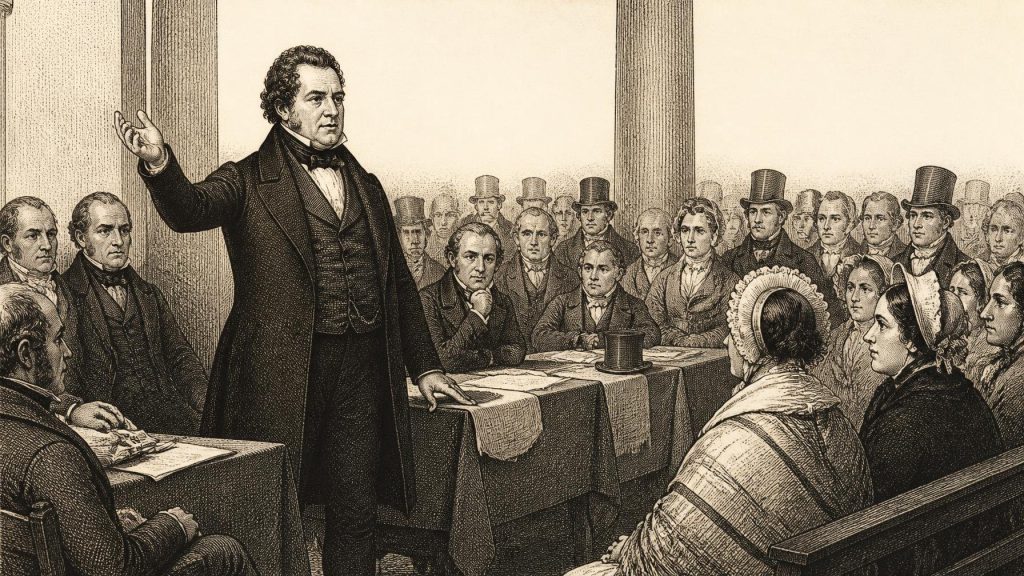
On 15 April 1840 O’Connell launched the National Association of Ireland for Full and Prompt Justice, or Repeal, at Dublin’s Corn Exchange. By July it was being styled the Loyal National Repeal Association of Ireland. The changing name is important: O’Connell did not propose separation from the Crown. He demanded restoration of an Irish legislature while maintaining the monarchical connection with Britain. The word “loyal” was intended to underline that this was to be a constitutional and peaceful campaign, not a preparation for rebellion.
The appeal revived a cause that O’Connell had promoted before Catholic emancipation and intermittently thereafter. It arose from disappointment with the limits of post-emancipation politics. Catholics could sit in Parliament, and Irish MPs were returned to Westminster, but the legislature that made Irish law remained across the Irish Sea. Many of O’Connell’s followers also felt that the Whig governments with which he had cooperated had delivered too little on municipal reform, franchise questions and local grievances. The prospect that Lord Melbourne’s ministry might soon fall further encouraged a new independent Irish mobilisation.
The Association was still small in 1840 and should not be confused with the vast “monster meetings” of 1843, which belonged to a later phase. Its immediate achievement was organisational. O’Connell again adapted methods that had served the Catholic Association: subscriptions, committees, public meetings, printed resolutions and a central Dublin headquarters capable of connecting local supporters to national politics. A modest annual “Repeal Rent” made participation possible for people unable to finance an election campaign or travel to Westminster. It also gave a political purpose to repeated small contributions and regular local activity.
O’Connell’s language could be fiercely accusatory, and opponents depicted Repeal as dangerous or seditious. Parliamentary debate in 1840 duly echoed with alarm about his speeches and about the prospect of elected Irish bodies dominated by Catholics. Yet O’Connell’s declared strategy was mass, disciplined and non-violent pressure. That distinction was central to his authority. He presented repeal not as a concession to disorder but as a remedy for it: Ireland, he argued, could be governed more justly if Irish affairs were debated by representatives responsible to an Irish public.
Municipal Reform at Last
Parliament’s answer to one longstanding Irish question came in August. The Municipal Corporations (Ireland) Act received royal assent on 10 August 1840. For years, Irish municipal corporations had been objects of controversy. Many were narrow, self-perpetuating bodies inherited from an older political order, often Protestant in membership and disconnected from the growing towns around them. The reform measure did not establish a broad democratic local-government system; property qualifications continued to restrict the electorate and municipal powers remained limited. But it swept away the great majority of the old corporations and reshaped the ten principal surviving boroughs: Dublin, Cork, Limerick, Waterford, Kilkenny, Drogheda, Clonmel, Sligo, Belfast and Derry.
The Act mattered because it changed the terms on which civic authority could be claimed. Councils, mayors, aldermen and burgesses were now to operate under a more uniform statutory framework, with defined borough boundaries, electoral arrangements and financial rules. Many smaller former boroughs lost their corporations altogether. For inhabitants, this was no abstract constitutional adjustment: local bodies touched markets, streets, nuisances, lighting, policing arrangements and the management of civic property. The reform also became part of the larger argument over whether representative institutions in Ireland could safely include the Catholic middle classes and nationalists who had been excluded from older corporate life.
O’Connell supported municipal reform but regarded it as insufficient. The Act demonstrated that Westminster could alter Irish institutions, yet it also highlighted the limited scale of the concession. A reformed council might improve a town’s administration; it could not decide national taxation, land policy, criminal law or the constitutional position of Ireland. In that sense, the municipal settlement of 1840 supplied both a practical reform and an argument for Repeal.
The First Workhouse Admissions
Another new structure was becoming visible in daily life. The Poor Relief (Ireland) Act of 1838 had divided the country into Poor Law Unions, each overseen by a board of guardians and intended eventually to have a workhouse. In 1840 the system moved from plans, rates and building contracts into operation. On 15 February the commissioners designated Cork’s existing House of Industry as a temporary union workhouse; it began admitting destitute people on 1 March. This was an early and symbolically powerful opening, though it was not yet the familiar purpose-built Cork workhouse of the following year.
By the end of 1840 only a handful of Irish workhouses were receiving inmates. Most unions were still acquiring sites, raising local rates, appointing officials or building the standardised institutions designed by George Wilkinson. The system was therefore far from a nationwide refuge. It was deliberately restrictive as well. Ordinary relief for able-bodied destitute people was to be granted within the workhouse rather than as assistance in their own homes. Admission meant submitting to an institutional regime, with segregated accommodation, regulated diets and the division of families by age and sex.
That harshness was not accidental. British administrators hoped that the workhouse would be a last resort, less desirable than independent labour, family support or charity. Irish critics argued that this imported model misunderstood a country where poverty often sprang not from individual idleness but from seasonal employment, insecure holdings, low wages and a scarcity of non-agricultural work. The debate was already ethically serious in 1840. It is misleading, however, to write as though the catastrophe of 1845–52 had already begun. The workhouses of 1840 were new, incomplete and untested by famine; their later notoriety came from the scale of suffering they would be asked to contain.
Work, Land and Uneven Change
Ireland in 1840 remained overwhelmingly rural, with livelihoods tied to small farms, cottier tenancies, conacre plots, agricultural labour and local markets. The potato was fundamental to the diet of many poorer households, while cattle, grain, butter and other produce linked Irish agriculture to markets in Britain. The economic landscape was highly uneven. Belfast’s linen manufacture, port and commercial networks offered a markedly different world from the congested, poorer western districts, while Dublin concentrated government employment, trade, professions and institutions.
Later evidence from the census of 1841 confirms the scale of population pressure and the regional contrast in housing and literacy that stood immediately ahead. It should be used carefully: the census day was 6 June 1841, not a measurement taken in 1840. Even so, it helps locate this year at the edge of a demographic peak. Ireland was not uniformly destitute, and many households combined farming, craft work, service, seasonal migration or remittances. Yet a large share of the population lived with little reserve against illness, unemployment, rent demands or harvest failure.
Transport and communications were also changing, although slowly. On 23 July 1840 Parliament passed an amending Act for the Dublin and Drogheda Railway. The line would not open until 1844, so it brought no trains to commuters or traders in 1840. Its authorisation nevertheless marked the growing importance of railway capital, parliamentary permissions and engineering schemes. Beside the established Dublin–Kingstown railway and the developing Ulster network, it suggested a future in which some Irish towns would be more closely joined to ports and commercial centres. For many rural people, however, the immediate realities remained the road, the fair, the coastal vessel and the journey on foot.
Religion, Sobriety and Public Culture
Religion continued to shape public life across denominational boundaries. The Church Temporalities Act, passed on 10 August, adjusted aspects of the property and financial administration of the established Church of Ireland. It did not settle the profound grievance that a mainly Catholic population supported, through the wider fiscal order, an established Protestant church. That question remained politically charged and would re-emerge repeatedly before disestablishment in 1869.
Meanwhile, Father Theobald Mathew’s Catholic-led temperance movement remained a conspicuous social force. Mathew had begun his Cork total-abstinence society in 1838, and the pledge spread rapidly across much of the island. In late 1840 O’Connell himself took it. Temperance was not simply about drink: advocates associated it with household economy, self-command, respectability and public order. Its rallies, medals, certificates and local networks showed how religious and social reform could mobilise crowds outside electoral politics. Mathew himself resisted making the movement an arm of Repeal, even though opponents often suspected that such large gatherings had political implications.
Thus 1840 was a year of beginnings rather than resolution. At the Corn Exchange, O’Connell gave Irish self-government a renewed institutional form. In Parliament, the municipal Act altered town authority but also exposed its limits. In Cork and a few other unions, workhouse admissions made a new official response to poverty tangible. Taken together, these were signs of a society becoming more organised, more contested and more visibly governed through associations, boards and statutes. They also revealed how little agreement existed over who should exercise power, who should bear the cost of poverty, and how Ireland’s interests could be represented within the United Kingdom.
Primary Sources
- O'Connell, Daniel | Dictionary of Irish Biography
- Political background to the exiles in paradise | Young Irelanders: Exiles in Paradise
- Municipal Corporations (Ireland), 24 February 1840 | Historic Hansard
- The Municipal Corporations (Ireland) Act 1840
- Shaw, Sir Frederick | Dictionary of Irish Biography
- Background to Local Bodies
- The Rise and Fall of Local Democracy | History Ireland
- Church Temporalities Act, 1840
- Lords Chamber, 11 August 1840 | Hansard
- Poor Law Records | National Archives of Ireland
- Poor Relief (Ireland) Act 1838
- A History of the Irish Poor Law | George Nichols
- Cork Workhouse Board of Guardians (BG69) | Cork City and County Archives
- Workhouse Story | Irish Workhouse Centre
- Conceiving and Constructing the Irish Workhouse, 1836–45 | Irish Historical Studies
- Population and Poverty in Ireland on the Eve of the Great Famine | Queen's University Belfast
- Introduction | Begging, Charity and Religion in Pre-Famine Ireland
- Census of Ireland, 1841 | Histpop
- Mathew, Theobald | Dictionary of Irish Biography
- Minutes of Board Meetings of the Commissioners of National Education, Ireland | National Library of Ireland
- Bianconi, Charles | Dictionary of Irish Biography
- Ireland, 25 April 1840 | The Spectator Archive
- Dublin and Drogheda Railway Act 1840 | Statute Law Revision Act 2009
- An Industrial Heritage Survey of Railways