Modest Proposal1729 CE
In 1729, Ireland displayed striking contrasts between elite ambition, commercial regulation and widespread hardship. Dublin’s new Parliament House began at College Green, while Castletown House was completed, both symbolising Protestant landed power despite Catholic exclusion from politics. Continuing scarcity after failed harvests left poorer households vulnerable to hunger, begging and displacement; Dublin expanded workhouse provision, combining relief with discipline. Jonathan Swift’s A Modest Proposal transformed these conditions into devastating satire. The Ballast Offices Act sought to improve provincial ports and maritime trade. Deaths of William Conolly, Archbishop William King and poet Aogán Ó Rathaille marked political, ecclesiastical and cultural transitions.
Dateline
In 1729 Ireland’s most telling events were not a battle or a change of dynasty, but a set of sharply contrasting signs: a foundation stone laid for political grandeur in Dublin; legislation aimed at keeping trade moving through provincial ports; and a famous pamphlet that made the hunger, begging and insecurity of the poor impossible to ignore. The year came after several bad harvests and amid a wider subsistence crisis. It also marked important deaths in church, political and Irish-language cultural life. Taken together, these developments reveal a kingdom in which confidence, commerce and architectural ambition existed beside deep material distress and enduring inequalities of power.
A New Seat for a Restricted Parliament
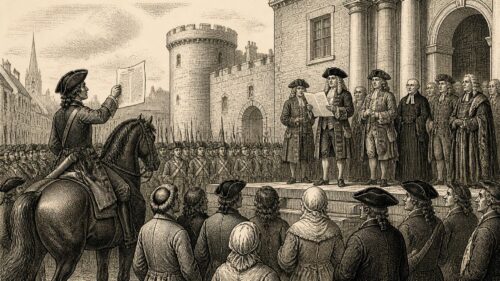
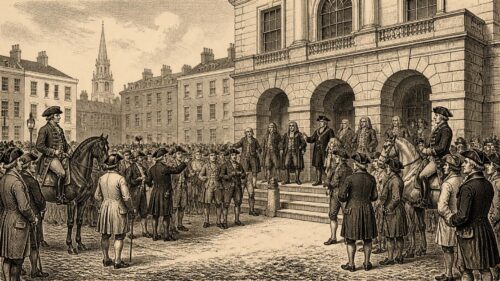
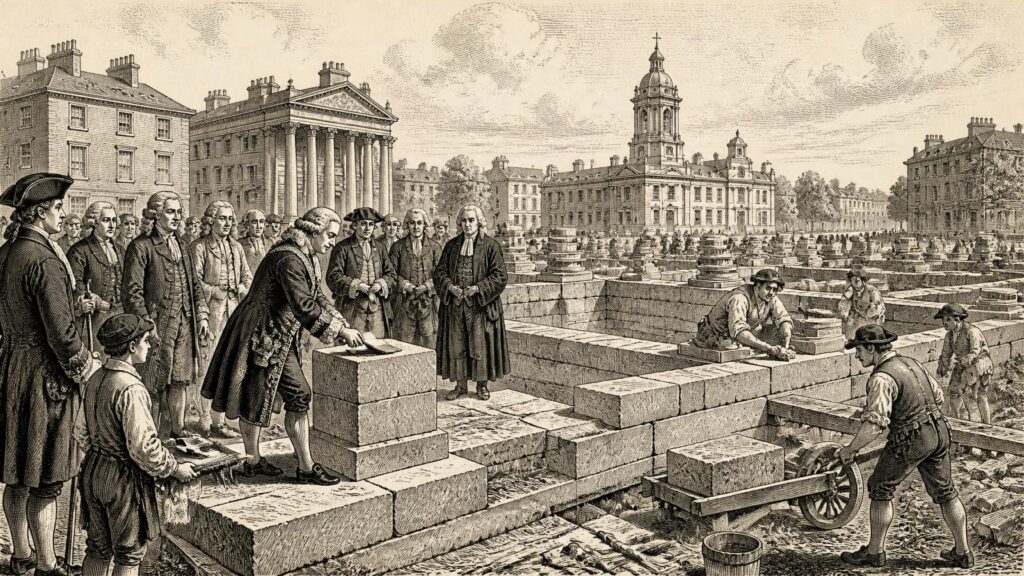
The most securely dated public event occurred on 3 February, when the foundation stone of the new Parliament House was laid at College Green, Dublin. The building was designed by Edward Lovett Pearce, an MP as well as an architect, who had won the commission in 1728. Its construction replaced the inadequate and decaying Chichester House, where the Irish parliament had previously met. The scheme was remarkable: it was intended from the outset to house both the Commons and Lords, making it an exceptionally early purpose-built bicameral legislature.
The stone did not, of course, signify political independence. The Parliament of Ireland was subordinate to the crown and to constitutional procedures that allowed the British government and privy council decisive influence over Irish legislation. Its electorate and membership were overwhelmingly Protestant and propertied. Catholics had been explicitly deprived of the parliamentary franchise in 1728, so the new building represented a political nation from which the large Catholic majority was legally excluded. Yet Parliament remained important: it passed revenue and regulatory measures, distributed patronage, and provided a stage on which Irish political interests could press their case against absenteeism, commercial restrictions and outside interference.
John, Lord Carteret, lord lieutenant from 1724 to 1730, was in office during the year and had sought to cultivate broad popularity after the controversy over Wood’s halfpence earlier in the decade. He worked with leading office-holders including Hugh Boulter, Church of Ireland archbishop of Armagh, and William Conolly, Speaker of the Commons. The political balance was changing, however. Conolly, the kingdom’s wealthiest and most influential commoner, died in October 1729. His death removed a formidable manager of parliamentary business just as questions of economic hardship and absentee landlords sharpened criticism of the administration.
Castletown and Conolly’s World
Conolly’s position was displayed not only at College Green but beside the River Liffey at Celbridge. Castletown House, built between 1722 and 1729, was completed in the year of his death. It was Ireland’s first great Palladian country house: a vast, classically ordered residence whose scale proclaimed the owner’s wealth, social authority and closeness to government. Designed through the collaboration of several architects, including Pearce’s involvement in the wider project, it was conceived for grand entertaining as well as domestic life. Political influence was exercised in drawing rooms, dining rooms and country estates no less than in parliamentary chambers.
The juxtaposition of Castletown and the new Parliament House is revealing. Both were products of a Protestant landed elite enriched by property, office and the post-Williamite order. Both employed an architectural language derived from classical Europe, asserting civility, permanence and public-mindedness. But the wealth supporting such display rested on a highly unequal rural society. Most people had no share in parliamentary representation, and many held land under insecure or burdensome arrangements. The severe food shortage of these years made that imbalance painfully visible.
Scarcity at the Cabin Door
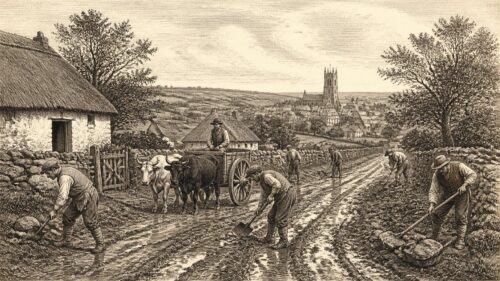
1729 should be placed within, rather than mistaken for the beginning of, the subsistence crisis brought by poor harvests from 1726 to 1728. The failure of the 1728 harvest was particularly serious. Grain prices remained high in 1729, and contemporaries feared that people would die before the next harvest. Evidence is fragmented: Ireland had no national system for counting deaths or systematically recording relief. It would therefore be irresponsible to attach a precise national mortality figure to this year. Nevertheless, correspondence, price evidence and later historical research leave little doubt that scarcity and hunger remained pressing realities, especially for households with little land, cash or stored food.
Dependence on potatoes for much of the poorer population’s diet could cushion families in ordinary years, but it did not remove vulnerability. When crops were poor and oatmeal prices rose, families consumed their potato stocks prematurely, cut back sharply, borrowed, begged or moved in search of support. In Dublin, charitable feeding by Archbishop Boulter and Trinity College during the 1728–29 emergency was remembered as a response to acute need. Such relief could save lives locally, but it was improvised and paternalistic, not a general entitlement.
The problem was also institutional. In 1729 Parliament passed an act empowering the governors of Dublin’s workhouse to provide for and employ poor people, punish vagrancy more effectively, and make provision for lunatics and foundling children. From 25 March 1730, the workhouse was to receive exposed children of either sex and any age. This was an important enlargement of the city’s poor-relief machinery, prompted by the visible plight of children and by concern at infant deaths under parish arrangements. It was not a modern welfare system. The institution joined care with discipline, labour, confinement and Protestant instruction; its assumptions about poverty, illegitimacy and social order were inseparable from its charitable purpose.
Swift’s Unforgiving Mirror
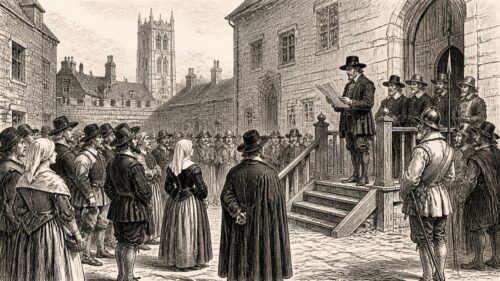
Against this background Jonathan Swift published A Modest Proposal in Dublin in 1729, printed by Sarah Harding. The pamphlet’s full title announced a scheme for preventing poor children in Ireland from burdening their parents or the country and making them “beneficial” to the public. Its narrator coolly proposes that infants should be sold as food. The horror is deliberate: Swift turned the language of calculation, improvement and commodity into an accusation against those who viewed impoverished people chiefly as an economic inconvenience.
The opening picture of women begging with ragged children in Dublin and on the roads is a literary construction, not a census or a neutral social survey. Yet its force depended upon circumstances readers recognised. Swift named unemployment, lack of productive opportunities, rent extraction, absentee landlords and the disregard shown to the poor. His satire offered no administrative blueprint; rather, it exposed the cruelty that could hide behind supposedly rational projects for managing population and poverty. In a year of continuing scarcity, its publication became one of the most enduring cultural interventions in Irish history.
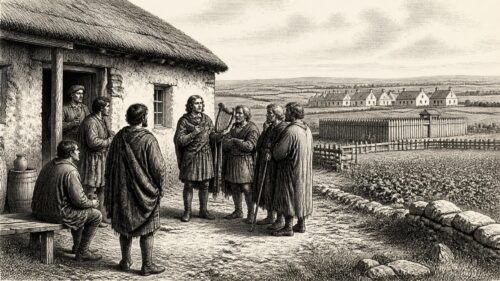
Swift wrote in English and addressed the political and print world of Dublin, but 1729 also belongs to the history of Irish-language learning and poetry. Aogán Ó Rathaille, the great Munster poet associated with the aisling tradition, died sometime between 1728 and early 1729; a lament copied in March 1729 provides the firmest boundary. His death cannot be assigned an exact day. It nonetheless marked the passing of a poet whose work preserved formidable command of older learned Irish forms while registering dispossession, poverty, Jacobite defeat and the loss of traditional patronage. His career demonstrates that Irish literary culture remained intellectually vigorous even as the social world which had long sustained hereditary poets had been profoundly weakened.
Ports, Ballast and Exchange
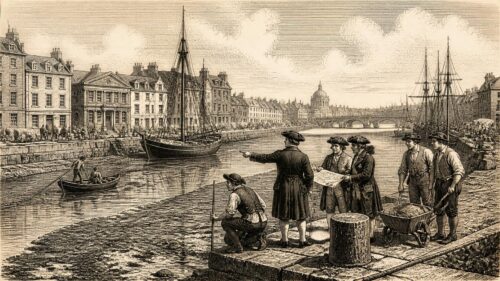
Economic life was not defined by deprivation alone. The Ballast Offices Act of 1729 addressed a practical danger to trade in Cork, Galway, Sligo, Drogheda and Belfast. The act complained that channels and harbours had become shallow, partly through the irregular removal and dumping of ships’ ballast, delaying voyages and increasing costs. It authorised ballast offices, under the respective town corporations, to regulate ballast and to act as conservators of their ports and rivers. The offices were to begin operating after 25 April 1730, so their creation belongs to the legislation of 1729 while their formal practical commencement belongs to the following year.
This measure points to an Ireland tied closely to maritime networks. Cattle products, hides, linen, provisions, imported manufactures and colonial goods all depended on usable quays, channels and shipping. The named ports show that commercial policy was not confined to Dublin. Yet improved navigation did not automatically translate into security for labourers or smallholders. Ireland could possess busy ports, imposing new buildings and a politically active elite while many inhabitants struggled to obtain sufficient food.
Church and Continuity
On 8 May William King, Church of Ireland archbishop of Dublin and a lord justice, died. King had been a major political churchman since the Williamite era and had often clashed with Boulter over appointments and the proper balance between Irish-born interests and an English-centred administration. His death strengthened Boulter’s position within the established church and the governing system. The succession was therefore more than ecclesiastical business: bishops sat in the House of Lords and senior churchmen were central to patronage and state authority.
Thus 1729 left tangible and intangible inheritances. College Green acquired the beginning of a building that would define Irish parliamentary life for the rest of the century. Castletown reached completion as a monument to elite power. Dublin’s poor-relief apparatus was expanded under the pressure of visible hardship, while port legislation acknowledged the material needs of commerce. And Swift’s savage pamphlet ensured that the year would be remembered not merely for stone, statutes and offices, but for its insistence that Ireland’s poor were human beings rather than problems to be managed.

Primary Sources
- Carteret, John | Dictionary of Irish Biography
- Boulter, Hugh | Dictionary of Irish Biography
- King, William | Dictionary of Irish Biography
- Ó Rathaille, Aogán | Dictionary of Irish Biography
- CO. DUBLIN, DUBLIN, COLLEGE GREEN, PARLIAMENT HOUSE | Dictionary of Irish Architects
- PEARCE, EDWARD LOVETT (SIR) | Dictionary of Irish Architects
- ‘More Patrick’s house than any other’: Parliament House, Bank of Ireland and the Iconography of the Irish Patriotic Project 1728–1810
- The Red Drawing Room Conservation Project at Castletown House | Heritage Ireland
- Castletown House and Parklands | Heritage Ireland
- Conolly Folly | Heritage Ireland
- A Modest Proposal | Jonathan Swift Archive
- A Modest Proposal | Wikisource
- Trinity Writers: Jonathan Swift | Trinity College Dublin
- Processes Prior and during the Early 18th Century Irish Famines—Weather Extremes and Migration
- Brian Francis Gurrin, The Irish Famine of 1740–41: Causes and Consequences
- Part 9 of History of the Commercial and Financial Relations between England and Ireland from the Period of the Restoration | CELT
- Ballast Offices Act 1729 | Irish Statute Book
- Foundling Children’s Welfare, Parliamentary Acts Proposed and Enacted, 1697–1800
- The Foundling Hospital | Ulster Historical Foundation
- Further Hospital Histories: Of the Work-house of the City of Dublin | Chapters of Dublin
- Eighteenth-century Dublin | Chapters of Dublin
- The Foundling Hospital, Dublin | History Ireland
- The History and Heritage of St James’s Hospital, Dublin | Four Courts Press
- A History of the Irish Poor Law | Project Gutenberg
- An Act to Explain and Amend Acts Relating to the Work-House of the City of Dublin | Wellcome Collection