Catholic Billeting1696 CE
In 1696, Williamite Ireland consolidated its post-war authority through military, fiscal and municipal controls rather than major conflict. Alarm over French-backed Jacobitism prompted proclamations against fugitives, alleged tories and absent officers, while Catholic disarmament authorised searches and deepened inequality. At Clonmel, the corporation ordered soldiers quartered in Catholic homes to prevent meetings, illustrating domestic surveillance despite continued Catholic trading. Poll and hearth taxes, regulated measures and proclamations sustained administration. Investigations into forfeited estates exposed continuing uncertainty over Catholic property rights. State-appointed fasts and thanksgivings reinforced Protestant political culture, while action against pirate Henry Every reflected Ireland’s place in imperial policing.
Dateline
The year 1696 in Ireland was not marked by a battle comparable to the Boyne or Aughrim. Its significance lies instead in the routines by which the Williamite state made its victory felt: tax collection, searches for arms, pressure on Catholic households, the pursuit of fugitives, and the management of forfeited land. Five years after the Treaty of Limerick ended organised Jacobite resistance, peace remained armed, suspicious and unequal. Ireland was governed for William III by a Protestant political elite whose security depended upon garrisons, county magistrates, corporations and a standing military presence. For the Catholic majority, the year brought a particularly clear demonstration that the post-war settlement was not simply a conclusion to fighting, but a new and closely supervised social order.
A Kingdom Still at War
Ireland was formally quiet, but it was not detached from the wider Nine Years’ War between William III’s coalition and Louis XIV’s France. The French court still sheltered James II and Jacobite exiles, while the possibility of a French-backed restoration remained a serious concern for Williamite governments. In February 1696, a plot in England to assassinate William III intensified official alarm across his kingdoms. On 4 March, the Irish administration issued a proclamation offering £1,000 for the apprehension of James FitzJames, duke of Berwick, James II’s illegitimate son, and his alleged associates. Berwick was a prominent Jacobite commander in French service. The proclamation did not mean that he had landed in Ireland; rather, it shows Dublin Castle treating Irish security as inseparable from the international struggle against France and the Stuart cause.
The calendar of proclamations records a state attentive to military readiness. On 16 November, officers absent from duty were ordered back to their garrisons. A further proclamation of 4 December prescribed orders to be observed by His Majesty’s forces in Ireland. Such measures belong to the ordinary maintenance of an army, but in Ireland their political meaning was unusually sharp. The army was not merely a defence against foreign attack. It helped sustain the new order in a country where the defeated side was associated, in the eyes of many Protestant landowners and office-holders, with a potentially resurgent Catholic and Jacobite interest.
That anxiety also explains official attention to men called “tories”. The term could cover robbers, fugitives and small armed bands, and it was readily applied to people seen as threats to property and government. On 11 February, a proclamation ordered tories named by the County Cork grand jury to surrender. Further orders followed on 25 April, concerning people presented by grand juries in Kerry, Sligo and Louth, and on 29 June, extending the process to Cork, Kerry, Armagh, Louth and Tipperary. This was not evidence of a renewed national Jacobite war. It was evidence that the aftermath of war included local violence, outlawry and fear, particularly in districts where difficult terrain, disrupted livelihoods and weak day-to-day policing complicated the reach of government.
Disarmament and Clonmel’s Catholics
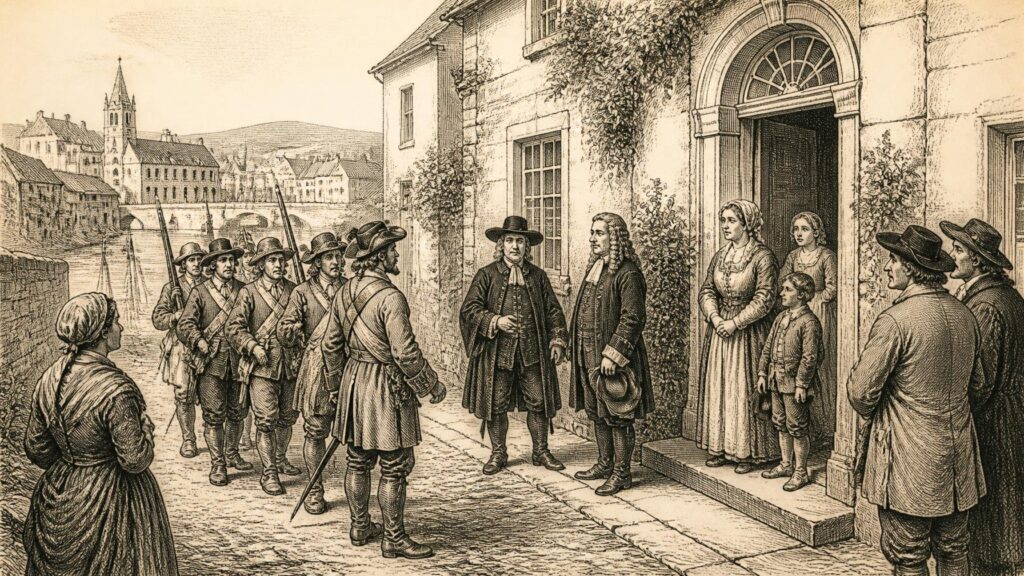
The most revealing dated evidence from within an Irish town comes from Clonmel. On 16 March 1696, the corporation’s minute book ordered that soldiers be quartered on all “Papist” houses in order to prevent “cabals & meetings”. The wording is stark, but its scale must be stated precisely: it records a measure in Clonmel, not an instruction proven to have applied throughout Ireland. Even so, it offers a rare close view of how fear of Catholic conspiracy could enter domestic life. Quartering troops imposed an immediate burden of space, provisions and surveillance upon households, and made religious identity a practical condition of municipal administration.
The order came shortly after the deadline imposed by the 1695 Act for disarming Papists. Catholics had been required to deliver their arms, armour and ammunition to local authorities by 1 March 1696. The statute also authorised justices, mayors, sheriffs and other officers to search places where weapons were suspected to be concealed. Its language presented disarmament as necessary for public peace and the prevention of rebellion. In practice it formalised a profound inequality: the Catholic population was denied the ordinary means of armed self-protection at the same time as the Protestant state relied heavily on soldiers, fortified towns and loyal office-holders.
Clonmel illustrates the awkward coexistence of economic usefulness and political exclusion. Its corporation had recorded in November 1695 that Catholics and Quakers might trade in the town. Commerce could not simply be switched off in a market centre on the Suir, where traders, craftspeople, carriers and rural suppliers depended upon one another. Yet permission to trade did not confer civic equality. The borough’s corporate authority rested with a Protestant urban elite, while Catholics could be treated collectively as a security risk. The distinction mattered in everyday life: a person might buy and sell in the market, pay rent and taxes, and still be subject to searches, billeting or exclusion from public power.
Taxes, Measures and the Work of Government
Much of 1696 was occupied not by dramatic policy announcements but by the administrative work through which government reached households. On 20 January, a proclamation named the people to whom money raised by poll was to be paid. On 11 February, officials were appointed to administer the hearth tax in County Cork. Both levies were intrusive because they converted persons and domestic space into taxable units. The hearth tax in particular required assessments of houses and fireplaces, bringing fiscal officers into close contact with the material conditions of towns and countryside.
On 22 February, the authorities ordered enforcement of the recent act regulating measures. This seemingly modest intervention mattered in a trading economy. Standard measures for grain, drink and other commodities were meant to restrain fraud and make market exchange more predictable. It is a reminder that the Williamite administration did not concern itself only with plots and punishment. It also sought reliable revenue and orderly commerce. Yet the benefits of regularised trade were inseparable from a coercive political structure: municipal corporations, magistrates and customs officials generally belonged to the Protestant interest strengthened by the war’s outcome.
Parliament itself was not the engine of new legislation in this calendar year. A proclamation of 16 March called Parliament together in order to prolong its adjournment until 27 June. The distinction is important. The Irish parliament elected after the Williamite victory was predominantly Protestant, but its intermittent sitting did not make government inactive. Proclamations, county grand juries, corporate orders and military commands carried much of the state’s daily business. They also reveal how Ireland’s constitutional life remained dependent on the crown and on the operation of Poynings’ Law, under which proposed Irish legislation required prior approval in England.
Forfeited Estates and Unsettled Rights
Land remained the central unresolved question of the post-war world. The Williamite victory had opened a final great phase of seventeenth-century confiscation and transfer. Catholic and Jacobite proprietors who had been attainted or outlawed faced the loss of estates, while Protestant purchasers, grantees and aspiring landowners looked to acquire secure titles. On 16 July 1696, a proclamation sought the discovery and securing of lands forfeited to the king. Its very issue indicates that the identification and recovery of forfeited property was still active business, five years after Limerick.
For Catholics who had remained in Ireland, the legal landscape was neither simple expulsion nor dependable protection. The articles negotiated at Limerick and Galway had preserved rights for certain named or qualified beneficiaries, but eligibility had to be established and the meaning of promises contested. Some Catholic landholders and their agents petitioned, pursued pardons or assembled evidence of entitlement. The later courts of claims, which sat from 1697, lay in the future; in 1696, families still had reason to fear that an uncertain title, an accusation of disloyalty or an adverse interpretation of a surrender agreement could alter their prospects. This was a society in which property, religion and political allegiance were tightly joined.
The social effects extended well beyond great estates. Landed insecurity affected tenants, labourers, servants, creditors and town merchants whose livelihoods depended on the spending and credit of local proprietors. The arrival of new owners or agents could change patterns of leasing, employment and consumption. Protestant settlement and advancement therefore proceeded not only through spectacular grants but through the slow remaking of local authority: who appointed officers, controlled borough corporations, administered justice and possessed the resources to lend, improve or purchase.
Worship, Fasting and Atlantic Horizons
The state also marked time through public worship. On 6 April a general thanksgiving was ordered for 23 April, and on 17 June a kingdom-wide fast was appointed for 10 July. Such observances were political as well as devotional. They called Protestant congregations into a shared public acknowledgement of providence, monarchy and war. Catholic worship persisted, but without equal legal standing or public institutional security. It is important not to project the harsher legislation of 1697 backwards: the banishment of Catholic bishops and regular clergy had not yet been enacted. In 1696, however, the direction of travel was already plain in disarmament, local surveillance and the language of Protestant preservation.
The year also connected Ireland to wider seas. On 21 August, the Irish government issued a proclamation ordering the apprehension of Henry Every and other pirates. Every’s spectacular attacks in the Indian Ocean had become an international concern, entangling English commercial interests with the Mughal empire and drawing official attention across the Atlantic archipelago. The proclamation does not make Ireland a principal theatre of piracy, but it shows that Irish ports and authorities were incorporated into a widening imperial and maritime policing network.
By the end of 1696, then, Ireland had no single decisive episode to rival the battles of the earlier decade. Instead, its history is visible in a sequence of official acts: taxes assessed, measures inspected, arms surrendered, alleged tories pursued, soldiers quartered, forfeitures investigated and fasts proclaimed. Clonmel’s order of 16 March gives those processes a human scale. It shows a post-war regime entering homes in the name of preventing meetings, and reveals how the settlement won by Williamite arms was consolidated not only in castles, parliaments and estate papers, but at the household door.

Primary Sources
- Statute Law Revision Act 2015
- In Pursuit of a Positive Construction: Irish Catholics and the Williamite Articles of Surrender, 1690–1701
- William III
- The Williamite War 1689–91
- Clonmel Corporation Minute Book, 1687–1711
- Clonmel Town Council Minute Book 1687–1718
- An Act for the Better Securing the Government, by Disarming Papists
- Statutes by Subject: Weapons
- Securing the Protestant Interest: The Origins and Purpose of the Penal Laws of 1695
- Williamite Peace Tactics, 1690–1
- ‘Publick and Solemn Acknowledgements’: Occasional Days of State-Appointed Worship in Ireland, 1689–1702
- ‘Like Amphibious Animals’: Irish Protestants, Ancient Britons, 1691–1707
- The Representation of Female Claimants Before the Trustees for the Irish Forfeitures, 1700–1703
- Ireland and Empire, 1692–1770
- James II and VII
- Raising the Irish Militia
- Penal Days in Clogher
- Restoration Dublin in the Ireland of Its Time c.1660–1700
- Acts and Statutes Made in a Parliament, Begun at Dublin the Twenty Seventh Day of August, Anno Dom. 1695
- Statutes in Chronological Order: Laws in Ireland for the Suppression of Popery
- Annals from 1640 to 1704
- The Crisis and the Manhunt: Henry Every
- By the Lords Justices of England, a Proclamation: Whereas We Have Received Information … That One Henry Every Commander of the Ship Called the Phancy … Has, Under English Colours, Acted as Common Pirate