
Capell’s Disarming Parliament1695 CE
In 1695 Lord Capell’s Dublin parliament, under Poynings’ Law, consolidated Williamite rule after the Treaty of Limerick, reconciling Crown revenue needs with Protestant demands for fiscal influence. Amid fears of France, Jacobite exile and Catholic rebellion, it initiated religious exclusion. The Disarming Act required Catholics to surrender weapons and restricted ownership of horses, extending officials’ powers of search and control. The Foreign Education Act curbed Catholic teaching, overseas study and support, attaching severe civil and property penalties. Parliament also regulated property, trade, coinage and worship. Its legislation strengthened administration while making Catholic disability a durable foundation of the post-war settlement.
Dateline
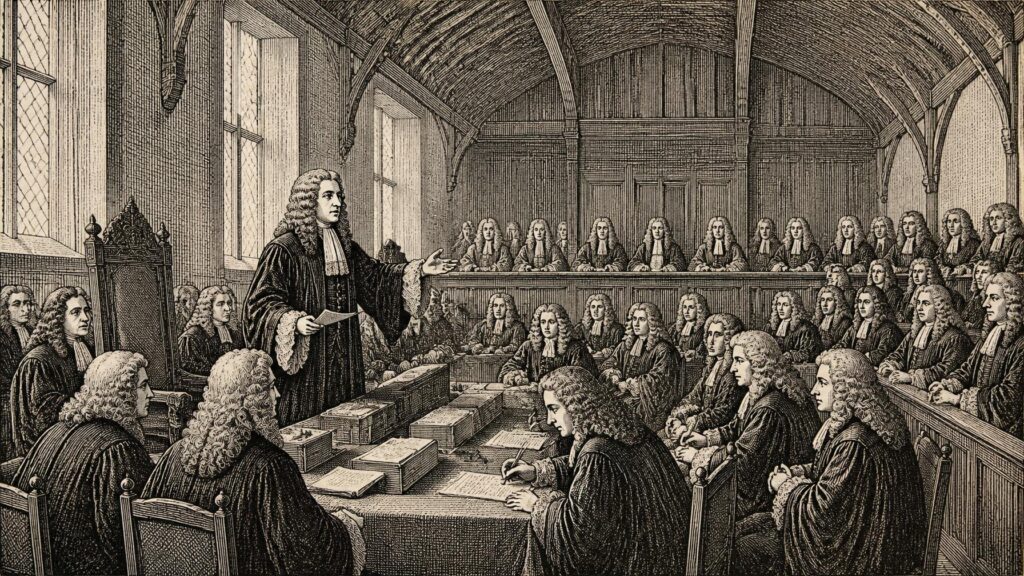
In 1695, Ireland’s most consequential events were made not on a battlefield but in Dublin’s parliament house and in the wording of statutes. Four years had passed since the Treaty of Limerick ended the Williamite war in Ireland, yet peace remained insecure in the minds of the victorious Protestant governing class. King William III was still fighting Louis XIV in the wider Nine Years’ War; Irish Jacobite exiles served abroad, France remained a feared ally of the Stuart cause, and the memory of recent siege, confiscation and civil conflict was immediate. The year therefore joined political settlement to religious exclusion. Under Henry, Lord Capell, the government secured revenue and parliamentary co-operation, while legislation began a more systematic attempt to subordinate Ireland’s Catholic majority.
A Parliament Called at Dublin
Capell became lord deputy in the spring of 1695 after a period in which Ireland had been governed by lords justices. His appointment was political as well as administrative. The government needed money, dependable institutions and a means of bringing influential Protestant landowners and office-holders into a workable relationship with Dublin Castle. The previous parliament of 1692 had broken down over the Commons’ claimed right to originate money bills. In 1695, however, negotiation produced a compromise: the Crown would retain its constitutional role under Poynings’ Law, while the Commons would be allowed a meaningful part in framing the methods by which revenue was raised.
A proclamation of 17 July summoned parliament to meet in Dublin on 27 August. Capell’s opening address made clear that financial supply was central. The government required funds for civil administration and defence at a time when the European war absorbed English, Scottish and Irish resources. The Commons, composed overwhelmingly of members committed to the post-war Protestant order, proved far more tractable than its predecessor. This was no simple surrender of parliamentary interest: Irish Protestant politicians wanted regular meetings, influence over taxation and a stable framework for property. But the settlement made in 1695 bound those ambitions to the Crown’s demand for revenue and to a shared programme of Protestant security.
The constitutional significance was lasting. The parliament that opened in August was treated by contemporaries and later historians as the first of two practical sittings within a session that technically ran until 1697. Its initial sitting continued until 14 December 1695. It established a pattern in which an Irish parliament, though constrained by Poynings’ Law and subordinate to the English Crown, could sit regularly and legislate extensively. At the same time, the political nation being consolidated was emphatically confessional. Catholics had no comparable representation in the assembly deciding measures that would reshape their civil position.
Peace Haunted by War
The fears behind the year’s legislation should not be dismissed as mere rhetoric, though neither should they be accepted as a neutral description of Ireland’s Catholic population. The Williamite victory had left a country marked by military mobilisation, ruined or disrupted local economies, contested estates and the departure of many Jacobite soldiers for service in France. Ireland itself was no longer an active theatre of war in 1695, but the international conflict had not ended. William III led the Grand Alliance against France, while the exiled James II and his supporters still offered a possible focus for invasion or renewed rebellion. Protestant officials repeatedly fused the danger posed by France, Jacobitism and Catholicism into a single political threat.
That fusion mattered because it turned a recently defeated enemy into a permanently suspect religious community. The Treaty of Limerick had offered protections to Catholics who submitted to Williamite rule, but the settlement was already interpreted narrowly by many Protestant politicians. In 1695 they did not yet enact every restriction later associated with the Penal Laws. In particular, the statute banishing Catholic bishops and regular clergy belongs to 1697, not to this year. Yet two laws passed in 1695 set the direction of travel: one concerned weapons and horses, the other schooling and links with Catholic Europe.
Weapons and Horses
The Act for the better securing the government by disarming Papists was among the defining enactments of 1695. It required Catholics to declare and surrender arms, armour and ammunition before 1 March 1696 in modern dating; the statute’s original dating followed the old legal calendar, under which the new year began on 25 March. After that deadline, justices of the peace and urban officers could authorise searches where arms were suspected. The law was not confined to firearms. Its language covered the material means by which households might protect themselves, hunt, travel or be drawn into military service.
Its horse provisions reveal the practical and symbolic breadth of the policy. Catholics were not to keep a horse above a low statutory value or above a specified height suitable for military use. A capable horse was essential to cavalry, but it was also valuable to a farmer, traveller, trader and gentleman. Catholic objections recorded during the bill’s passage warned that the measure would damage horse breeding and prevent people of standing from keeping good riding or coach horses. Those objections did not succeed. The law’s effect was to mark Catholics as people whose access to arms and mobility should be conditional, inspectable and vulnerable to seizure.
The statute was therefore more than a precaution against an imminent rising. It translated the insecurity of the early 1690s into a continuing hierarchy of trust. Protestant magistrates, sheriffs and municipal officers acquired powers over Catholic neighbours; declarations, searches and licences brought confessional identity into local government. Enforcement could vary greatly from place to place, and a statute cannot by itself tell us how often a search occurred in a particular parish. What can be firmly said is that, by the end of 1695, the law had made unequal possession of weapons and valuable horses a principle of the post-war state.
Schooling and Overseas Ties
The second landmark measure was the Act to restrain Foreign Education, which received royal assent on 7 September. It prohibited Catholics from sending children or other people abroad to be educated in Catholic universities, colleges, schools or households, and penalised the sending of money for that purpose. A person convicted under the act could lose important civil capacities, including the ability to bring an action at law, act as guardian or executor, receive a legacy, hold office or retain land for life. Such penalties made education a question not only of learning but of inheritance, family strategy and property.
The act also attacked Catholic schooling within Ireland. Catholic teachers were forbidden publicly to teach or instruct young people in learning, while schoolmasters were required to conform to the established Church of Ireland and obtain episcopal certification. The immediate target was not literacy in the abstract but the reproduction of Catholic religious and educated life. Continental colleges had long supplied Irish Catholic clergy and provided education for families able to bear the expense. To the government, those institutions also represented contact with Irish exiles and foreign Catholic powers. The statute sought to break that connection and encourage conformity to the established church.
It would be misleading to project later images of “hedge schools” neatly back onto 1695. Informal and private teaching did not suddenly begin with this act, and the law’s enforcement changed over time. Its importance in this year lies in the intention stated by parliament: religious identity could be regulated through the schooling of children, the movement of students across the sea and the legal security of their families. The state’s programme was both immediate, shaped by post-war fears, and generational.
Law, Money and Ordinary Dealings
Not all the year’s business was directed against Catholics. Parliament also passed measures that addressed inheritance, contracts, rents, civil procedure, sheriffs, markets and religious observance. The Irish Statute of Frauds of 1695, for example, required certain dealings concerning land and wills to be put in writing; its provisions on devising land were to take effect in 1696. Such rules mattered in a society where estates, leases, marriage settlements and debts underpinned political power. They also show the parliament acting as a legislature of property and commercial practice, not merely as an engine of confessional repression.
Money itself was a pressing concern. On 29 May, before parliament assembled, a proclamation sought to improve the availability of coin by making foreign coin tender. The measure points to the difficulty of conducting everyday payments, tax collection and trade where specie was scarce or unevenly available. Later in the year, legislation regulated measures used in trade, while the Lord’s Day Act, receiving assent in December, restricted work and recreation on Sundays. Alongside an act against profane cursing and swearing, it expressed the governing class’s wish to order public behaviour through Protestant moral norms. Markets, household obligations, local courts and parish life were all being drawn into a more regulated legal culture.
Government also used public worship to frame political events. A general fast was proclaimed for 12 July 1695, and a public thanksgiving was later ordered for 8 October. These were state-appointed observances, intended to make providence, war and loyalty visible in parish churches throughout the kingdom. Their official character should not obscure the uneven religious realities of Ireland. The Church of Ireland was established and politically privileged, but it did not contain the faith of most inhabitants. The distance between official ritual and popular religious allegiance was one of the central facts with which the new order had to live.
A Settlement with Boundaries
By December 1695, Capell’s parliament had strengthened Williamite government, addressed revenue and supplied an expanding body of law for property, commerce and administration. Its most enduring legacy, however, was the decision to build security through religious disability. The acts on arms, horses and education did not end Catholic life, loyalty or learning. They did establish that the Catholic majority could be treated in law as a population whose military capacity, institutions and family connections required special control. Ireland’s war had ended in 1691; in 1695, its political consequences were being made durable.
Primary Sources
- Securing the Protestant Interest: The Origins and Purpose of the Penal Laws of 1695
- English Ministers, Irish Politicians and the Making of a Parliamentary Settlement in Ireland, 1692–5
- An Act for the Better Securing the Government, by Disarming Papists
- An Act to Restrain Foreign Education
- Acts and Statutes Made in a Parliament, Begun at Dublin the Twenty Seventh Day of August, Anno Dom. 1695
- Pre-Union Irish Statutes Affected: 1695
- Statute Law Revision Act 2015, Schedule 2
- CAPELL, Henry (1638–96)
- Capel (Capell), Sir Henry
- Chief Secretary’s Office: Entry Book of Papers Signed by the Lord Lieutenant, Lords Justices or Chief Secretary, 28 Aug. 1692–15 Feb. 1695/6
- Securing the Protestant Interest: The Origins and Purpose of the Penal Laws of 1695
- Publick and Solemn Acknowledgements: Occasional Days of State-Appointed Worship in Ireland, 1689–1702
- Irish Legislation Database: Help on Regnal Years and Session Dates
- Statute of Frauds 1695, Section 3
- Short Titles Act 1962, Schedule 1
- His Excellency Henry Lord Capel His Speech to Both Houses of Parliament, 1695
- Battle of the Boyne
- Nine Years War
- A Chronology of Ireland
- The Seventh Year of William III: Irish Penal Law Chronology
- An Act for the Better Securing the Government by Disarming Papists
- The Acts of James II’s Parliament in Ireland