Shannon Bridge1506 CE
In 1506 Turlough O’Brien, his brother Donnell and the bishops of Killaloe and Kilfenora built a bridge at Port Croise across the Shannon, demonstrating Thomond’s resources, ecclesiastical partnerships and strategic influence near Limerick. Meanwhile, Gerald FitzGerald’s lord-deputyship remained powerful but limited, as Henry VII contemplated an unrealised expedition. Dublin civic authorities defended Dominican hay against Kilmainham’s prior. Northern Ireland saw cattle raids, succession struggles, killings and Scottish mercenary involvement, devastating communities. Annals also record church officials, merchants, nobles and scholar Páidín Ó Maol Chonaire alongside lightning damage at Trim. Together these events reveal medieval Ireland’s regional, interconnected and contested order.
Dateline
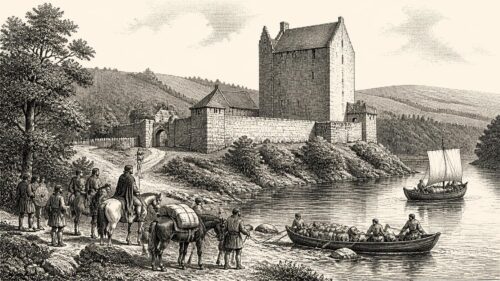
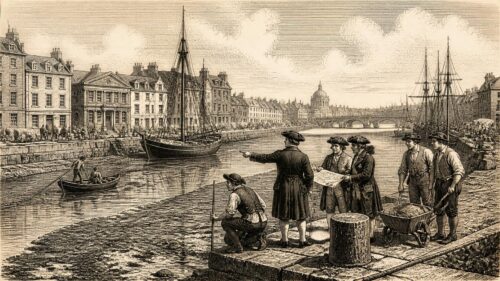
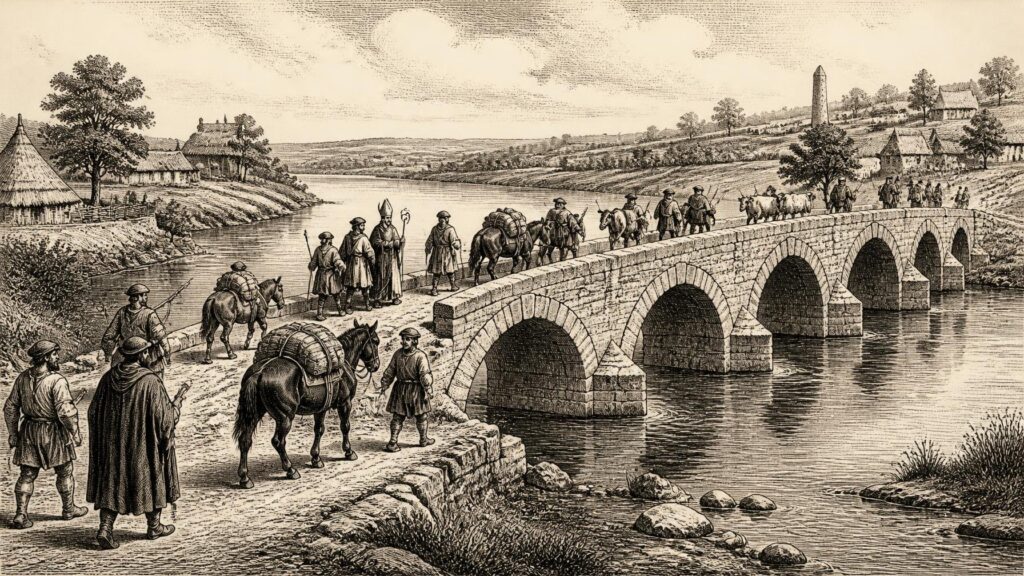
In 1506 a new bridge crossed the Shannon at Port Croise, the crossing later associated with O’Brien’s Bridge. The annals credit its erection to Turlough O’Brien, lord of Thomond, his brother Donnell, and the bishops of Killaloe and Kilfenora. It was an unusually tangible achievement in a year more often recorded through raids, killings and deaths. A bridge could make a river crossing more dependable for travellers, livestock, messengers and armed companies; at this point it also had political force. The Shannon was not merely a geographical feature dividing regions. It was a major route, barrier and frontier beside the contested city of Limerick. The new crossing showed that the O’Brien lordship could mobilise labour, ecclesiastical co-operation and resources on a substantial scale.
A Crossing at Port Croise
The bridge is firmly placed in 1506 by the Annals of the Four Masters. Their wording matters: Turlough, Donnell and two bishops appear together as its makers. This was not simply a private improvement by one lord, but an undertaking in which secular power and diocesan institutions were publicly associated. Medieval bridge-building brought religious credit as well as practical advantage. A crossing served pilgrims and clergy, local people going to market or church, drovers moving cattle, and travellers who otherwise depended on a ford or boat. Its construction also proclaimed responsibility for a route used by people from both sides of the river.
Yet the bridge was not politically neutral. Turlough Donn O’Brien had fought against Gerald FitzGerald, eighth earl of Kildare, at Knockdoe in 1504. That huge battle had ended in Kildare’s victory over the coalition led by Ulick Burke of Clanricard and supported by Thomond. The victory did not make Kildare master of the western and mid-western lordships. O’Brien remained formidable west of the Shannon, while Limerick sat close to the interface of English urban jurisdiction, Geraldine influence and Gaelic lordship. Modern scholarship connects the Port Croise bridge with O’Brien’s capacity to put pressure on Limerick and to extend influence across the river. That is an interpretation of its strategic setting, not evidence that a particular military operation took place in 1506.
The enterprise therefore captures a larger condition of Ireland in this calendar year: authority was regional, negotiated and visible in infrastructure as well as in titles. Turlough’s lordship did not need to displace the English crown in order to act decisively in Thomond. Nor did the Dublin administration possess the reach to prevent such works. The river crossing was a statement of local power made in wood, stone and organised labour, under the blessing of churchmen whose dioceses were themselves rooted in the Shannon region.
Kildare’s Uneasy Supremacy
At the national level, Gerald FitzGerald, known as Gearóid Mór, remained lord deputy for Henry VII and the dominant magnate in the English lordship. His position rested on much more than royal office. He held extensive estates, drew support from towns and lords within the Pale, and maintained alliances reaching deep into Gaelic Ireland. His victory at Knockdoe had displayed an ability to bring together English and Irish followers, but it had also exposed the limits of that alliance: the defeated powers survived, and the political geography of the island remained plural.
In 1506 Henry VII considered a major expedition to Ireland, reportedly on a scale of thousands of men. The proposal did not become a landed royal campaign. It nevertheless reveals concern at the English court about the effectiveness of Kildare’s government and the uncertain extent of royal control. It would be misleading to imagine a simple opposition between a clearly English east and an entirely independent Gaelic west or north. Kildare’s own authority was built through Irish alliances, while leading Gaelic dynasties fought one another, employed Scottish mercenaries and dealt with towns, churchmen and English-descended neighbours. The central question was not whether one government ruled a unified Ireland, but who could command obedience, hostages, service and safe passage in particular regions.
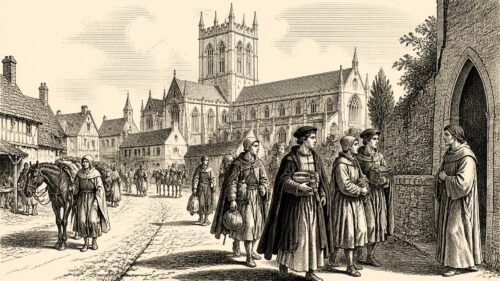
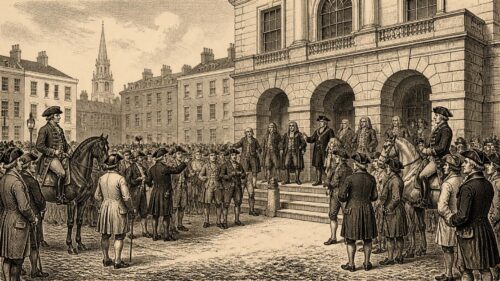
Records from 1506 also show ordinary civic authority in Dublin being exercised close to home. A later Dublin chronicle relates that the prior of Kilmainham tried to seize hay belonging to the Dominican friars; the mayor and commons supported the friars, recovered the loads and drove the prior back towards Kilmainham. The account is brief and should not be inflated into a national political crisis. It does, however, offer a vivid glimpse of a corporate town defending religious neighbours’ economic property. Hay was essential fodder, especially valuable where religious houses kept horses or cattle. A dispute over it could readily draw civic officeholders and a crowd into action.
Raids and Rival Successions
The annals’ most detailed reports for 1506 come from the north and north-east, where control of cattle, territory and kinship succession shaped daily insecurity. Aedh, son of Edmund Maguire, was killed while pursuing cattle taken from Cúil na nOirthear by sons of Conn O’Neill; Philip Maguire, of another branch, was named as the killer. This was not random theft. Cattle-raiding was a recognised instrument of coercion, retaliation and wealth transfer, and pursuit could swiftly turn a local seizure into a deadly encounter between lordly kindreds.
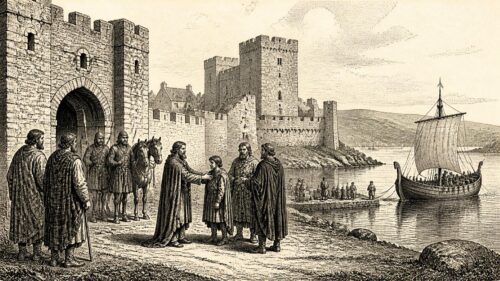
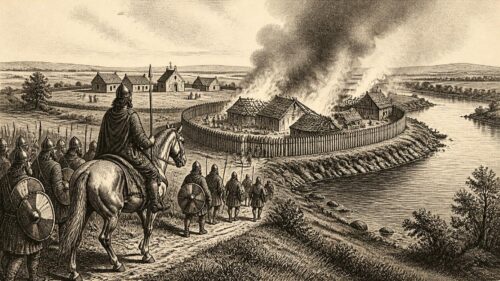
Conflict then widened within the Maguire world of Fermanagh. The Annals of Ulster describe serious enmity between Philip, son of Toirdelbach Maguire, and Philip, son of Brian Maguire. When a division of territory was demanded, Philip son of Brian brought in Scots under Somairle Aneloigh. A raid followed; Ruaidhri Maguire and Philip son of Toirdelbach pursued it despite advice to make peace. The Scots turned on the pursuers. Ruaidhri was captured, his son John was killed, and Philip was dangerously wounded. The annalist’s judgement is stark: devastation came to the whole country, church and laity alike. The phrasing conveys the consequences of lordly conflict for tenants, clergy, households and ecclesiastical lands, even if it does not supply a modern tally of damage.
Other killings underline how crowded and volatile the political landscape was. Thomas, son of Oliver Plunkett, was slain by Calvagh O’Reilly and his sons, an event said to have brought war between ‘Foreigners and Gaels’—the annalists’ conventional language for English-descended and Irish groups. It should not be read as a description of two fixed national blocs: both communities were internally divided and capable of alliance. In the Route of north Antrim, Walter MacQuillin was killed by O’Kanes on the vigil of Lammas, 31 July, with members of several associated families and many leading followers falling beside him. A successful O’Kane raid later carried herds and horses eastward across the Bann. These entries show political power being measured through men, cattle, movement and the ability to retaliate.
Church, Learning and Memory
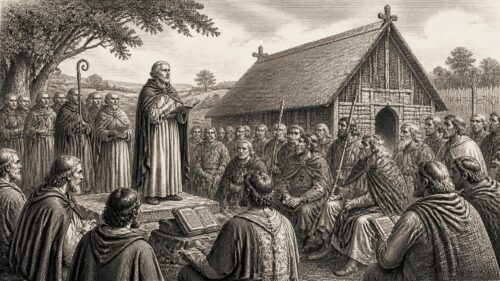
Religion appears throughout the year’s notices not as a sphere apart from society, but as part of its institutional fabric. Thomas Boy Mac Cosgraigh, erenagh of Clones, and John O’Fiaich, erenagh of part of Derrybrusk, died in 1506. Erenaghs were hereditary managers of church lands and revenues in many Gaelic areas, responsible for sustaining local ecclesiastical establishments. Their deaths therefore mattered to communities in which kin, landholding and church service were closely entwined. James Maguire, described as prudent and pious, was buried at Donegal, while Domnall O’Craidhín, called a conscientious merchant, died while hearing Mass in the Franciscan monastery there. Such notices place the Donegal friary within networks of devotion, burial, trade and elite patronage.
The death of Páidín Ó Maol Chonaire was a loss of another kind. The annals praise him as Ireland’s foremost man in poetry and history, and the Annals of Ulster date his death to the night of Little Easter Monday. This language is formal praise, but it points to the standing of hereditary learned families in late medieval Gaelic society. Poets and historians preserved genealogies, composed praise and elegy, interpreted precedent and helped articulate the legitimacy of ruling houses. Their learning was professional, demanding and sustained by patronage. Páidín’s death is consequently evidence not of a fading culture, but of an active intellectual order whose practitioners were esteemed across lordships.
Elsewhere, disaster arrived without human agency. Much of Ath Truim, or Trim, on the far side of the water was burned by lightning. The annal gives no date, casualty figure or full description of the destruction, so none can responsibly be supplied. But the entry recalls the vulnerability of a town built with combustible roofs, stores and workshops. Fire could damage homes, trade goods, food supplies and records in a matter of hours. In the south, Catherine, daughter of the earl of Desmond and lady of Hy Carbery, also died; the annals remember her hospitality and charitable character, and associate her with the building of Beann Dubh and Dún na mBeann.
A Year of Connected Regions
1506 left no single event that transformed Ireland as a whole. Its value lies in the pattern formed by its records. At Port Croise, an O’Brien bridge materially joined the banks of the Shannon while advertising the strength of Thomond. In Dublin, civic government intervened in a quarrel over monastic fodder. In Fermanagh, Breifne and the Route, raids and succession disputes showed how quickly local competition could bring wider destruction. In Donegal and Connacht, clerics, merchants and learned men remained embedded in religious and social networks. The year was thus neither a pause between great campaigns nor a mere list of deaths. It was a year in which infrastructure, lordship, church life and learning all revealed the many-centred character of late medieval Ireland.
Source References
Hover over a number to see the source. Select it to open the source.

- [1] Annals of the Kingdom of Ireland, Volume 5: Annal M1506
- [2] The Annals of Ulster: Year U1506
- [3] English Lordship of Ireland and the Irish Sea World: Re-assessing the Origins of the Kildare Ascendancy, c.1390–c.1513
- [4] The Hegemony of the Earls of Kildare, 1494–1520
- [5] James IV, the O’Donnells of Tyrconnell and the Road to Flodden
- [6] O’Briensbridge Heritage
- [7] The Other Clare, Volume 22: Roundabout Shannon
- [8] Letters Patent of Henry VII Granting Sir Peter Botiller Custody of Parts of the Prise of Wines at Limerick, 28 July 1506
- [9] FitzGerald, Gerald (Gearóid Mór)
- [10] Payne, John
- [11] Annals from 1504 to 1639
- [12] The Struggle for Control of the Irish Mint, 1460–c.1506
- [13] Bardic Poetry and the MacMahons of Oirghialla
- [14] Mendicant Orders and Vernacular Irish Learning in the Late Medieval Period
- [15] Erenachs, Erenachships and Church Landholding in Gaelic Fermanagh, 1270–1609
- [16] Donegal Franciscan Friary
- [17] Introduction: The Role of the Bardic Poet in Gaelic Ireland
- [18] A Survival from a Sixteenth-Century Bardic School
- [19] Patronage Networks in Gaelic Ireland ca. 1541–ca. 1660
- [20] Brian Ború and the O’Briens in County Clare
- [21] A Short Tour; or, an Impartial and Accurate Description of the County of Clare
- [22] Tudor Policy and the Kildare Ascendancy in the Lordship of Ireland, 1496–1534
Primary Sources
- Annals of the Kingdom of Ireland, Volume 5: Annal M1506
- The Annals of Ulster: Year U1506
- English Lordship of Ireland and the Irish Sea World: Re-assessing the Origins of the Kildare Ascendancy, c.1390–c.1513
- The Hegemony of the Earls of Kildare, 1494–1520
- James IV, the O’Donnells of Tyrconnell and the Road to Flodden
- O’Briensbridge Heritage
- The Other Clare, Volume 22: Roundabout Shannon
- Letters Patent of Henry VII Granting Sir Peter Botiller Custody of Parts of the Prise of Wines at Limerick, 28 July 1506
- FitzGerald, Gerald (Gearóid Mór)
- Payne, John
- Annals from 1504 to 1639
- The Struggle for Control of the Irish Mint, 1460–c.1506
- Bardic Poetry and the MacMahons of Oirghialla
- Mendicant Orders and Vernacular Irish Learning in the Late Medieval Period
- Erenachs, Erenachships and Church Landholding in Gaelic Fermanagh, 1270–1609
- Donegal Franciscan Friary
- Introduction: The Role of the Bardic Poet in Gaelic Ireland
- A Survival from a Sixteenth-Century Bardic School
- Patronage Networks in Gaelic Ireland ca. 1541–ca. 1660
- Brian Ború and the O’Briens in County Clare
- A Short Tour; or, an Impartial and Accurate Description of the County of Clare
- Tudor Policy and the Kildare Ascendancy in the Lordship of Ireland, 1496–1534