Ath Seanaigh’s New Castle1423 CE
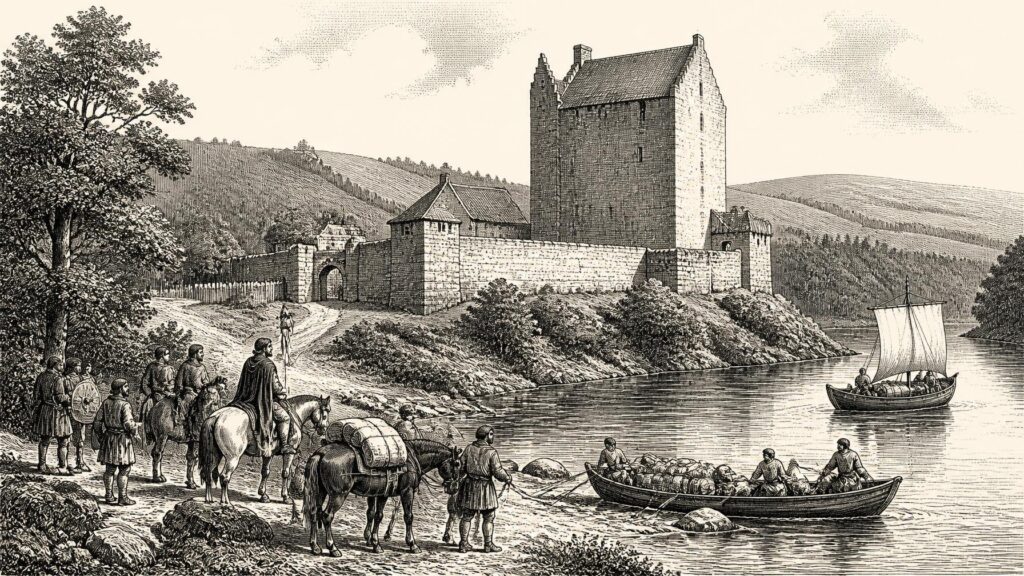
In 1423, Ireland was shaped by competing Gaelic lordships and a weakened English administration. Domnall and Eóghan Ó Néill, with Niall Garbh Ó Domhnaill, led an Ulster coalition through Louth into Meath, defeating forces associated with the king’s deputy and securing tribute and agreements. Niall Garbh also built Ath Seanaigh castle at Ballyshannon, reinforcing his new rule in Tír Chonaill after his father’s death. Dublin government was divided by disputes among Mortimer’s deputies and Richard Talbot. In Connacht, Uilleag de Burgh died, while Uí Maine underwent a violent succession. Clerical and scholarly obituaries reveal intertwined religious, hereditary and political authority.
Dateline
In 1423, Ireland’s political map was defined less by a single government than by competing lordships, shifting alliances and the practical reach of armed power. The year’s clearest events are concentrated in Ulster and Connacht, while changes in the administration based at Dublin reveal how uncertain royal authority could be even within the English lordship. The most vivid record is a major Ulster expedition against the English of the north-east and Meath, followed by a settlement that the annals present as highly favourable to the Gaelic coalition. At the opposite end of the island, successions, deaths and a killing within the ruling family of Uí Maine showed that power changed hands as often through kinship conflict as through open war.
A Northern Hosting
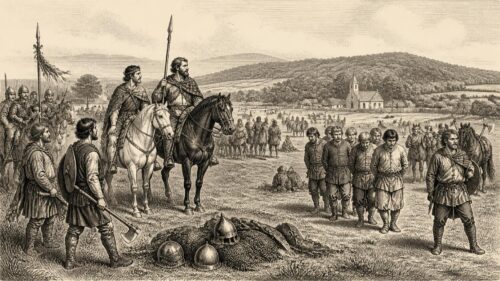
The Annals of Ulster and the Annals of the Four Masters both place a large Gaelic hosting in this year. Its leaders were Domnall Ó Néill, Eóghan Ó Néill and Niall Garbh Ó Domhnaill, joined, in the Ulster annalist’s phrase, by the Gaels of the rest of Ulster. Such a coalition should not be mistaken for a national Irish army. It was a temporary concentration of lordly followings, dependants and professional fighting men, assembled by rulers whose interests happened to coincide. Yet its scale mattered. The participation of leading Ó Néill and Ó Domhnaill figures brought together the principal powers of Tír Eógain and Tír Chonaill at a moment when the northern approaches to the English lordship were especially contested.
The route recorded by the annals ran south through Louth and the plain of Oriel, and towards Meath. The Four Masters describe the force reaching Dundalk, the town of Louth and then Meath; the Annals of Ulster use related but not identical place-names. The agreement between the accounts is more important than the variation: the host struck at settlements and forces connected with the English lordship beyond Ulster’s southern frontier. The annalists call their opponents the “Foreigners” or “English”, terms that reflect the Gaelic writers’ political vocabulary rather than a simple ethnic description of every inhabitant in the area.
A battle followed against the king’s deputy and the forces of Meath, Oriel and the place called Sradbhaile in the Annals of Ulster. The sources claim a decisive Gaelic victory. The Four Masters name Máel Muire Mac Suibhne Connachtach, constable to Ó Domhnaill, as the man who killed the English force’s leading knight, and give a total of one hundred slain. That number cannot be independently checked and should be treated as an annalistic claim, not a modern casualty count. Still, both accounts agree that the English side suffered a serious reverse and that the victors carried away substantial movable wealth.
The aftermath is as revealing as the encounter. Rather than continuing indefinitely into Meath, the coalition made peace. The Annals of Ulster says that the settlement left Sradbhaile and the English associated with it under tribute and covenants; the Four Masters makes a similar claim. Whether those terms endured is not established by the evidence for 1423. What can responsibly be said is that the expedition sought more than plunder. It was also a demonstration of northern military capacity, intended to impose a negotiated relationship on vulnerable frontier communities. Tribute, protection, ransom and agreements were all familiar instruments of power in late-medieval Ireland.
New Stone at Ballyshannon
The same year brought a more durable assertion of Ó Domhnaill authority. Niall Garbh Ó Domhnaill built the castle of Ath Seanaigh, identified with Ballyshannon on the River Erne. The notice appears independently in the Annals of Ulster and the Four Masters. Its brevity conceals its importance. A castle was not merely a residence: it was a defended base from which a lord’s household could store goods, receive allies, shelter followers, oversee a river crossing and project authority into a strategic district. Ballyshannon lay where the Erne met the sea, at a meeting point between Tír Chonaill, Lower Connacht and maritime routes around the north-west coast.
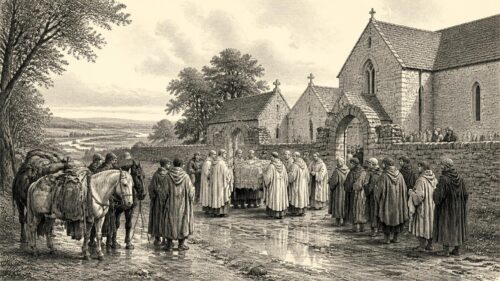
The builder had recently succeeded to the kingship of Tír Chonaill. His father, Toirdhealbhach an Fhíona Ó Domhnaill, died in 1423, according to the annals, having taken the habit of a monk at Assaroe. The Four Masters portray him warmly as peaceable, wealthy and gracious, and stress his final penance and anointing. Such language belongs to the moral conventions of annal-writing, but it also records a meaningful ideal: an aristocratic ruler could end his life under monastic protection, converting worldly standing into a carefully commemorated Christian death.
For Niall Garbh, however, the new castle marked the beginning rather than the end of political work. A succession within a Gaelic lordship did not automatically settle all rival claims. Building at Ath Seanaigh gave visible form to the new ruler’s position. It also complemented the campaigning of the year. A lordship was sustained by mobile followings and alliances, but also by fixed places: strongholds, churches, river crossings, ports and estate centres. The construction therefore belongs beside the hosting, not apart from it.
Dublin Offices and Absentee Power
Events in the English administration were no less unsettled. Henry VI, still a child after the death of Henry V in 1422, was lord of Ireland. On 9 May 1423 Edmund Mortimer, earl of March and Ulster, was appointed the king’s lieutenant in Ireland for a lengthy term. Mortimer’s title of earl of Ulster linked him to great inherited interests in Ireland, and his appointment was intended to address factional disorder in the administration. Yet he did not immediately come to Ireland. Modern biographical research, drawing on governmental records, places his eventual arrival in September 1424.
This matters because one annalistic entry says that the earl of March came to Ireland in 1423 with a great following of English and Welsh. The discrepancy should not be concealed by forcing an exact arrival date. The Annals of Connacht preserve valuable contemporary Irish historical tradition, but annal dates and later chronological alignment can diverge. For 1423, the secure point is Mortimer’s appointment, not his physical presence. His government was initially to be exercised through deputies, including Edward Dauntsey, bishop of Meath, and James Butler, earl of Ormond.
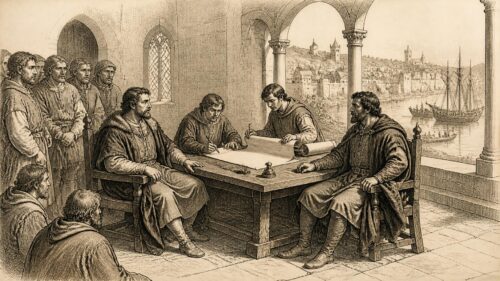
Richard Talbot, archbishop of Dublin, was another central figure. He received the chancellorship by patent dated 19 May 1423 and was sworn in on 13 July. He had already served as justiciar from October 1422. Talbot’s offices placed the archbishop at the heart of royal administration, where the custody of the great seal and the issue of authoritative documents had practical as well as ceremonial force. But office did not mean harmony. Talbot refused to recognise Dauntsey’s appointment as Mortimer’s deputy in August. The dispute was part of the larger Talbot–Butler rivalry which divided the Anglo-Irish political community. Thus, while the Ulster host challenged the lordship in the field, leading servants of that lordship contested its direction from within.
Connacht and the Cost of Succession
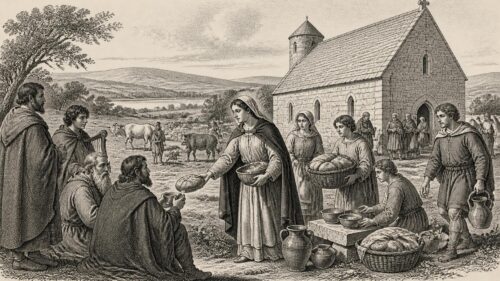
Connacht’s annals record two significant changes among regional rulers. Uilleag an Fhíona de Burgh, lord of Clanricard, died in the fullness of his lordship. The annalist praised a ruler who would not refuse a poet or an exile, a formula that points to the political value of hospitality. Learned guests, poets, churchmen, clients and refugees could all enhance a lord’s reputation, circulate news and bind networks of obligation. Uilleag had dominated much of southern Connacht for decades and dealt repeatedly with the Dublin administration. His death therefore created an important transition in a lordship whose influence reached into both Connacht and Munster.
In Uí Maine, covering much of present-day east Galway and south Roscommon, Donnchad Ó Ceallaigh was killed by the sons of Uilliam Ó Ceallaigh. Aed, son of Brian Ó Ceallaigh, was then made king in his place. This was not an anonymous outbreak of disorder but a struggle inside a ruling lineage. The same wider family could supply kings, ecclesiastics, military leaders and rival claimants; descent offered legitimacy, but it also created competition. The annalistic evidence does not allow a reconstruction of every motive or participant, yet it plainly shows that political stability rested on continual negotiation within dynasties as well as between them.
Churches, Learning and Commemoration
Several obituaries offer a narrower but valuable view of religious and learned life. Maurice Maguire, archdeacon of Clogher, parson of Aghalurcher and lord of Cleenish and Rossorry, died on 26 April. His combination of ecclesiastical office and local lordship illustrates how church institutions were embedded in territorial society, especially around Lough Erne. Marcus Magrath, coarb of the Termon of St Davog, also died, and his brother John Mór succeeded him. A coarb was the hereditary or successor-holder of a saintly foundation; the succession shows that religious office, property and kinship could be closely intertwined.
The deaths of the coarb of Drumcliff, Bishop Conchobar Ó Fearghail of Ardagh and the historian Faelán Mac an Ghabhann were likewise recorded. Conchobar’s obituary praises his generosity to the poor and to people of learning and skill, while Faelán’s designation as a learned historian reminds us that scholarship had patrons and recognised specialists. These notices do not describe the daily experience of most people in 1423. They do, however, show what contemporaries considered worth remembering: lordship, religious standing, hospitality, learning, military success and a good Christian death.
The year therefore resists any simple picture of an Ireland divided neatly between “English” and “Irish”. Authority overlapped. The Dublin government had royal offices, seals and legal claims, but it was strained by faction and dependent upon deputies. Gaelic lords could raid, bargain and exact terms across political frontiers, while also building castles, supporting churches and maintaining learned households. In 1423, Ath Seanaigh’s new castle, the Ulster coalition’s victory and Connacht’s contested successions each made that fragmented but highly organised political world unmistakably visible.
Primary Sources
- Annals of the Four Masters: Annal M1423
- The Annals of Ulster
- Annála Connacht: Annal 1423
- Annála Connacht: Background Details and Bibliographic Information
- Annals of the Four Masters: CELT Project Record
- Mortimer, Edmund
- Talbot, Richard
- Burke, Uilleag (‘Uilleag an Fhiona’) (Ulick de Burgh)
- O'Kelly (Ó Ceallaigh), Maolsheachlainn
- O'Donnell (Ó Domhnaill), Niall Garbh
- Talbot, John
- Life of Lord Chancellor Talbot
- Chronicle of the Law Officers of Ireland: Lord Chancellors and Keepers of the Great Seal
- Niall Garbh II O Donnell, King of Tír Conaill, 1422–39
- North-West Donegal: Scenery and Antiquities
- The Annals of the Kingdom of Ireland: Index Entry for Ath-Seanaigh
- Richard II and the Wider Gaelic World: A Reassessment
- Castles of Ward and the Changing Pattern of Border Conflict in Ireland
- Irish Clergy and the Diocesan Church in the ‘Four Obedient Shires’ of Ireland, c.1400–c.1540
- ‘Geographical Loyalty’? Counties, Palatinates, Boroughs and Ridings
- Gaelic Lordship and Tudor Conquest: Tír Eoghain, 1541–1603
- Returning to Core Principles
- Gaelic Ireland: Land, Lordship and Settlement, c.1250–c.1650