Dublin’s Protected Schools1358 CE
In 1358, Edward III protected masters, scholars and clerks travelling to Dublin, reinforcing the university associated with St Patrick’s Cathedral. The petition exposed poverty, hazardous sea crossings and inadequate educational resources. Annals recorded fragmented politics: Áed Ó Néill defeated Airgialla and Fermanagh forces; Ó Mórdha overcame men identified with Dublin in Leinster; and Clann Cathmhaoil killed Manus Maguire. Bishop Brian Mac Cathmhaoil and Gaelic rulers also died. A Carbury hailstorm illustrated environmental uncertainty, while disease reports cannot be precisely dated. Together, these events reveal contested authority alongside continuing learning, religious institutions, warfare and local seasonal vulnerability across late medieval Ireland.
Dateline
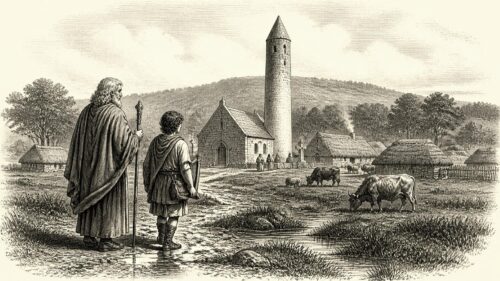
In 1358, Ireland’s political map was a patchwork of lordships, towns, church jurisdictions and rival dynasties rather than a country governed uniformly from one centre. The king of England, Edward III, was lord of Ireland, and royal officials operated from Dublin; yet Gaelic rulers and great Anglo-Irish families exercised decisive power across much of the island. The year’s surviving notices are therefore strikingly dispersed. They record a royal intervention to support learning in Dublin, serious fighting in Ulster and Leinster, a killing within Fermanagh’s ruling world, the death of a bishop, and an extraordinary summer hailstorm. Together they show a society in which scholarship, religion, war and weather were immediate concerns.
A Petition for Learning
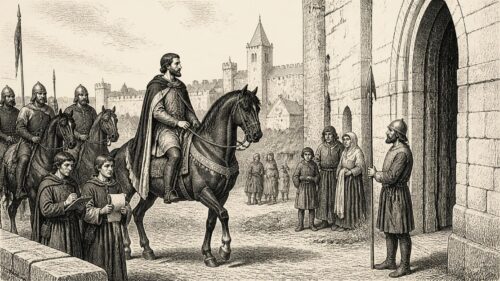
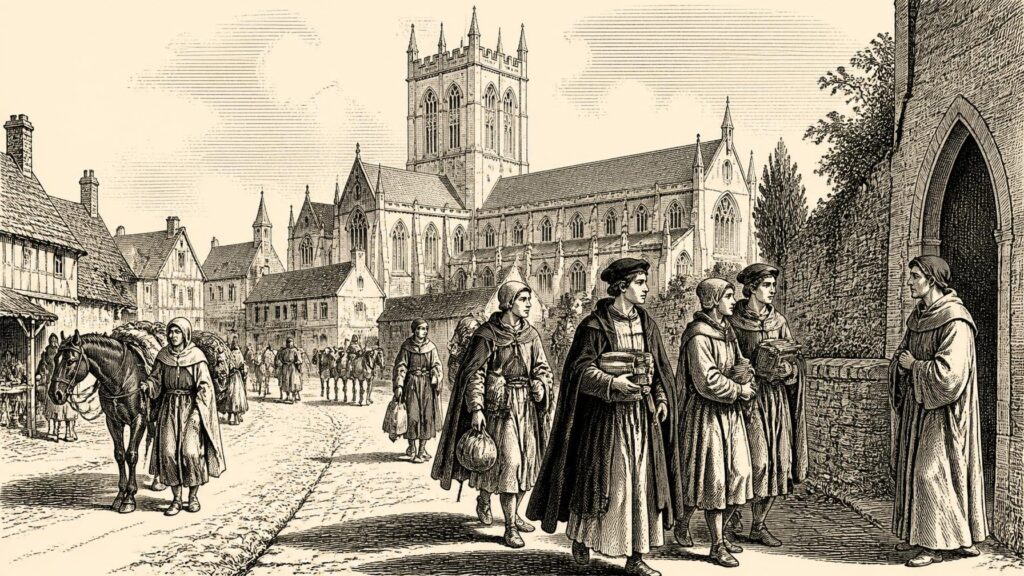
The most consequential securely dated development was connected with the medieval University of Dublin. Clerks and scholars of Ireland petitioned Edward III, explaining that poverty and the danger and expense of crossing the sea prevented them from travelling abroad for education. They proposed to study and teach in Dublin in theology, civil law, canon law and other clerical disciplines. The king granted protection to masters, scholars and clerks coming to the city, together with their servants and goods.
This was not the creation of a university from nothing. A university associated with St Patrick’s Cathedral had been founded earlier in the fourteenth century and had struggled to acquire the endowment and institutional permanence enjoyed by Oxford, Cambridge or the Continental schools. Nor should the royal response be confused with the later foundation of Trinity College. What happened in 1358 was a practical reinforcement of an existing but fragile scholarly enterprise. Later accounts describe Edward’s action as the provision of a theology lectureship; the surviving record is clearest about royal protection for teaching and attendance.
The petition illuminates the realities behind intellectual life. Advanced clerical education required books, teachers, accommodation and travel, all of them costly. Sea crossings were hazardous as well as expensive. The request also envisaged access wider than the colonial elite of Dublin: the protection extended to people arriving from whatever parts of Ireland. That did not erase political or cultural divisions, but it shows that the study of theology and law could create a recognised channel across them. Theology mattered not simply as private devotion. Educated clergy administered ecclesiastical courts, advised patrons, served churches and helped sustain the learned Latin culture shared by religious institutions in Ireland and Europe.
War on Several Frontiers
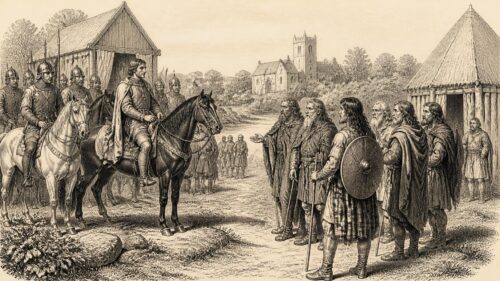
The annals place a major northern encounter in this year. Áed Ó Néill defeated the Airgialla and the men of Fermanagh heavily. Hugh Mac Cabe and the son of Bishop Ó Dubda were among those reported killed. The brief entry gives neither battlefield nor full explanation, and it would be wrong to supply them. Yet its wording makes clear that this was not a small private affray. It brought Ó Néill’s force into conflict with powers in Oriel and Fermanagh, areas where lordship rested upon kinship, armed followers, alliances and control of routes, dues and dependants.
That victory belongs to the shifting politics of Ulster rather than to a simple contest between an English administration and a united Irish opposition. Airgialla, Fermanagh and Tyrone contained numerous competing interests. The Mac Cabes named among the dead were part of a kindred whose military importance would become especially conspicuous in later centuries; in 1358 the annal simply preserves the death of one Hugh Mac Cabe. The participation of the bishop’s son is also a reminder that ecclesiastical and secular networks overlapped. Bishops possessed lands, tenants and political relationships, while their relatives remained embedded in the rivalries of their regions.
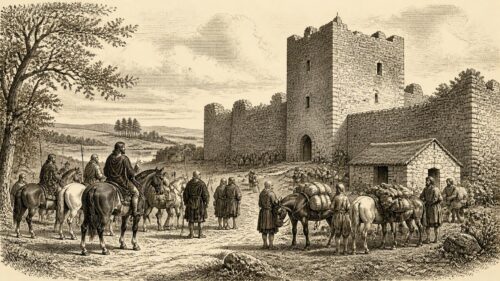
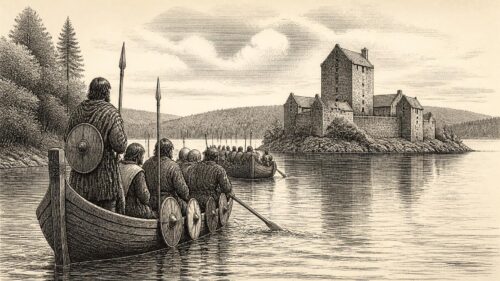
In Leinster, the annals report that Ó Mórdha inflicted a great defeat on the English of Dublin and claim that 240 men were killed. The figure is the annalist’s and cannot be independently checked; neither the site of the battle nor the composition of the defeated force is supplied. Still, the report deserves weight. A reverse large enough to be remembered in this way speaks to the insecurity of the lordship’s hinterland and to the capacity of a Gaelic Leinster dynasty to strike men identified with Dublin. It should not be read as an attack upon the city itself, or as proof that Dublin ceased to function. The walled port and administrative centre remained vital. Rather, the episode demonstrates how limited the reach of its surrounding power could be.
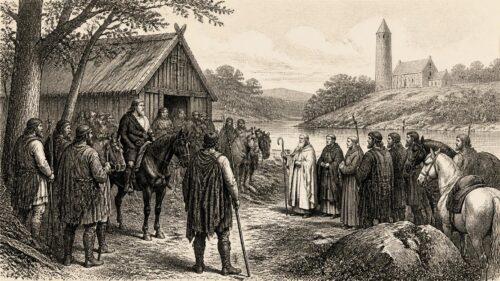
Such fighting occurred in the aftermath of the Black Death’s first Irish visitation of 1348–50 and amid the longer contraction of some settler communities and estates. Those circumstances helped alter the balance of power, but they did not produce a uniform Gaelic advance or an English disappearance. Local alliances, lordly resources and the resilience of towns varied greatly. The events of 1358 are best understood as evidence of contested authority: Ó Néill could win in the north, Ó Mórdha could defeat a Dublin-associated force in Leinster, while the Crown could still answer a petition from Irish scholars and extend its peace to Dublin’s schools.
Fermanagh, Oriel and Lordship
Violence also touched the ruling family of Fermanagh. Manus Maguire was killed by Clann Cathmhaoil, according to the annals. The notice does not identify a place, motive or wider settlement, so it cannot responsibly be turned into a detailed succession story. It does, however, reveal the personal stakes of politics in a lordship where the Maguires were becoming pre-eminent. The death of a member of such a dynasty could alter relationships between branches of a family and their clients, rivals and allies.
Brian Mac Cathmhaoil, bishop of Oriel, died in the same year. His designation reflects the older regional identity of Airgialla/Oriel, while the see associated with the bishop was Clogher. The coincidence of a Mac Cathmhaoil group killing Manus Maguire and the death of a bishop bearing the same surname should not be made into a causal connection: the sources provide none. But both entries underline the density of kin and church connections in the north. Episcopal office was a spiritual responsibility, but bishops also mattered in the social and political landscape through their lordship, resources and family ties.
Elsewhere, Domnall Ó hEaghra, king of Leyney, died at Easter. Annalists used the language of kingship for rulers of regional Gaelic polities, a useful corrective to the assumption that the title belonged only to distant monarchs. His recorded death on one of the most important feasts of the Christian year shows how annalistic time joined political memory to the liturgical calendar. Conchobar Ó hAinle, chief of Cenél Dofa, also died; the obituary praises him in conventional religious terms as having gained victory over the world and the Devil. Such phrases tell us less about the details of a man’s life than about the moral language through which elite deaths were commemorated.
Hail and Uncertain Disease
One of the year’s most vivid notices is environmental. A heavy summer hailstorm fell in Carbury, its stones said to be as large as crab apples. The comparison conveys astonishment rather than a measurable meteorological record, and the annals do not report damaged crops, houses or livestock. It would therefore be unsafe to claim a local famine or agricultural crisis. Nevertheless, the entry offers a rare glimpse of weather intruding into the historical record. For farming households dependent on grain, pasture and animals, a severe summer storm could be alarming even when its longer consequences went unrecorded.
The Annals of Ulster add another caution. Under a heading that spans 1358–61, they say that the ‘King’s Game’ was widespread in Ireland and that Richard Savage died from it. A later Ulster entry explicitly calls the same affliction a plague, but the chronicle’s compressed dating and its multi-year heading make it impossible to assign every item in that cluster firmly to calendar year 1358. The phrase should thus be treated as evidence that epidemic disease was remembered in this period, not as proof of a precisely dated nationwide outbreak in 1358. This distinction matters, especially after the devastation associated with the Black Death.
A Year of Connected Fragility
In 1358, Ireland’s vulnerabilities were connected but not identical. The Dublin petition revealed how poverty, dangerous travel and inadequate endowment constrained learning. The northern and Leinster conflicts showed armed power being negotiated beyond the immediate control of the Crown’s officials. The deaths of rulers, a bishop and a Maguire kinsman demonstrate how much political life depended upon individuals and families. The Carbury hailstorm, meanwhile, hints at the environmental uncertainty confronting communities whose livelihoods were tied closely to the seasons.
Yet the year was not solely one of breakdown. People continued to seek advanced education, church institutions continued to organise learned life, and annalists continued to preserve political, religious and natural events in a shared record. Royal protection for scholars travelling to Dublin may have been modest beside battlefield losses, but it was an important acknowledgement that learning required security, movement and material support. Against the background of contested lordship, it offers a different view of fourteenth-century Ireland: not merely a land of conflict, but one still making deliberate provision for study, teaching and the transmission of knowledge.
Primary Sources
- Annals of Connacht
- Annals of the Four Masters, 1352–1359
- The Annals of Ulster, Year U1358
- Annala Uladh: Annals of Ulster otherwise Annala Senait, Annals of Senat
- Annales Hiberniae
- Annals of the Kingdom of Ireland
- An English Record of the Founding of a University in Dublin in 1358
- University and Parliament
- A Volume Containing Transcripts of Petitions in Parliament from 21 Edw. III to 6 Henry IV
- Crisis and Survival in Late Medieval Ireland: The English of Louth and Their Neighbours, 1330–1450
- A Land of War
- Disaster and Opportunity: 1320–1450
- The Resurgence of Gaelic Power in Ireland and Scotland and Its Wider Impact, c.1350–1513
- The Last Kings of Ireland: Material Expressions of Gaelic Lordship c.1300–1400 A.D.
- English Lordship of Ireland and the Irish Sea World: Re-assessing the Origins of the Kildare Ascendancy, c.1390–c.1513
- Richard II and the Wider Gaelic World: A Reassessment
- Crisis and Survival in Late Medieval Ireland: The English of Louth and Their Neighbours, 1330–1450 — Review
- The Annals of Ulster, Year U1366
- Exploring the Irish Annals
- Ireland c.1250–1500: Gaelic Revival A