Dúnchad Beyond Dorsum Britanniae717 CE
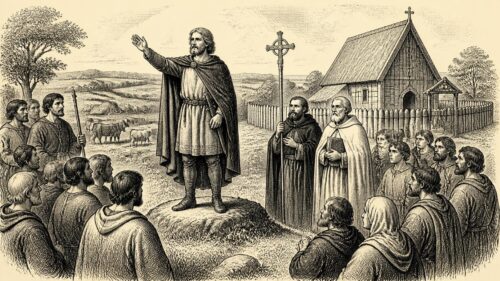
In 717, Irish annals record the death of Dúnchad, eleventh abbot of Iona, an Irish-founded monastery central to networks linking Ireland, Dál Riata, Pictland and Northumbria. They also note King Nechtan’s expulsion of Iona’s community from Pictish lands beyond Dorsum Britanniae, probably amid reforms concerning Roman Easter, although its scale and cause remain uncertain. In Ireland, Fogartach disrupted the royal assembly at Tailtiu, where a man was killed, illustrating contested Uí Néill authority. Dál Riata defeated Britons at Minuirc. Together, these sparse records in 717 clearly reveal strained religious, political and maritime connections across early medieval Ireland and northern Britain.
Dateline
In 717 CE, Ireland’s most consequential recorded developments lay both at a great royal assembly in the midlands and across the sea in the Columban church’s northern sphere. The Irish annals date the death of Dúnchad son of Cenn Fáelad, abbot of Iona, to this year. They also record King Nechtan’s expulsion of the familia, or community, of Iona beyond Dorsum Britanniae, the mountainous spine of northern Britain. In Ireland itself, Fogartach disrupted the assembly at Tailtiu, modern Teltown in County Meath, and a man identified as the son of Máel Rúba son of Dub Sléibe was killed. These brief notices do not yield a continuous narrative, but together they reveal how closely ecclesiastical authority, royal competition and seaborne connections were intertwined.
An Abbot’s Death
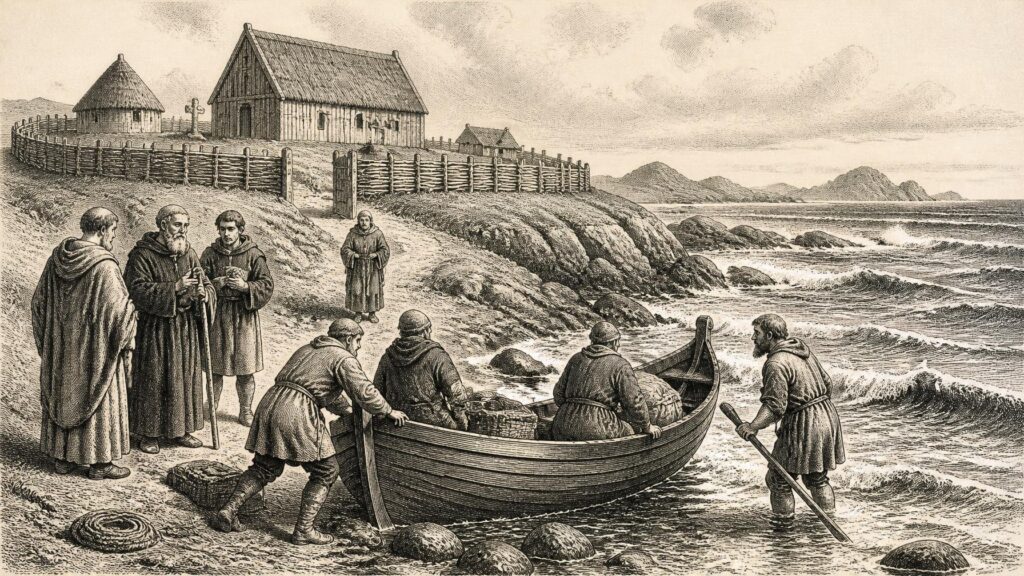
Dúnchad was the eleventh abbot of Iona, the monastery founded by Columba in 563. Though Iona lies off the west coast of what is now Scotland, it was a major Irish religious institution in the eighth century. Its founder was an Irish churchman; its leading personnel, associated monasteries and political relationships linked it deeply to Ireland, Dál Riata, Pictland and Northumbria. The sea was a route connecting these places rather than a hard frontier. Iona’s significance in Irish history therefore makes Dúnchad’s death a properly Irish as well as a Scottish event.
The annals give no date within the year, no account of his burial and no assessment of his administration. Later tradition places his feast on 25 May, but the firm contemporary-style annalistic fact is simply his death in 717. His position was nevertheless weighty. The abbot of Iona stood at the head of a Columban network whose churches possessed land, learning, relics, scribal expertise and powerful patrons. Leadership of such a community involved much more than worship: it meant managing people and estates, safeguarding books and sacred objects, receiving visitors, maintaining travel links and negotiating with kings.
Dúnchad’s tenure belonged to a period of argument over ecclesiastical practice, especially the calculation of Easter and the clerical tonsure. These questions could look technical, but they carried institutional and political consequences. Different calculations could mean neighbouring churches celebrated the central feast of the Christian year at different times; differing tonsures marked distinctive clerical affiliations. The Irish annals record that Iona adopted the Roman Easter calculation in the preceding year, 716. This makes 717 part of a wider process of change, but it would be unsafe to assume that every monk accepted it in the same manner or at the same speed.
Expulsion from Pictland
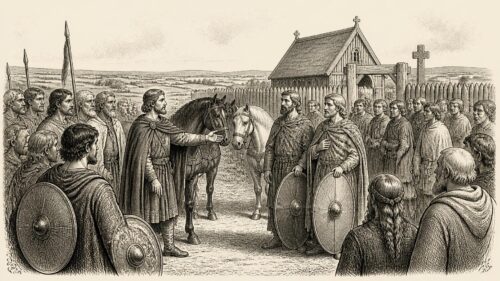
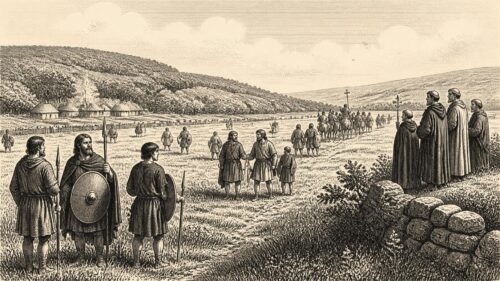
The notice concerning Nechtan is among the year’s most important. The Annals of Tigernach say that the community of Iona was expelled across Dorsum Britanniae by the king; the Annals of Ulster and Chronicon Scotorum preserve closely related wording. The phrase indicates removal from lands under Pictish authority, across the great north–south upland divide, rather than an expulsion from the island of Iona itself. The records do not name the clergy involved, the houses from which they were removed, their destination, or the scale and duration of the action.
It is tempting to picture every Columban cleric in Pictland being driven out at once. The evidence does not warrant that certainty. Historians have long connected the expulsion with Nechtan’s programme of reform, including his adoption of Roman Easter observance after seeking guidance from the Northumbrian abbot Ceolfrith. Yet scholarly interpretation remains divided. The expelled group may have been a minority resisting change rather than the entire Columban presence; royal attempts to reshape authority within the Pictish church may also have mattered. Bede, writing within a Northumbrian ecclesiastical world, celebrates Nechtan’s adoption of Roman usage but does not describe a mass expulsion. The annal confirms the expulsion, not its precise cause or scale.
The coincidence of Dúnchad’s death and Nechtan’s action should likewise not be turned into a proven chain of cause and effect. A vacancy or succession dispute at Iona may have made a difficult moment more acute, but the sources do not say so. What can be said is that 717 exposed the vulnerability of a far-reaching religious federation when royal policy changed. Iona remained immensely important, and Columban influence did not vanish from northern Britain. Still, Nechtan’s intervention showed that monasteries could not treat political borders as irrelevant, however broad their spiritual claims.
Iona’s Irish World
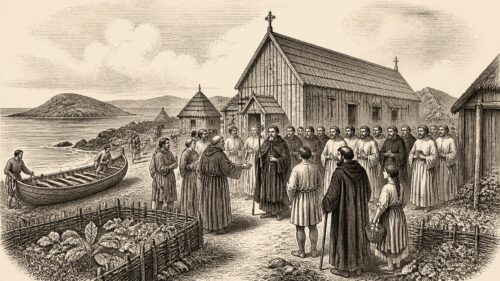
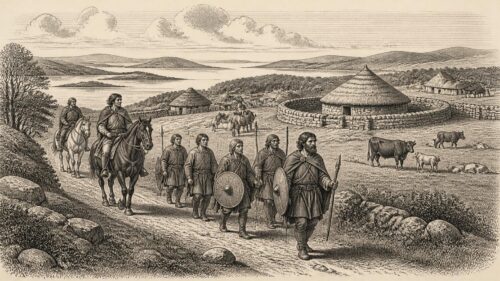
For people in Ireland, Iona’s troubles would have mattered because the monastery was embedded in a shared Gaelic and Christian world. Boats could carry clergy, messengers, manuscripts, foodstuffs and gifts between Irish coasts, the Hebrides and western Scotland. Archaeology and later standing remains cannot reconstruct the monastery exactly as it looked in 717, but they confirm a substantial enclosed religious settlement whose early fabric largely survives below later medieval buildings. Its community was not an isolated collection of hermits. Iona was a place of worship, teaching, writing, hospitality and production, sustained by relationships that reached well beyond its small island.
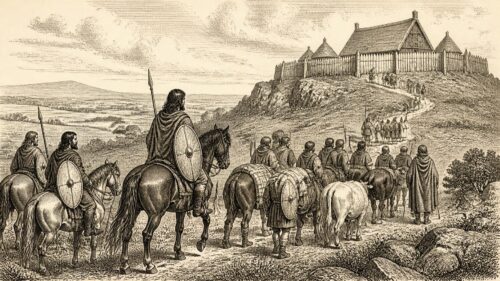
The immediate political setting was unsettled. Dál Riata, the Gaelic kingdom spanning parts of north-east Ireland and western Scotland, features in another annalistic notice for 717: its people encountered Britons at a place called Minuirc, where the Britons were defeated. The location is uncertain, and the terse entry supplies neither commanders nor numbers. It nevertheless belongs beside the expulsion as evidence that the Irish Sea and western Scottish zone remained a region of movement and conflict. Churchmen, kings and fighting men travelled through overlapping networks.
This was also a world in which learning travelled. The Irish annals themselves preserve the memory of events in Ireland, Iona, Pictland and Britain because religious communities recorded significant deaths, battles, celestial phenomena and political disruptions. Their surviving manuscripts are later than 717, and their chronological systems require careful comparison. Even so, the agreement of related annalistic traditions on Dúnchad’s death and Nechtan’s expulsion gives the events unusual weight. The entries are short precisely because contemporaries or near-contemporaries did not need a long explanation of why Iona mattered.
Fogartach at Tailtiu
Back in Ireland, the disturbance at Tailtiu brought violence into a royal gathering place. Tailtiu stood in the heartland of Brega, close to Tara and within the political landscape of the southern Uí Néill. Its assembly, or óenach, was not merely a market or festival in the modern sense. Such gatherings could bring together rulers, dependants, clerics, traders, entertainers and litigants. They created opportunities to display rank, make alliances, exchange goods, hear legal business and assert control over a strategically important landscape.
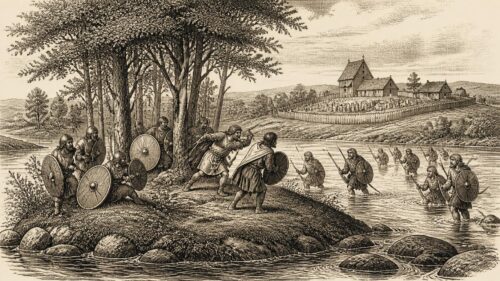
The annal’s economy of language is striking: Fogartach caused a disturbance, and one named victim fell. It does not say whether the disorder was an armed attack, a clash between retainers or a more limited confrontation that became lethal. Nor does it explicitly state Fogartach’s purpose. Yet his presence was politically charged. Fogartach, of the Síl nÁedo Sláine dynasty of Brega, was a prominent Uí Néill contender. Fergal son of Máel-dúin of Cenél nÉogain was the dominant king of Tara in these years, but the record of Fogartach’s changing fortunes demonstrates that authority among the Uí Néill was contested rather than automatic.
Tailtiu was therefore a poor place for a private quarrel and an excellent place for a public challenge. Disrupting an assembly associated with royal authority could undermine an opponent’s prestige, test loyalties and demonstrate a claimant’s capacity to command armed followers. That interpretation must remain cautious: the source does not call the episode a rebellion or a battle. But it does show that ceremonial order, political legitimacy and physical security were inseparable. The death recorded there was not simply an individual misfortune; it marked the failure of a gathering meant to gather people under recognised rules.
Power, Food and Everyday Life
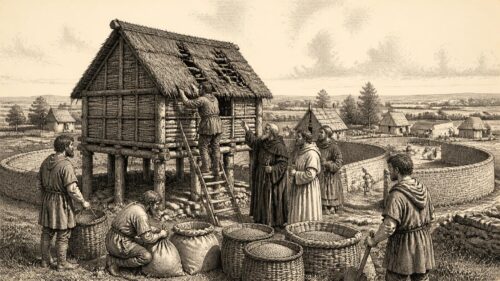
The year’s notices mostly name rulers, abbots and casualties, but their importance rested on a wider rural society. Ireland in 717 was divided among numerous small kingdoms. Wealth depended heavily on cattle, land, labour and food renders, while cereal cultivation was becoming increasingly important to the generation’s economy. Kings maintained followings through hospitality, protection, military service and exactions; churches likewise needed provisions, workers and patronage. A royal assembly such as Tailtiu was consequential because it concentrated people and resources otherwise dispersed across a predominantly rural landscape.
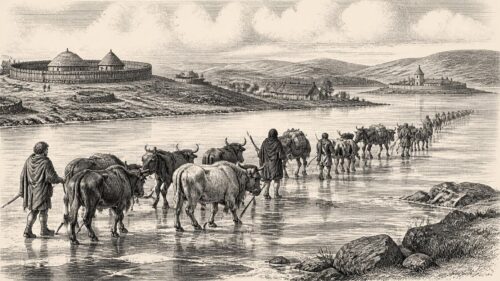
Neither the annals nor archaeology permits a day-by-day reconstruction of ordinary life in 717. There is no securely dated report of a harvest, famine, epidemic or major environmental event for Ireland in this calendar year in the principal notices considered here. It would be wrong to invent one. What the evidence does support is a landscape of farmsteads, ecclesiastical settlements and royal centres, joined by tracks, rivers and coastal sea-lanes. Monasteries were major social institutions within that landscape, not remote refuges from it.
A Year of Strained Connections
Viewed together, 717 CE was not a year of island-wide conquest or a single national crisis. Its surviving record instead captures fractures in connected systems. At Iona, the death of Dúnchad coincided with a challenge to Columban influence in Pictland. At Minuirc, Dál Riata and Britons fought in a contested northern zone. At Tailtiu, Fogartach’s disturbance showed that the ceremonial heartland of Uí Néill power could become dangerous ground. These events occurred in different places, but all concerned the practical reach of authority: who directed a church, who controlled routes and territories, and who could impose order at an assembly.
The limits of the evidence are part of the history. We do not know how many Columban clergy Nechtan expelled, what became of the victim at Tailtiu’s family, or how the battle at Minuirc was fought. Yet the annals preserve enough to show that Irish political and religious life in 717 extended far beyond the shoreline. Ireland’s kings competed in the midlands while an Irish-founded monastery negotiated change across the sea. The year stands as a reminder that early medieval Ireland was locally divided, but never merely local.
Primary Sources
- The Annals of Tigernach
- Chronicon Scotorum, Part 74
- The Annals of Ulster
- Annals of Inisfallen, Part 27
- Annals of the Four Masters, Part 55
- Fragmentary Annals of Ireland
- Dúnchad
- Fergal
- The Chronology and Sources of the Early Irish Annals
- Chronological Synchronisation of the Irish Annals
- Medieval History: 700–900
- The Pictish Church and the Northumbrian Connection
- The Ecclesiastical History of the English People, Book V, Chapter 21
- The Life of Columba, Written by Adamnan
- Iona Abbey and Nunnery: History and Stories
- St Mary's Abbey, Iona, Monastic Settlement (SM12968)
- Iona Abbey Statement of Significance
- Furnishing an Early Medieval Monastery: New Evidence from Iona
- Agriculture, Settlement and Society in Early Medieval Ireland
- Early Medieval Ireland: Archaeological Excavations, 1930–2009
- Early Medieval Archaeology Project Report 2.1
- Landscapes of Kingship in Early Medieval Ireland, AD 400–1150
- The Metrical Dindshenchas: Tailtiu
- The Church and the World in Early Christian Ireland