Druim Inasclainn Succession879 CE
In 879, Áed Findliath, northern Uí Néill ruler and king of Tara, died at Druim Inasclainn, modern Dromiskin. His death brought Murchad son of Máel Dúin to the northern kingship and Flann Sinna of Clann Cholmáin to Tara, reviving a northern-southern Uí Néill alternation. Annals also record deaths among regional chiefs and church leaders, exposing widespread succession uncertainties. Foreigners captured Armagh’s superior Máel Coba and lector Mochta, demonstrating ecclesiastical vulnerability amid Scandinavian maritime activity. Spring fodder scarcity, followed by autumn abundance, highlighted cattle’s economic importance. The year revealed decentralised politics, influential churches, local instability, and relationships renegotiated after royal change.
Dateline
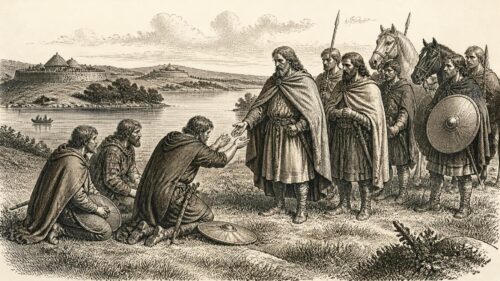
The death of Áed Findliath on 20 November 879 was the year’s decisive Irish event. At Druim Inasclainn, modern Dromiskin in County Louth, a king whose power had connected the northern Uí Néill, Tara and the politics of Viking-age Ireland passed from the scene. The Annals of Ulster date his death precisely and call him king of Temair, or Tara; a short elegy within the entry calls him Áed of Ailech and over-king of the Irish. Such phrases should not be mistaken for evidence of a centrally governed kingdom. Ireland remained a landscape of regional kingships, lordships and ecclesiastical federations. Yet the death of the ruler acknowledged at Tara mattered far beyond the place where he died.
The year must be handled with some care. Medieval Irish annals do not always align neatly with modern calendar dating: their year-headings, chronological systems and later copying traditions can vary. The 879 entry in the Annals of Ulster gives 20 November, while the later Annals of the Four Masters place the same death under a chronologically displaced entry. Modern historical reference works conventionally date Áed’s death to 879. The date is therefore firm; much else about the immediate transition—ceremony, negotiations and the movements of armed followers—was not recorded and cannot responsibly be reconstructed.
The Death of Áed Findliath
Áed was a member of Cenél nÉogain, the leading northern branch of the Uí Néill, and had held the kingship of Tara since the early 860s. His career had involved warfare against neighbouring Irish rulers, shifting dealings with Scandinavian forces and an enduring concern with authority in the north. His death came not in his northern heartland around Ailech, but in Conaille, the territory around Dromiskin on the route between the northern and central political worlds. That location is suggestive, though not proof of why he was there: it lay in a strategically connected zone, rather than at an isolated frontier.
The annalist’s poem is unusually revealing about the ideals attached to him. It praises a generous and prudent shield-bearing ruler, a protective buckler against spear-points, and the man who brought “plenty” to Tara. This was memorial language, not a neutral audit of a reign. It expresses what kingship was expected to provide: defence, generosity, order and material sufficiency. The prominence of Tara in the verse likewise reflects a political claim. To be king of Tara was to occupy a pre-eminent, but never uncontested, position within a network of Irish kings rather than to command a modern territorial state.
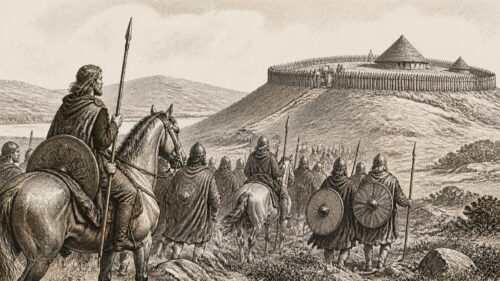
Áed’s death did not simply deliver all his power to his son. Within Cenél nÉogain, the immediate northern succession went to his cousin Murchad son of Máel Dúin. At Tara, however, Flann Sinna son of Máel Sechnaill began to reign. The annals record that accession without describing an inauguration or battle. Flann belonged to Clann Cholmáin, the principal southern Uí Néill dynasty, and his accession restored the alternation between northern and southern Uí Néill kindreds that had often structured the contest for Tara. Family relationships helped make such transitions intelligible: Flann was also Áed’s stepson through Áed’s marriage to Flann’s mother, Lann. Kinship could create bridges across rival dynasties, but it did not abolish competition.
A Change in the Political Weather
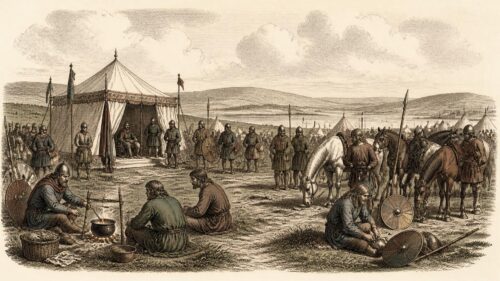
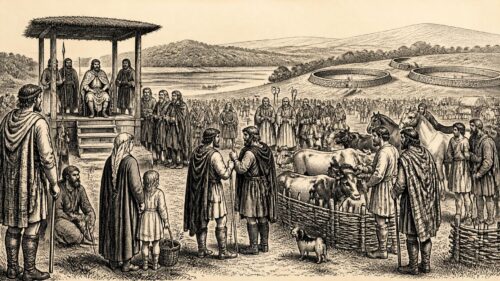
Flann’s accession was a change in the balance of power, not a guarantee of peace. Áed had been an energetic northern king who had made and broken alliances as circumstances demanded, including dealings with the Scandinavian kingdom at Dublin. Flann inherited neither a unified Ireland nor an automatic obedience from provincial rulers. His claim had to be made effective through the familiar mechanisms of early medieval politics: personal following, alliances, hostage-taking, tribute, ecclesiastical support and the credible threat of force. The sources do not permit us to assign a particular assembly or diplomatic settlement to late 879. What can be said is that an established king’s death made every existing relationship subject to renewal.
Other notices in the annals underline the fragility of regional leadership. Máel Cáire, chief of Uí Chremthainn, was killed. Ualgarg son of Flaithbertach, described as heir designate of the North, died. Finnechta son of Máel Corcra, king of the Luigni of Connacht, also died. The entries are terse and provide neither motives nor fuller narratives. They should not be combined into an imaginary general war. Collectively, however, they show that 879 brought losses among men whose positions linked local communities to wider provincial politics. Succession was not an issue confined to Tara.
The death of Aengus son of Cinaed, chief of Ard Ciannachta, belongs to the same political landscape. Ciannachta lay in the north-east, in a region where the influence of Uí Néill rulers, the churches of the Boyne and Louth districts, and maritime connections could overlap. These death notices remind us that a king’s authority was experienced through many lesser rulers and their client communities. When a local chief died, claims to land, cattle, dues and allegiance could be reopened even when the annals preserve no account of the resulting settlement.
Armagh’s Vulnerable Churchmen
The most alarming ecclesiastical event of the year was the capture of Máel Coba son of Crunnmael, superior of Armagh, together with Mochta, its lector, by foreigners. The later Annals of the Four Masters identify the captors as foreigners of Loch Cúan, Strangford Lough; the contemporary annalistic tradition represented by the Annals of Ulster merely says “foreigners”. The fuller localisation is plausible within the wider history of Scandinavian activity around Strangford Lough, but it remains important to distinguish the later specification from the shorter earlier record.
This was not necessarily a raid on Armagh itself. The sources do not say where the two men were seized, whether they were travelling together, how long they were held, or what price—if any—secured their release. It is nevertheless a sharp indication of vulnerability. Armagh was not simply a church with a resident clergy. It was a major ecclesiastical centre with spiritual prestige, landholdings, dependants, learned personnel and political connections. Its superior headed an institution associated with Patrick; its lector occupied a role bound to teaching and the preservation of learned culture. Their capture put both authority and expertise at risk.
The event also belongs to a northern maritime setting shaped by Scandinavian mobility. Loch Cúan had seen conflict between rival Viking groups only two years earlier, in 877. Its islands, inlets and access to the Irish Sea made it a useful maritime zone, though the evidence does not justify imagining a continuously occupied, neatly bounded Viking town there in 879. The seizure of Armagh’s churchmen demonstrates that Scandinavian groups could threaten people and institutions beyond the immediate shore. It should not, however, be inflated into evidence that all northern churches lay defenceless or that the captors controlled the whole region.
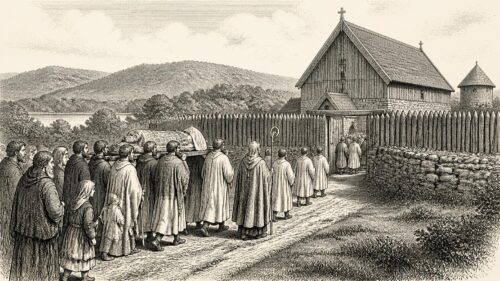
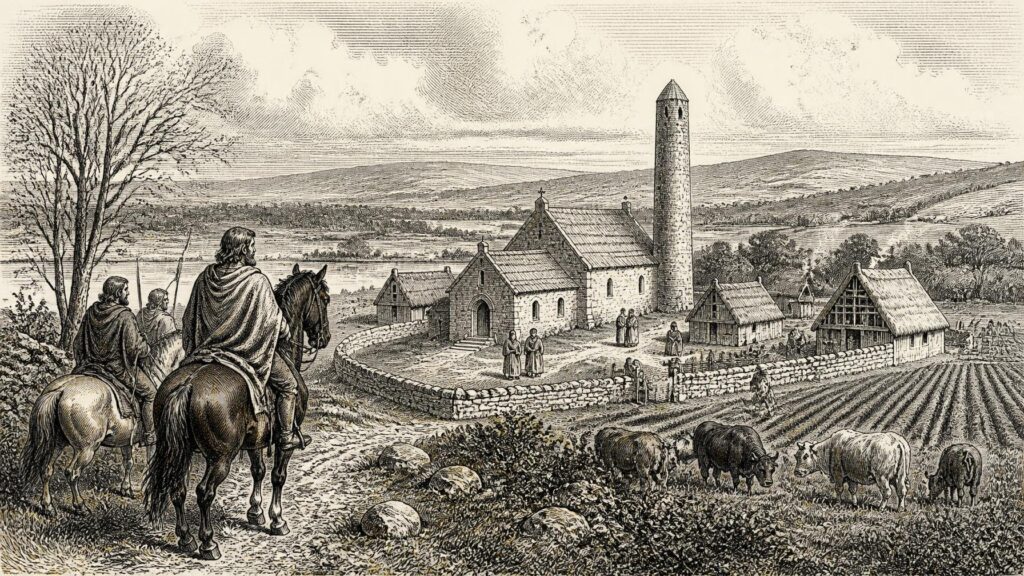
Ecclesiastical instability is visible elsewhere in the notices. Tigernach son of Muiredach, bishop and superior of Druim Inasclainn, died after prolonged suffering. His death at the very place where Áed died lends Dromiskin an exceptional prominence in the record for this year, though it does not prove that the deaths were connected. Fergil son of Cumsad, abbot of Domnach Sechnaill, was secretly murdered, an entry whose wording gives no suspect or cause. Ainmire, superior of Armagh for only nine months, died; Dúngal, superior of Lethglenn, also died. These were reminders that churches were corporate landholders, places of worship and learning, and centres of local leadership whose succession could be politically significant.
Fodder, Plenty and the Farming Year
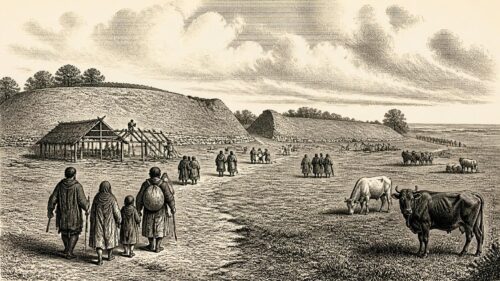
The annals offer one of their rare direct glimpses of seasonal conditions: there was “great scarcity of food for cattle” in spring, followed by “great profusion” in autumn. The entry does not identify the cause. It may reflect a difficult preceding winter, poor spring grazing, a shortage of stored fodder, or some combination of weather and local management. It does not establish a countrywide famine, and it gives no human mortality figures. Its value lies in showing that the chronicler considered the condition of livestock important enough to record alongside royal and ecclesiastical deaths.
That concern makes economic sense. Cattle were a principal measure of wealth in early medieval Ireland and were central to food production, dairying, labour, tribute, compensation and status. Most rural households worked mixed agricultural systems rather than living from cattle alone; grain, sheep, pigs and gathered resources also mattered. Yet a spring shortage of fodder could have been serious for households dependent on animals surviving the lean months. The autumn abundance may have eased immediate pressure through better pasture, harvest residues and winter stores. It does not erase the hardship implied by the spring notice, but it cautions against presenting 879 as an unrelieved crisis.
For ordinary people, the annual rhythm behind this brief sentence was demanding: livestock needed shelter or careful grazing, fields required labour, food had to be stored, and obligations to lord, church and kin remained. A good autumn could improve prospects for the winter ahead. The annal does not tell us whose herds suffered most, whether some regions fared better than others, or how communities adapted. These silences are as important as the statement itself. The surviving record preserves an elite chronicle, but its attention to fodder briefly exposes the material foundations on which elite power rested.
A Year Marked by Transition
In 879, a king died at Dromiskin, Flann Sinna commenced his rule at Tara, and two leading men of Armagh were carried off by foreigners. Around those events were quieter but consequential changes: the deaths of chiefs, heirs, bishops and abbots; a clandestine killing; and an agricultural year that moved from spring scarcity to autumn plenty. None of this amounted to a single national drama. Ireland had no unified administration capable of making one event equally felt everywhere.
But the entries belong together. They reveal a society in which kingship relied on relationships rather than bureaucracy, churches were both sacred institutions and centres of wealth and learning, maritime raiders could reach into political life, and cattle welfare registered as a public concern. Áed Findliath’s death was the year’s clearest turning point. The succession of Flann Sinna did not settle Ireland; it set the terms for the next phase of rivalry, alliance and negotiation across the island.
Primary Sources
- The Annals of Ulster, Year U879
- The Annals of Ulster
- CELT Project: The Annals of Ulster
- Chronicon Scotorum
- Annals of Inisfallen
- CELT Project: Annals of Inisfallen
- Annals of the Four Masters
- CELT Project: Annals of the Four Masters
- Vikings in Irish Chronicles, 794–902: Data
- Áed Findliath
- Flann Sinna
- The Vikings in Ninth-Century Ireland: Sources and Settlements
- The Vikings in Ninth-Century Ireland: Sources and Settlements (full text)
- The Vikings in Ulaid
- A Viking Ship Graffito from Kilclief, County Down, Ireland
- Inishargy, County Down: Investigation of a Viking Silver Find-Spot
- Strangford Lough's History
- Animals and the Economy of Medieval Ireland: A Zooarchaeological Analysis of the Faunal Remains from Caherconnell Cashel, Co. Clare
- The Impacts of Past Land-Use on the Ecology of an Ancient Oak Woodland
- Climate in Medieval Ireland
- Making Hay While the Sun Shines? Socio-Economic Change, Cereal Production and Climatic Deterioration in Early Medieval Ireland
- Reflections on Kingship, the Church and Viking-Age Silver in Ireland