Dún Bolg’s Night Assault870 CE
In 870, Áed Findliath, king of Tara, invaded Leinster from the Dublin region, allied with his brother-in-law Cerball of Osraige and Cennétig of Loíches. Leinster’s king Muiredach led resistance, attacking Cerball’s camp at Dún Bolg by night. Despite losses, including Cennétig’s son, the attackers retreated, leaving the wider struggle unresolved and no recorded tribute or hostages. Annals also record deaths of prominent abbots, bishops and anchorites, notably at Clonard and Kildare, illustrating ecclesiastical influence. Meanwhile Dublin’s Norse rulers Amlaíb and Ímar besieged and plundered Dumbarton Rock, demonstrating Ireland’s political and military connections across the Irish Sea during this eventful year.
Dateline
A Year Centred on Leinster
The Irish evidence for 870 is unusually concentrated. Rather than offering a complete picture of life across the island, the annals focus on a major royal invasion of Leinster, a contested night attack at Dún Bolg, deaths within important churches, and the overseas campaign of Dublin’s Norse rulers. These entries nevertheless reveal a great deal about Ireland’s political geography. Power did not flow from a single capital. It was negotiated through kingships, kindreds, monasteries, military followings and alliances that crossed provincial and even Irish Sea boundaries.
The most firmly dated Irish event is the campaign led by Áed Findliath, son of Niall, king of Tara and head of the northern Cenél nÉogain. The Annals of Ulster state that he overran Leinster from Áth Cliath, the Liffey crossing associated with Dublin, to Gabrán, probably in the south-west of the province. This was not a leisurely royal progress. “Overran” denotes an armed incursion, and the fuller account in the Fragmentary Annals of Ireland describes burning, plunder and killing. Such language is conventional in annalistic warfare, but it makes clear that the campaign imposed its costs on rural communities as well as on the province’s rulers.
Áed’s Two-Sided Attack
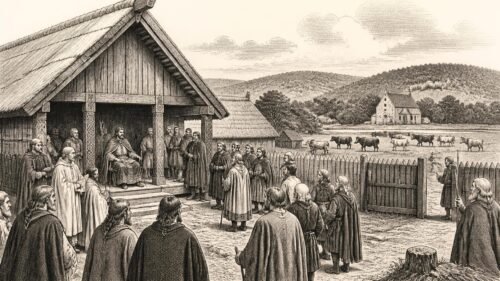
Áed did not act alone. From the western and southern side of Leinster came Cerball son of Dúngal, king of Osraige, accompanied by his nephew Cennétig son of Gáethíne, ruler of Loíches. Cerball was Áed’s brother-in-law: Áed had married Cerball’s sister Lann. Kinship was therefore an active political resource, binding the king of Tara to one of the most formidable regional rulers in southern Ireland. The arrangement also placed Leinster under pressure from two directions. Áed’s forces moved across the province from the Dublin side, while Cerball and Cennétig advanced to Dún Bolg.
The target was not merely territory but Leinster’s capacity to resist. Áed’s campaign followed his victory over a Leinster-and-Brega coalition in 868, and it demonstrated that the old northern and southern Uí Néill contest for paramount influence could draw Leinster into wider struggles. Cerball had his own reasons to intervene. Osraige, centred broadly on the later counties of Kilkenny and western Laois, lay beside Leinster and had repeatedly pressed into its affairs. In 870 the alliance gave Cerball an opportunity to weaken a neighbouring rival while displaying his value to Áed.
The annals name Muiredach son of Bran as the Leinster king who led the response. Leinster was not an easily unified realm: its Uí Dúnlainge dynasties shared and disputed authority, while Viking activity around Dublin had altered the political balance in the east. Muiredach’s presence at the head of the defenders nonetheless shows that the invasion compelled a provincial mobilisation. This was a conflict among Irish kings, not a simple contest of Irish against Scandinavian newcomers.
The Fight at Dún Bolg
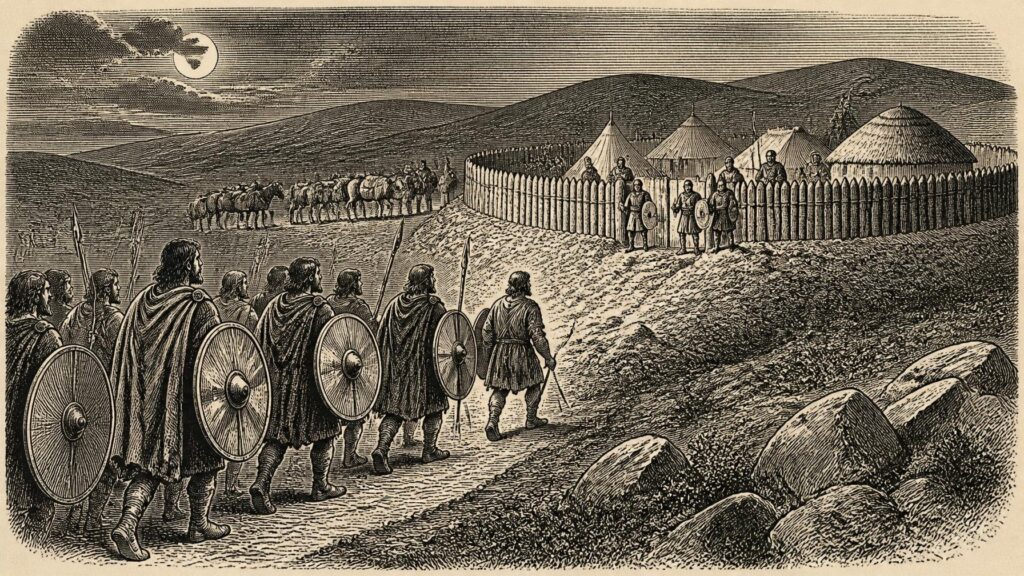
The concise record in the Annals of Ulster supplies the secure outline. Leinster men attacked Cerball’s encampment at Dún Bolg, killed Cennétig’s son and others, but were then driven back in flight with Muiredach. Some of the Leinster force were killed. That outcome mattered: an assault on an enemy camp had failed, and Áed’s coalition remained intact.
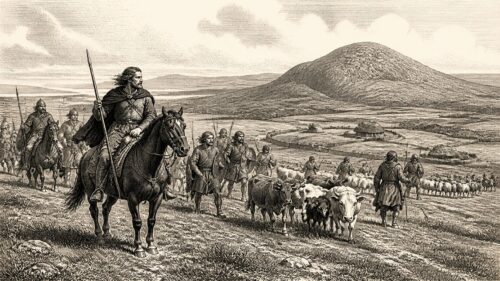
A later, much fuller account preserves the drama of a night attack. It says the Leinster leaders chose to strike Cerball and Cennétig rather than Áed’s own force, which lay at Belach Gabrán. It portrays intense fighting amid war trumpets, frightened horses and pack animals, and confusion among rocky clefts. It also makes the religious language of warfare explicit: the Leinstermen sought the help of St Brigit, while the Osraige side invoked St Ciarán of Saigir. These details should be read carefully. The extended narrative has clear literary shaping, and its exact speeches, emotions and miraculous framing cannot be treated as a verbatim battlefield report. Yet its basic sequence agrees with the shorter annal: an attack on the camp, losses among Cerball’s allies, a Leinster retreat, and no reckless pursuit by the victors.
Even allowing for embellishment, the episode offers a rare glimpse of campaigning realities. Armies were not permanent national institutions. They consisted of the forces a king could gather, sustained by local food, animals and transport. An encampment was vulnerable at night; horses and pack animals were essential enough for their panic to disrupt fighting; and a costly victory could quickly become dangerous if pursuers lost order in unfamiliar ground. The destruction recorded across Leinster was therefore both a political instrument and an immediate burden on households whose cattle, stores and labour supported armies or became their prey.
The campaign did not produce a recorded Leinster submission in 870. The Fragmentary Annals says Muiredach gave Áed neither tribute nor hostages after the fighting. That claim fits the narrative’s emphasis on defiance, but it is best understood as an account of an unresolved political encounter, not proof that Leinster had escaped damage or that Áed’s expedition had achieved nothing. The military success at Dún Bolg strengthened the alliance of Áed, Cerball and Cennétig; it did not settle the enduring contest for authority in the province.
Churches, Scholars and Local Authority
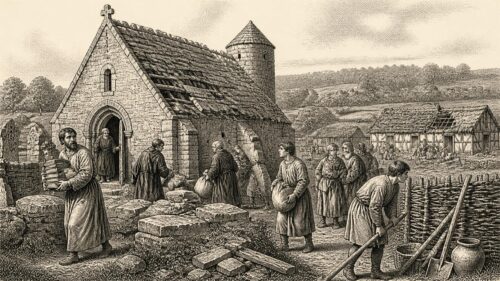
Amid the reports of war, the annals mark a remarkable number of ecclesiastical deaths. Most prominent was Suairlech of In tEidnén, bishop, anchorite and abbot of Clonard in Mide. The Annals of Ulster calls him the best exponent of religion in all Ireland. Such praise signals more than private devotion. Clonard was a major ecclesiastical centre, and Suairlech had participated in royal meetings with the clerics of Mide. His death removed a figure who linked local religious life, scholarship and high politics.
Other obituaries show the breadth of clerical roles. Dub dá Thuile was abbot of Liath Mór Mo-Chaemóc; Máel Odar was both bishop and anchorite and abbot of Daiminis; Cumscuth of Ciarán’s hermitage at Belach Dúin was described as scribe and bishop; Comgán the Tall was an anchorite of Tallaght and disciple of Máel Ruain; and Connla was an anchorite of Druim Cara in Ard Cíannachta. The record is selective, but it reveals a religious landscape of communities, hermitages, schools and offices whose leaders could be remembered across Ireland.
Kildare suffered a particularly notable cluster of losses. Cobthach son of Muiredach, its superior, died, and the Fragmentary Annals calls him a scholar and doctor, later praising him as chief of Leinster’s scholars. Móengal, bishop of Kildare, also died. Their passing came during a year when Leinster itself was under attack. It would be unwarranted to assume a direct connection: the sources do not say that either death resulted from violence. But the coincidence underscores Kildare’s dual importance, as a great religious institution and as a centre embedded in the politics of the Liffey plain and the Leinster kingship.
One brief entry brings royal authority and ecclesiastical space uncomfortably close. A man was killed at Armagh before the door of Áed’s house there. The annal gives no motive and offers no basis for turning the incident into a larger political drama. Still, Áed’s possession of a house at Armagh is significant. It illustrates the practical relationship between kings and leading churches: royal presence, hospitality, patronage and influence could be established within the precincts of a major ecclesiastical centre.
Dublin’s Kings at the Clyde
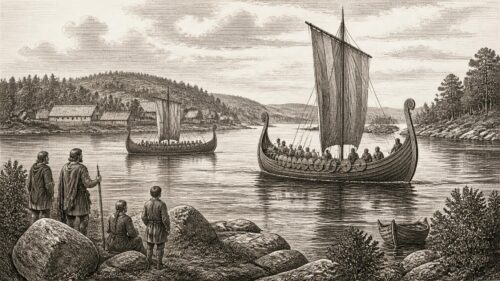
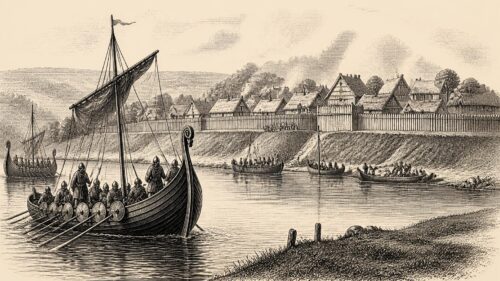
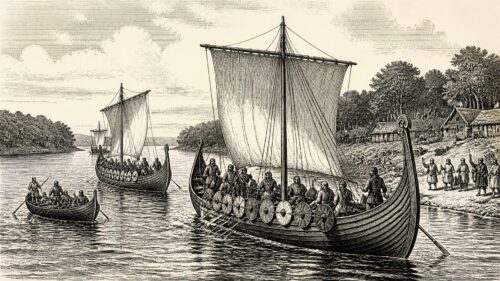
870 also confirms that Irish politics belonged to a wider seaborne world. Amlaíb and Ímar, the joint Norse rulers associated with Dublin, besieged the fortress of Ail Cluaithe, Dumbarton Rock, the stronghold of Strathclyde, for four months. The Annals of Ulster reports that they destroyed and plundered it at the siege’s end. Historic evidence from Scotland independently preserves the exceptional significance of this assault.
The event is directly relevant to Ireland because Amlaíb and Ímar ruled from Dublin and commanded maritime forces operating between Ireland and Britain. It should not, however, be compressed into a false date. The siege belongs to 870; the annals place the rulers’ return to Áth Cliath with a large human booty and two hundred ships in 871. Captives from Britain therefore should not be said to have reached Ireland during 870 itself. The distinction matters, especially because enslaved people, portable wealth and ships were central to the political economy of Irish Sea warfare.
Dublin in 870 was already a fortified Norse base, not yet the fully developed town of later centuries. Archaeology nevertheless indicates Scandinavian settlement and burial around the ninth-century Dublin area, while Irish rulers treated the place as a powerful neighbour, ally and threat. Áed had previously maintained connections with Dublin’s rulers, even while resisting Norse expansion in the north. The simultaneous Leinster campaign and Strathclyde siege show no simple division between “native” and “foreign” politics. Alliances could be pragmatic, while competition for tribute, land, captives and prestige remained relentless.
An Uneven Record
For much of Ireland, 870 remains quiet only because the sources are quiet. There is no responsible basis for inventing a nationwide harvest, climate crisis, trade boom or general peace. What can be said is more precise. Leinster endured a co-ordinated invasion and a failed counterstroke at Dún Bolg. Osraige’s king Cerball and his nephew Cennétig emerged as essential partners of Áed Findliath. Great churches mourned learned abbots, bishops and anchorites. And Dublin’s Norse kings demonstrated, at Dumbarton, that a power based on Ireland’s east coast could reshape events across the Irish Sea. In a single year, local camp warfare, monastic learning and overseas raiding formed parts of the same connected political world.
Primary Sources
- The Annals of Ulster: Year U870
- Fragmentary Annals of Ireland: Annals for 870–871
- Annals of Inisfallen: Annal AI870
- Annals of the Four Masters: Annal M870
- Chronicon Scotorum
- Vikings in Irish Chronicles, 794–902: Data
- Áed Findliath
- Cerball
- Cennétig
- Ímar (Ívaar)
- Suairlech ind Eidnén
- Dúnlaing
- Fethgna
- The Viking Age in Ireland
- History and Stories: Dumbarton Castle
- Guide to the National Museum of Ireland
- Early Medieval Ireland: Archaeological Excavations, 1930–2009
- Geophysical Investigation of the Site of the Former Monastic Settlement, Clonard, County Meath, Ireland
- County Kildare Urban Archaeology Survey
- Early Medieval Ireland, AD 400–1100: The Evidence from Archaeological Excavations
- Irish Historic Towns Atlas Volume I: Kildare, Carrickfergus, Bandon, Kells, Mullingar, Athlone