Ímar and the Missing Fair873 CE
In 873, amid uncertain annalistic dating, Ireland experienced political change across local kingdoms and the Irish Sea world. Ímar, pre-eminent Norse ruler associated with Dublin, died, weakening but not ending Scandinavian influence; his dynasty remained important. Irish kings Dúnchad of Cashel and Cerball of Osraige raided Connacht, while Dublin forces plundered Munster. Lethlabar of Dál nAraide died, reshaping succession and rivalry in Ulaid. Several lesser rulers and church leaders also died. Most notably, Tailtiu’s great assembly failed to convene without adequate cause, apparently exposing Áed Findliath’s weakened royal authority. These events reveal resilient communities, enduring institutions, and fragmented, competitive power.
Dateline
The events conventionally assigned to 873 CE reveal an Ireland in which authority was both intensely local and connected across the Irish Sea. The year is best approached with some caution. Medieval annals did not always align their year-headings with modern calendar reckoning: the Annals of Ulster place their principal notices in an entry labelled U873, while its internal chronological note corresponds to AD 872; the Annals of the Four Masters put a closely related sequence under 871. Modern reference works nevertheless conventionally date the deaths of Ímar and Lethlabar to 873. The agreement of several annalistic traditions on the sequence matters more than an artificial certainty about the month or day.
A Norse King’s Death
The most consequential death recorded for the year was that of Ímar, described in the Annals of Ulster as “king of the Norsemen of all Ireland and Britain”. The wording should not be mistaken for a claim that he ruled every part of either island in a territorial sense. Ireland remained divided among numerous Irish kingdoms, while Britain contained several competing polities. Yet the title is remarkable evidence of Ímar’s standing among Scandinavian forces operating from Dublin and around the Irish Sea.
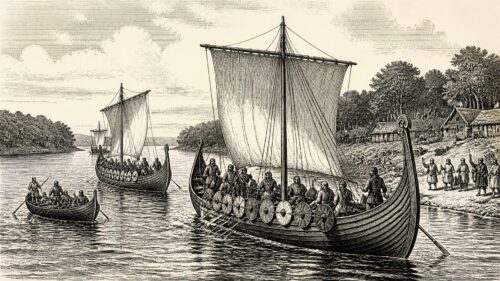
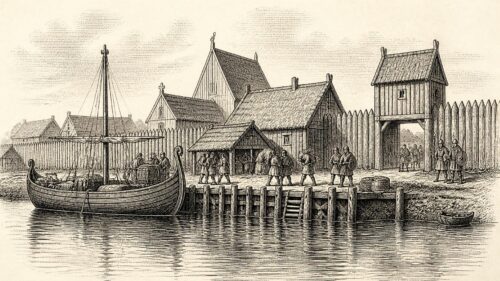
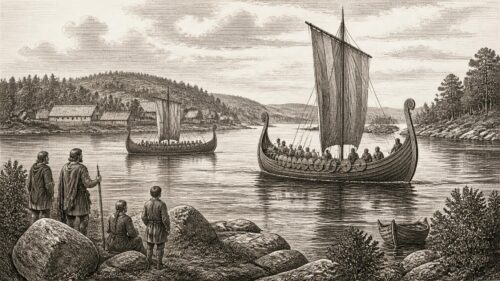
Ímar had been one of the leading figures in the transformation of Viking activity from seasonal raiding into enduring military and political presence. Dublin was already a defended Scandinavian base, linked by sea-routes to western Britain, northern England, the Hebrides and beyond. In the years before his death, Ímar and his associates had campaigned in Scotland and returned to Ireland with captives from Britain. Such expeditions joined warfare, forced movement of people, ransom and trade. The people taken across the sea were not an incidental detail: human beings were valuable in the slave economies of the Irish Sea world.
His death did not mean that Dublin suddenly ceased to matter. Nor does the surviving record securely identify an immediate successor or allow a precise reconstruction of events within the settlement during 873. It did, however, remove a ruler whom the annals credited with exceptional pre-eminence. Later members of the dynasty associated with him, commonly called Uí Ímair, would remain central to Irish Sea politics. For contemporaries in Ireland, the death of a Norse king with connections across Britain was therefore a major shift in the balance of power, even if its immediate practical results are only partly visible.
Raids Across the Provinces
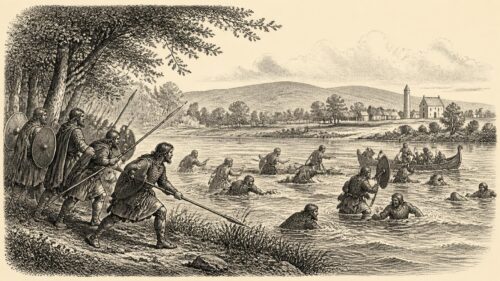
Chronicon Scotorum and the later Annals of the Four Masters associate the same annalistic year-group with two major acts of plunder. Dúnchad mac Duib-dá-Bairenn, king of Cashel, and Cerball mac Dúngail of Osraige raided Connacht together. Separately, the foreigners of Dublin plundered Munster. The entries are terse, and neither gives a route, a battle-site, a casualty figure or a season. They should not be expanded into campaigns for which the evidence does not exist. Still, their pairing conveys something important: warfare in 873 was not simply an opposition between “Irish” and “Vikings”.
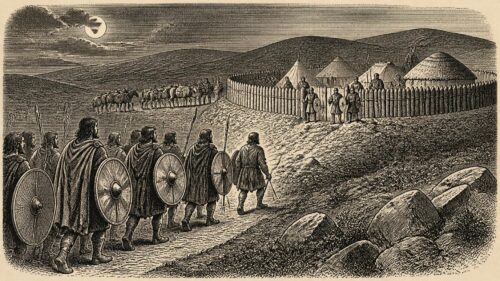
Dúnchad and Cerball were Irish rulers with their own dynastic ambitions, and their alliance crossed the regional boundary between Munster and Osraige. A raid upon Connacht could yield cattle, provisions, valuables, hostages and prestige, while displaying the capacity of allied kings to mobilise armed followers over long distances. Meanwhile, the Dublin raiders who struck Munster were not merely outsiders appearing at the coast. Their base at Áth Cliath sat within Irish political networks, sometimes allied with Irish kings and sometimes their enemy. Sea-power enabled sudden movement, but expeditions also depended on knowledge of rivers, landing places, food supplies and local rivalries.
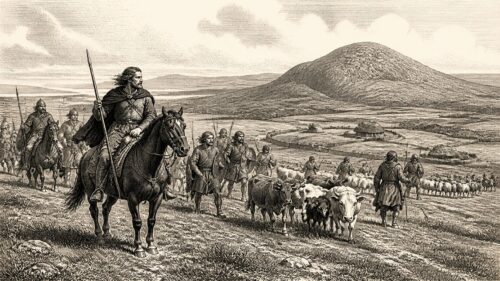
The raids underline the vulnerability of productive landscapes. Most people lived in dispersed rural settlements, sustained chiefly by cattle, dairying, cereals and seasonal labour. Plunder could mean the loss of livestock and stored food as well as portable wealth. It could interrupt harvest work, oblige households to move animals to safety, and compel local rulers to call out men for defence. Yet the record does not justify depicting all Ireland as devastated. Raiding was severe precisely because it targeted resources concentrated in particular territories and communities.
Losses and Succession in Ulaid
Another firmly associated event was the death of Lethlabar mac Loingsig, whom the Annals of Ulster call “king of the Province”. In this context the province was Ulaid, broadly eastern Ulster. Lethlabar belonged to Dál nAraide, a powerful people whose core territories lay in parts of what are now counties Antrim and Down. His obituary says that he died “as an old man”, a rare and revealing qualification in annalistic writing, where many rulers meet violent ends.
Lethlabar’s death was politically significant because Ulaid was not a single, uncomplicated kingdom. Its leading dynasties, notably Dál nAraide and Dál Fiatach, competed for provincial pre-eminence. His long career had included conflict with Vikings and with the Northern Uí Néill. By 873, the high king Áed Findliath of Cenél nÉogain exercised strong influence in the north, but even he did not erase the authority of provincial rulers. The passing of Lethlabar therefore opened a fresh stage in Ulster’s internal competition. His son Cenn Étig succeeded within Dál nAraide, while the wider overkingship of Ulaid reverted to a rival line.
The annals also mark the deaths of lesser kings across the island: Flaithbertach son of Dub Roip of Corcu Mruad Ninais in north Clare; Uathmarán son of Brócán of Uí Fhiachrach Aidni in south Galway; and Dúnadach son of Rogallach of Cenél Cairpri Mór. These brief notices are a useful corrective to any Dublin-centred account of the year. Ireland’s political life was made up of many such lordships. Kingship was personal, kin-based and territorial; a ruler’s death could alter local alliances, tribute arrangements and rights over land and church patronage even when it did not make wider annalistic headlines.
Tailtiu Falls Silent
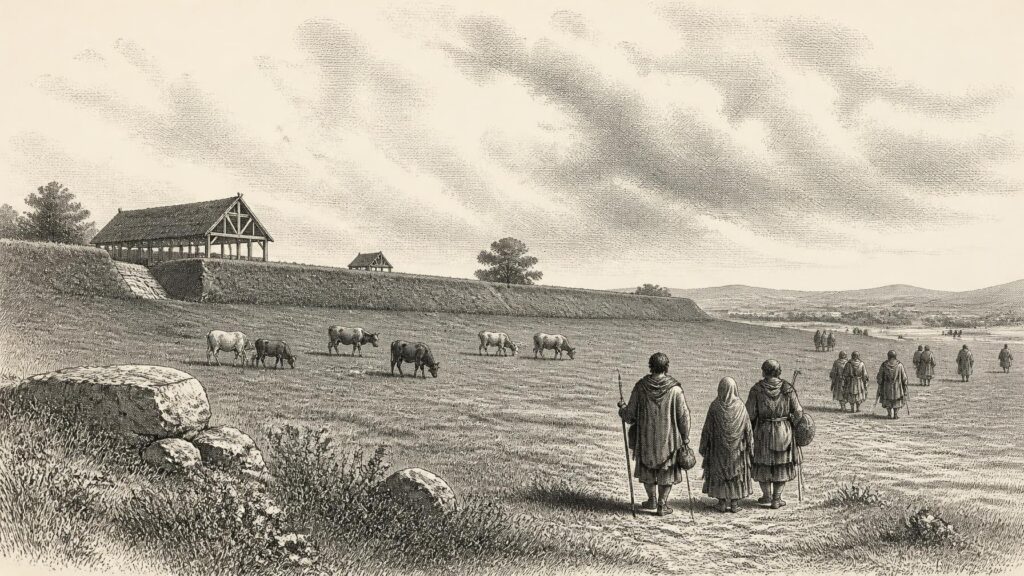
The year’s most evocative entry concerns neither a battle nor a death. The Annals of Ulster state that the fair of Tailtiu was not held, “although there was no just and worthy reason for this”, adding that such a failure had not been known from ancient times. Tailtiu, near modern Teltown in County Meath, was far more than a market day. It was an óenach: a great periodic assembly connected with the kingship of Tara and the political heartland of the Southern Uí Néill.
Medieval literary tradition attached the fair to Lugnasad and to the foster-mother of the god Lug, Tailtiu herself. That origin story is not straightforward evidence for ninth-century practice, but it shows the fair’s claimed antiquity and ceremonial importance. Assemblies of this kind could bring together trade, games, legal business, proclamations, alliances, displays of royal authority and social encounters. Later tradition also associated Tailtiu with negotiations over marriage and friendship. A fair did not suspend hierarchy; rather, it offered a public setting in which hierarchy could be enacted and recognised.
The annalist’s disapproval is especially striking. He did not record an unavoidable interruption caused by invasion, famine or weather; he explicitly insisted that no adequate reason existed. This reads as criticism of political failure, most plausibly directed towards Áed Findliath, then king of Tara. A ruler’s ability to convene and protect an assembly was part of what made his supremacy meaningful. If no fair was held, no public peace was proclaimed, no royal gathering occurred, and no visible centre held the island’s competing interests together.
It would be wrong to conclude that ordinary exchange ceased across Ireland in 873. Local markets, ecclesiastical centres and household networks continued to move food, animals, tools and craft goods. But Tailtiu’s absence exposed the weakness of an island-wide royal ideal. The failure became memorable because the fair represented a claim to order greater than any one raid or local feud.
Churches, Scribes and Communities
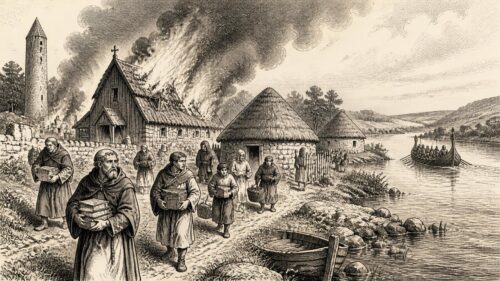
Churchmen also feature prominently in the year’s obituaries. Dúngal son of Máenach, superior of Inis Caín Dega, died; so did Colmán, bishop, scribe and abbot of Naendruim, the monastery of Nendrum in Strangford Lough; and Flaithbertach son of Muirchertach, superior of Dún Caillen. The combination of titles given to Colmán is important. An abbot could be a major landholder and political figure; a bishop carried sacramental and pastoral authority; a scribe participated in the preservation and production of learning. In early medieval Ireland these offices could overlap rather than belong to separate institutions.
Such notices offer a glimpse of a literate religious landscape extending beyond the best-known great churches. Monasteries were places of worship, but also centres of farming, hospitality, craftsmanship, teaching and record-keeping. Their communities were embedded in regional politics through patronage and kinship. The deaths recorded in 873 therefore signal changes in the leadership of institutions that helped organise local life. They do not prove a particular manuscript was copied that year, nor should they be used to invent a cultural flowering; rather, they show that scribal learning and ecclesiastical office remained sufficiently valued for annalists to preserve their holders’ names.
An Uneasy Turning Point
873 was not a year in which a new unified Ireland emerged, nor one in which Viking power simply overwhelmed the island. It was a year of connected endings: Ímar’s death weakened a formidable Dublin-centred Norse leadership; Lethlabar’s death changed the political calculation in Ulaid; local kings and monastic superiors passed from the record; and Tailtiu’s great assembly failed to convene. Raiding in Connacht and Munster continued alongside these transitions. Together, these events show an Ireland sustained by resilient local communities and institutions, yet troubled by competition among kings and by a royal centre unable, at least that year, to perform one of its most public duties.
Primary Sources
- The Annals of Ulster — U873
- The Annals of Ulster
- Chronicon Scotorum
- Annals of the Kingdom of Ireland — M871–M874
- Annals of the Kingdom of Ireland
- Ímar (Ívaar) — Dictionary of Irish Biography
- Lethlobar — Dictionary of Irish Biography
- Áed Findliath — Dictionary of Irish Biography
- Vikings in Irish Chronicles, 794–902: Introduction
- Vikings in Irish Chronicles, 794–902: Data
- Vikings in Ireland and Scotland
- The Metrical Dindshenchas: Tailtiu
- The History of Ireland: The Fair of Taillte
- Exploring the Irish Annals
- The Economy of Early Medieval Ireland
- Evidence for ‘Trade’ in Early Medieval Ireland
- Early Medieval Archaeology Project Report 2.1: Early Medieval Dwellings, Settlements and Landscapes
- Early Medieval Ireland: Archaeological Excavations, 1930–2009
- Clonmacnoise, County Offaly — National Monuments Service
- Monasterboice, County Louth — National Monuments Service
- Glendalough, County Wicklow — National Monuments Service
- Saints in Scottish Place-Names: Cóelán of Nendrum