Clonfert’s Burning844 CE
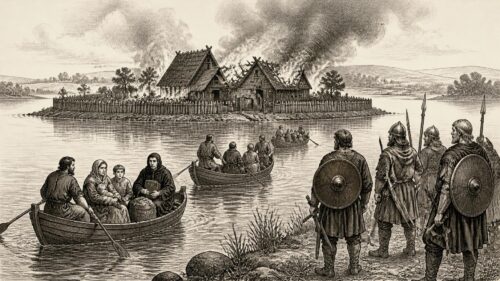
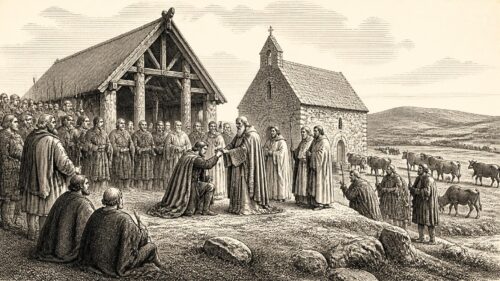
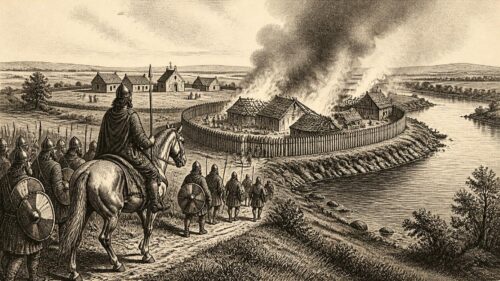
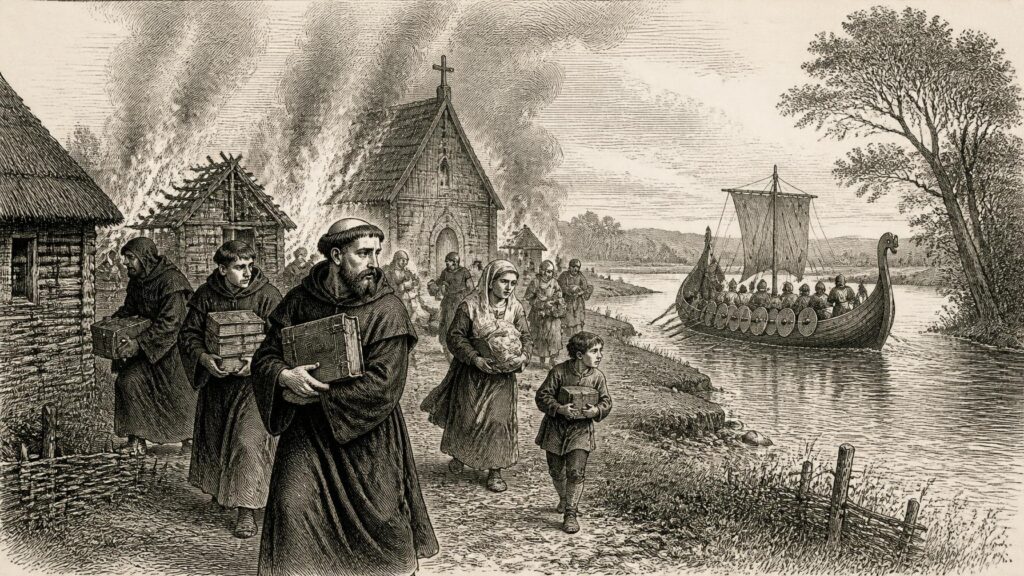
In 844, raiders described as heathens from Loch Rí burned Clonfert, an important Shannon ecclesiastical settlement associated with St Brendan. The campaign also killed Tolarc, lord of Fella, while his kinsman Finnechán escaped; Máel Mithig son of Cináed likewise died at heathen hands. Annals securely date Clonfert’s burning but do not justify a detailed unified narrative. Rónán, former abbot of Clonmacnoise, and Cairpre son of Cathal, king of Leinster, also died. These sparse records reveal inland waterborne raiding, vulnerability among churches and rulers, and Ireland’s interconnected yet politically fragmented communities. Clonfert survived, though the immediate destruction remains unknown in detail.
Dateline
The clearest Irish events that can be placed in 844 CE form a small but revealing group. They centre on the middle Shannon and on the political and religious communities linked by its waterways. In this year, raiders described in the annals as heathens or foreigners from Loch Rí burned Cluain Ferta Brénainn, modern Clonfert in east Galway. The same campaign killed Tolarc son of Allailed, ruler of Fella, while his kinsman Finnechán escaped. Máel Mithig son of Cináed was also killed by heathens. Elsewhere, Rónán, former abbot of Clonmacnoise, died, as did Cairpre son of Cathal, king of Leinster.
These notices require care. Medieval Irish annals were compiled and copied long after many of the events they record, and their year headings do not always align neatly between texts. Yet the burning of Clonfert is unusually secure for 844: it is entered under that year in the Annals of Ulster, while other annalistic traditions preserve the associated killing of Tolarc. The year therefore cannot be made into a detailed narrative of one coordinated war, but it does offer firm evidence of violence emanating from Loch Rí and of the pressure this placed upon communities along the Shannon system.
Fire from Loch Rí
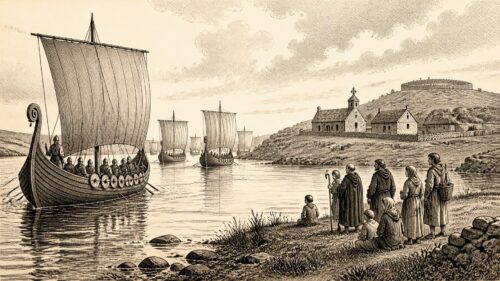
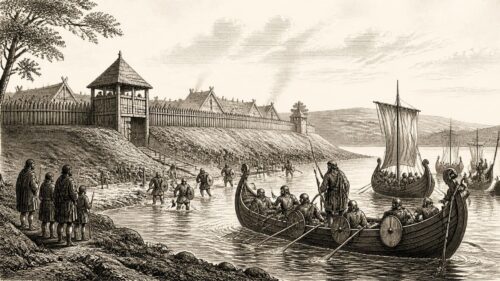
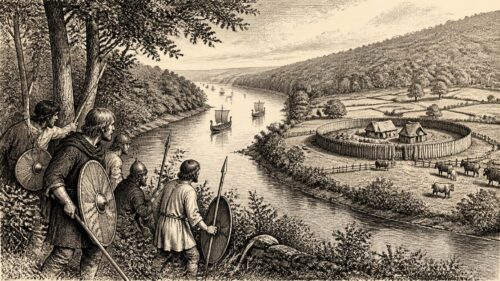
The entry for Clonfert is brutally concise: the church settlement of St Brendan was burned by heathens from Loch Rí. The wording matters. It identifies not merely seaborne raiders arriving at an exposed coast, but a mobile force operating from, or through, a great inland lake on the Shannon. Loch Rí lay at the meeting point of routes running north towards Mide and south and west along the river. Craft capable of navigating river and lake could carry armed men, provisions and plunder into Ireland’s interior with a speed impossible for a large force travelling overland.
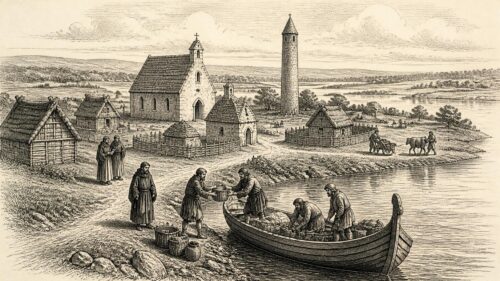
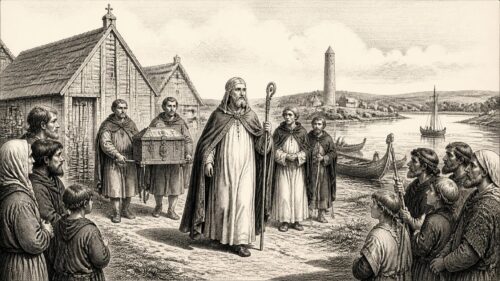
Clonfert was no insignificant isolated chapel. Founded in the sixth century and associated with Brendan, it had long been an ecclesiastical centre in a cultivated landscape near the Shannon corridor. Earlier learning connected with the community, including the work of the scholar Cummian, gave the place standing beyond its immediate neighbourhood. Its resources would have included land, livestock, food stores, metalwork, books and church furnishings, as well as the labour and obligations owed by surrounding households. A burning was consequently an assault on a settlement’s material base, its sacred space and the authority exercised from it.
It would be irresponsible, however, to imagine details the annal does not supply. We do not know which buildings burned, how many people were present, whether captives were taken, or how quickly the community rebuilt. Nor should the word “burned” be mistaken for permanent extinction. Irish monasteries were extensive, living settlements rather than a single stone church, and their built fabric often included timber structures and thatch especially vulnerable to fire. Destruction could be severe while institutional continuity survived through clergy, dependants, land rights, relics or books carried away from immediate danger.
Tolarc of Fella
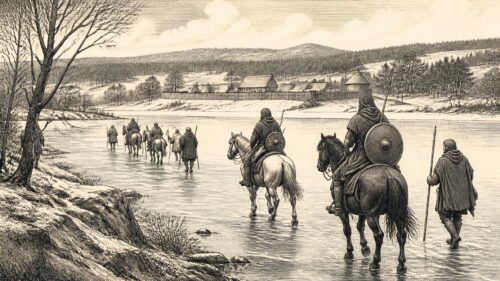
The killing of Tolarc son of Allailed gives the raid a human and political dimension. He is called flaith of Fella, a lordly title rather than a claim to island-wide kingship. The exact extent of Fella is not certain, but the notice belongs to the same midlands world exposed to raiders from Loch Rí. Finnechán son of Allailed escaped them. That small contrast – one kinsman killed, another surviving – suggests the sudden vulnerability of regional ruling families when river-borne forces entered their territory.
The annals’ brevity obscures much. Tolarc may have been killed resisting, while travelling, or during an attack on a settlement; the sources do not say. They do not prove that he died at Clonfert, nor that his death and the burning occurred on the same day. What they establish is narrower and more valuable: in 844 a local political leader fell to the Loch Rí foreigners, and a major church in the wider Shannon region was put to the torch. Such blows could alter local balances of power even without a decisive pitched battle. A lord’s death opened questions of succession, alliance, tribute and protection; damage to a church affected those who relied upon it for worship, hospitality, literacy and the public memory of kin.
The otherwise unexplained killing of Máel Mithig son of Cináed belongs in the same atmosphere of insecurity. The Annals of Ulster record his death at the hands of heathens but give neither place nor rank. It is tempting to attach him to the Clonfert episode, but that would exceed the evidence. His notice is best read as corroboration of a broader fact: violence attributed to Scandinavian raiders was not confined to a single famous monastery or one named ruler in this year.
Churches, Learning and Recovery
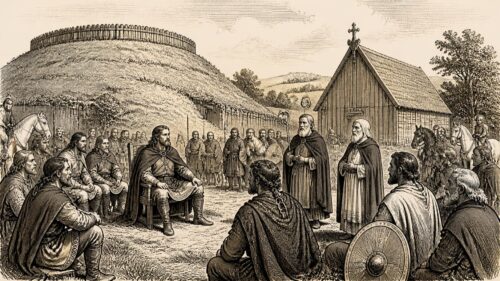
At Clonmacnoise, farther up the Shannon, Rónán died in 844. He had ceased to hold the abbacy some years earlier, but his obituary still places one of Ireland’s foremost ecclesiastical centres within the year’s record. Clonmacnoise stood at a major crossing and communication route, and its influence rested on more than prayer: it was a community of clerics, scholars, artisans, tenants, travellers and patrons. Archaeology has revealed the scale of its early medieval infrastructure, including a substantial roadway and a wooden bridge across the Shannon dating to the early ninth century. Such evidence helps explain why river routes were at once economic lifelines and strategic dangers.
The deaths and burnings recorded in annals should not lead to an image of a silent countryside inhabited only by monks and warriors. Most people in 844 lived in dispersed rural settlements, tending cattle and pigs, growing cereals, maintaining boundaries and moving goods through local obligations and seasonal exchanges. Churches and monasteries sat within these economies. They received food renders and gifts, provided hospitality, employed skilled workers and preserved texts, while their saints, relics and burial grounds tied communities to places. When an ecclesiastical site was attacked, the effects spread into households that supplied it and sought its protection.
Learning was also practical power. A scribe could preserve land claims, genealogies, liturgical books and commemorative records; an abbot or senior cleric could act as a broker between rival kindreds. The survival of the annals themselves is a reminder that neither raids nor political deaths halted writing. But survival should not be romanticised. Each terse entry is the residue of choices about what later record-keepers considered worth remembering: the death of a king, the burning of a famous church, or a killing that might otherwise have vanished from communal memory.
Leinster’s Vacant Kingship
In eastern Ireland, the death of Cairpre son of Cathal, king of Leinster, was another firmly dated development. Leinster was not a unified state with an automatic succession. Its kingship depended upon powerful dynasties, relationships among regional rulers and the capacity to command followers and tribute. Cairpre’s death therefore marked a moment of political uncertainty, even though the annals do not describe the negotiations or conflict that followed. It should not be assumed that the Loch Rí raids caused this change: the records offer no connection between Cairpre’s death and the violence in the Shannon basin.
Taken together, the entries show an Ireland of many centres rather than a country ruled from one capital. The Shannon corridor connected ecclesiastical settlements such as Clonfert and Clonmacnoise with inland kingdoms; Leinster had its own royal politics; Loch Rí enabled armed outsiders to intervene in both local and regional affairs. Scandinavian raiders were already a durable presence in Irish history by 844, but they acted within an Irish landscape whose waterways, rival lordships and wealthy churches created opportunities as well as resistance.
A Year of Sparse Certainties
844 CE is not remembered for a named national battle or a dramatic change of high kingship. Its importance lies in the sharply observed local losses: Clonfert burned; Tolarc of Fella killed; Finnechán escaped; Máel Mithig killed; Rónán of Clonmacnoise died; and Cairpre of Leinster died. These are not fragments to be inflated into certainty. Rather, they are enough to show how a raid from an inland waterway could touch monastic life, regional lordship and the security of ordinary communities dependent on both.
For Clonfert, fire did not end the story. The site continued as a religious settlement, and later buildings, graves and documentary traces attest to its long afterlife. That endurance is significant, but it belongs to the centuries after 844. Within this year itself, the annalists leave us with a stark image: a renowned church community on the Shannon frontier, vulnerable to a force moving out from Loch Rí, and an Irish political order obliged to absorb the loss.
Primary Sources
- Annals of Ulster
- Chronicon Scotorum, Annals CS843–CS847
- Chronicon Scotorum: edition information
- Annals of the Four Masters, Annals M837–M850 (translation)
- Annals of the Four Masters, Annals M837–M850 (Irish text)
- Annals of the Four Masters: CELT edition
- Vikings in Irish Chronicles, 794–902: Data
- Vikings in Scotland and Ireland
- General Vikings in Ireland
- The Annals of Clonmacnoise, Being Annals of Ireland from the Earliest Period to A.D. 1408
- Annals of Inisfallen
- Clonfert Conservation Plan
- Clonfert
- 2001:496 – Clonfert Cathedral, Clonfert, Galway
- Clonmacnoise Monastic Site
- Early Medieval Archaeology Project: Report 2.1
- Early Christian Irish Monasteries
- Book of Leinster, Formerly Lebar na Núachongbála
- Exploring the Irish Annals
- CELT Project: Chronicon Scotorum