The Fleet of Seven Score849 CE
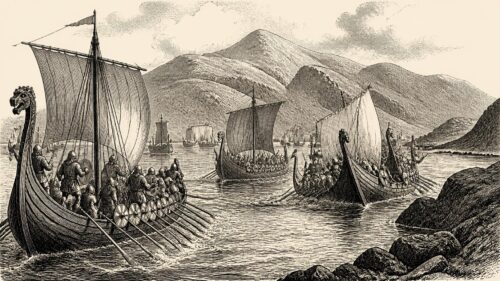
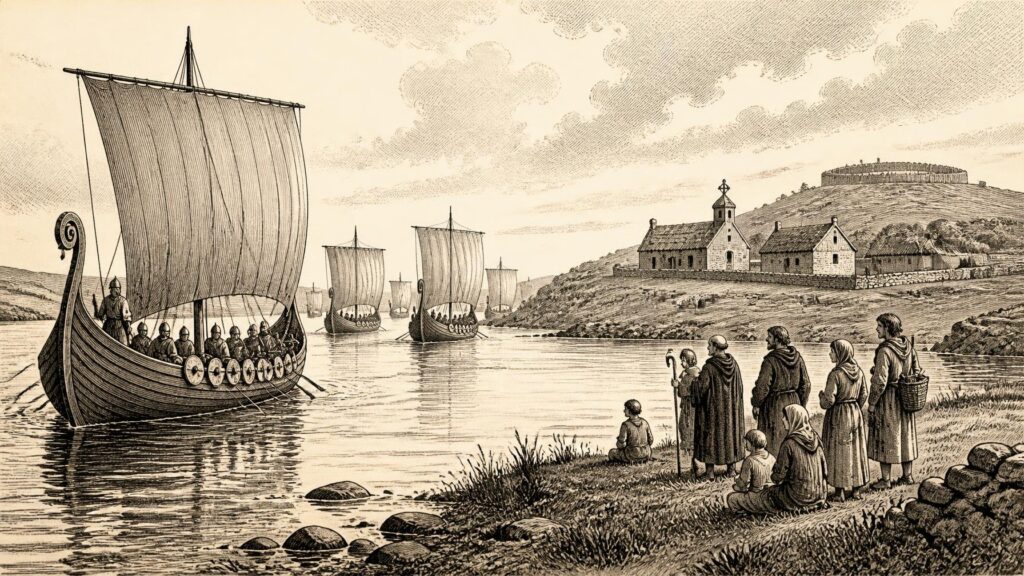
In annalistic year 849, a fleet of seven score ships arrived in Ireland to compel obedience from Scandinavian groups already established there, causing disruption. The evidence does not identify its leader, landing place or achievements. Meanwhile, Máel Sechnaill of Tara maintained an encampment at uncertain Crufaid, while regional rulers died or were killed, including Flannacán of Dál Araidi. Ecclesiastical notices recorded deaths, Robartach of Sláine’s voluntary exile, and Indrechtach of Iona’s arrival carrying Colum Cille’s sacred objects. Máel Bresail, king of Mugdorna turned cleric, was killed by heathens. The annals depict overlapping political, religious and Scandinavian conflicts, not a campaign.
Dateline
A Year Known Through Annals
What can be said securely about 849 is bounded by the character of the evidence. The principal record is a compact cluster of notices in the Annals of Ulster, conventionally entered under this year. They do not supply months, days or a continuous narrative. Moreover, early medieval Irish annals have chronological complications: the year-number assigned by a surviving compilation may not align perfectly with a modern calendar year. It is therefore safest to treat the events below as belonging to the annalistic year styled 849, while resisting any invented precision about their sequence or season.
Even so, the entries reveal an Ireland under exceptional pressure. A great overseas fleet arrived to impose authority upon Scandinavian groups already operating in Ireland; rulers died or were killed; an important Columban abbot crossed from Iona with the sacred objects of Colum Cille; and Máel Sechnaill, king of Tara, maintained a military presence at an otherwise uncertain place called Crufaid. The year was not simply one of ‘Viking raids’. It records conflict within Irish kingdoms, competition among the newcomers, and the movement of people and holy objects across the Irish Sea.
Seven Score Ships
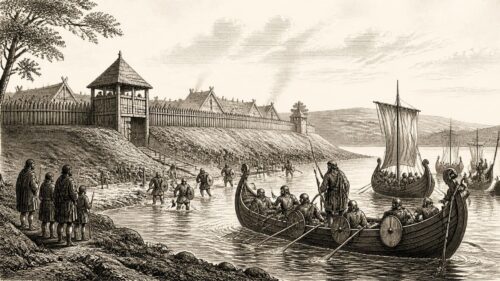
The year’s most striking notice reports that a naval expedition of seven score ships—140 vessels in the annalist’s formula—came from the followers of a “king of the foreigners”. Its purpose, the text says, was to exact obedience from foreigners who had already been in Ireland. Afterwards, they “caused confusion in the whole country”. This is a rare statement of intention as well as violence. The force was not described merely as a raiding party seeking portable wealth. It had arrived to subordinate other Scandinavian groups already active on Irish shores and waterways.
The annal does not name the overseas king, identify a landing-place, or enumerate the Irish districts affected. Those silences matter. A fleet of 140 ships should not be imagined as a single, neat armada moving in formation, nor should its reported number be treated as a modern naval census. Nonetheless, the figure is deliberately large and indicates a mobilisation on a scale that contemporaries found remarkable. The phrase “whole country” is likewise rhetorical rather than a map of universal occupation, but it conveys disruption reaching well beyond one coastal settlement.
Recent scholarship places this expedition within a mid-ninth-century struggle for predominance among Vikings in Ireland. The Irish annals had recorded fortified ship-camps, or longphuirt, at strategic river and coastal locations since the 830s and 840s. Dublin had become one such base in 841. These were not yet towns in the later medieval sense, but they gave mobile seaborne groups places to overwinter, store goods, repair vessels and launch expeditions inland. Control over the men holding such bases could translate into command of plunder, tribute, captives and sea routes.
It is tempting to attach the 849 fleet to later, more fully named Scandinavian leaders. A notice in the much later-preserved Fragmentary Annals associates Amlaíb Conung and his brother Ímar with demands for tribute. Yet its chronology is internally troublesome: it calls the episode the sixth year of Máel Sechnaill’s reign, which points later than 849, and modern historians generally place it in the early 850s. Amlaíb and Ímar should therefore not be presented as securely arriving in Ireland in 849. The anonymous fleet, and its attempt to command earlier foreign settlers, are what the evidence firmly places in this year.
Irish Kingships Under Pressure
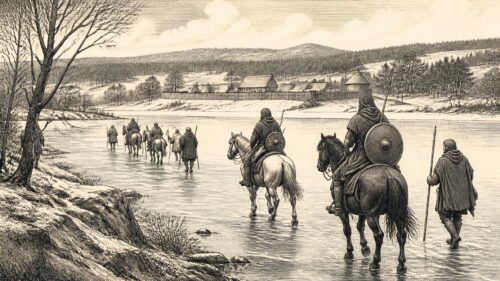
The overseas intervention unfolded in an Ireland divided among many kingships, not a state governed from a single capital. Máel Sechnaill mac Máele Ruanaid of the southern Uí Néill had recently become king of Tara, a position carrying a claim to pre-eminence rather than uncontested rule over the island. In the entry for 849, the annals preserve a brief notice of his forbas at Crufaid: an encampment or military investment. A poem attributed to Máel Féichín, quoted in the Fragmentary Annals, evokes the hardship of being exposed to the sharp wind at “withered Crufaid” while crossing the Boyne towards Meath.
The location of Crufaid is not securely identified, and the sources do not tell us whom Máel Sechnaill faced, how long he remained, or whether there was a battle. The verse nevertheless offers a small glimpse of campaigning as lived experience: troops on the move, a river crossing, an open and uncomfortable camp, and a royal host operating in the central Irish heartland. It also cautions against seeing royal power only through set-piece battles. Maintaining men in the field, controlling movement and compelling submission were fundamental instruments of ninth-century rulership.
Other notices underline the instability of regional politics. Conaing son of Flann, king of Brega, died. Brega, in the lower Boyne region, was politically important to the southern Uí Néill world and to any ruler seeking influence around Tara. Cairpre son of Cináed, king of Uí Máel, also died. The annals give no cause for either death, nor do they record the succession that followed. Yet the passing of kings was consequential: legitimacy depended heavily on kin-group standing, and every vacancy could reopen arguments among rival branches.
In the north, Flannacán son of Eochaid, king of the northern Dál Araidi, was killed by the Cenél nEógain. This was an Irish conflict, not an episode attributed to the foreign fleet. Dál Araidi, based in eastern Ulster, and Cenél nEógain, the powerful northern Uí Néill people, were neighbours and competitors within a shifting northern political landscape. The annal supplies neither a battlefield nor an explanation. Its bare wording is enough to establish that a regional king died violently at the hands of a rival people, a reminder that Irish political rivalries were neither suspended nor replaced by Scandinavian activity.
Churches, Exile and Sacred Objects
Church institutions were central to this world: places of worship and burial, but also landholders, centres of literacy, employers of craftsmen and focal points for local lordship. Several ecclesiastical deaths were recorded in 849. Fínnechta, abbot of Damlíag; Máel Fuatig, abbot of Ard Braccáin; and Onchú, bishop and anchorite of Sláine, all died. Airennán, abbot of Bangor, also “fell asleep”, the conventional monastic expression for death. Such notices show an annalistic culture attentive to religious office and learned authority, even in a year dominated by political turmoil.
Robartach son of Colgú, abbot of Sláine, “went into voluntary exile”. The phrase does not explain whether his departure followed a local dispute, a political threat, penitential choice or some other cause. It would be irresponsible to assign it automatically to a Viking attack. Voluntary exile was, however, a recognisable religious and political act in early medieval Ireland: a withdrawal that could express penitence, protect a person from danger, or mark a rupture in local relationships. The entry reminds us how much of the human story lies beyond the annal’s terse formulation.
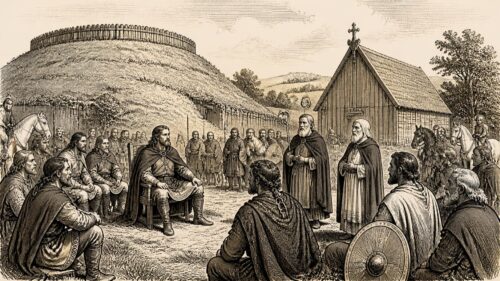
The movement of Indrechtach, abbot of Í— Iona—was more public and symbolically charged. He came to Ireland carrying the minda, translated as the holy objects, reliquaries or relics of Colum Cille. Iona was a Columban foundation with deep Irish connections, while Colum Cille’s memory bound religious communities on both sides of the sea. The annal does not state the objects’ final destination, or explicitly say that they were being removed for safety. Later historical interpretation often connects the journey to the threat posed by repeated Viking attacks on Iona and to the dispersal or division of Columban relics between Irish and Scottish centres. That remains a plausible context, but not an explicit statement of the 849 entry.
What is certain is the journey itself. Sacred objects were not passive treasures. They embodied the saint’s authority, helped define institutional inheritance and could be carried in ceremonial progress. In a year when a foreign naval force sought obedience from Scandinavian communities in Ireland, Indrechtach’s crossing asserted another kind of transmarine network: the resilient religious fellowship linking Iona to Irish Columban houses.
Violence and Vulnerability
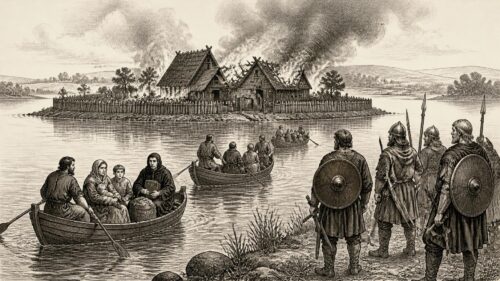
The annals also record the death of Máel Bresail son of Cernach, king of Mugdorna, killed by “heathens” after he had entered clerical life. The description makes the religious dimension unusually explicit. He had once held secular kingship, had renounced worldly status for the clergy, and was then slain by the foreigners. No site, assailants or circumstances are given. The episode cannot be expanded into a detailed martyrdom, but it shows that the boundaries between kingship and ecclesiastical life were permeable, and that adopting clerical status did not remove a prominent man from the risks of a violent age.
For ordinary people, the year’s largest developments would have been experienced locally: rumours of fleets, the billeting or passage of armed men, uncertain access to river crossings and coastal waters, and demands made by competing rulers. Ireland remained overwhelmingly rural, its wealth grounded in cattle, crops, labour and control of land. Monasteries and royal settlements concentrated people, food stores, valuables and skilled work, making them consequential nodes in both local society and conflict. The annals do not permit a detailed social history of 849, but they make clear that warfare was inseparable from these places and resources.
A Turning Point Without a Final Outcome
Nothing in the surviving notices says that the fleet of seven score ships established permanent mastery of Ireland. Nor do they show a unified Irish response. Instead, 849 captures a moment when authority was being contested simultaneously at several levels: among Scandinavian groups, between Irish dynasties, within church communities, and across the Irish Sea. Máel Sechnaill’s camp at Crufaid, the killing of Flannacán, the death of Máel Bresail, and Indrechtach’s journey with Colum Cille’s holy objects belong to the same unsettled landscape without being parts of one documented campaign.
The year is therefore significant less for a single battle than for the scale of its pressures. Ireland faced a force ambitious enough to demand obedience from other foreign settlers, while its own kings and churches continued to negotiate survival, prestige and power. The annals leave much unknown. Their restraint is itself a lesson: 849 was a year of great commotion, but history can responsibly recover only the movements, losses and claims that the evidence actually records.
Primary Sources
- The Annals of Ulster: Year U849
- The Annals of Ulster
- Fragmentary Annals of Ireland, Annals 236–240
- Fragmentary Annals of Ireland
- Vikings in Irish Chronicles, 794–902: Data
- Vikings in Irish Chronicles, 794–902: Introduction
- Vikings in Ireland and Scotland
- Vikings in Early Medieval Ireland: Church-Raiding, Politics and Kingship
- Vikings in Early Medieval Ireland: Appendix 1 – Catalogue of Viking Raids on Irish Churches in the Annals, 795–1015
- The Vikings in Ninth-Century Ireland: Sources and Settlements
- The Viking Age in Ireland
- The Vikings in Ireland
- Iona and the Shrine of Columba, c. 800–1200
- Indract (Indrechtach)
- The Language and the Date of Amrae Coluimb Chille
- Annals of Inisfallen
- Annals of Inisfallen: Bibliography and Annal Index
- Chronicon Scotorum
- Agriculture, Settlement and Society in Early Medieval Ireland
- Fortified Settlements in Early Medieval Europe: Defended Communities of the 8th–10th Centuries
- The Annals of the Four Masters
- Exploring the Irish Annals