Máel Ruanaid of Mide843 CE
Conventionally dated to 843, despite annalistic chronological discrepancies, the year is chiefly recorded through deaths that affected Irish political, ecclesiastical and scholarly life. Máel Ruanaid son of Donnchad, king of strategically important Mide, died, leaving his dynasty poised for the later rise of his son Máel Sechnaill. Fergus son of Fothaid, king of Connacht, also died, creating uncertainty in another major province. Conglach, vice-abbot of Clonmacnoise, died after the monastery’s recent Viking plundering. Donnacán, an Irish scribe and anchorite, died in Italy, demonstrating enduring continental links. Viking pressure remained a background threat, although no battle is securely recorded for 843.
Dateline
The year 843 CE is a quiet-looking year only if the surviving annals are read as a list of spectacular raids and battles. Their notices for Ireland are instead dominated by deaths: of Máel Ruanaid, king of Mide; Fergus son of Fothaid, king of Connacht; Conglach, vice-abbot of Clonmacnoise; and Donnacán son of Máel Tuile, a scribe and anchorite who died in Italy. These brief records mark changes in political leadership, ecclesiastical administration and the learned networks that connected Ireland to the Continent.
There is an important chronological caution. The Annals of Inisfallen and Chronicon Scotorum place Máel Ruanaid’s death under 843. The Annals of Ulster preserve the same notice under an annal whose internal dating falls a year earlier, a familiar problem in early medieval Irish annalistic chronology. It is therefore responsible to treat the deaths discussed here as conventionally assigned to 843, while avoiding claims about an exact day, season or sequence of events that no source supplies.
A King’s Death in Mide
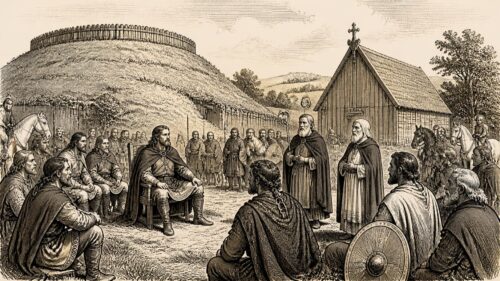
The foremost Irish political event associated with 843 was the death of Máel Ruanaid son of Donnchad, king of Mide. Mide, centred on the rich central plain and the royal landscape around Tara, was not merely one kingdom among many. It was the core territory of the southern Uí Néill, a powerful dynastic grouping whose rulers could make claims far beyond their immediate homeland. Máel Ruanaid’s standing is confirmed by the annalists’ plain designation of him as king of Mide and, in the Annals of Ulster, as father of Máel Sechnaill.
That final detail gives the notice its wider significance. Máel Sechnaill mac Máele Ruanaid would become one of the most formidable kings of the ninth century, but 843 should not be written as though his later prominence had already been secured. The sources do not provide a dated ceremony of succession in Mide, nor do they describe the political bargaining, military support or hostage-taking that must have accompanied a change of ruler. They do, however, show that Máel Ruanaid’s family was already deeply entangled in the politics of the midlands. An annal for 841 records conflict involving Máel Ruanaid and his son, while the later annals record Máel Sechnaill’s rise to wider authority. The death in 843 thus removed an experienced king at a moment when dynastic capacity mattered greatly.
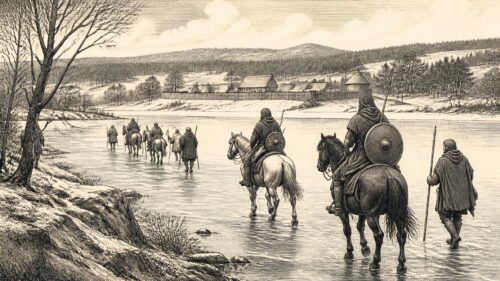
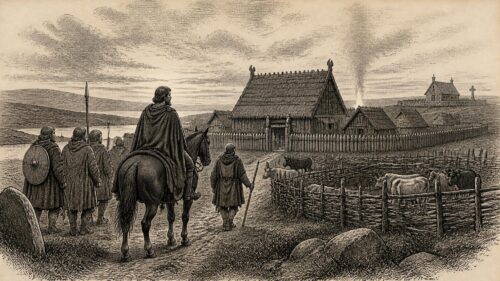
Mide’s importance rested on more than royal genealogy. Its fertile lowlands supported cattle-rearing and grain cultivation; its roads and river crossings linked Leinster, Connacht, Munster and the northern provinces. Control of such a region brought revenues, food renders, military followers and leverage over neighbouring rulers. Yet early Irish kingship was personal and competitive rather than securely territorial in a modern sense. A king’s death could expose rival branches of a kindred, ambitious neighbours and dissatisfied local lords. The annals’ brevity should not be mistaken for evidence of an uncomplicated transition.
Connacht Without Fergus
Fergus son of Fothaid, king of Connacht, also died in the year. This was another substantial loss of leadership, though the record gives no cause of death and no account of who immediately succeeded him. Connacht was not a single uniform political unit: its kings had to negotiate the interests of several powerful regional groups, including branches of the Uí Briúin and Uí Fiachrach. The death of a provincial king therefore mattered both within the west and at Ireland’s centre, where Mide’s rulers had long sought influence across the Shannon.
No battle or diplomatic settlement involving Fergus is securely recorded for 843 itself. It would be wrong to invent one merely because a royal death appears in the annals. Still, the setting was plainly unstable. In the preceding years, Viking forces had used inland waterways and bases to strike at churches and populations; Irish rulers likewise campaigned across provincial borders. A change at the top in Connacht may consequently be understood as a political vulnerability, not as proof that the kingdom collapsed or submitted to an outside power. The appropriate conclusion is narrower: in 843, both Mide and Connacht lost recognised kings, leaving two major regions to manage succession during a period of severe pressure.
Clonmacnoise and the Shannon World
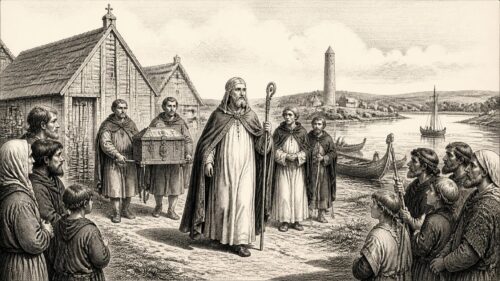
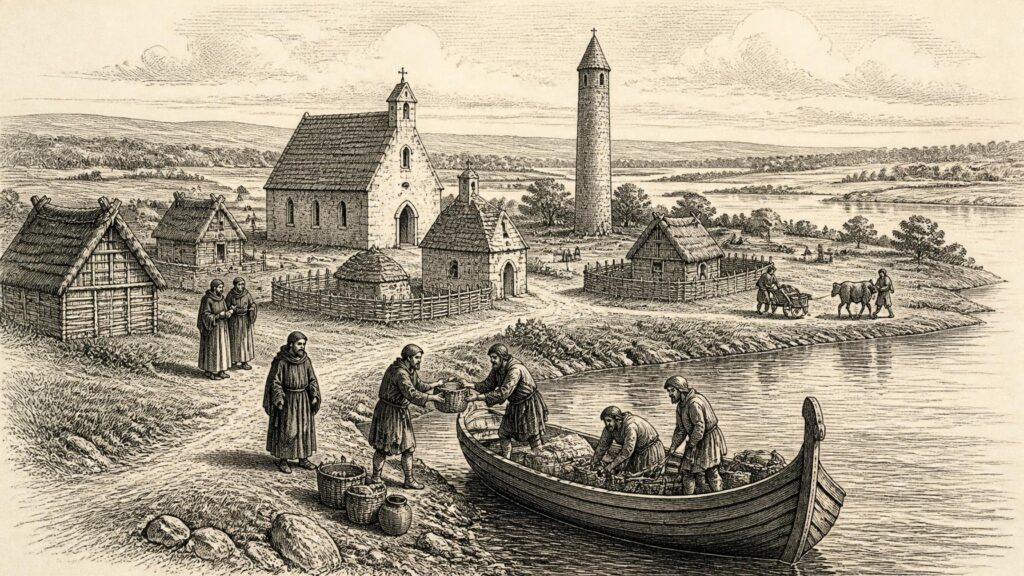
The ecclesiastical notice for Conglach son of Irgalach, vice-abbot of Clonmacnoise, is equally revealing. Clonmacnoise stood on the eastern bank of the Shannon, close to the meeting point of Mide and Connacht and near important overland routes. Its position made it a religious centre, a place of learning and craftsmanship, and a strategic crossroads in the traffic of people, cattle, goods and political influence. The death of a vice-abbot was not a minor internal matter: a great monastery had estates, dependants, students, tenants, church personnel and patrons to organise.
The title ‘vice-abbot’ suggests a layered institution rather than an isolated community of holy men. In early medieval Ireland, abbots and senior clerics could exercise authority over substantial resources, while monasteries were bound to aristocratic families through patronage, inheritance and protection. At Clonmacnoise, religious prestige and political geography reinforced one another. Kings from both sides of the Shannon had reason to court the community, while the community had reason to preserve relationships with them.
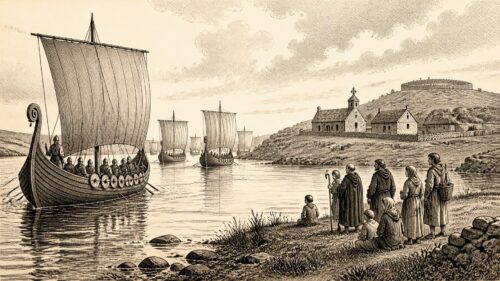
Conglach’s death came after a particularly threatening phase for the monastery. In 842, according to the annalistic record, Clonmacnoise was plundered by raiders operating from Linn Duachaill. That raid belongs firmly to the previous year, not to 843, but it is indispensable context for understanding the community Conglach served. The annals do not report a fresh attack on Clonmacnoise in 843; silence cannot demonstrate safety. It does show that the year’s securely dated notice concerns an institutional loss, not a recorded destruction.
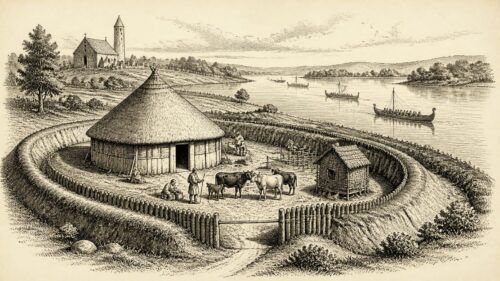
For ordinary people living in and around the monastic settlement, these pressures were practical. A monastery needed food, fuel, livestock, boats, building materials and labour. Its riverside setting brought opportunity as well as danger: the Shannon was a principal artery for movement through Ireland, carrying visitors, messengers, pilgrims and traders, but also making the district accessible to armed fleets. Archaeological and historical interpretation therefore supports an image of Clonmacnoise in 843 as a busy settlement with religious, economic and political roles—not a remote refuge separated from secular affairs.
A Scribe in Italy
The most striking notice of the year concerns Donnacán son of Máel Tuile, described as both scribe and anchorite, who ‘rested in Italy’. The entry is frustratingly concise. It does not name the place where he died, identify a monastery, explain whether he had travelled as pilgrim, scholar or exile, or preserve any manuscript that can confidently be assigned to his hand. What it does establish is remarkable enough: an Irish religious intellectual was remembered in Irish annals as dying in Italy.
Donnacán’s paired titles are significant. A scribe belonged to the world of books, copying and learned religious culture; an anchorite was associated with a rigorous ascetic vocation. These identities were not incompatible. Irish monastic culture valued literacy, scriptural study, penitence and pilgrimage, and its members travelled across Britain and continental Europe. Donnacán’s death demonstrates that such connections were not a distant memory of an earlier ‘golden age’ but remained meaningful amid the disruptions of the ninth century.
His commemoration also exposes the reach of Irish memory. News of a death in Italy, or knowledge preserved by a travelling ecclesiastical network, reached the compilers of Irish annals. That does not mean that every Irish monastery was wealthy or internationally connected to the same degree. Rather, it shows that clerical travel, correspondence and reputation could cross seas even while communities at home faced raids and dynastic conflict.
Viking Pressure, Not a Recorded Battle
Viking activity remained the inescapable background to 843, but it must be described carefully. The annals record longphuirt, or naval encampments, at Duiblinn and Linn Duachaill in the immediately preceding years. From these bases, raiders attacked churches and populations in Leinster, the midlands and along the Boyne. Clonmacnoise itself had been plundered in 842. These were no longer simply occasional coastal landings: river systems and fortified ship-bases enabled repeated inland operations.
Yet 843 should not be supplied with a famous Viking battle simply because later entries describe one. The burning of Clonfert by raiders from Lough Ree belongs to the following annalistic year, and the large campaign attributed to Tuirgéis on Lough Ree belongs later still in the surviving sequence. Such reports illuminate the worsening environment around Mide, Connacht and the Shannon, but they are not events to be relocated into 843. The year’s importance lies instead in how leadership changed while that danger persisted.
A Year of Transitions
843 was therefore a hinge rather than a climax. Máel Ruanaid’s death opened a new phase for the southern Uí Néill of Mide; Fergus’s death created a comparable uncertainty in Connacht. At Clonmacnoise, the passing of Vice-Abbot Conglach touched an institution whose spiritual authority, learning and material resources made it central to midland life. In Italy, Donnacán’s death preserved evidence of the outward-looking scholarly and ascetic world to which Irish churchmen belonged.
There is no securely dated harvest, weather event, treaty or major Irish battle to fill out the year. That limitation is itself part of the history. The annals were selective memorial records, not daily chronicles, and they make 843 visible chiefly through the people whose deaths were judged worth entering. Read closely, those notices reveal an island in which royal succession, monastic administration, river-borne vulnerability and international religious travel were inseparable features of life.
Primary Sources
- The Annals of Ulster
- Annala Uladh: Annals of Ulster otherwise Annala Senait, Annals of Senat
- Annals of Inisfallen
- CELT Project: Annals of Inisfallen
- Chronicon Scotorum
- Chronicon Scotorum (Irish Text)
- The Annals of Tigernach
- Fragmentary Annals of Ireland
- Irish Texts at CELT
- Exploring the Irish Annals
- Clonmacnoise, County Offaly
- Clonmacnoise Monastic Site
- Clonmacnoise Monastic Site Highlights
- High Crosses
- Irish School of Illumination
- The Longphort Phenomenon in Early Christian and Viking Ireland
- The Viking Slave Trade: Entrepreneurs or Heathen Slavers?
- Earlymedieval Ireland 431–1169
- Life after Brian: the High-Kingship
- Annals of Inisfallen to Go on Public Display in University College Cork