Winter at Ard Brecáin821 CE
Annals conventionally dated to 821 depict severe winter conditions, when ice enabled livestock and laden traffic to cross waters, reshaping movement across Ireland. Political rivalry centred on Brega: Murchad of Cenél nÉogain gained secret submissions after reaching Ard Brecáin, while Conchobar of Mide later campaigned there, inflicting heavy losses and compelling Uí Chernaig submission. Other killings involved Ard Ciannachta. In Connacht, Uí Briúin suffered defeat at Tarbga; in Bréifne, Cenél Feidlimthe killed King Máel Dúin. Local groups also defeated the Delbna. Deaths of leaders at Birr and Achad Bó underline monasteries’ political, economic and scholarly importance amid fragmented, competing lordships.
Dateline
A year fixed by difficult evidence
The Irish annals preserve an unusually full cluster of notices for 821 CE, but they must be read with care. Their surviving manuscripts are later copies, and the numbered year in one annal can be offset from the modern calendar year. The sequence conventionally aligned with 821 in the Annals of Ulster is nevertheless clear enough to show a hard winter, intense competition in the midlands, fighting in Connacht and Bréifne, and the continuing importance of monasteries as centres of authority. It does not offer a continuous narrative. Rather, it records the occasions that annalists and their informants judged memorable: deaths of leading churchmen, royal expeditions, submitted dynasties and battle losses.
That limitation is significant. Nothing in the principal 821 notices permits a reconstruction of a single island-wide war, a national government, or a settled hierarchy of provinces. Ireland remained a landscape of overlapping lordships, church federations and kin-groups. Kingship was exercised through personal followings, tribute, hostages, seasonal assemblies and the ability to move armed men into contested territory. The events recorded this year expose how unstable that authority could be.
Ice across the waters
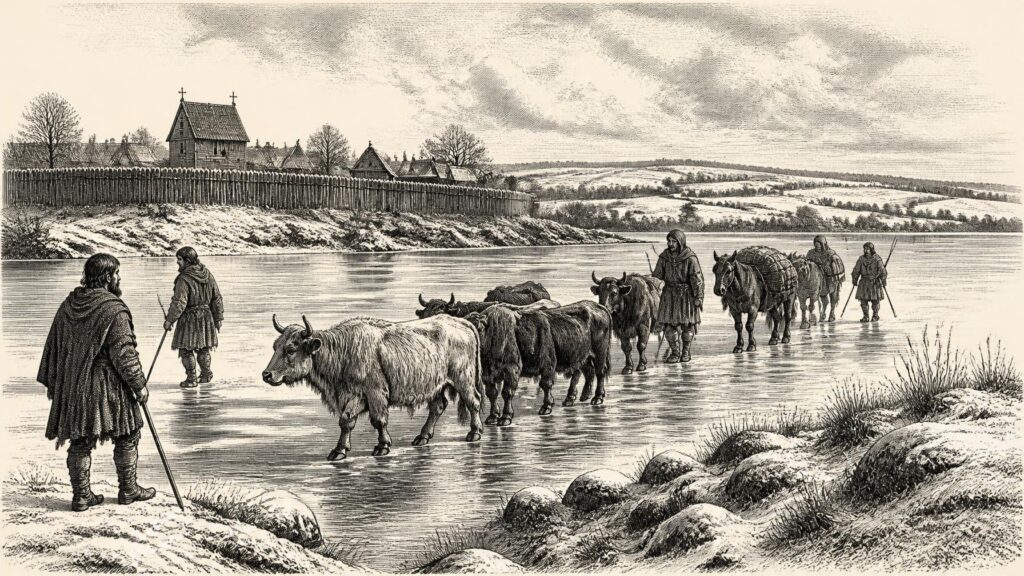
The most striking entry is environmental. The annalist reports “abnormal ice”: seas, lakes and rivers froze sufficiently for herds of horses and cattle, as well as laden traffic, to be brought across them. The wording should not be turned into a modern meteorological measurement. It supplies neither duration nor temperatures, and it is not proof that every Irish waterway froze. Yet the description is emphatic and points to exceptionally severe conditions over a wide area.
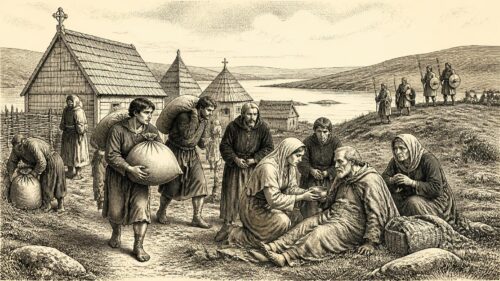
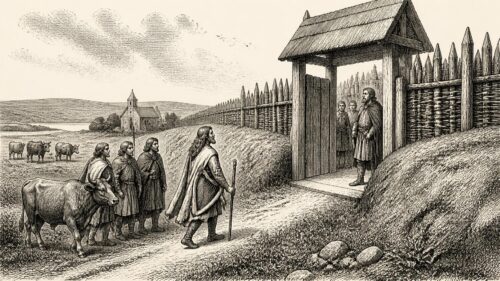
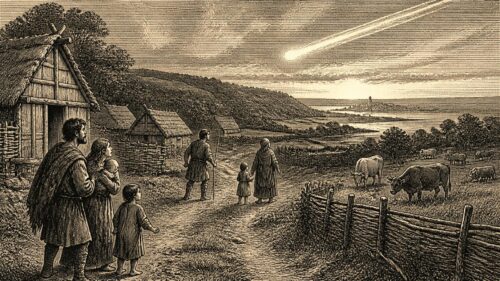
For rural communities, frozen water was both hazard and opportunity. Cattle were fundamental stores of wealth, food, labour and political compensation; moving them in winter was normally constrained by rivers, loughs and tidal channels. Ice could make crossings possible where boats, fords or ferries were otherwise necessary, while also threatening grazing, fodder supplies and travel. The annalist’s inclusion of “loads” suggests that the phenomenon mattered not merely as a marvel but because it altered movement and carriage. It would have been experienced by farmers, drovers, clerics and royal retinues alike, not only by the political elites who dominate the written record.
The winter notice also provides a useful check on easy assumptions about early medieval Ireland as an isolated world of local travel. People, livestock and goods moved continually, even if by routes unlike modern roads. Rivers and lakes were barriers, highways and boundaries according to season. In 821 their freezing briefly changed that geography.
Murchad’s Midland Venture
The year’s central political episode unfolded around Brega, the fertile and strategically important region of the eastern midlands, broadly centred on modern County Meath and adjoining districts. Its proximity to Tara, its dense network of royal and ecclesiastical sites, and its routes towards the Irish Sea made control or influence there valuable to every ambitious ruler.
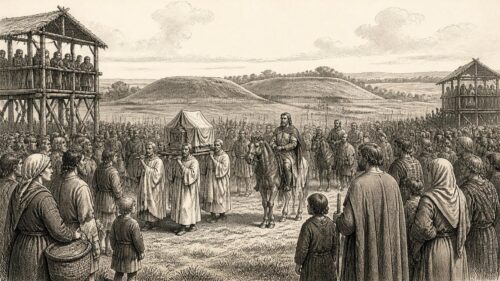
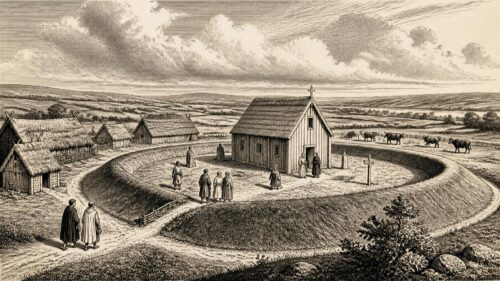
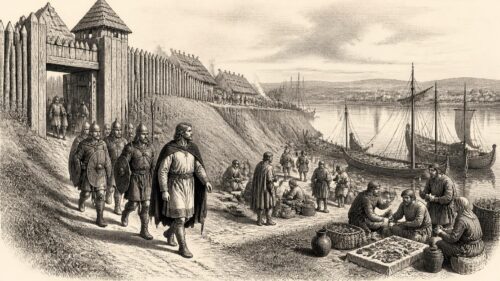
Murchad son of Máel Dúin, ruler of Cenél nÉogain in the north, led “the men of the North” south to Ard Brecáin, the important church settlement at Ardbraccan near Navan. Such an expedition was a demonstration of armed capacity as much as a march from one fixed frontier to another. The annal does not say that Ard Brecáin was attacked, nor does it describe a battle there. Its importance lies in what followed: Diarmait son of Niall and descendants of Áed Sláine among the men of Brega secretly went over to Murchad and submitted to him at Druim Fergusa.
Submission was not a vague gesture. In early Irish political practice it could involve acknowledgement of superiority, the offering of hostages, service in war and access to tribute. The secrecy noted by the annalist indicates the danger of changing sides. Brega was divided among rival branches of the Southern Uí Néill, including the Síl nÁedo Sláine, descendants of Áed Sláine. Their local rivalries gave an outside power opportunities, but dependence on allies also made any northern intervention precarious.
Murchad’s advance must be set against his position, not exaggerated into a bid for a unified “high kingship of Ireland”. His father, Máel Dúin, had been an earlier ruler of Ailech, and Murchad had emerged as a significant northern leader after the death of Áed Oirdnide in 819. He was competing in a political field in which claims over the midlands were constantly contested. The march to Ard Brecáin and the Brega submission show that he could attract allies beyond his own northern base. They do not show that he secured lasting control. Within two years he would be displaced as ruler of Ailech by Niall Caille.
Conchobar’s November Answer
The response came from Conchobar son of Donnchad, the Clann Cholmáin ruler of Mide who had claimed the kingship of Tara after 819. Conchobar entered Brega, camped at Gualu, and then returned to southern Brega on 1 November. This is one of the rare precise dates in the record for the year. The annal says that a very great number of the men of southern Brega fell before him and that the Uí Chernaig submitted under compulsion.
The contrast between Murchad’s secret acquisition of support and Conchobar’s coercive campaign is revealing. Both were pursuing authority through Brega, but by different means and from different political bases. Conchobar’s family, Clann Cholmáin, held Mide to the west; Murchad represented Cenél nÉogain in the north-western and northern sphere. The Uí Chernaig, a Síl nÁedo Sláine branch associated with southern Brega, found themselves caught between larger powers and internal competition.
It would be unsafe to claim that Conchobar’s November campaign directly answered Murchad’s earlier expedition: the annalist does not make that connection. Still, its placement in the same annual sequence makes clear that Brega was under exceptional pressure. The casualties were not abstract military statistics. They meant deaths among household warriors and dependants, disruption to cultivation and stock-rearing, and a sharpened demand for provisions from communities near the route of armies.
Another notice places Murchad at the killing of Cumuscach son of Tuathal, king of Ard Ciannachta, a small but significant kingdom near the lower Boyne and coast. The annals do not explain the cause. A separate entry records that Cumuscach son of Congalach routed men of Ard Ciannachta and killed Eudus son of Tigernach with many others. The similarity of names is a warning against careless reading: these were different men in a dense political landscape, and the sources do not provide enough detail to combine the incidents into a single episode.
Connacht and Bréifne in conflict
Violence was not confined to the eastern midlands. At Tarbga, in a battle described as being “between the Connachta themselves”, the Uí Briúin were defeated. Two named leaders, Dúnchad son of Máenach and Gormgal son of Dúnchad, were among the many nobles slain. The victors were the Uí Maine and Diarmait son of Tomaltach. The terse notice does not establish the battlefield’s exact location, the causes of the conflict or the status of every participant. It does, however, show that Connacht’s politics were not reducible to the rule of one overking. Major dynastic blocs could oppose each other with lethal results.
In Bréifne, the Cenél Feidlimthe inflicted a slaughter on the local people, killing their king, Máel Dúin son of Échtgal. Bréifne, spanning parts of the north-central interior, was a region of smaller kingdoms and powerful kin-groups rather than a political blank between Connacht and Ulster. The death of a king in such a conflict could trigger immediate succession disputes, reallocation of clientships and new demands upon church estates and farming communities. The record does not tell us who succeeded Máel Dúin, so later consequences must remain open.
The Uí Garbáin, Cuircne and Felle also defeated the Delbna. This apparently local conflict is important precisely because it is brief. It reminds us that Ireland’s political map was sustained from below by struggles among peoples whose names survive more securely in annals and place-name traditions than in modern county boundaries.
Churches, learning and remembrance
Two deaths in the Annals of Ulster illuminate the institutional world behind the campaigns. Mac Riaguil grandson of Magléne died as scribe, bishop and abbot of Birr. The accumulation of titles is telling. Birr was not simply a place of worship: it was a learned community, a landholder and a node in networks of patronage. A man who was at once scribe, bishop and abbot embodied overlapping spiritual, intellectual and administrative roles.
Forbasach, abbot of Achad Bó Cainnig, also died. Achad Bó, later Aghaboe, was another major ecclesiastical settlement. Such obituaries are not mere clerical bookkeeping. They mark changes in control of institutions with estates, tenants, sacred prestige and links to ruling families. The sources do not name successors or describe disputes in 821, so it would be wrong to invent a crisis; but leadership changes at prominent churches mattered politically as well as devotionally.
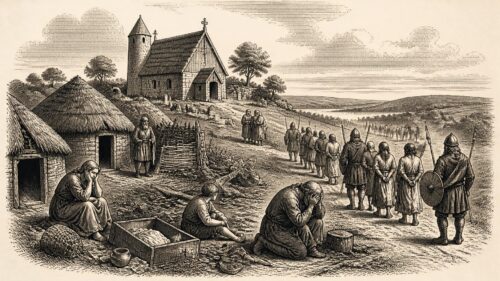
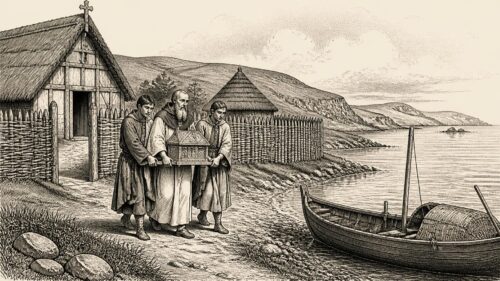
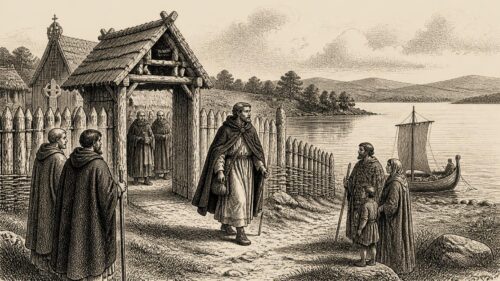
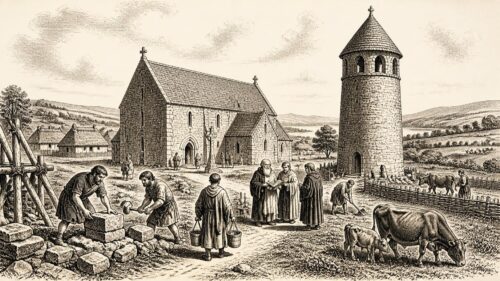
The wider church was deeply woven into everyday life. Monastic enclosures included churches, burial areas, workshops, storehouses, livestock and cultivated ground, while clergy and lay dependants formed sizeable communities. Their scriptoria and schools preserved Latin learning, Irish literary culture, genealogies and annalistic memory. The fact that the year survives at all is part of that achievement. Yet monastic wealth and strategic location also made church centres unavoidable partners, prizes or refuges in secular politics.
A divided island, not a silent one
Later annals attach additional obituaries and political notices to 821, including the death of Artrí, king of Cashel, in the Annals of Inisfallen and a report in the Annals of the Four Masters that Murchad was deposed by Niall Caille. These should be handled differently. Artrí’s death belongs securely to the annalistic tradition for this period, though Feidlimid son of Crimthann had already taken the Cashel kingship in an entry dated 820, suggesting a contested or transitional succession. Murchad’s deposition is generally placed in 823 by modern scholarship; it should not be treated as a firmly dated event of 821 merely because the much later Four Masters place it there.
No major Viking raid is recorded in the principal 821 entries used here. That silence does not mean raiding ceased, nor that communities on the coast were safe. Scandinavian attacks had already begun in the late eighth century and would become more sustained during the following decades. In 821, however, the surviving evidence directs attention elsewhere: weather severe enough to transform travel, rival Irish rulers competing in Brega, and conflicts from Connacht to Bréifne that cost local leaders their lives.
The year therefore offers no simple story of centralisation or collapse. It shows a connected island in which winter weather, ecclesiastical institutions and regional warfare shaped one another. Ard Brecáin, Brega and the frozen waters were not marginal details: together they reveal how power in early medieval Ireland depended on moving people, animals, goods and allegiance through a contested landscape.
Primary Sources
- The Annals of Ulster, Year U822 (AD 821)
- The Annals of Ulster
- Annals of the Four Masters, Part 65
- Annals of the Four Masters
- Annals of Inisfallen
- Annals of Inisfallen, Corpus of Electronic Texts Edition
- Chronicon Scotorum, Part 78
- Chronicon Scotorum
- Chronological Synchronisation of the Irish Annals
- The Chronology and Sources of the Early Irish Annals
- Niall Caille
- Conchobar
- Fedelmid (Feidlimid)
- Muirgius
- The Vikings in Ninth-Century Ireland: Sources and Settlements
- Mapping Social, Ideological and Economic Transformations: Settlement and Landscape in the Early Medieval Kingdom of Brega, AD 400–1100
- Early Christian Monasteries
- Patrician and Early Christian Architecture
- Annals of Inisfallen to Go on Public Display in University College Cork
- The Annals of Inisfallen: Library Catalogue Record