Death at Áth Dá Ferta819 CE
In 819, Áed Oirdnide, northern Uí Néill king of Tara, ravaged Cualu and reached Glendalough before dying near Áth dá Ferta in Mag Conaille. His death ended a long pursuit of supremacy but did not create a unified Irish kingdom. Conchobar son of Donnchad of Clann Cholmáin succeeded him, amid rivalry between Cenél nÉogain and Cenél Conaill, in which Máel Bresail was killed. Other conflicts claimed Cairell in Ulaid, while Leinster lost Cathal of Uí Cheinnselaig, prior of Ferns. At Armagh, Whitsun rites were disrupted. Ecclesiastical obituaries underline churches’ political, social and learned importance, while rural communities endured warfare’s burdens.
Dateline
In 819, the political map of Ireland did not change because a single kingdom conquered the island. It changed because Áed Oirdnide, the dominant northern Uí Néill ruler of his generation, died while still campaigning, and because several other struggles exposed how contingent power remained. The year’s annals record a Leinster ravaging, deaths and victories among northern dynasties, a killing within Ulaid, and an interrupted Whitsun observance at Armagh. Taken together, they show a society in which kingship, armed followings, churches and dynastic memory were tightly interwoven.
There is an important warning about dates. The Annals of Ulster and Chronicon Scotorum place the principal sequence under 819. The much later Annals of the Four Masters place some of the same notices two annals earlier, under 817, reflecting the well-known chronological difficulties of Irish annalistic transmission rather than securely demonstrating a separate campaign. The discussion here therefore treats the events as belonging to 819 where the principal contemporary-style annalistic tradition does so, while distinguishing disagreement where it matters.
Áed’s Last Leinster Campaign
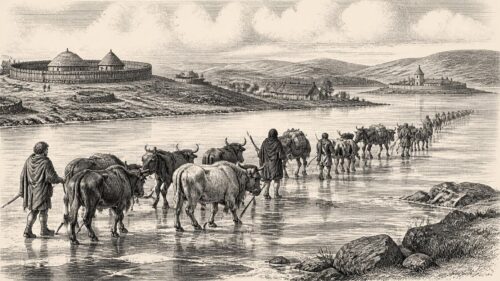
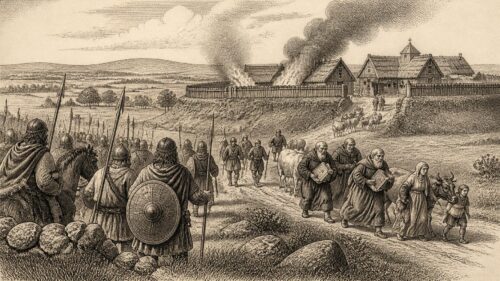
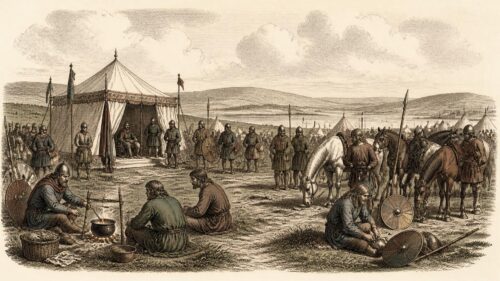
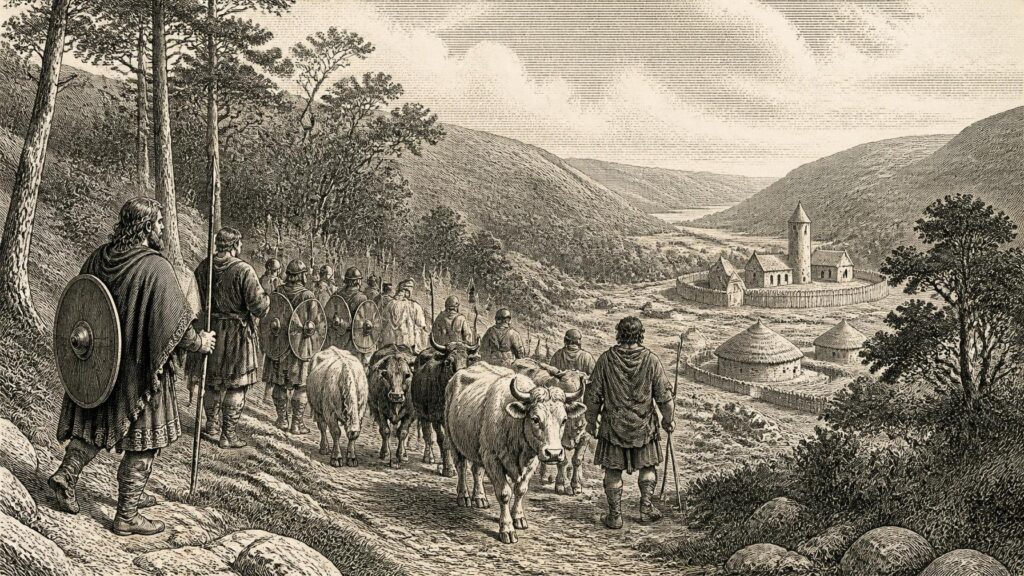
The first major notice is blunt: Áed son of Niall laid waste Leinster, specifically Cualu, the coastal and upland district south of Dublin, as far as Glenn dá Locha, Glendalough. “Laying waste” was not a description of a formal battle with a known field or date. It normally indicates a royal expedition that moved through a rival territory, seizing livestock and foodstuffs, taking hostages or other booty, and demonstrating that local rulers could not protect their dependants. Its impact would have fallen most heavily on farming communities, their herds, storehouses and seasonal labour.
The choice of route was politically expressive. Cualu gave access towards the Wicklow mountains, while Glendalough was one of Leinster’s important ecclesiastical centres. Reaching it did not mean that Áed ruled Leinster directly, still less that the monastery itself was necessarily attacked; the annal does not say so. But it did announce that his army could penetrate far into a province that had repeatedly resisted northern Uí Néill claims. Áed had pursued dominance in Leinster over many years, alternately intervening in its dynastic divisions and using military pressure against its kings. This raid was therefore a final assertion of an established policy, not an isolated act of opportunism.
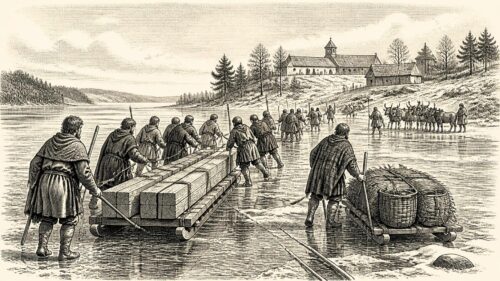
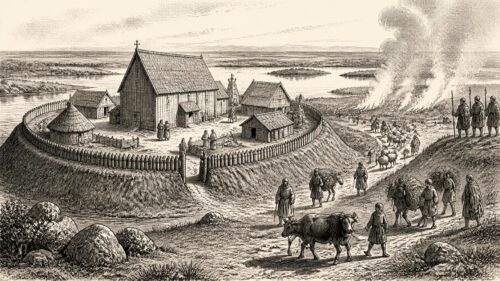
Such expeditions depended on more than warriors. Armies needed provisions, guides, horses, boats where rivers intervened, and a means of driving captured cattle home. For the wider population, the year’s warfare was experienced not as a neat contest between “Ireland” and “Leinster”, but through obligations to local kings and churches, the danger of losing animals, and the burden of feeding armed men. Most people lived in dispersed farmsteads, often within ringforts: enclosed household centres associated with fields, animals and timber or stone-built domestic structures. The annals name the rulers; archaeology helps to recover the rural world that sustained, supplied and suffered from their campaigns.
A King Dies in Conaille
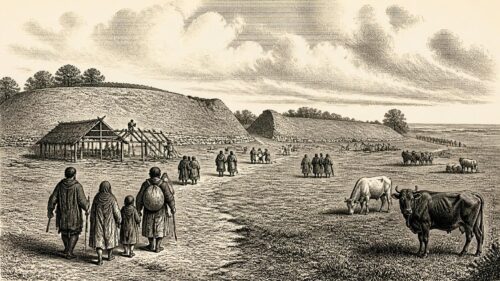
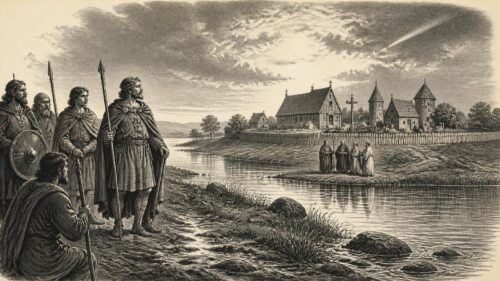
Later in the year Áed died near Áth dá Ferta, “the ford of the two graves”, in Mag Conaille, a territory in what is now north County Louth. The Annals of Ulster commemorate him in elevated language as “Áed the eminent son of Niall of the showers”; Chronicon Scotorum also records his death there. His death came after roughly two decades in which he had held the kingship of Tara and sought to turn northern Uí Néill military strength into island-wide paramountcy. Modern labels such as “high king” are useful shorthand, but should not imply a unitary Irish state. Authority rested on personal lordship, tribute, alliances, hostages, ecclesiastical partnerships and the continuing capacity to lead successful hostings.
A southern annalistic tradition preserves a sharply different version. The Annals of Inisfallen says that Áed, king of Temuir or Tara, died while on a hosting in Alba. That conflict cannot simply be harmonised away. Yet the location at Áth dá Ferta in Mag Conaille is supported by the northern annals and by modern biographical assessment; the Inisfallen notice is generally regarded as mistaken on this point. Neither tradition supplies a firm day of death, the circumstances of the killing, or an eyewitness narrative. Claims that identify a particular assassin belong to later or less secure reporting and cannot responsibly be treated as established fact for this year.
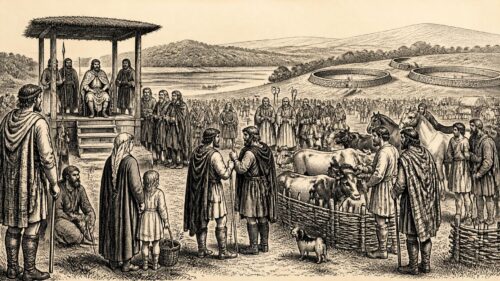
Áed’s passing did not bring an uncontested settlement. Chronicon Scotorum records that Conchobar son of Donnchad began to reign. Conchobar belonged to Clann Cholmáin, the southern Uí Néill dynasty centred on Mide, whereas Áed had been of Cenél nÉogain, the northern branch based around Ailech. The succession thus transferred the Tara kingship across the Uí Néill’s northern–southern divide. It was a significant political adjustment, but it was not a peaceful constitutional handover in a modern sense. The new ruler inherited a network that had to be maintained by negotiation and force, while Áed’s own descendants and wider northern kindred retained substantial power.
Conflict Within the North
The instability surrounding the succession is visible in the same annal. A skirmish between Cenél nÉogain and Cenél Conaill killed Máel Bresail son of Murchad, king of Cenél Conaill; Murchad son of Máel Dúin was victorious. Both groups belonged to the northern Uí Néill, but shared ancestry did not prevent rivalry. Cenél Conaill occupied much of the north-west, while Cenél nÉogain’s power lay further east and north. The annal’s compact notice offers no battlefield, motive or casualty total, so it should not be inflated into a decisive civil war. It does, however, demonstrate that the death of a powerful Cenél nÉogain overking did not suspend competition among northern elites.
The identity of the victor matters beyond this single clash. Murchad son of Máel Dúin later succeeded to the kingship of Ailech, the position Áed had held within Cenél nÉogain. The 819 victory can therefore be seen as part of the immediate rearrangement of northern power, although the evidence does not allow us to say that the skirmish was fought specifically to choose Áed’s successor. In early medieval Ireland, royal succession commonly involved several overlapping claims: descent, seniority, control of followers and the ability to prevail in precisely such confrontations.
Ulaid and Leinster Losses
Elsewhere, the annals report “a skirmish between the Ulaid themselves”, in which Cairell son of Fiachna fell and Muiredach son of Eochu was victorious. Again, the wording is revealing. Ulaid was not a single obedient bloc but a region and constellation of competing dynasties in the north-east. The notice does not licence certainty about the contenders’ wider programme, yet it records a local victory and death at a moment when northern politics were particularly fluid.
Leinster also lost Cathal son of Dúnlang, described both as king of Uí Cheinnselaig and prior of Ferns. His double designation is especially valuable. Uí Cheinnselaig was a major south-Leinster dynasty, while Ferns was one of its principal churches. Cathal’s career illustrates that ecclesiastical office and aristocratic status could meet in one person; monastery and church were not remote from politics, but were bound into lordship, landholding, learning and commemoration. His death occurred in the same year as Áed’s destructive advance through Leinster, but the annals do not claim that the two were connected.
Whitsun at Armagh
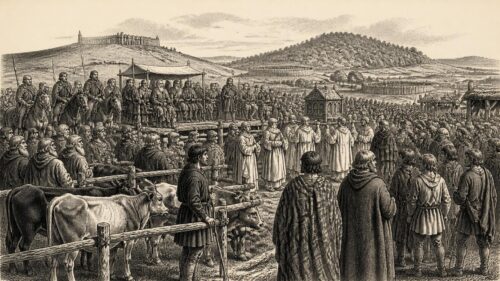
The most precisely dated Irish notice of the year concerns Armagh. On Whitsun, 5 June, the feast was not celebrated publicly and Patrick’s shrine was not taken on its customary circuit; during a disturbance, the son of Echaid son of Fiachna was killed. This is a remarkable entry because it records not merely an elite death but a disruption of public religious practice at Ireland’s foremost Patrician church. The annalist supplies no explanation for the cancellation, no name for the dead man, and no account of responsibility. It would be wrong to invent a riot, a dynastic plot or a particular disagreement.
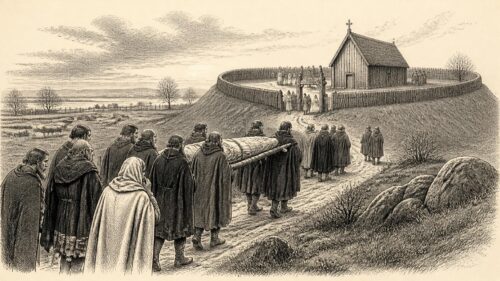
Nevertheless, the notice makes clear that liturgy, relics and public order could not be separated. The movement of a shrine made a saint’s authority visible in the landscape and assembled clergy and laypeople around a prestigious institution. Its suspension would have been noticed well beyond the church enclosure. Armagh’s association with the northern Uí Néill was already politically important in Áed’s lifetime, and his burial there after death reinforced that relationship. Yet the Whitsun disturbance also cautions against imagining the church as merely a royal instrument: it had its own personnel, ritual calendar, possessions and claims to protection.
Churches, Learning and Ordinary Continuity
Other obituaries preserve the quieter institutional texture of 819. Crunnmáel son of Ailill, superior of Damlíag, and Muiredach son of Crunnmáel, abbot of Dísert Ternóc, died; Fothad of Othan also died. The Inisfallen annal adds Rechtabra son of Muchthigern, abbot of Imlech Ibuir. These are brief notices, but they show that the annalists considered ecclesiastical succession worthy of record alongside kings and battles. They also indicate a connected learned culture in which houses across the island maintained offices, communities and memories.
Irish churches of this period were often substantial settlements rather than isolated buildings. Enclosures could contain churches, burial places, workshops, dwellings, livestock and cultivated ground; monastic communities participated in local economies even as they practised prayer, teaching and manuscript culture. That broader setting should not be mistaken for a detailed description of any particular site in 819. It does, however, explain why the deaths of abbots and superiors mattered socially as well as devotionally. The year’s records survive because literate ecclesiastical communities compiled and transmitted them, selecting events that touched kingship, violence, sanctity and their own institutions.
Thus 819 stands as a hinge rather than a clean break. Áed Oirdnide’s last ravaging of Leinster demonstrated the reach of his authority; his death at Áth dá Ferta showed its mortal limits. Conchobar’s accession, the northern skirmish, conflict in Ulaid and the interruption at Armagh reveal an Ireland of powerful regional dynasties and equally consequential churches. For most inhabitants, continuity endured in fields, ringforts, cattle and local obligations. But the deaths and disturbances recorded that year altered the people through whom political protection, religious patronage and communal order were negotiated.
Primary Sources
- The Annals of Ulster, Year U819
- The Annals of Ulster: CELT Edition and Bibliography
- Chronicon Scotorum, Annal CS819
- Chronicon Scotorum: CELT Bibliographical Information
- Annals of Inisfallen, Annal AI819
- Annals of Inisfallen: CELT Project Record
- Annals of the Four Masters
- Translated Texts at CELT
- Áed Oirdnide
- Áed Oirdnide mac Néill: (d. 819), high-king of Ireland
- Annals of Tigernach: CELT Project Record
- The Annals of Tigernach
- List of Published Texts at CELT
- Irish Texts at CELT
- Early Medieval Farmsteads
- Ireland’s Field Monuments
- Churches and Ecclesiastical Enclosures / Shéipéil agus Ráthanna
- Early Christian Monasteries
- Literacy and Identity in Early Medieval Ireland
- Early Christian Ireland: Introduction to the Sources
- Vikings in Ireland and Scotland in the Ninth Century
- A Chronology of Ireland