Cnoc Báine and Heaven-Fire772 CE
In 772, despite chronological uncertainties in the annals, Donnchad Midi of Clann Cholmáin led a hosting to Cnoc Báine in Airgialla, projecting Midland power northwards amid changing Uí Néill leadership. Connacht lost Áed Aithgén of Uí Maine and Art of Aidne, while the law of saints Comán and Aedán was renewed across its three divisions. On St Michael’s Day, lightning, thunder and heaven-sent fire terrified an assembly, prompting widely observed penitential fasts. Airlid of Clonard, Máel Aichthen of Cluain Eidnig and Suibne of Iona died, illustrating ecclesiastical networks linking Ireland, regional politics and the wider Columban world beyond its shores.
Dateline
The Irish record for 772 is unusually vivid, though it requires careful handling. The principal cluster of notices appears under the Annals of Ulster’s entry U772, whose internal AD synchronism points to 771: a familiar problem in early Irish annalistic chronology rather than a reason to discard the material. Modern historical reference works conventionally place Donnchad Midi’s expedition to Cnoc Báine in 772. The year can therefore be approached as a securely connected sequence of events, while recognising that some annal headings and later compilations do not align perfectly with a modern calendar.
What emerges is not a single national story but a set of pressures felt in several regions: a powerful Midland ruler displayed force in the north; two Connacht kings were killed; a saint’s law was renewed across Connacht; leading churchmen died; and, at an assembly on St Michael’s Day, a violent storm or fiery celestial phenomenon provoked a remarkable collective fast. In a politically divided island, religious observance, royal action and public fear could all become matters of countrywide significance.
Donnchad’s Northern Hosting
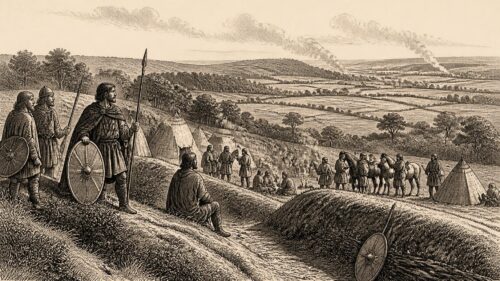
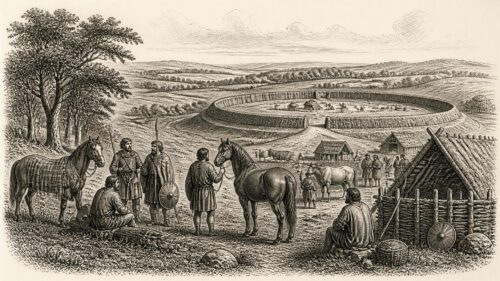
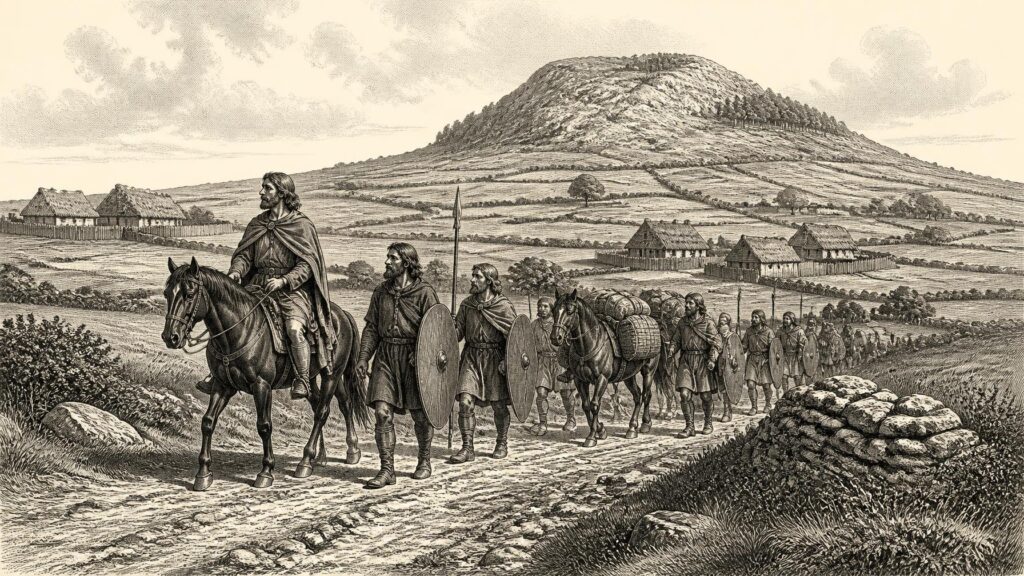
Donnchad Midi, son of Domnall Midi of Clann Cholmáin, led a hosting to Cnoc Báine, identified with Knockmany in present-day County Tyrone. The annal gives no battle, surrender or list of hostages. “Hosting” nonetheless meant more than a journey: it denoted the mobilisation and movement of a king’s armed following, supported by subordinate rulers and local provisions. Such a progress could demand allegiance, threaten opponents, collect dues or demonstrate that an overlord could bring men into contested territory.
The destination matters. Cnoc Báine lay in Airgialla, near the political world of the northern Uí Néill. Donnchad’s own base was in the Midlands, centred on Clann Cholmáin power in Mide. His movement northwards was therefore a public assertion that his influence was not confined to his home province. It came during a transition in the kingship of Tara. Niall Frossach of Cenél nÉogain had held the leading Uí Néill position from 763, but Donnchad’s power was rising sharply. Historians disagree over whether Niall’s effective kingship ended around 770 or only after this northern expedition in 772. What is clear is that Donnchad’s march belongs to the struggle through which he became the dominant Uí Néill ruler.
The absence of a recorded clash is itself informative. Early Irish kingship depended not only on decisive battles but on persuasion backed by military capacity. A host visible on the roads, drawing supplies from allied territories and encamping near an important hill could alter political calculations without producing the sort of slaughter that annalists usually recorded. It would be unsafe to claim a conquest of Airgialla or Tír nÉogain in 772. The evidence supports something more precise: Donnchad projected power into the north at a moment when the balance within the Uí Néill was shifting.
The St Michael’s Day Alarm
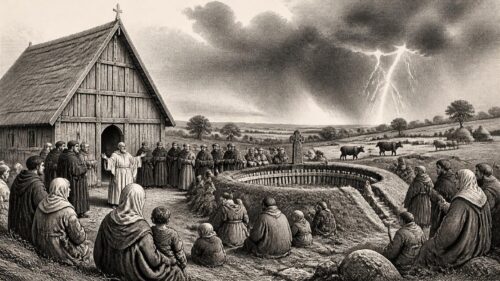
The most striking notice of the year concerns an assembly described in translation as that of the “hand-clapping”. Its exact character is uncertain. The annalist may have used a name or expression whose meaning is now obscure; it should not be turned into a confidently reconstructed festival. Yet the entry is unusually exact about one point: on St Michael’s Day, 29 September, there was lightning and thunder “like the day of judgment”, and the gathering was associated with fire coming from heaven.
Modern readers may think of a severe electrical storm, perhaps accompanied by a lightning strike and fire. That is possible, but the annal neither identifies a location nor allows a modern diagnosis. Its wording instead records how the phenomenon was experienced: as terrifying, extraordinary and charged with eschatological meaning. Thunder and lightning were natural events, but a sudden destructive display at an assembly could be understood as a warning from God. The phrase comparing it to the Day of Judgement is not meteorological description alone; it reveals the religious language through which danger was made intelligible.
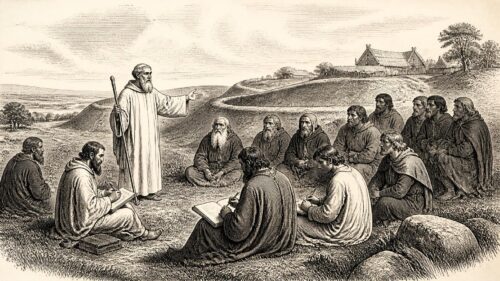
The response was extraordinary in scale. The annalist says that “the Irish” undertook two fasts of three days, separated by a single meal, through fear of the fire. This should not be read as proof that every inhabitant of Ireland observed an identical regimen. Annalistic shorthand often gives a whole people to a mobilisation promoted by kings, churches and major communities. Even so, the wording strongly suggests a widely proclaimed penitential response. Fasting was a disciplined social practice, not merely private devotion: it could bring communities together, seek divine protection and publicly acknowledge collective vulnerability.
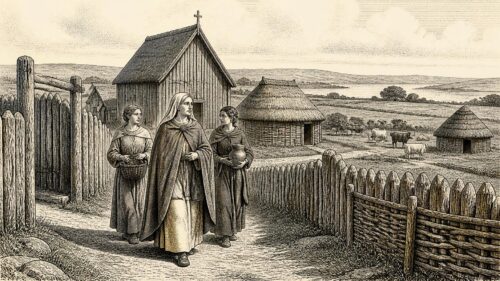
The episode offers a rare glimpse of ordinary experience behind the names of rulers and abbots. People in settlements, monasteries and royal territories could have heard reports of the event spreading outward from the assembly. Clerics had the authority to frame fear as a need for penance; local leaders could encourage observance; households had to alter eating routines. The annals preserve no individual voices, no damage assessment and no account of the weather after 29 September. They do preserve the fact that an alarming phenomenon was considered serious enough to change behaviour on an island-wide scale.
Connacht’s Kings and Saintly Law
While Donnchad was active in the north, Connacht suffered a double political loss. Áed Aithgén, king of Uí Maine, and Art son of Flaithnia, king of Aidne, were killed. Uí Maine occupied a broad territory east of the River Shannon, spanning parts of modern east Galway and south Roscommon; Aidne lay further west and south, in the region later associated with south Galway. The annal does not say who killed the two kings, whether they fell in the same encounter, or what succession followed. Any attempt to supply those details would go beyond the evidence.
Still, the pairing is significant. Kingship in eighth-century Ireland was layered. A ruler of Uí Maine or Aidne was a king within his own people and territory, but also operated amid stronger provincial dynasties, church federations and rival kindreds. The deaths of two such rulers could unsettle local alliances, inheritance and control of land, cattle and clients. They also demonstrate why “Connacht” should not be imagined as a unitary kingdom. It was a region of competing dynasties, among them the Uí Briúin, Uí Fiachrach and Uí Maine, whose interests did not always coincide.
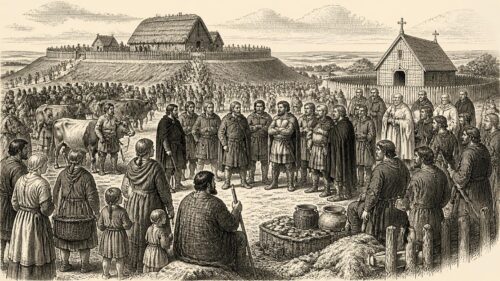
Against that background, the second enforcement of the law of Comán and Aedán over the “three Connachts” is especially important. This was a saint’s law: an ecclesiastically sponsored legal and devotional settlement whose authority was attached to holy patrons, probably Comán of Roscommon and Aedán associated with his cult. Such laws were periodically proclaimed or renewed, often with the co-operation of secular rulers. They could protect church interests and vulnerable persons, impose penalties, regulate conduct and generate obligations or payments for the saint’s community. Their exact provisions are not preserved in the brief annal notice, so it would be wrong to define them as a single modern-style statute.
Its second enforcement nevertheless signals institutional reach. A law articulated through saints could cross the boundaries of individual túatha and speak to the three traditional divisions of Connacht. In a year of killings among regional rulers, its renewal offered a language of order stronger than one dynasty’s immediate fortunes. That did not make Connacht peaceful. Rather, it shows churchmen and kings using religious authority to organise society across a large area.
Church Networks and Fragile Memory
Church life appears throughout the record. Airlid, abbot of Clonard, died; the Annals of Inisfallen independently record his death. Clonard, in the Boyne valley, was an established ecclesiastical centre with a long reputation for learning. The death of an abbot mattered not simply because a pious individual had gone, but because an abbot directed land, dependants, worship, hospitality and the community’s place within wider political networks. The Annals of Ulster also note the death of Máel Aichthen, abbot of Cluain Eidnig, though the surviving notice offers no further biography.
The same annal records the death of Suibne, abbot of Í, or Iona. Iona stood off the west coast of Scotland but belonged to a Columban ecclesiastical world deeply connected with Ireland. Its abbots travelled to Ireland, its dependent churches and political relationships crossed the sea, and its intellectual influence reached well beyond the island monastery. Suibne had visited Ireland before succeeding fully to the abbacy. His death therefore marked a change in an institution whose authority was both religious and transmarine. It is a reminder that Irish history in 772 cannot be confined to the modern island’s shoreline.
Another source, the Annals of Inisfallen, records the death in its entry for 772 of a different Suibne, abbot of Armagh, as well as Airlid of Clonard and Cluichechair of Cenn Mara. The coincidence of names is a warning against careless conflation. Annals preserve short, selective notices compiled and copied over generations. They are indispensable evidence, but they demand comparison: the Suibne of Iona in the Ulster annals and the Suibne of Armagh in the Inisfallen record were not automatically the same man.
The year closes, in the surviving notices, with the killings of rulers, the deaths of abbots and an unnamed Lergus son of Dub Comair. There is no secure basis for a fuller story of harvests, trade, disease or building in 772. Yet the evidence that does survive is unusually revealing. It shows a society in which armed hosts made political claims, local kings could die suddenly, saints’ laws bound regions together, monasteries linked Ireland to Iona, and an awe-inspiring storm could lead communities to fast in fear of heaven-sent fire.
Primary Sources
- The Annals of Ulster: Year U772
- CELT Project: The Annals of Ulster
- The Annals of Ulster: Year U769
- The Annals of Ulster: Year U770
- The Annals of Ulster: Year U771
- The Annals of Ulster: Year U773
- The Annals of Ulster: Year U780
- Annals of Inisfallen: Part 33
- CELT Project: Annals of Inisfallen
- Annals of the Four Masters: Part 60
- CELT Project: Annals of the Four Masters
- Donnchad Midi
- Niall Frossach
- Sléibíne
- Dicuil (Dícuil(l))
- CELT Project: The Annals of Tigernach
- The Annals of Tigernach
- CELT Project: Chronicon Scotorum
- Chronicon Scotorum
- The Céli Dé and Ecclesiastical Government in Ireland
- Exploring the Irish Annals
- The Annals Attributed to Tigernach