Oak-Mast After Drought773 CE
In 773, securely dated by a December lunar eclipse, Ireland experienced exceptional drought and heat, causing widespread failure of staple bread-grain. Abundant oak-mast, or acorns, offered limited relief, particularly through pig fodder, but did not erase subsistence pressures. Donn Cothaid, king of Connacht, died, prompting a dynastic transition later associated with Flaithrí of the Uí Briúin. Annals also recorded deaths of Maenach of Sláine, scribe Dainél of Letuba, several abbots and bishop Aedán, Lerthan, abbess of Kildare, and Áed of Rechru. These notices reveal interconnected environmental, political and ecclesiastical vulnerabilities, while preserving only limited detail about local consequences for communities.
Dateline
A Year Fixed by Sky and Scarcity
The evidence for Ireland in 773 is unusually concentrated, yet unusually revealing. The Annals of Ulster record the death of a provincial king, the passing of leading churchmen and an abbess, the loss of a scribe, an exceptional failure of bread-grain, a subsequent crop of acorns, and a darkened Moon in December. It is not a narrative of a single campaign or royal assembly. Instead, it gives a cross-section of a society whose political authority, religious institutions and household survival all depended upon fragile networks of land, food and patronage. The annal’s heading preserves an old chronological form which can look one year adrift to a modern reader, but synchronisation work treats these entries as belonging to 773; the December lunar eclipse is a particularly valuable anchor for that conclusion.
The annals should nevertheless be read carefully. Their short notices are not a census of everything that happened, nor do they explain every connection between their entries. A death notice establishes that a person died in the year assigned by the chronicle; it does not automatically reveal the cause, the succession arrangements or the scale of local disruption. Likewise, the report that almost all “bread-grain” failed is powerful contemporary testimony, but it should not be enlarged into an unsupported claim that every crop, every district or every household suffered identically. What can responsibly be said is that the annalist considered the weather and cereal shortfall grave enough to deserve island-wide notice.
Heat, Failed Grain and Woodland Food
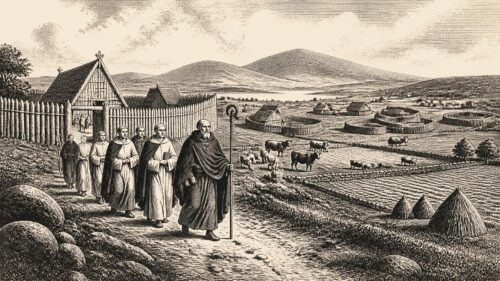
The year’s central entry reports “unaccustomed drought and heat of the sun”, followed by the failure of nearly all bread-grain. In an overwhelmingly rural Ireland, that was a threat to daily subsistence rather than a mere inconvenience to landowners. Archaeobotanical research shows that early medieval cultivation included especially hulled barley and oats, with wheat also present; grain was processed into food and drink, while its cultivation was bound up with the work of ploughing, sowing, harvesting, grinding and storage. A poor harvest therefore affected not only meals but rents, dues, hospitality, brewing, seed for the following season and the ability of households to meet obligations to secular lords and ecclesiastical communities.
“Bread-grain” should not be treated as a precise modern agricultural category. The annalist’s wording conveys the failure of cereals intended for staple food. It does not tell us whether drought damaged crops at germination, during growth or near harvest, nor does it allow a numerical reconstruction of yields. Nor does the record prove a general famine mortality in 773. Its force lies elsewhere: it preserves the perception that ordinary grain supplies had been severely compromised. In a society where many people lived at dispersed farmsteads, and where access to stored grain varied greatly with status and local ties, such a setback would have sharpened existing inequalities. Those with stock, stores, dependants or powerful patrons may have endured differently from tenants, labourers and the poor.
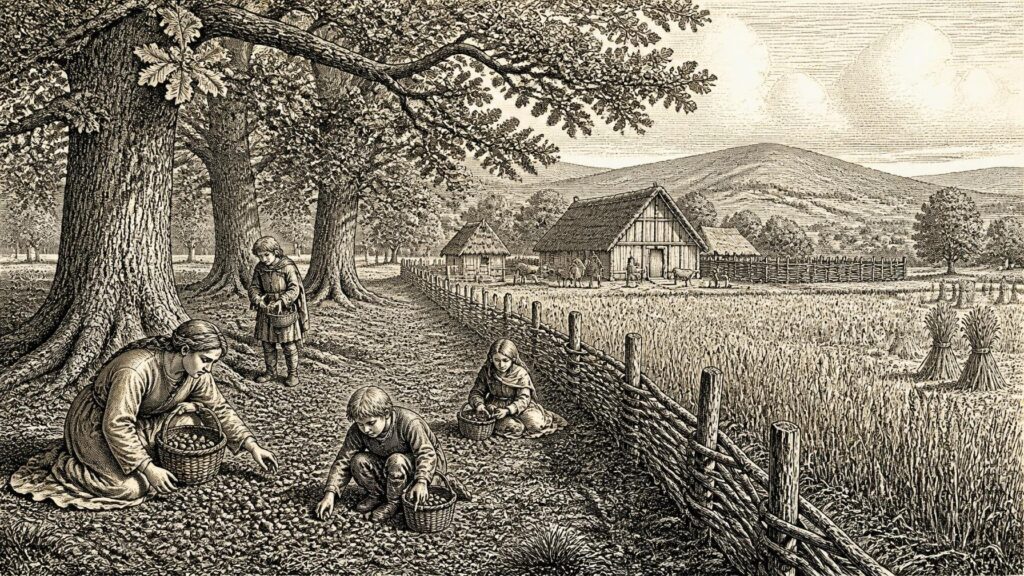
The annalist immediately adds a counterpoint: there was an abundance of oak-mast afterwards. Oak-mast means the seasonal crop of acorns. This was not a replacement for bread in any simple sense, but it mattered in a mixed farming economy. Acorns could feed pigs, and woodland resources could ease pressure on households whose grain had failed. The juxtaposition of failed bread-grain and plentiful mast captures a practical logic of resilience: a bad arable season might be partly mitigated by resources outside the cereal field. Yet it also underlines vulnerability. Reliance on woodland fodder was an emergency advantage of a diversified landscape, not evidence that the harvest failure had ceased to matter.
There is broader environmental context, but it must remain context. Research combining annalistic weather reports with palaeoenvironmental evidence identifies climatic instability and changing agricultural conditions in later eighth- and ninth-century Ireland. That does not make the drought of 773 a proven symptom of one single island-wide climatic mechanism, and it cannot supply details the annal omits. It does, however, caution against imagining early medieval farming as static or insulated from weather. The 773 notice belongs to a record tradition in which climate, livestock, crops and food supply could all become matters of public historical concern.
Connacht Without Donn Cothaid
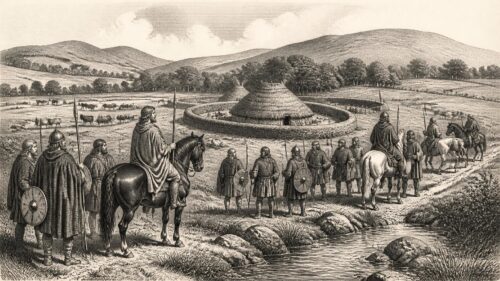
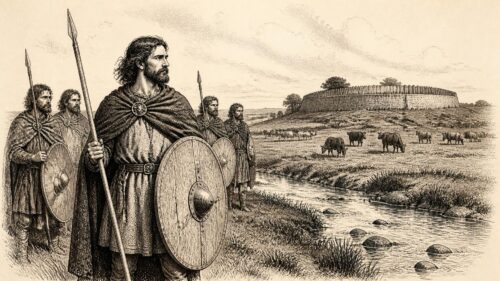
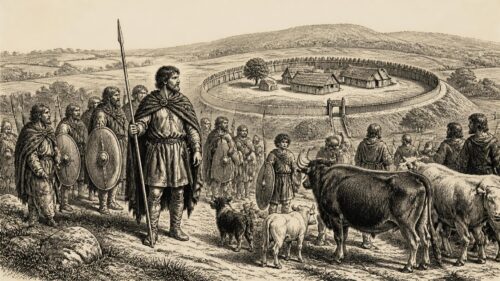
Political change came with the death of Donn Cothaid, called king of Connacht by the annalist. Connacht was not a modern province governed through a fixed bureaucratic state. Kingship rested on kinship, military following, clientship, control of resources and recognition among competing dynasties. Donn Cothaid belonged to the Uí Fiachrach Muaidhe, a northern Connacht lineage associated with the Moy region. His death ended a short period in which that branch held the overkingship of Connacht. Scholarly reconstructions place Flaithrí son of Domnall of the Uí Briúin in the kingship after him, marking a return of the provincial throne to a rival Connacht dynasty.
That transition should not be dramatised as a recorded battle or coup: the annal gives only Donn Cothaid’s death. Still, a king’s death was inherently political. It reopened questions about hostages, alliances, subordinate rulers and access to the revenues of important territories. The coincidence of succession with a serious grain failure may have made the year more difficult for communities across Connacht, but the sources do not state that the two events were connected. The responsible conclusion is narrower: 773 brought both an environmental shock and a change at the summit of Connacht’s regional kingship.
Churches, Learning and Local Leadership
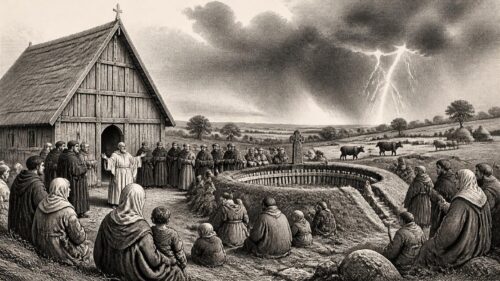
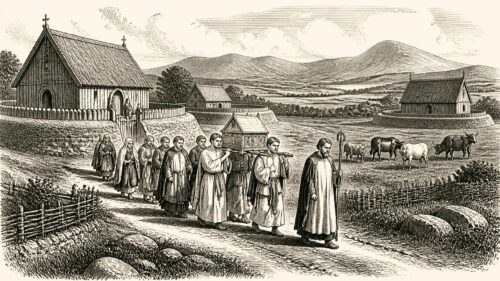
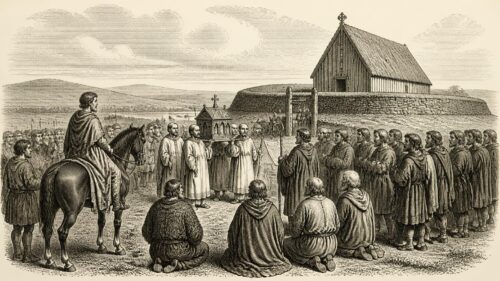
The cluster of ecclesiastical deaths illustrates the density of institutions woven through Irish society. Maenach son of Colmán, abbot of Sláine and Cell Fhoibrich, died “from the bloody flux”. The phrase describes a severe symptom, not a diagnosis that permits modern certainty about the illness. His paired titles indicate authority extending beyond one place. Sláine, in the Boyne valley of Brega, was a major church settlement, and an abbot’s death concerned more than a small enclosed religious household. Such offices could carry spiritual prestige, landholding, dependants, learned personnel and connections to ruling families.
Dainél grandson of Foiléne, described simply as scribe of Letuba, also “rested” in 773. The notice is brief, but it is important. A scribe was part of the human infrastructure that sustained books, legal and genealogical learning, liturgy, correspondence and record-keeping. Letuba’s location is uncertain, and it would be unsafe to turn the entry into a firm map reference. Its inclusion nevertheless shows that scholarly labour itself was considered worthy of annalistic commemoration. Ireland’s surviving annals are the descendants of such literate institutional worlds, even though the manuscripts now preserving them are much later than the events they report.
Three further male ecclesiastics died: Martin of Inis Eidnech; Aedán, bishop of Mag Eó; and Ceithernach grandson of Erumain, abbot of Cluain Ferta Brénainn, now Clonfert. Their titles point across the island’s religious geography, from an island church to a bishopric in the west and a major Shannon-side foundation. These were not necessarily communities of uniform, enclosed monastic life. Irish churches could be sizeable settlements, sites of worship, learning, production and exchange, closely entangled with local politics. The deaths in 773 therefore mark turnover in institutional leadership, although the annal does not name successors or describe any resulting disputes.
Lerthan, abbess of Cell Dara, or Kildare, also died. Her inclusion is significant because it records a woman holding recognised senior authority at one of Ireland’s foremost ecclesiastical centres. Evidence for women’s religious communities is uneven, but scholarship stresses that large early Irish monasteries could resemble small villages in their social complexity; women’s houses and double communities were part of that landscape. Lerthan’s death must not be used to reconstruct Kildare’s internal life in detail, yet it confirms that an abbess there was important enough for the annalistic record.
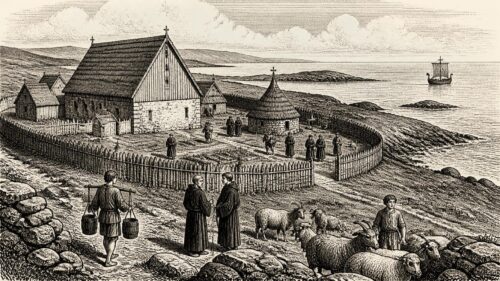
The final religious death was that of Áed son of Cairpre, superior of Rechru, conventionally identified with Rathlin Island off the Antrim coast. Even if the title princeps is translated cautiously as superior rather than made to mean a later office, it points to leadership in a maritime ecclesiastical community. Taken together, the notices from Sláine, Kildare, Mag Eó, Clonfert, Letuba and Rechru show that 773 was remembered not only through kings and weather, but through personnel whose work bound local churches into wider networks of learning, devotion and landed support.
The Dark Moon of December
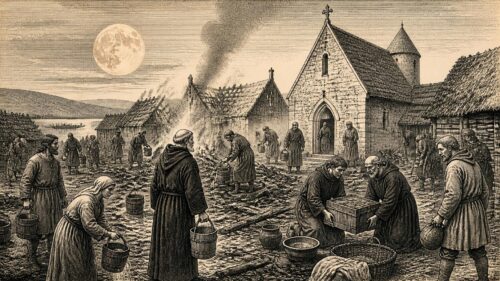
On 4 December, the annalist recorded a “dark moon”. This is understood as a lunar eclipse: when the Earth stands between Sun and full Moon, its shadow falls across the lunar surface. The event is more than a striking image. Astronomical observations can test annalistic chronology, and the eclipse associated with 773 is one reason scholars regard the dating of this otherwise difficult stretch of the Annals of Ulster as secure. For people who saw it, the darkening Moon was a memorable celestial occurrence; the source does not tell us what explanations, fears or religious interpretations any particular Irish community attached to it.
Thus 773 can be approached as a year of pressure and transition rather than as an invented story of national crisis. Drought damaged the staple grain supply, while oak-mast offered a limited seasonal resource. Connacht lost its king. Churches and communities across Ireland lost abbots, a bishop, a scribe and Kildare’s abbess. In December, an eclipse gave the year a dateable marker in the sky. The annals do not allow us to hear every household’s experience, but they preserve enough to show how closely environment, subsistence, authority and learning were joined in early medieval Ireland.
Primary Sources
- The Annals of Ulster: Year U773
- The Annals of Ulster: Irish and Latin Text, Year U773
- CELT Project: The Annals of Ulster
- Chronological Synchronisation of the Irish Annals
- Exploring the Irish Annals
- The Chronicle of Ireland: Then and Now
- The Annals of the Four Masters
- Early Medieval Farming and Food Production: A Review of the Archaeobotanical Evidence from Archaeological Excavations in Ireland
- Making Hay While the Sun Shines? Socio-economic Change, Cereal Production and Climatic Deterioration in Early Medieval Ireland
- The Archaeology of Livestock and Cereal Production in Early Medieval Ireland, AD 400–1100
- Reassessing the Irish ‘Monastic Town’
- Nuns in the Large Women’s Monasteries
- The Social Roles of the Early Irish Monastery of Kildare and Its Paruchia within the Kingdom of Leinster
- The Céli Dé and Ecclesiastical Government in Ireland
- Genealogical Tables of Medieval Irish Royal Dynasties
- The Life of St Cainnech of Aghaboe
- Hidden Voices: The Archaeology of the M8 Fermoy–Mitchelstown Motorway
- Ecclesiastical Architecture Before 1169
- Eclipses and the Moon
- NASA Lunar Eclipses of History