Tóim Snáma’s Fall769 CE
In 769, annalistic dating varied, yet records depict regional conflict. Donnchad Midi’s Uí Néill army camped at Ráith Ailinne for seven days and ravaged Leinster’s borderlands, while Cellach of Leinster later won at Áth Orc amid internal provincial struggles. Battles also affected Brega, Dublin Bay and south Leinster. In Osraige, King Tóim Snáma was killed after recent dynastic fighting. Conchobar of Aidne and Torpaid of Corcu Modruad died, alongside prominent churchmen, including abbots of Clogher and Clonmacnoise. The sources reveal fragmented kingship, military mobility and vulnerable communities. Tallaght’s foundation remains uncertain, and adjacent notices cannot securely be assigned to 769.
Dateline
For Ireland in 769, the surviving record is unusually revealing precisely because it is difficult to date with complete mechanical certainty. The principal contemporary-style annalistic tradition places a substantial group of events beneath a heading whose internal chronological notation identifies the year as AD 769, although the entry is numbered U770 in the Annals of Ulster. The Annals of Inisfallen preserve parallel notices under their own following-year heading. Such variation is normal in medieval Irish annals, where copied chronologies, differing year starts and later editorial work can shift an event by a year. What can responsibly be said is that 769 saw fierce conflict in Leinster and Osraige, a damaging northern intervention in Leinster, and the deaths of regional rulers and churchmen. It was not a year in which a single king ruled a unified Ireland, but one in which several competing powers tested one another across the island.
Leinster Under Pressure
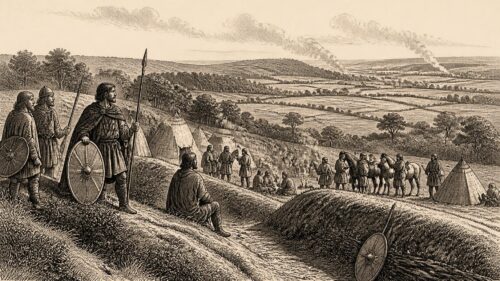
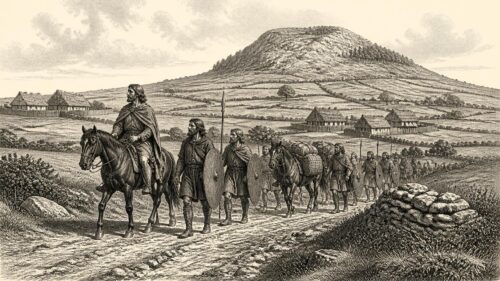
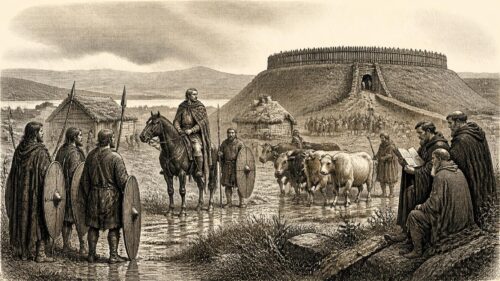
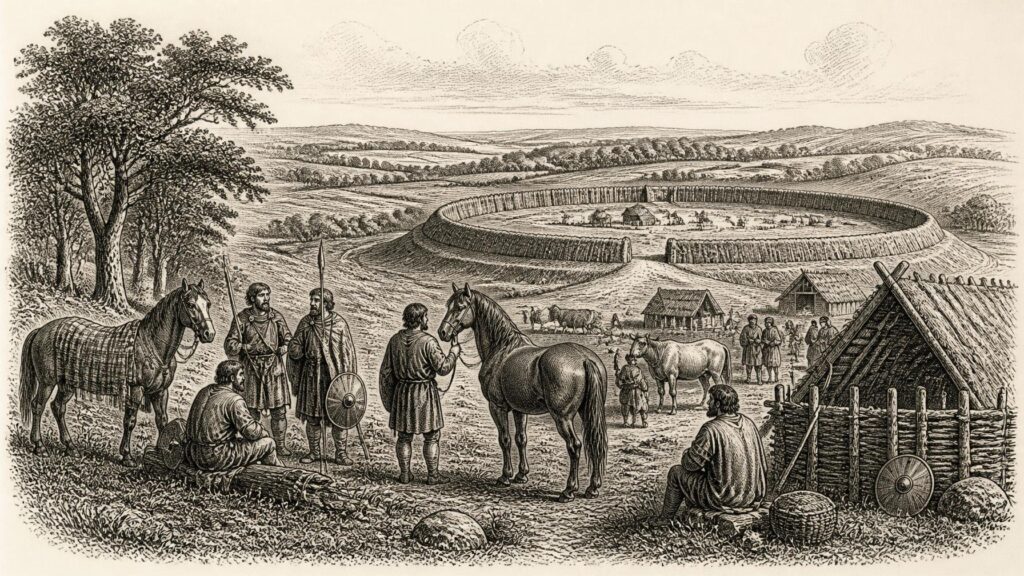
The most consequential campaigning centred on Leinster. Donnchad Midi, king of Mide and leading figure among the southern Uí Néill, encountered Cellach son of Dúnchad, overking of Leinster. Cellach belonged to the Uí Dúnlainge, a dynasty whose strength lay in northern Leinster; Donnchad was of Clann Cholmáin, based in the midlands. Their meeting did not bring a decisive set-piece battle. Instead, the annals say that the Leinstermen avoided Donnchad and moved to Scé Nechtain, while the Uí Néill army remained for seven days at Ráith Ailinne, the great royal enclosure at Knockaulin in modern County Kildare. From there, it burned the borderlands of Leinster.
The language is terse, but its implications are stark. A hosting was an organised military expedition, sustained by food, animals, equipment and the obligations of subordinate rulers. The destruction of “confines” was not necessarily an attempt to seize every settlement permanently. It was a demonstration of superiority, aimed at breaking resistance, extracting submission or tribute, and weakening a rival’s ability to mobilise. Farmsteads, stored produce, grazing and livestock were all vulnerable. For communities near Ráith Ailinne, seven days of an enemy army in the district would have meant flight, concealment and the immediate loss of resources, even where the annals record no individual civilian victims.
Cellach nevertheless showed that Leinster could resist. A battle at Áth Orc, probably in the south of the province, ended with his victory. Cinaed son of Flann and his brother Cellach were killed, alongside Cathnia son of Béc and many others. Later historical interpretation identifies Cinaed as king of Uí Fhailge, a powerful midlands people whose territory lay on Leinster’s western side. The struggle was therefore not simply Leinster against the Uí Néill: it also exposed divisions and rivalries within Leinster itself. Another battle among the Uí Chennselaig, the principal dynasty of south Leinster, killed Ceinnselach son of Bran and left Eterscél son of Áed victorious. Provincial kingship rested on alliances between kindreds, and those alliances could be violently renegotiated while an external army threatened the province.
The Boyne and Dublin Bay
Conflict did not end at the Leinster frontier. The annals report an overthrow of the men of southern Brega at Bolg Bóinne, near the River Boyne, in which several named leaders died. Brega, spread across the rich plains north of the Boyne, was politically divided among branches of the southern Uí Néill. Donnchad’s own expanding authority in Mide could not erase these internal rivalries. The entry is a reminder that political power in eighth-century Ireland was layered: a king might claim pre-eminence over wider territories while facing armed opposition among people who belonged to related dynasties.
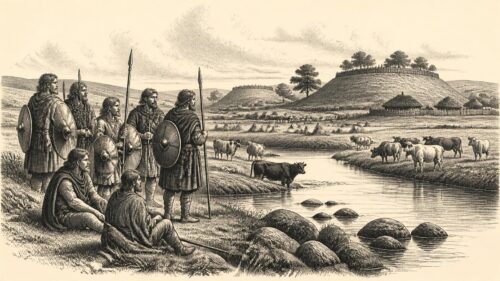
There was further violence at Áth Cliath, the river crossing that would later give Dublin its Irish name. The Ciannachta defeated the Uí Téig; the annalist adds that many Leinster men were slain and that some Ciannachta drowned in the full tide on their return. This is one of the year’s most vivid glimpses of landscape shaping warfare. A tidal crossing could turn a successful raid or battle into disaster. It also shows that the Dublin area, long before the ninth-century Scandinavian settlement, was already a strategic zone where routes, river mouth and coastal waters mattered to neighbouring Irish powers.
The Killing of Tóim Snáma
In Osraige, between Leinster and Munster, Tóim Snáma son of Flann was killed. His death followed closely upon the previous year’s reported victory over the sons of Cellach son of Fáelchar in a battle among the Osraige themselves. The sources do not explain who killed him, where it happened, or whether his death directly resulted from that earlier civil conflict. They do establish, however, that the kingship of Osraige was unstable at a moment when Leinster itself was under severe pressure.
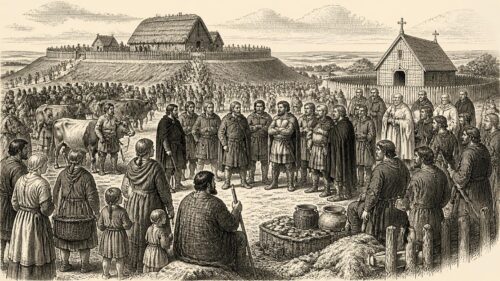
Osraige was no peripheral backwater. Its position around the Barrow and Nore corridors gave its rulers a role in relations between Leinster and Munster, and its royal kindreds had their own ambitions. Tóim Snáma’s killing should not be inflated into proof of a general collapse, but the rapid succession of battle and royal death signals a contested political order. In a society without a standing national army or a fixed law of succession, a ruler’s death could alter obligations of protection, tribute and military service across a wide district. Retainers had to decide whom to follow; dependent communities had to calculate who could protect them; rival branches could seek advantage before a successor secured recognition.
Deaths on the Western Seaboard
The west also saw changes in local rule. The Annals of Inisfallen record the death of Conchobar son of Cumascach, called king of Uí Fhiachrach, while the Annals of Ulster style him king of Aidne. These descriptions need not be contradictory. Aidne was a kingdom in south Connacht associated with a branch of Uí Fhiachrach, and annalists could identify a ruler either by his wider dynastic affiliation or his immediate territory. His death mattered chiefly in Connacht, but it illustrates a larger fact about Ireland in 769: kingship was intensely regional, built through kinship, territory and control of followers rather than through a single island-wide administration.
The same Inisfallen entry notes the death of Torpaid, king of Corcu Modruad, in the Burren region of north Clare. Neither notice supplies a narrative of succession. Yet the recording of both deaths shows the geographical range of the annalists’ interests. Ireland’s political map consisted of numerous peoples and petty kingdoms, whose rulers might be powerful at home while scarcely appearing in accounts of the better-known royal centres of Tara, Cashel or Armagh.
Churches, Literacy and Uncertain Foundations
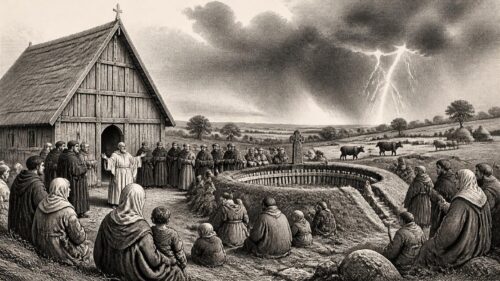
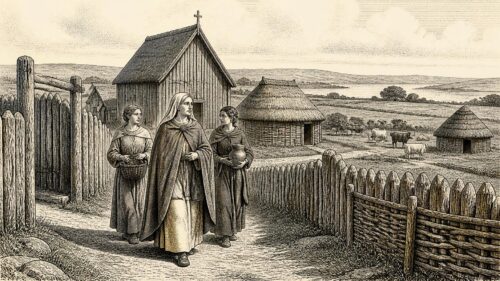
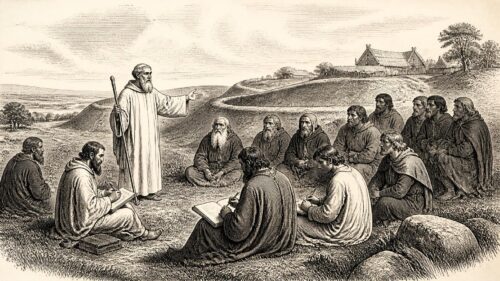
Ecclesiastical communities remained among the institutions best able to preserve memory across regions. For 769, the Ulster annals record the deaths of Artgal, abbot of Clogher; Folachtach, abbot of Clonmacnoise; Bishop Crunnmael of Cell Mór Enir; Connmach, abbot of Cluain Dochra; and an abbot of Fore. Nargal son of Nat Sluaig also died of bloody flux. Such entries do not offer biographies, but their concentration reflects a connected landscape of churches, monasteries and ecclesiastical estates. Abbots and bishops were spiritual leaders, landholders, patrons of learning and political actors whose communities could command labour and maintain links with ruling families.
A caution is especially necessary over Tallaght. The much later Annals of the Four Masters place “the first erection of Tamlacht Máel Ruain” in 769 and also assign several clerical deaths to that year. The claim has rightly shaped Tallaght’s historical tradition. However, modern reference scholarship places Máel Ruain’s foundation at Tallaght in 774, and the documentary basis for an exact 769 foundation is not contemporary. Tallaght would indeed become an important centre of Céli Dé reform, disciplined monastic observance and learning, but that later importance should not turn a disputed annalistic date into a securely dated event. In an account of 769, the reported foundation belongs as evidence of later historical memory, not as certain fact.
A Year Without Easy Certainties
The annals offer no securely dated report of long-distance trade, harvest conditions or major building work for calendar year 769. Nor should notices of earthquake, famine, skin disease and abundant oak-mast placed under the preceding Ulster annal heading be casually transferred into this year. They are important evidence for an adjacent, differently dated annalistic entry, but not firm evidence for 769 itself. The restraint matters. Medieval Ireland’s people certainly depended on mixed farming, cattle, grain, woodland resources and local exchange, but the sources for this particular year chiefly preserve conflict and elite mortality.
What emerges is a country of active regional politics. Donnchad Midi could bring an Uí Néill army to Ráith Ailinne and ravage Leinster, yet Cellach remained in the field and won within his own province. Osraige lost a king amid internal instability. Rulers died in Aidne and Corcu Modruad, while monasteries from Clogher to Clonmacnoise registered the passing of their leaders. The record is fragmentary, but it captures 769 as a year in which power was exercised through movement, armed retinues, vulnerable landscapes, kin-based competition and ecclesiastical institutions capable of remembering all of it.
Primary Sources
- The Annals of Ulster, Year U769
- The Annals of Ulster, Year U770
- Annals of Inisfallen, Annal AI769
- Annals of the Four Masters, Annal M769
- CELT Project: The Annals of Ulster
- CELT Project: Annals of Inisfallen
- CELT Project: Annals of the Four Masters
- Donnchad Midi
- Cellach
- Máel-Ruain
- Fínshnechtae Cetharderc
- Dúnchad
- Áed Oirdnide
- Exploring the Irish Annals
- Chronicon Scotorum
- The Annals of Tigernach
- The Annals of Tigernach: National Library of Ireland Catalogue
- The Annals Attributed to Tigernach
- Prehistoric and Early Christian History of Tallaght
- Saint Maelruain's Church, Tallaght
- From blefed to scamach: Pestilence in early medieval Ireland
- A Seismic Tsunami in the Irish Annals, Recorded at Iona in October 720