Donnchad’s Tailtiu Disturbance774 CE
In 774, Irish annals recorded political unrest, elite deaths, ecclesiastical change and lethal illness across a fragmented yet connected island. A disturbance involving Donnchad Midi, probably at Tailtiu’s major assembly, reflected his contested consolidation of Clann Cholmáin power in Mide and among the Uí Néill, though details remain unknown. Kings of Cruachain Ai, Cenél Fiachach, the Cruithni, Uí Fhidgeinte and Corcu Baiscinn died, illustrating regional succession. Obituaries for abbots, a bishop-scribe and an anchorite demonstrate churches’ social and political importance. A bloody flux killed Eógan son of Colmán and many others, exposing wider vulnerability. No Viking raids were recorded there.
Dateline
A Year Preserved in Brief Notices
The evidence for Ireland in 774 CE is unusually compact but far from empty. The principal contemporary-style record is the annal customarily cited as Annals of Ulster 774. Its entries do not narrate a single national story. Instead, they register deaths, a political disturbance associated with Donnchad Midi, and an outbreak of grave illness. The Annals of Inisfallen, preserving a different and more southern set of notices, adds further ecclesiastical deaths and the passing of two Munster rulers. Taken together, these terse records reveal a country of many regional kingships and church communities, linked by travel, learning and political rivalry, but without a unified state.
Such precision has limits. Medieval annals were compiled, copied and later arranged according to systems of dating that do not always align neatly with the modern calendar. The events discussed here belong to the annalistic year conventionally labelled 774; the sources do not normally provide modern-style dates, locations or explanations. That restraint matters especially for the year’s most suggestive political entry: a short Latin phrase concerning Donnchad, king of Mide and rising king of Tara.
Donnchad and the Interrupted Assembly
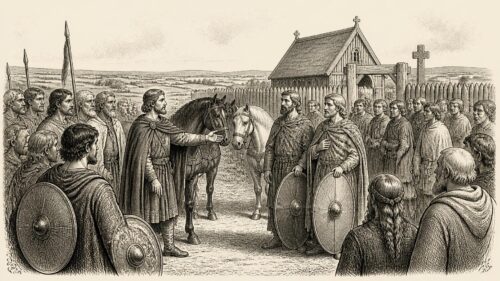
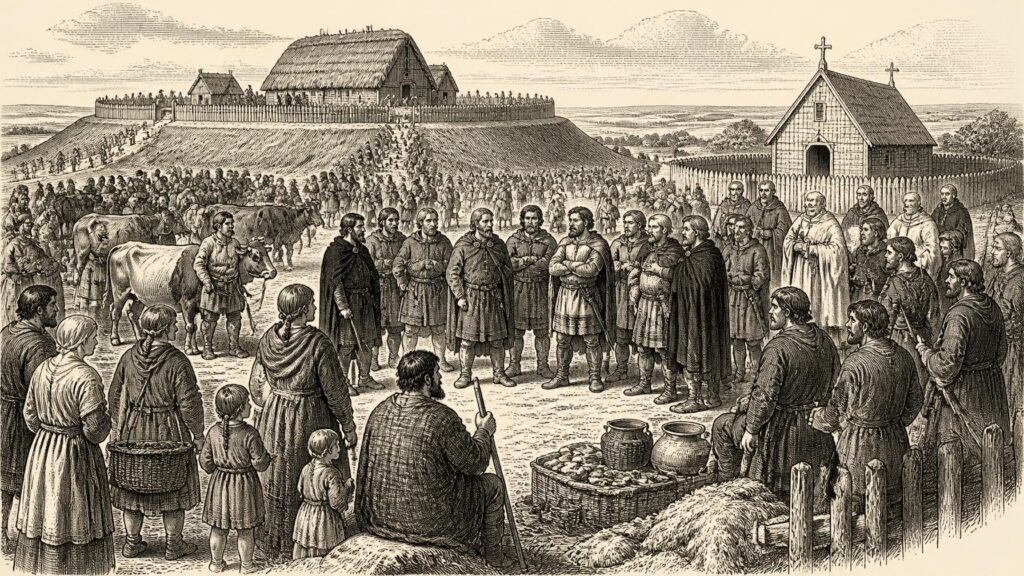
The Annals of Ulster record a comixtio agonis “by Donnchad”: literally, a disturbance or mêlée at a public contest. Later scholarship has plausibly connected this phrase with the great óenach, or assembly, of Tailtiu, now Teltown in County Meath. The identification is an interpretation rather than something the surviving entry explicitly states, and the annal does not name opponents, casualties or a cause. Yet the wording resembles notices for disruptions at recognised assemblies, while Tailtiu lay within the political landscape of Mide.
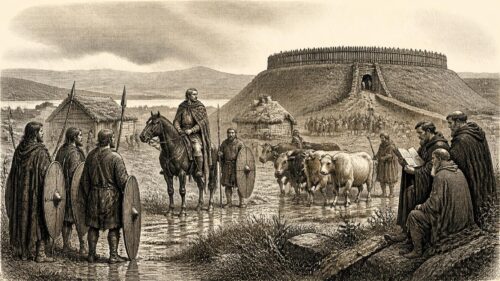
If Tailtiu was indeed the setting, the incident was politically meaningful. An óenach was not merely a fair in the modern commercial sense. It was a gathering where lordship could be displayed and contested, and where social, legal, religious and economic life met. People might come to exchange goods and livestock, arrange marriages and alliances, hear judgements, compete in games, perform genealogies and poetry, or attend religious observances. Control of access, security and ceremonial precedence therefore mattered greatly. A disorder at such a meeting could demonstrate that a ruler could not yet turn prestige into undisputed obedience.
Donnchad Midi, of Clann Cholmáin of the southern Uí Néill, was consolidating power in the midlands during the early 770s. His position in relation to the kingship of Tara was strong but not uncomplicated. Niall Frossach of the northern Uí Néill had recently ceased to exercise effective authority, though the chronology of his displacement and Donnchad’s accession remains debated. Donnchad’s earlier hostings northwards and into Leinster show the breadth of his ambitions. The disturbance of 774 fits that unsettled setting: it signals contention within the political heartland, not proof that all Ireland accepted a single “high king”.
The entry’s silence is itself instructive. Annalists could be remarkably exact when a battle had a name, a victor and prominent dead. Here they supplied none. It would be unsafe to turn the notice into a full battle narrative or to name a rebel faction. What can responsibly be said is narrower: Donnchad was involved in a serious enough public disturbance to be entered in the annals, and the episode belongs to the process by which he asserted Clann Cholmáin authority in Mide and among the Uí Néill.
Deaths Among the Kings
Elsewhere, 774 brought changes at several levels of secular rule. The Annals of Ulster record the death of Tomaltach son of Murchad, king of Crúachu or Cruachain Ai, the royal district in what is now central County Roscommon. Cruachain Ai was a major Connacht political centre, and the death of its king mattered beyond one settlement: kingship depended on kin-group leadership, the collection of renders and military following, and the maintenance of relationships with neighbouring dynasties and churches. The annal does not say who followed Tomaltach or whether his death caused violence. Succession should therefore not be invented from the bare obituary.
Bodbchad son of Ectgus, king of Cenél Fiachach, also died. Cenél Fiachach was one of the important midland populations whose lands and allegiances affected the balance around Mide. Farther north, Flathrua son of Fiachrach, called king of the Cruithni, died. “Cruithni” could denote peoples of north-eastern Ireland rather than a single centralised kingdom, so the notice signals a change in a northern kingship without allowing a modern map of fixed borders to be drawn.
The southern annals add the deaths of Cenn Fáelad, king of Uí Fhidgeinte, and Rechtabra, king of Corcu Baiscinn. These were Munster regional kingships, respectively associated with territories in the modern Limerick area and western Clare. Their paired notice is a reminder that Munster was not one seamless kingdom ruled directly from a single centre. Overkingship rested on negotiations with smaller dynasties, and the death of a local ruler could alter the web of tribute, military service and marriage alliance on which wider power depended.
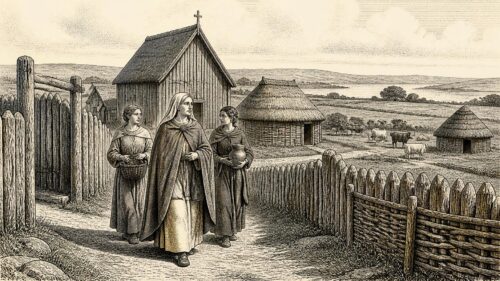
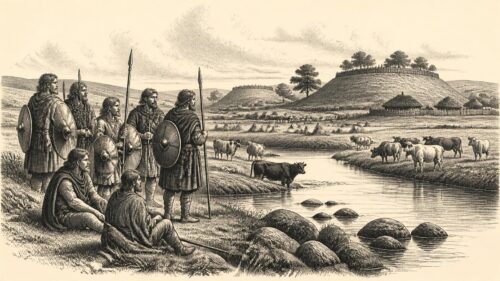
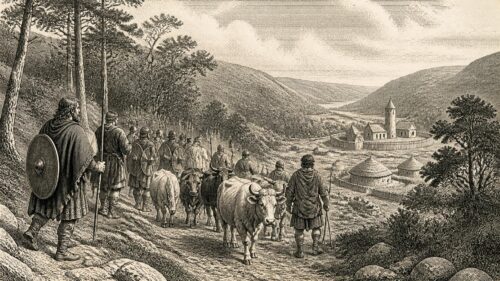
For ordinary households, elite succession was not remote. A new ruler or claimant could mean renewed demands for cattle, food-renders, labour, fosterage or armed support. Most people lived in dispersed agricultural settlements: ringforts and stone cashels served as enclosed farmsteads, while crannógs offered defended residences in some lake districts. Mixed farming supported these communities, with cattle especially important as wealth and as a medium in obligations, alongside crops grown in small fields. None of the annals describes harvests or prices in 774, so there is no basis for claiming either prosperity or famine; the wider settlement evidence simply helps explain the material world in which political changes were felt.
Churches, Scholars and Anchorites
The year’s obituaries show that ecclesiastical institutions were as important to Irish life as royal households. Albrán son of Foidmi, abbot of Trevet or Treoid Mór, died on a Friday “between the two Easters”, a rare attempt at a more particular liturgical dating. Ultán grandson of Bero Deirg, abbot of Othna Mór, Érennach son of Eichne, abbot of Lethglinn or Leighlin, and Forannán, described both as scribe and bishop of Trevet, also died. The combination of offices attached to Forannán is telling: writing was a valued and public skill, while episcopal authority could operate within a monastic-centred church landscape rather than a later parish-and-diocese system.
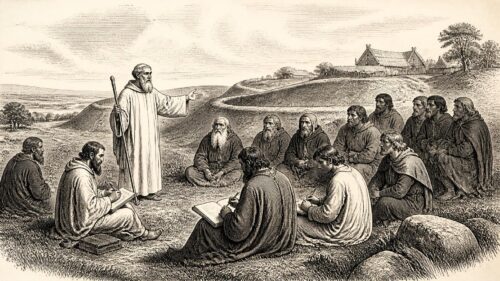
In the south, the Annals of Inisfallen record Selbach of Corcach, Suairlech, abbot of Lismore, and Féilic of Dún Blesce. It is possible that these were deaths or retirements expressed through the conventional language of “rest”; the short notices give little biographical detail. Even so, Lismore’s appearance points to the enduring importance of ecclesiastical centres in Munster. Such communities were places of worship, burial, education, manuscript production and craftwork, but also estates with livestock, crops, tenants and patrons. Their abbots and senior clergy could be drawn from powerful families and were embedded in regional politics.
The annals also note Imraithech of Glenn Cloithe as an anchorite. An anchorite had adopted an ascetic religious life, often associated with retreat, prayer and spiritual authority. His inclusion beside kings, abbots and bishops indicates that holiness could command commemoration alongside secular rank. It should not, however, suggest that every Irish churchman lived in isolation. Large ecclesiastical enclosures accommodated a varied population of clergy, students, craftspeople, dependants and visitors; their churches, workshops, fields and cattle made them active centres within the rural economy.
Illness and Vulnerability
The starkest entry of the year concerns Eógan son of Colmán. He died from a fluxus sanguinis, a “flux of blood”, and the annalist adds that many others died from the same affliction. The wording may describe a severe intestinal disease, but it does not permit a confident retrospective diagnosis. Nor does it identify a locality, season or total number of victims. What is firm is that the illness was sufficiently widespread or alarming to warrant an annalistic notice.
That single sentence offers a rare glimpse of vulnerability beyond the political elite. Epidemic disease could disrupt households, cultivation and travel, and it could expose the dependence of religious communities and rulers on the labour and food-surplus of surrounding populations. Yet there is no evidence that the outbreak caused a general famine, military collapse or demographic catastrophe. The responsible conclusion is more modest: in the same annalistic year that recorded political friction and repeated elite deaths, contemporaries remembered a lethal illness affecting more people than the named individual.
A Fractured but Connected Island
Ireland in 774 was not isolated, static or politically simple. Its records move from Mide and Connacht to the northern Cruithni and the lordships of Munster; they name kings, abbots, a bishop-scribe, an anchorite and a woman, Dúnlaith daughter of Fogartach, whose death was noted without further explanation. These entries reveal networks of remembrance extending across the island. They also reveal the limits of the record: women, cultivators, traders and most local communities appear only indirectly.
There is no Viking raid in the annals for 774; the first recorded raids on Ireland lie two decades later, in 795. The year belongs instead to the last generation before that new pressure transformed coastal and monastic security. Its defining evidence is domestic: Donnchad’s uncertain assertion of authority at a major assembly, succession among regional rulers, the institutional continuity of churches and schools, and an outbreak of deadly disease. In their brevity, the notices preserve a credible portrait of an island whose power was dispersed, whose religious communities were deeply woven into society, and whose people remained exposed to forces that no king could command.
Primary Sources
- The Annals of Ulster: Year U774
- The Annals of Ulster: CELT edition and bibliographical information
- Annals of Inisfallen: Annals AI769–AI779
- Annals of Inisfallen: CELT project edition
- Annals of the Four Masters: Annal M774
- Annals of the Four Masters: Irish text, Annal M774
- Donnchad Midi
- Niall Frossach
- The Fair of Tailtiu and the Feast of Tara
- The Cult of Relics in Early Medieval Ireland
- Exploring the Irish Annals
- Irish Texts at CELT
- Early Christian Monasteries
- The Rural Settlement Pattern
- Rathbeagh Ringfort, Co Kilkenny
- Crannogs / Cránnoga
- Churches and Ecclesiastical Enclosures / Shéipéil agus Ráthanna
- Christian Ireland 5th–8th Centuries
- Waterway Corridor Study: River Shannon, Meelick to Limerick
- Gazetteer of Ireland / Gasaitéar na hÉireann