Donnchad’s Sodden Hosting776 CE
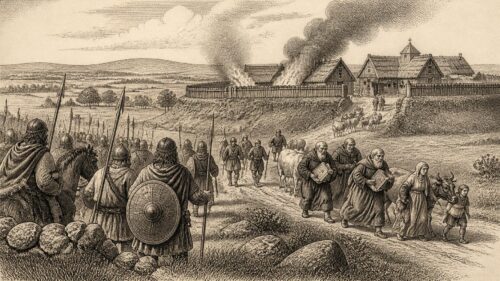
In 776, Irish annals record political conflict alongside severe environmental and health pressures. Donnchad Midi, ruler of Mide, organised a Leinster hosting against Brega, disturbed an assembly involving the Ciannachta, and entered conflict with Congalach, whose later defeat should not be dated to this year. Flaithrí, king of Connacht, died, while skirmishes and killings involved northern and local dynasties. Most strikingly, summer brought heavy rain and wind, described as winterlike, followed by bloody flux, widespread illness and major cattle murrain. These disasters threatened rural livelihoods, tribute and social security. The notices also record death of Bán Boidbgni, a learned man.
Dateline
In the annalistic record for 776 CE, Ireland appears as a country of movement, contention and unsettling weather. A force associated with Leinster was brought against Brega at the instigation of Donnchad, a dispute involving the Ciannachta developed into open warfare, a Connacht king died, and fighting was reported in the north-west. Yet the year’s most vivid notice is neither battle nor kingship. The Annals of Ulster describe a summer that felt like winter: heavy rain and great wind. They then record bloody flux, other diseases approaching a general mortality, and a major murrain among cattle. For communities whose food, wealth and political obligations were intimately bound to land and livestock, this was grave news.
The evidence must nevertheless be handled carefully. Irish annals were compiled and copied over centuries, and their year-numbers do not always align neatly between texts or with a modern calendar. The modern edition of the Annals of Ulster places the following cluster under its entry corresponding to AD 776. The Annals of Inisfallen, compiled in a different milieu, places the death of Flaithrí of Connacht under a neighbouring annal. The secure conclusion is that these were events of this immediate period; the fullest contemporary framework for 776 comes from the Ulster annal.
Rain in the Summer
The annalist’s formula is striking: “the whole winter in summer”, explained as heavy rain and a great windstorm. It is not a modern meteorological report, and it supplies neither months nor measurements. Still, it plainly preserves a season remembered as abnormal and destructive. The phrase conveys more than an unpleasant run of wet days. It evokes a reversal of the expected order of the year, when summer should have offered workable ground, growing crops, drying hay and easier travel.
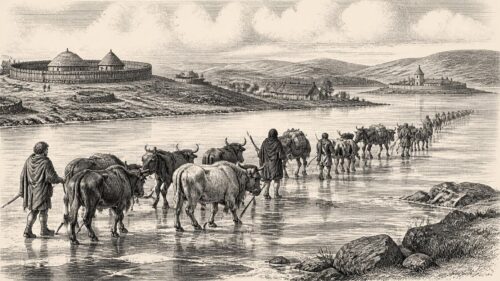
It would be unsafe to calculate a harvest failure from this sentence alone. No surviving entry says that the cereal crop failed, that rivers flooded particular settlements, or that famine followed immediately. But the risks were real. Wet weather could make tracks and fords difficult, interrupt milling and haymaking, diminish fodder quality, and complicate the movement of people, animals and supplies. In an overwhelmingly rural society, a bad season was not merely a backdrop to politics. It shaped the practical capacity of rulers, churches and households to act.
The annal then adds a more direct warning: bloody flux, many other illnesses “almost a mortality”, and a great cattle murrain. Bloody flux probably denotes a severe dysenteric illness rather than a diagnosis identifiable to modern medicine. The wording does not permit a death toll, a pathogen or a precise geographical range. Nor can the diseases be proved to have resulted from the weather. Their juxtaposition, however, shows why the season mattered to contemporaries: human sickness and bovine disease were both serious enough to enter the historical record.
Cattle, Illness and Security
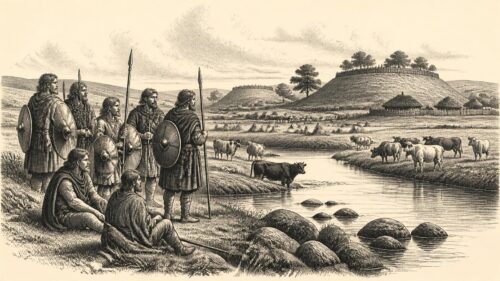
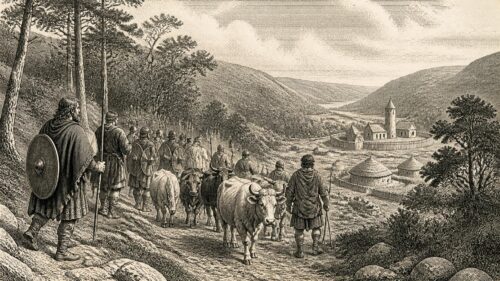
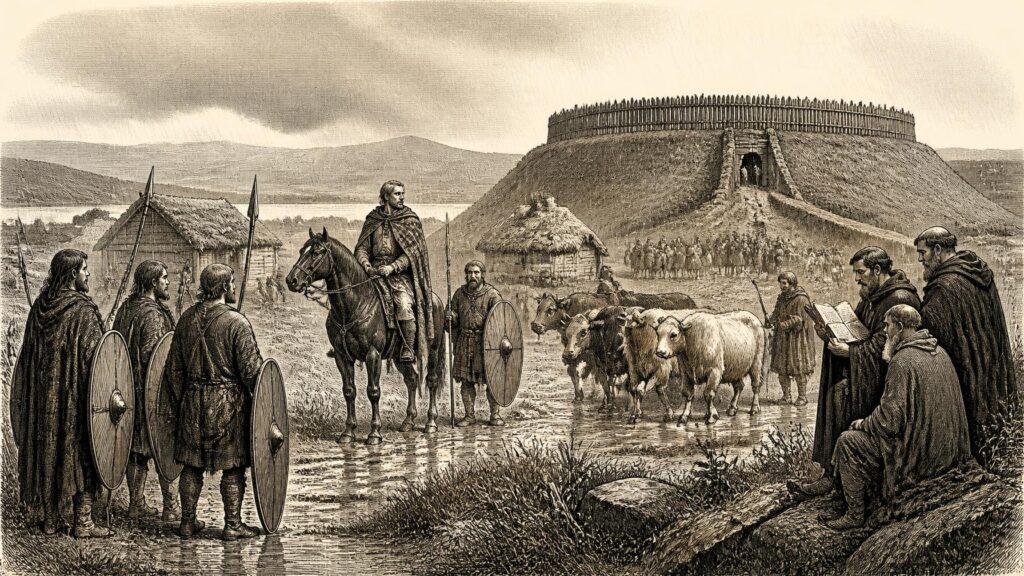
Cattle were not a marginal resource in eighth-century Ireland. They supplied milk, meat, hides, traction and breeding stock; they also measured wealth and helped structure tribute, compensation and political patronage. Archaeology and early Irish legal material alike point to a mixed farming economy in which livestock stood at the centre of household security. A “great murrain of cows” therefore threatened more than food on the table. It could reduce the herds through which families met obligations, maintained status and recovered from hardship.
That does not mean every community suffered equally, or that all trade ceased. Ireland contained many local economies, from enclosed farmsteads and dispersed fields to ecclesiastical settlements with tenants, storehouses, workshops and access to wider networks. Some households had more animals, more land or stronger kin support than others. Yet a widespread cattle disease would have sharpened the vulnerability of poorer dependants and strained the resources of secular and ecclesiastical patrons alike. The annal’s decision to record it alongside human disease is itself a measure of its significance.
Donnchad and Brega
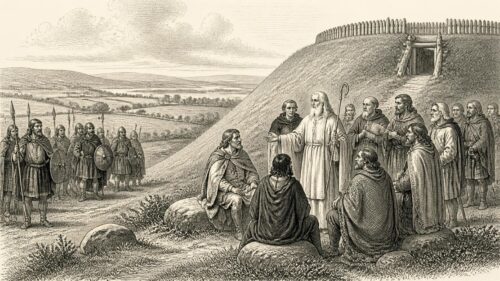
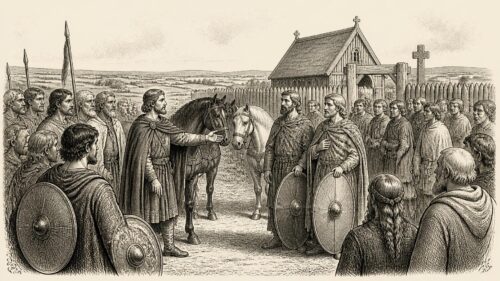
The year’s principal political notice concerns Donnchad mac Domnaill, usually known as Donnchad Midi, ruler of Mide and a leading member of Clann Cholmáin among the southern Uí Néill. The annal records “a hosting of the Laigin by Donnchad against Brega”. A hosting was an organised military expedition, not necessarily a pitched battle. The terse wording does not tell us how the Leinster force was assembled, how long it campaigned, whether it took cattle or hostages, or whether Brega’s rulers submitted. It does establish that Donnchad could bring Leinster into a campaign directed at Brega.
This was politically consequential. Brega, the rich central region around the lower Boyne and Blackwater, was not an empty borderland but a landscape of powerful dynasties, major churches and ceremonial places. Its rulers belonged to branches of the southern Uí Néill as well as related and neighbouring peoples. For Donnchad, intervention there concerned influence in the very heartland from which claims to wider authority could be made. The use of a Leinster force also reveals that political alignments were not fixed blocks. Laigin and Uí Néill had fought fiercely in earlier generations, but rulers could make temporary combinations when advantage required it.
The annal gives no justification for the expedition. It should not be presented as a conquest of Brega, still less as a national war between modern regions. Early medieval Ireland was divided among numerous kingships and lordships, connected through kinship, church alliances, tribute, fosterage and rivalry. Military action could be punitive, demonstrative, opportunistic or designed to alter a local succession. In 776, Donnchad’s move against Brega belongs to this fluid political world.
An Assembly Disturbed
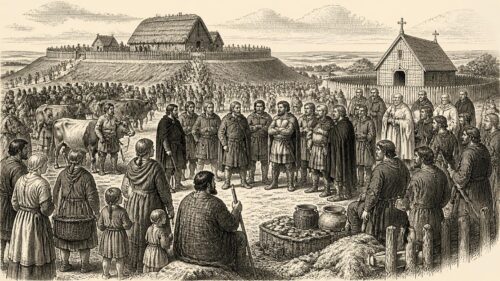
A second entry brings the dispute into sharper focus. Donnchad caused a disturbance at an assembly against the Ciannachta, and the annalist immediately notes warfare between Donnchad and Congalach. Assemblies were places where legal business, political negotiation, proclamation, exchange and public display could meet. To disrupt one was therefore not a minor quarrel. It challenged the authority of those gathered and turned a recognised venue of order into a scene of coercion.
The annal does not name the assembly site, describe speeches, or say whether the dispute began there. Nor does it specify the terms sought from the Ciannachta or from Congalach. We should resist supplying a story that the source does not preserve. What can be said is that the conflict had not ended with the year’s hosting. In the following annal, fighting between Donnchad and Congalach culminates in a battle at Forchalad, where Congalach was killed and Donnchad was victorious. That later outcome demonstrates the seriousness of the tension visible in 776, but it must not be folded back as though the decisive battle itself occurred this year.
Deaths and Smaller Wars
Elsewhere, the annal marks the death of Flaithrí son of Domnall, king of Connacht. A royal death could open questions of succession, clientship and control of tribute, even when the record is silent about the transition. The brevity of the notice is characteristic: it honours Flaithrí’s rank but provides no obituary, cause of death or assessment of his reign. Its preservation nonetheless reminds us that Connacht remained a significant political sphere while the struggle around Brega unfolded farther east.
Two other notices show the reach of conflict below the level of the largest kingships. At Caladrum, Niall and Cumuscach, described as grandsons of Cernach, fought a skirmish in which Échtgus son of Báeth and many others fell. The killing of Cumuscach’s sons at Odra is also reported, with the compressed and unusual verdict that one survived while the other died. A further slaughter set the Uí Fhiachrach against the Calraige. These entries provide few motives or locations, but they make an important point: warfare in Ireland was often intimate, dynastic and local. Not every killing was a clash of provinces; many arose from competitions within related political communities.
Learning, Faith and the Limits of the Record
The death of Bán Boidbgni, called “the learned”, is the year’s sole explicit notice of scholarship. The title signals recognised learning, but the annal does not identify his school, church or writings. It would be tempting to attach him to a famous monastery; the evidence does not allow it. Even so, the description belongs to a society in which literacy, genealogical knowledge, legal expertise, Latin learning and the keeping of historical memory carried prestige.
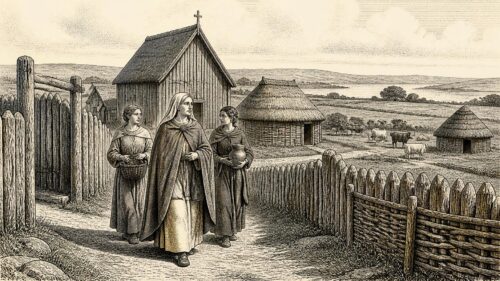
Church communities were deeply woven into this world, but 776 offers no securely dated grand synod, foundation or spectacular ecclesiastical building project. Their importance is better understood as structural. Churches and monasteries were centres of worship, burial, learning, hospitality, production and landholding, while clerics helped preserve the chronological record through which this difficult year is known. The annals chiefly name kings, clerics and violent episodes; they rarely describe ordinary people directly. The wet summer, illness and cattle murrain are consequently precious glimpses of pressures shared far beyond the elite names on the page.
For Ireland in 776, then, the central image is not of a settled island awaiting later upheavals. It is of communities managing rainfall, wind, sickness and animal loss while ambitious rulers contested the middle of the country. Donnchad’s use of a Leinster hosting against Brega and his confrontation with the Ciannachta indicate political reach, but the annal’s sombre final notices suggest the limits of power. Armies could be summoned and assemblies disturbed; neither king nor church could command a sodden season or halt a murrain.
Primary Sources
- The Annals of Ulster, Year U776
- The Annals of Ulster, Year U777
- The Annals of Ulster, Year U778
- The Annals of Inisfallen
- Annals of the Four Masters, Part 61
- The Annals of Ulster: CELT Edition
- TEI Header for Annals of Tigernach
- Annals of the Four Masters: CELT Edition
- Exploring the Irish Annals
- Built to Last: The Leinster Polity and Early Medieval Ireland
- Monasticism and its Limits: Rematerialising Monastic Space in Early Medieval Ireland
- Ringforts
- Farming and Archaeology: The Irish Historic Landscape
- Early Medieval Farmsteads
- Animals and the Economy of Medieval Ireland: A Zooarchaeological Analysis of the Faunal Remains from Caherconnell Cashel, Co. Clare
- Water-Power as a Factor of Industrial Location in Early Medieval Ireland: The Environment of the Early Irish Water Mill
- Technological Change in the Agrarian Economy of Early Medieval Ireland: New Archaeological Evidence for the Introduction of the Coulter Plough
- The Saint and the Sacred Centre: The Early Medieval Pilgrimage Landscape of Inishmurray
- The “Cathedral”, Temple Kelly and Temple Ciarán: Notes from the Annals
- National Monuments Service: Monument Class and Scope Notes