Claenfhinn Before Daybreak703 CE
In 703, Connacht defeated an invading northern Uí Néill coalition at Corann or Claenfhinn, killing Loingsech son of Óengus, styled king of Ireland, his three sons and numerous allied rulers. The battle, probably in south-central Sligo, checked Loingsech’s claim to wider supremacy and preserved Connacht’s autonomy under Cellach son of Rogallach. Annals also record the Ulaid’s victory over Britons at Mag Cuilinn, though details remain uncertain. Colmán, abbot of Lismore, died, while notices mention Ailén Daingen’s construction and Rithe’s siege. These events reveal a rural, contested Ireland where kings, churches and fortified communities managed warfare, resources, mobility and insecure authority.
Dateline
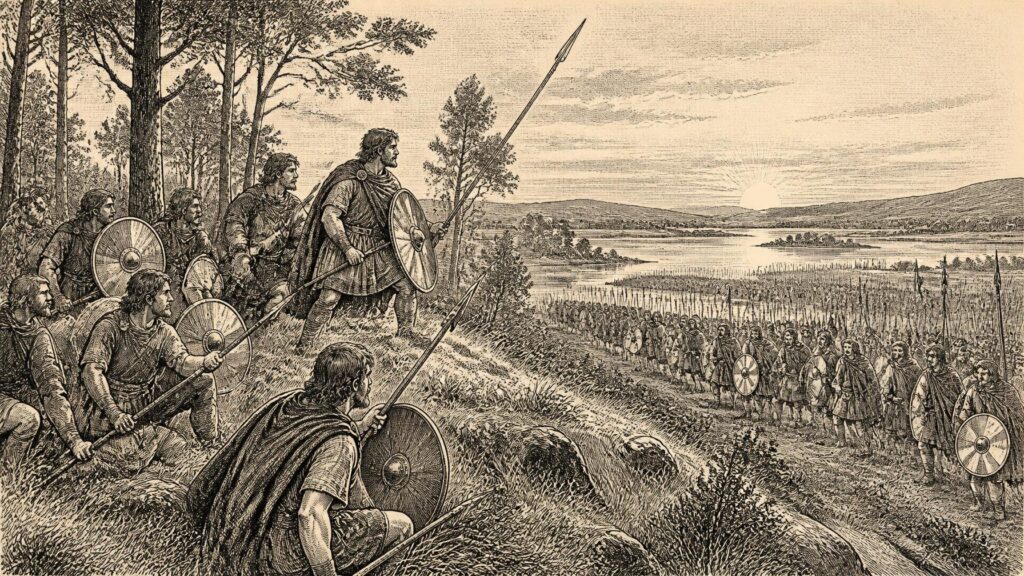
In 703 CE, the Irish annals place a decisive battle in Connacht at the centre of the year: Loingsech son of Óengus, styled rí Érenn, or king of Ireland, was killed at Corann by Cellach son of Rogallach, king of Connacht. The record is unusually exact, saying that the fighting took place on a Saturday, on the fourth day before the Ides of July, at the sixth hour: conventionally, 12 July at about dawn. Yet care is required. The surviving annal manuscripts were compiled later, and the chronological systems of the principal chronicles do not always align perfectly with modern calendar dating. What can be said firmly is that the annalistic year labelled 703 preserves a major Connacht victory and the death of one of early medieval Ireland’s most powerful rulers.
A King Falls at Corann
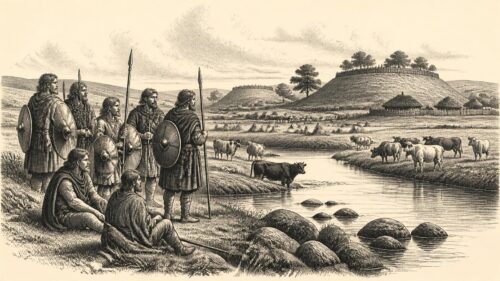
The fullest contemporary-style notice comes from the Annals of Ulster, echoed by Chronicon Scotorum. It identifies the battlefield as Claenfhinn, at the head of Óenach Loga, “between Cenél Conaill and Connacht”. The exact site has not been securely identified, although Corann is generally located in south-central County Sligo. This was a frontier zone between the northern Uí Néill world, from which Loingsech came, and the Connacht kingdom of Cellach. It was therefore a place where an expedition from the north-west could be checked before penetrating further into Connacht.
Loingsech belonged to Cenél Conaill, a leading branch of the northern Uí Néill. His pedigree was important political language: the annal gives his descent through Óengus, Domnall, Áed and Ainmire. But he was more than a regional dynast. The original hand of the Annals of Ulster calls him king of Ireland, one of the comparatively few pre-Brian Bórama rulers to receive that title there. It did not mean that Ireland possessed a centrally administered kingdom. Rather, it signals an exceptionally strong claim to supremacy: the ability to command allies, extract submission or tribute, and intervene far beyond one’s own core territory.
The list of those killed at Corann makes the scale of the reverse unmistakable. Loingsech’s three sons—Artgal, Connachtach and Flann Gerg—fell with him. So too did two sons of Colcu, Dub Díberg son of Dúngal, Fergus Forcraith, Congal of Gabar and “many other leaders”. A further annalistic formulation adds the king of Cairpre Droma Cliab, the king of Uí Chonaill Gabra and ten other kings. Such totals should not be read as a modern casualty return, but they convey the loss of a royal coalition rather than merely a ruler and his household. The defeat damaged a network of client kings and fighting retinues as well as one dynasty.
Invasion, Plunder and Defence
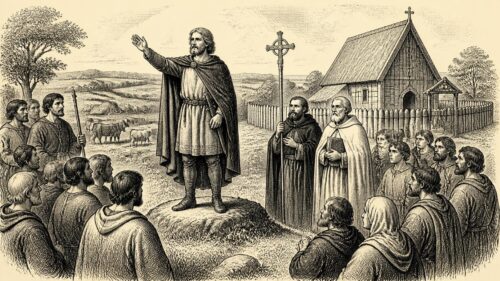
A later narrative source, the Fragmentary Annals of Ireland, supplies a dramatic explanation. It says Loingsech led a great army into Connacht “to destroy and plunder” it, while his poets taunted Cellach as an old and unsteady king who would have to yield. This account also puts three thousand men around Loingsech and depicts Cellach summoning two men named Dúnchad as prospective successors before taking the field. These details are valuable evidence for how the battle was remembered, but they should not be treated as a verbatim report from 703. The work survives in much later form and shapes history through speeches, poetry and moral contrast.
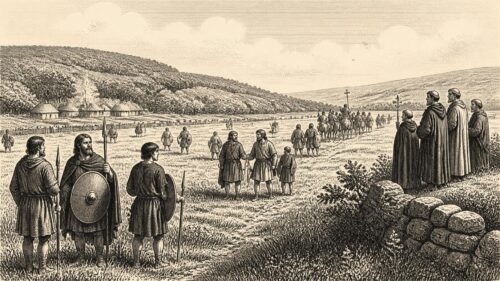
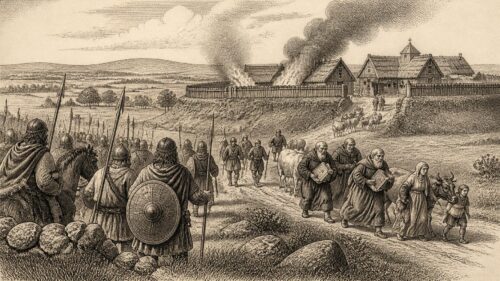
Even with that caution, its basic setting agrees with the shorter annals: an army had crossed into Connacht, and Cellach successfully resisted it. Raiding was not a marginal feature of political life. A royal hosting could seize cattle, food, portable wealth and captives, damage farms, and compel a weaker ruler to give hostages. For ordinary people, the approach of such a force meant urgent decisions about animals, stores, dependants and refuge. The outcome at Corann thus mattered well beyond the named kings. A defended province retained its resources and its political autonomy; a defeated one might lose both.
Cellach is called “of Loch Cime”, linking him to a lake-centred royal landscape in what is now north County Galway. Such names matter because lordship was rooted in particular estates, kin groups and assembly places, not in abstract territory alone. Connacht was itself a patchwork of competing dynasties, and Cellach’s authority rested on the Uí Briúin and on alliances with other Connacht leaders. Corann demonstrated that a Connacht king could defeat an overking claiming authority across Ireland. It did not abolish northern Uí Néill power, but it sharply exposed the limits of that power when a provincial coalition held together.
After the Rout
The political consequences should be measured rather than exaggerated. No annal says that Cellach became king of Ireland after the victory, and the kingship of Tara did not pass to him. In later years the northern Uí Néill recovered influence, while Connacht’s own kingship changed hands. Nevertheless, the death of Loingsech and three sons at once created an immediate succession problem within Cenél Conaill and removed experienced leaders from its allied ranks. Corann was therefore a turning point in the balance between Connacht and the northern Uí Néill, not the creation of a unified Connacht state.
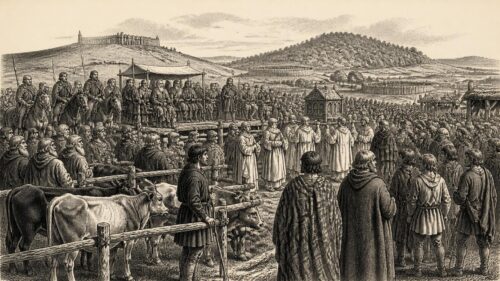
The conflict also stands close to the career of Adomnán, abbot of Iona, whose law for the protection of non-combatants had been promulgated at Birr in 697 with support from Loingsech and many other secular and ecclesiastical leaders. The law’s ideals and the reality of campaigning should not be confused. Its very concern with women, clerics and young people shows that raids and warfare threatened persons considered entitled to special protection. There is no evidence that Cáin Adomnáin governed the conduct at Corann, and its enactment did not end warfare. But 703 reveals the political world in which such legislation sought to restrain violence: one in which rulers could be patrons of church law and commanders of destructive expeditions.
War on the Northern Shore
Another battle recorded under the year lay in the north-east. At Mag Cuilinn in Ard Ua nEchdach, the Ulaid fought Britons and won. The annals say that the son of Radgann fell, characterising him as an enemy of God’s churches. The brevity of the notice leaves crucial matters unresolved: neither the precise location of Mag Cuilinn nor the identity, origin or purpose of Radgann’s force is securely known. It would be unsafe to turn this into a national war between Ireland and Britain. “Britons” could describe a mobile armed group from the Brittonic-speaking regions across the North Channel, and the sea was a route of contact, migration, ecclesiastical travel and conflict.
Still, the entry is an important corrective to any view of early medieval Ireland as isolated. The Ulaid faced a force understood by the annalist as British, while the charge of hostility to churches shows that ecclesiastical communities and their property were politically significant. Churches were places of worship and burial, but they also held land, livestock, learning, skilled personnel and ties to royal families. An assault on them could be framed as both sacrilege and a challenge to local power. The victory of the Ulaid belongs to the year’s wider pattern: regional rulers defending their lands against armed incursions rather than submitting to a durable island-wide authority.
Church, Building and Settlement
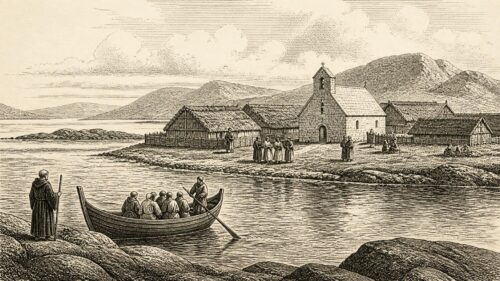
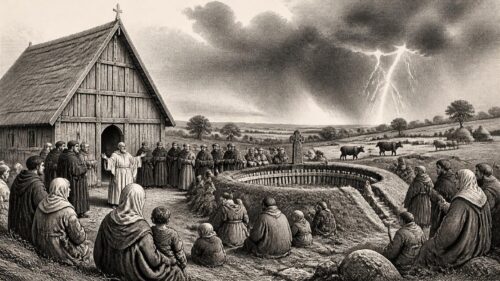
703 also brought the death of Colmán son of Finnbarr, abbot of Les Mór, modern Lismore in County Waterford. The entry gives no biography, but the office itself is revealing. An abbot headed a substantial religious household whose responsibilities extended beyond liturgy: the management of land and food renders, hospitality, teaching, manuscript culture and dealings with local rulers. Colmán had been among the ecclesiastical guarantors associated with Adomnán’s law in 697. His death therefore removed a figure connected both to a major Munster church and to an island-wide legal and religious initiative.
Two smaller notices are equally suggestive but much less intelligible. The annals record that Ailén Daingen was built, and separately note “the siege of Rithe”. Ailén Daingen has not been securely located or identified in the archaeological record. Its name may suggest a fortified place, but the annal does not tell us who built it, where it stood or whether it was an island settlement, a defended residence or another kind of stronghold. Rithe is likewise unidentified, and the notice does not name attackers, defenders or result. These entries are reminders of the limits of the evidence: fortification and siege were important enough to record, but the stories behind them have been lost.
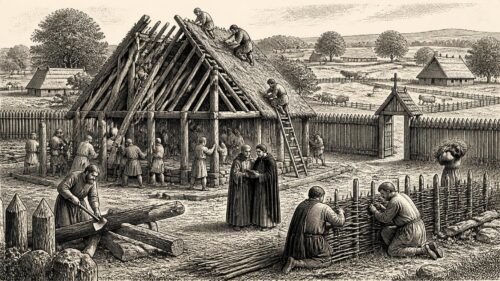
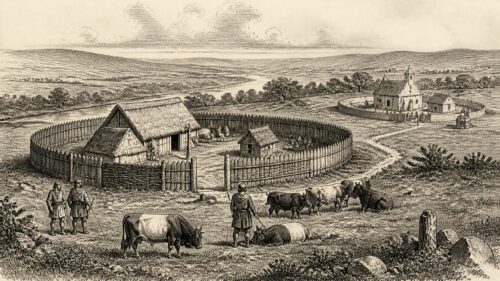
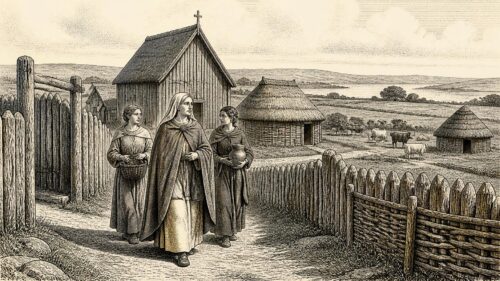
Archaeology helps place such sparse notices in a broader, securely attested setting. Early medieval Ireland was principally rural, with households living among enclosed farmsteads, fields, pasture and woodland. Ringforts were residential agricultural enclosures, while lake settlements and crannógs could offer additional security, status and access to water-borne transport. Building a defended site required timber, labour, food for workers and authority to mobilise them. In a year marked by raids, battles and a siege, the construction of Ailén Daingen—whatever its exact character—fits a landscape in which security, lordship and control of resources were closely connected.
The year’s final named death, Fergussán son of Máelchú, is recorded without title or location. Nothing responsible can be added about him. That restraint is appropriate for 703 as a whole. The evidence gives a sharp view of a few great shocks—above all the dawn battle at Corann—and only flashes of the communities around them. It nonetheless shows an Ireland of powerful but contingent kingships, organised church communities, fortified settlements and constant movement across land and sea. At Claenfhinn, Connacht’s defence against Loingsech’s army made that political fragility visible in a single, violent morning.
Primary Sources
- The Annals of Ulster: Year U703
- The Annals of Ulster: Year 703 (Latin and Irish text)
- Chronicon Scotorum
- Fragmentary Annals of Ireland: Annals FA 157–159
- Fragmentary Annals of Ireland
- Annals of Inisfallen: Annal AI703
- Annals of the Four Masters
- The Annals of Tigernach
- CELT Project: The Annals of Tigernach
- Cellach
- Loingsech
- Adomnán
- Egerton Annals: Mionannala
- Exploring the Irish Annals
- Crannogs / Cránnoga
- The Rural Settlement Pattern
- The Earthen Rath or Lios
- Loughnacrannoge
- The Question of the Etymology of Dunadd, a Fortress of the Dalriadic Scots
- Irish Hagiography and Its Dating: A Study of the O’Donohue Group of Irish Saints’ Lives
- Tracing the Community of Comgall Across the North Channel
- Cáin Adomnáin (Law of Adomnán)