Cúán’s Death641 CE
In 641, Cúán mac Amalgado of the Eóganacht Áine died as king of Munster. The annals record only his death, leaving its cause, location and circumstances unknown. His passing marked a dynastic transition within Munster’s fragmented system of kingships, alliances and tributary relationships. He was succeeded, according to later reconstructions, by Máenach mac Fíngin of another Eóganacht branch. Munster was not governed from a fixed capital, but through personal authority, kinship and regional negotiation. Churches and learned communities supported royal memory and legitimacy, while most people depended on mixed farming, livestock and local exchange.
Dateline
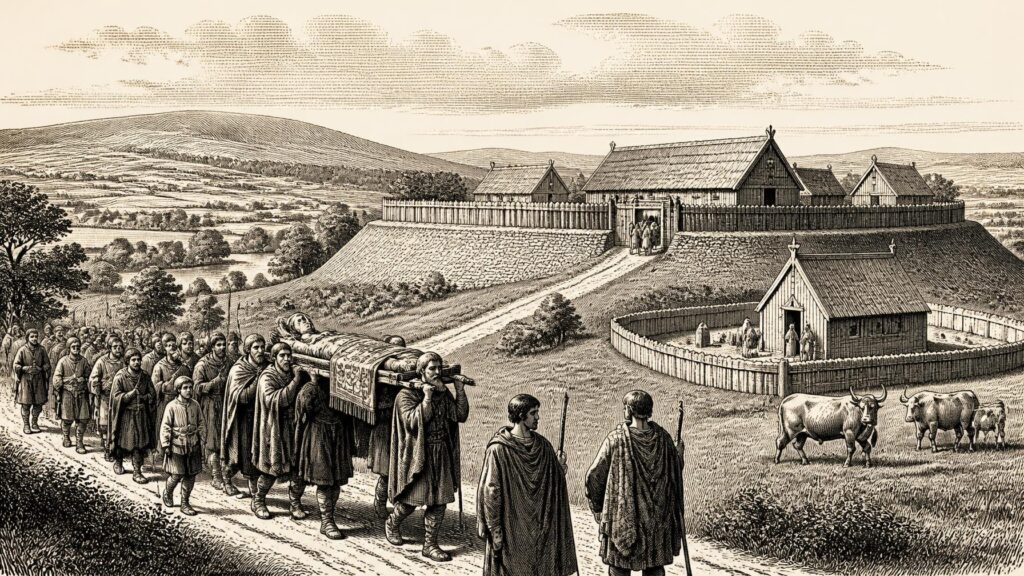
In 641 CE, the securely dateable Irish development is the death of Cúán mac Amalgado, a king of Munster from the Eóganacht Áine branch of the Eóganachta. The surviving annalistic notice is brief: it records his death without a place, cause, successor’s inauguration or account of public reaction. Yet the loss of a provincial overking mattered. In a country of many small kingdoms, Munster’s ruler stood within a dense hierarchy of client peoples, churches, kin-groups and rival royal lines. Cúán’s death therefore marks a real, if sparsely described, transition in the political life of southern Ireland.
A Death in the Annals
The principal early notice appears in the Annals of Tigernach, whose entry for 641 names “Cúán son of Amalgaid, king of Munster” and says simply that he died. Such economy is characteristic of the annals. They preserve a valuable contemporary framework of deaths, battles, ecclesiastical successions and extraordinary occurrences, but they rarely supply the explanations a modern reader wants. We cannot responsibly turn this entry into a deathbed scene at Cashel, a murder, a battle casualty or a formal assembly of succession. None of that is stated.
Dating requires care. The Irish annals were copied, revised and synchronised over centuries; their numbered entries can sit awkwardly beside modern calendar dating. This is especially obvious in the years around 641. Some notices placed under neighbouring annal-years belong, after modern correction, to 639, 640, 642 or later. Cúán’s death, however, is conventionally placed in 641 by modern chronological work and by reconstructions of the Munster regnal sequence. It is therefore appropriate to make him the centre of this year, while avoiding the transfer into 641 of events merely found nearby in a medieval compilation.
Cúán was son of Amalgaid mac Éndai, himself remembered as a king of Munster. The dynasty was not a single unified household but a collection of related Eóganacht branches, each with its own territorial base and claims to precedence. Cúán represented Áine, associated with the district around Knockainey in present-day County Limerick. His short recorded reign followed that of Faílbe Flann and was succeeded, in the usual reconstructions, by Máenach mac Fíngin of another Eóganacht branch. The succession shows both continuity and competition: royal status remained within the wider Eóganacht kindred, but not necessarily in the nearest available line.
Munster Without a Single Centre
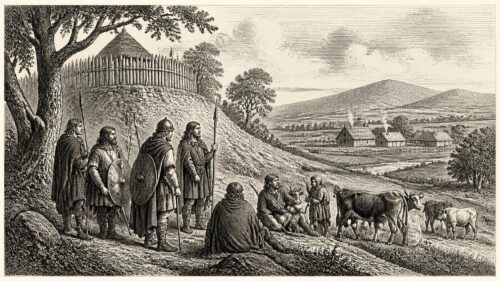
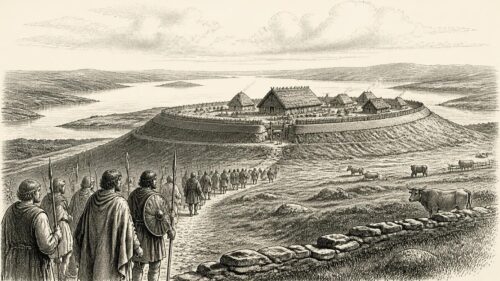
Calling Cúán “king of Munster” should not suggest a state resembling a modern province. Seventh-century Munster contained numerous peoples and petty kingdoms. Its overking exercised authority through personal alliances, tribute, military following, hostages, marriage connections and the recognition of status. The practical reach of that authority varied greatly. A king could be powerful in his own heartland yet depend on negotiation with regional rulers in western Munster, the Shannon region, the Déisi, the Éile and the kingdoms of the south-east.
The royal site of Cashel later became the most potent emblem of Munster kingship, but power in 641 was not administered from a capital city. Ireland had no towns in the later medieval sense. Authority moved with rulers and their households, was expressed at assemblies and inaugurations, and depended upon rights over land, cattle and people. A change of king was consequently more than a family bereavement. It could alter which branch received tribute, which allies secured favour, and whose claims churches and poets might validate.
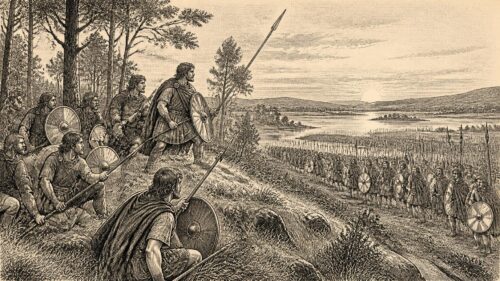
There is no recorded campaign in Munster for 641. That silence is meaningful only in a limited sense: it tells us that the annals preserve no securely dated battle or settlement for the year, not that southern Ireland was wholly peaceful. Raiding and local coercion were ordinary instruments of politics, and the prospect of disputed succession was inherent in a dynasty divided among several branches. The evidence does not identify any challenger to Cúán, nor does it tell us whether Máenach’s accession met resistance. A responsible account must leave those questions open.
Beyond Munster, Domnall mac Áedo of Cenél Conaill remained the leading Uí Néill ruler in Ireland during 641. His authority had been strengthened after the major northern conflict of Mag Roth in 637, but it did not erase the independence of provincial kings. Domnall’s death belongs to 642, not 641, despite misleading placements in some annalistic sequences. In 641, then, Cúán’s death occurred while the northern Uí Néill overlordship was still associated with Domnall, and while Munster’s internal succession remained a southern matter within a wider Irish balance of power.
Churches, Kings and Memory
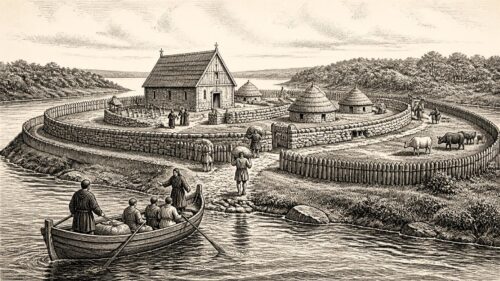
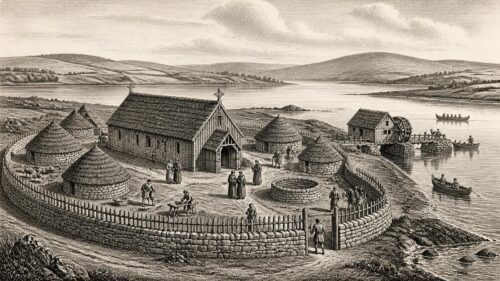
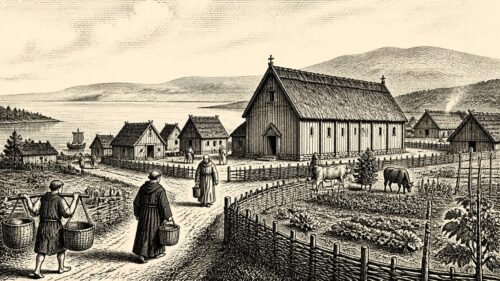
The death of a king also belonged to an ecclesiastical world. Monasteries and churches were not detached refuges beyond politics. They held land, received gifts and food-renders, educated clerics, maintained learned networks and preserved the genealogies through which ruling families explained their legitimacy. Major communities could become substantial settlements, enclosed by banks or walls and containing churches, dwellings, workshops, crops and livestock. Their leaders might be bishops, abbots or both, and were often drawn from influential kin-groups.
In Cúán’s Munster, churches associated with places such as Emly, Lismore, Cork and Inis Cathaig formed part of this expanding religious landscape, though no source permits us to assign a particular act by Cúán to any of them in 641. The proper point is broader: kingship and ecclesiastical patronage were interwoven. A ruler’s standing could be enhanced by association with a saint’s foundation; conversely, a church’s security and resources depended partly on the protection of powerful lay families. The annals’ preservation of royal obituaries is itself evidence of a learned Christian culture that regarded political succession as worth recording.
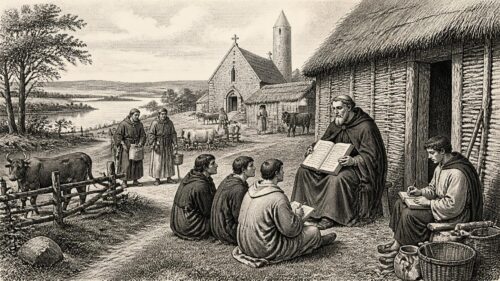
Learning was conducted through Latin as well as Irish. Clerics copied biblical, liturgical and scholarly texts, while secular genealogies and praise traditions provided dynasties with usable pasts. Writing did not make Ireland uniformly literate, but it gave churches and elite households tools for administration, commemoration and argument. Cúán’s name survives because such institutions and their successors maintained records. The bareness of the entry should not be mistaken for insignificance; it reflects the selective form of the source.
Land, Food and Ordinary Work
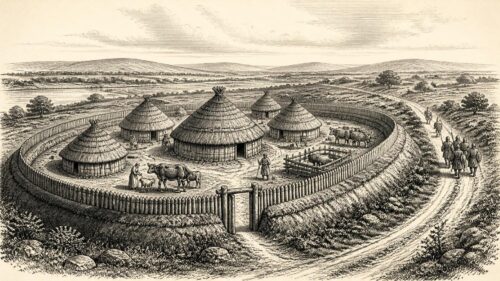
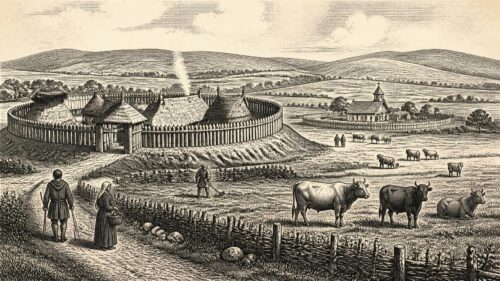
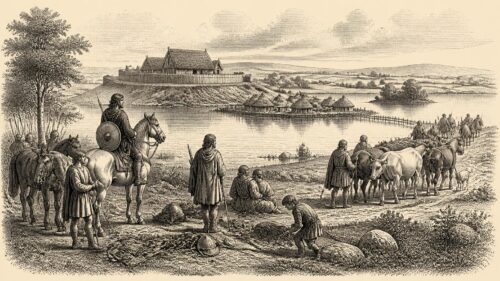
For most people, the crucial business of 641 was seasonal rather than annalistic. Communities lived chiefly from mixed farming. Cattle were central to wealth, dairy production, exchange and compensation, while sheep, pigs, cereals and smaller resources such as fishing, hunting and gathering supplemented household economies. People commonly lived in ringforts or other enclosed farmsteads, where timber and wattle buildings have usually vanished but archaeology reveals domestic work, grain processing, metalworking, weaving, leatherworking and animal butchery.
The Munster overking’s resources ultimately rested on such labour. Food-renders, livestock and services moved up through layers of lordship; protection, judgement, prestige goods and reciprocal hospitality moved down or across the same networks. This was not a cashless world without exchange, but cattle and agricultural produce were especially important measures of value. Water-powered milling was also becoming an increasingly significant feature of early medieval Ireland by the seventh century, linking cereal cultivation to technical skill and favourable locations near streams or estuaries.
Nothing in the reliable evidence identifies a famine, epidemic, climatic disaster or exceptional harvest in Ireland during 641. It would be wrong to invent one merely to enliven the year. The environment nevertheless shaped every political calculation. Wet ground, rivers, woodland, pasture, maritime routes and access to grain all affected settlement and campaigning. The death of Cúán mattered to people far beyond an elite household because changes among kings could affect the demands, protections and alliances under which ordinary farming communities lived.
A Carefully Bounded Year
641 is therefore best understood not as a year of a famous battle or sweeping reform, but as a documented dynastic hinge in Munster. Cúán mac Amalgado’s death closed the brief recorded prominence of the Eóganacht Áine and opened the way for another branch of the same broad royal family. The surviving sources do not reveal the mechanism of that change, yet they place it within a recognisable seventh-century Ireland: politically fragmented, bound together by rival overlordships and kinship, sustained by farming households, and increasingly articulated through wealthy ecclesiastical and learned centres. The restraint of the evidence is part of the history. It allows us to see both what contemporaries chose to preserve and how much of daily life, negotiation and succession passed without a written record.

Primary Sources
- The Annals of Tigernach
- Annal T641, The Annals of Tigernach
- The Annals of Ulster
- Year U641, The Annals of Ulster
- Annals of the Four Masters
- Part 47 of Annals of the Four Masters
- Contributions Towards the Political History of Munster, 450–800 A.D. (concluded)
- Early Christian Ireland
- The Powers of Kings
- Áed Dub
- Exploring the Irish Annals
- The Annals Attributed to Tigernach
- Early Christian Monasteries
- Churches and Ecclesiastical Enclosures / Shéipéil agus Ráthanna
- Early Medieval Farmsteads
- Archaeological Survey
- Water-Power as a Factor of Industrial Location in Early Medieval Ireland: The Environment of the Early Irish Water Mill
- Animals and the Economy of Medieval Ireland: A Zooarchaeological Analysis of the Faunal Remains from Caherconnell Cashel, Co. Clare
- Christian Ireland, 5th–8th Centuries
- Patrician and Early Christian Architecture
- The Church and the World in Early Christian Ireland