Buide Chonaill666 CE
In 666, the buide Chonaill epidemic continued in Ireland, prolonging a mortality crisis that had begun in 663 and affected both elites and wider rural society. Despite disease, regional conflict persisted: the Arada and Uí Fhidgeinti fought at Áine, where Eógan son of Crunnmáel was killed. The death of Cernach Sotal, son of the Uí Néill ruler Diarmait mac Áedo Sláine, reflected dynastic vulnerability after earlier plague deaths. Annalistic chronology varies between sources, limiting certainty about dates and related events. The surviving records show communities, churches and political rivalries enduring under the shadow of prolonged illness.
Dateline
In 666 CE, Ireland remained in the grip of the great epidemic remembered in the Irish annals as the buide Chonaill, while a battle at Áine brought together the Arada and the Uí Fhidgeinti and cost the life of Eógan son of Crunnmáel. These are the securely relevant notices in the Annals of Ulster under its heading for AD 666. The same entry also records the death of Cernach Sotal, son of Diarmait. They are brief records, not narratives: they do not tell us the cause of the disease, the size of either force, the precise location of the battlefield, or the date within the year. Yet together they show a society in which sickness did not halt political rivalry, regional violence or the recording of elite deaths.
A Year of Continuing Plague
The annalist’s first notice is stark: “The plague still in Ireland.” Its wording matters. It does not announce a new outbreak in 666, but establishes that the mortality which had already devastated the island continued into this calendar year. Earlier entries place the arrival of the disease in Ireland on 1 August 663 according to the annals’ internal dating system, and describe it first raging at Mag Itha in Fotharta. In the modern AD alignment used by the same edition, the major mortality and many famous deaths belong principally to 664 and 665. By 666, therefore, Ireland was living through the prolonged aftermath rather than confronting an isolated disaster.
The name buide Chonaill, often rendered “Conall’s yellow plague”, is traditional rather than diagnostic. It cannot responsibly be equated with a particular modern illness. Medieval writers did not supply symptoms sufficient to identify a pathogen, and the label may preserve cultural memory as much as clinical observation. What is beyond doubt is the scale implied by the annals’ earlier list of deaths: kings, bishops, abbots and “innumerable others” were said to have perished. The survival of the plague notice in 666 is important precisely because it denies any easy assumption that the crisis had passed after the deaths of prominent people in the preceding year.
Its effects would have reached far beyond the named elite. Early medieval Ireland was predominantly rural, organised through dispersed agricultural households, kin-groups and lordships. Cattle were central to wealth, food and social obligation; grain-growing, dairying, seasonal labour and the management of animals depended upon people whose names annalists did not record. A sustained mortality could disrupt cultivation, care for livestock, fosterage, food-renders and the ability of rulers to assemble dependants. These are reasonable consequences of an extended epidemic, not separate events documented for 666. The sources do not report a harvest failure, famine, trade collapse or universal depopulation in this particular year, and such claims should not be added to the evidence.
Áine and a Southern Battle
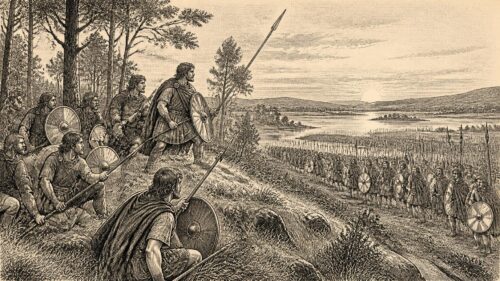
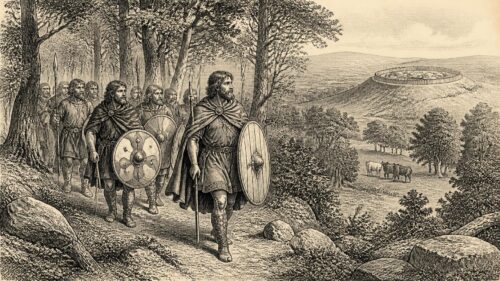
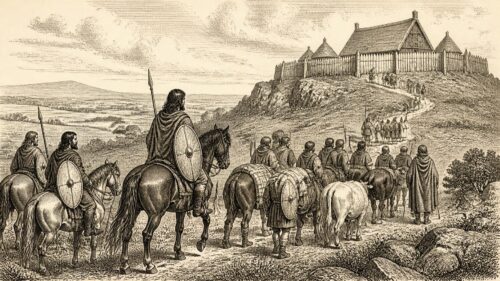
The year’s only explicitly recorded conflict is the battle of Áine, fought between the Arada and the Uí Fhidgeinti. Eógan son of Crunnmáel fell there. The notice supplies no victor, no reason for the war and no casualty total. It nevertheless places armed conflict firmly within a year otherwise defined by disease. Warfare in seventh-century Ireland often took the form of contests between neighbouring or rival dynasties for cattle, tribute, dependants, territory and precedence. A battle could be a short, violent encounter rather than a campaign of conquest, and the death of a leading man was often the detail considered worth preserving.
Áine is generally associated with the district around Knockainey in modern County Limerick, a landscape of royal and ritual significance in later tradition. The Uí Fhidgeinti were a powerful Munster people whose territory lay in the wider Limerick region. The identity of “the Arada” is less straightforward in the surviving annalistic record, and the terse entry should not be made to bear more geographical certainty than it can carry. The Annals of Inisfallen, which preserves a parallel notice under a different year-heading, calls Eógan son of Crunnmáel king of Uí Chairpri. That additional title suggests that the dead man belonged to the upper ranks of regional politics, but it does not explain which side he led or why he was killed.
The discrepancy between chronicles is itself part of the history. The Annals of Ulster places the battle under an entry explicitly headed AD 666; the Annals of Inisfallen gives its related notice under 667; and the Annals of Tigernach and Chronicon Scotorum have their own chronological arrangements. Such one-year shifts are familiar hazards in early Irish annalistic chronology. For this year-by-year account, the explicit Ulster heading is the principal basis for including Áine in 666, while the disagreement means that no exact day, season or sequence relative to the epidemic can be claimed.
Dynasty After Mortality
Cernach Sotal’s death linked 666 to the changing politics of the Uí Néill. He was a son of Diarmait mac Áedo Sláine, one of the joint rulers whose death in the great mortality was recorded in the preceding crisis. His obituary in 666 is consequently more than a private loss: it reflects the vulnerability of a ruling kindred after disease had removed senior figures. The annals do not call Cernach a king, do not say that he died of plague, and do not report a succession struggle caused by his death. Still, his place in the genealogy demonstrates how closely royal households were entangled with the epidemic’s political consequences.
Sechnassach, son of Blathmac, had begun to rule after the deaths of Diarmait and Blathmac. He was the leading claimant associated with Síl nÁedo Sláine, the southern Uí Néill lineage based in the midlands and Brega. Descriptions of him as “high king of Ireland” should be treated carefully: early Irish overkingship rested on personal authority, alliances, hostage-taking and recognition by other rulers, not on a central state governing the whole island. In 666 there was no Irish capital, no unified administration and no permanent national army. The annals’ kingship language nevertheless signals an ambition to supremacy centred on Tara and the southern Uí Néill world.
Other obituaries conventionally associated with “666” show why chronological caution is essential. The Annals of Tigernach and Chronicon Scotorum group deaths including Eochaid Iarlaithe, king of the Cruithin, Dub Innrecht of Uí Briúin Aí, Baithíne of Bangor and Fáelán son of Colmán, king of Leinster, under their annal for 666. The Annals of Ulster, however, aligns comparable notices with AD 665, while modern scholarship regards Fáelán’s supposed 666 death as probably much earlier, perhaps around 645. These entries illuminate the uncertain transmission of regnal and ecclesiastical memory, but they cannot all be presented as securely dated events of calendar year 666.
Churches in a Stricken Landscape
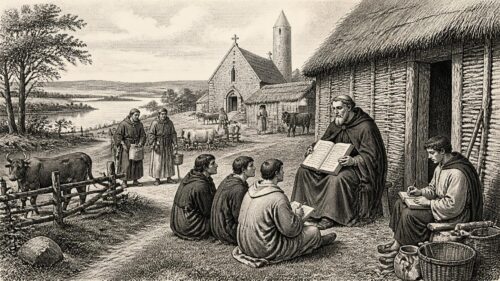
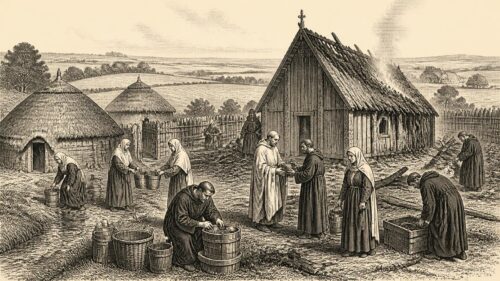
Religious institutions remained central to how Ireland experienced and remembered catastrophe. The plague’s earlier victims included abbots of Clonard and Clonmacnoise, the learned Ailerán, Féichín of Fore, and churchmen connected with Bangor and other communities. Their deaths were recorded because monasteries were not remote refuges from political life. They were centres of learning, prayer, hospitality, landholding and exchange, tied to ruling families through patronage, kinship and burial. Losses among abbots and teachers could therefore affect both devotional life and the management of institutional estates.
Yet the evidence does not permit a picture of monastic civilisation suddenly collapsing in 666. The continuation of annal-writing, the preservation of genealogies and the recording of battles indicate institutional resilience as well as loss. Scribes and scholars ordered events by kalends, regnal associations and remembered deaths, even when later copying created chronological divergences. The annals are selective records of what religiously educated communities judged memorable: a plague continuing, a battle, the death of a dynast. Their silences are equally instructive. They rarely describe women, children, tenants, slaves, craftsmen or the sick in ordinary households, although those people bore most directly the daily burden of mortality.
What Can and Cannot Be Seen
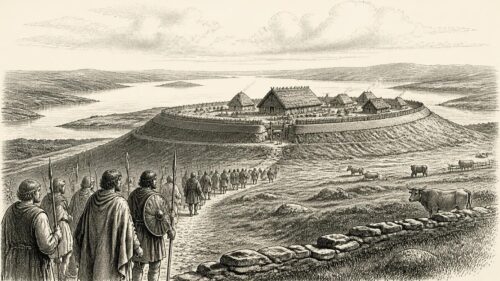
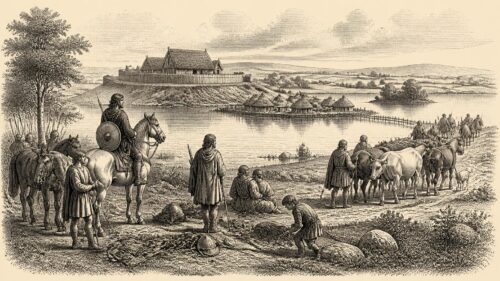
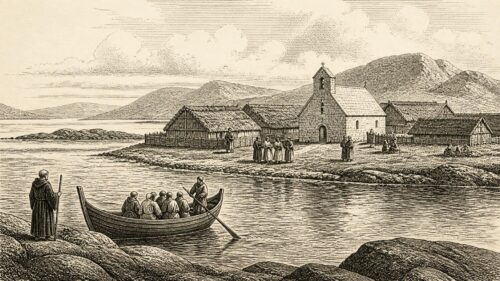
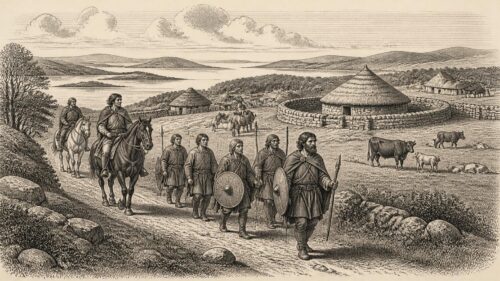
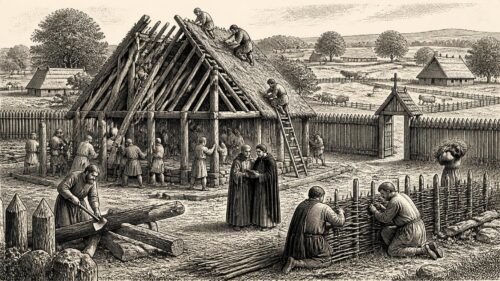
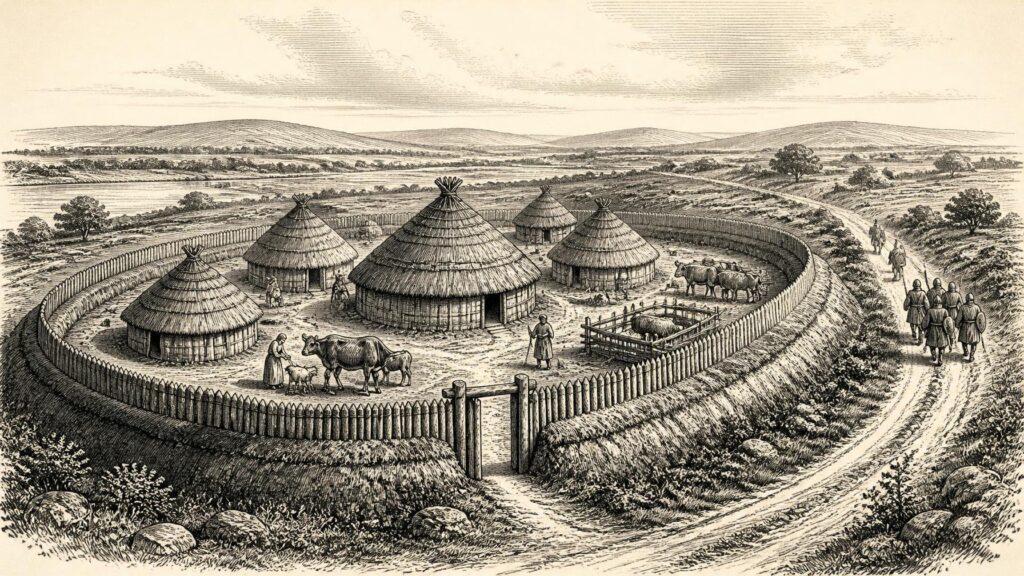
The material world of 666 was one of farmsteads, small ecclesiastical settlements, waterways and routes connecting regional kingdoms. Ringforts and enclosed farmsteads offered places to house people, store food and protect valuable animals; churches and monasteries punctuated the same rural landscape. The battle at Áine and the continuing plague would have been experienced in such local places, not in anonymous national space. But archaeology cannot presently assign an ordinary dwelling, burial ground or field-system specifically to the year 666, and the annals do not identify the settlements most affected by disease.
Nor is there a securely dated Irish diplomatic mission, overseas voyage, major building project, environmental event or commercial development to add for this year. That absence should not be mistaken for inactivity. Ireland continued to be connected to Britain, western Scotland and the wider Irish Sea through kinship, church networks and seaborne movement. Rather, the surviving record for 666 directs attention elsewhere: to a health emergency that endured, a lethal regional battle, and a dynastic death in a kingdom still adjusting to losses among its rulers. It is a narrow documentary window, but a powerful one. Ireland in 666 was neither still nor uniformly ruined; it was a landscape of communities continuing their work and rivalries under the shadow of mortality.
Primary Sources
- The Annals of Ulster AD 431–1201
- The Annals of Ulster: Year U664
- The Annals of Ulster: Year U666
- The Annals of Ulster: Year U667
- The Annals of Ulster: Latin text, Year U666
- The Annals of Tigernach
- Chronicon Scotorum
- Fragmentary Annals of Ireland
- Fragmentary Annals of Ireland: Annals 21–40
- Fragmentary Annals of Ireland: Annals 41–60
- Annals of Inisfallen
- Annals of the Four Masters
- Exploring the Irish Annals
- Fáelán
- Blathmac
- Early Irish Population-Groups: Their Nomenclature, Classification, and Chronology, Part 3
- Fingal Rónáin: Background
- Fingal Rónáin
- Imarcaigh sund ar gach saídh
- An ‘earthquake’ in Britain in 664
- Medieval Irish Chronicles Reveal Persistent Volcanic Forcing of Severe Winter Cold Events, 431–1649 CE
- Ringforts / Ráthanna
- Rathdrummin – Ringfort
- The Earthen Rath or Lios
- Early Medieval Belfast: The Archaeological Evidence