Connmach’s Dún Cuair Synod804 CE
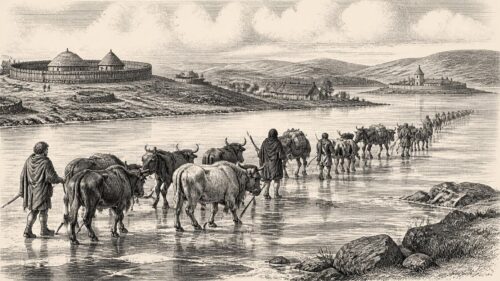
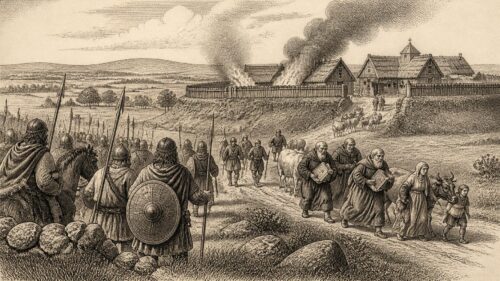
In 804, Áed Oirdnide, king of Tara, intensified Uí Néill authority by devastating Leinster twice and securing the submission of Fínnechta Cetharderc. Connmach, abbot of Armagh, led a synod of Uí Néill churches at Dún Cuair, linking ecclesiastical influence with royal power. A tradition credits Áed with exempting clergy from military service, though its evidence is uncertain. Northern conflict claimed several leaders, while a severe March storm devastated Corcu Baiscinn and altered coastal land. Deaths at Birr, Lusk and Kildare highlighted ecclesiastical succession; Cenannas was peacefully transferred to the Columban community, demonstrating religious patronage’s political importance during this turbulent year.
Dateline
In 804, power in Ireland was displayed not through a single national government but through movements of armed followings, submissions by provincial kings, church assemblies and control of major religious communities. The year is unusually revealing because the surviving annals place political coercion, ecclesiastical negotiation and a catastrophic coastal storm side by side. At its centre stands Áed Oirdnide, king of Tara and leading ruler of the northern Uí Néill, pressing Leinster; beside him stands Connmach, abbot of Armagh, presiding over a meeting at Dún Cuair. Their association shows how closely royal authority and ecclesiastical standing could intersect.
A Caution on the Year
The chronological label in the Annals of Ulster is awkward. Its entry numbered U804 carries an internal AD date of 803, yet modern synchronisation and standard historical reference works place the events discussed here in 804. This article follows that corrected dating. Even so, the annals rarely supply days or months, and their short notices do not prove a full sequence of events. The devastation of Leinster, the assembly at Dún Cuair and the submission of its king belong securely to 804; their precise order within the year remains unknown.
Leinster Under Pressure
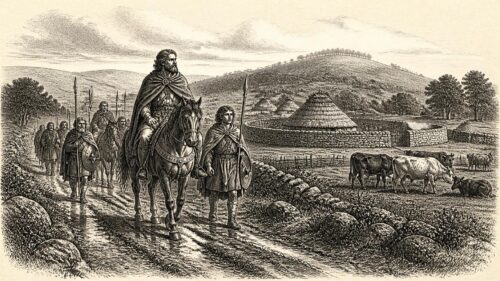
Áed Oirdnide had held the kingship of Tara since 797. He was a Cenél nÉogain ruler from the northern Uí Néill, but the title did not give him automatic command over Ireland. It represented a claim to pre-eminence which had to be repeatedly demonstrated: by leading hostings, receiving submissions, distributing authority and winning the co-operation of churches. Leinster, immediately south of the Uí Néill heartlands and rich in agricultural land, routes and prestigious churches, was an especially important testing ground.
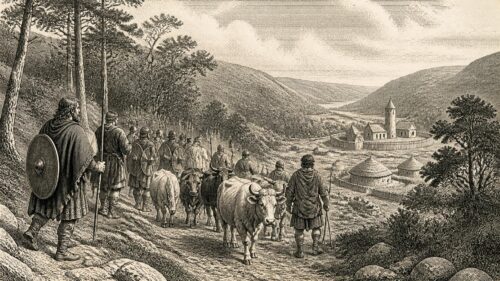
The annal records that “the son of Niall” devastated Leinster twice in one month. This was Áed, son of the former king Niall Frossach. “Devastation” should not be softened into a merely ceremonial incursion. An early medieval hosting could seize cattle and foodstuffs, burn settlements, take captives, and compel local rulers to sustain troops moving through their territory. The annalist gives neither battle-site nor casualty total, so it would be wrong to reconstruct a campaign route. Yet two incursions in a single month indicate deliberate pressure rather than a fleeting border encounter.
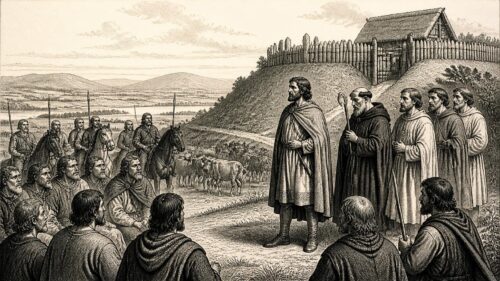
The immediate political result was stated plainly: Fínnechta Cetharderc, king of Leinster, submitted to Áed. Fínnechta belonged to the Uí Dúnchada branch of the Uí Dúnlainge, the dominant royal kindred of northern Leinster. His submission did not mean that Leinster had become a province governed from Tara, nor did it settle the rivalry of Leinster’s dynasties. It marked a negotiated, and potentially temporary, acknowledgement of Áed’s superiority after military coercion. The following years would show how fragile that arrangement was, but the firmly dated achievement of 804 was the submission itself.
An Assembly at Dún Cuair
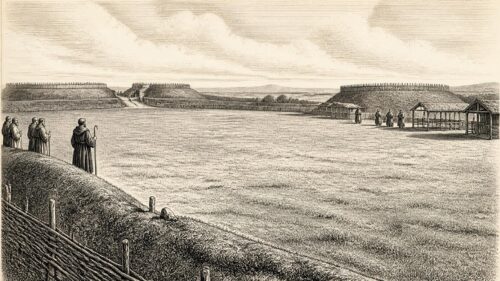
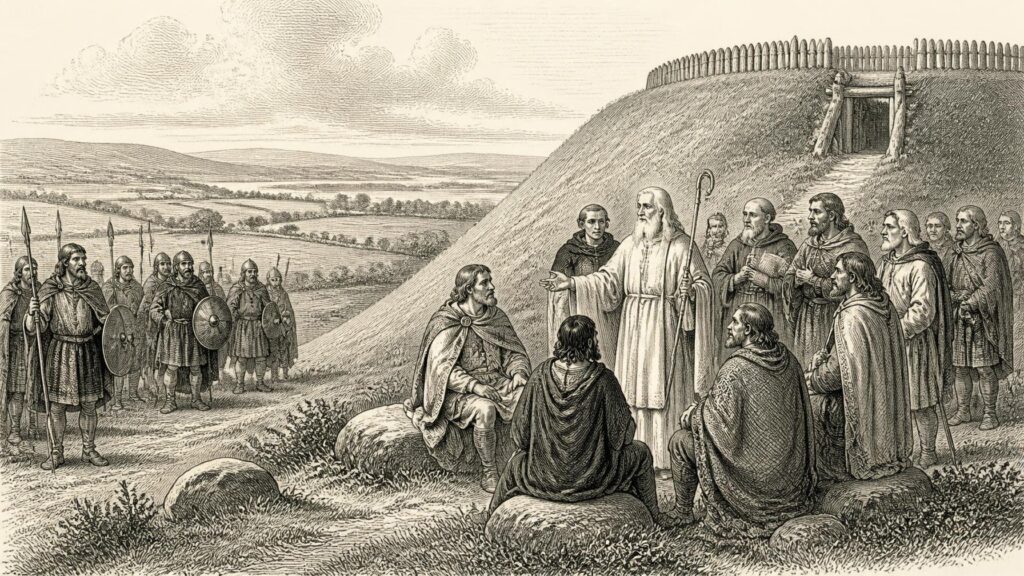
In the same year, the annals report a meeting of the synods of the Uí Néill at Dún Cuair, led by Connmach, abbot of Ard Macha. Dún Cuair is generally identified with the Rathcore area of modern County Meath, close to the Leinster frontier, though the identification is not absolute. It was an apt place for a gathering that joined northern political interests to a campaign against Leinster: near enough to the border to muster forces and negotiate, but within the wider Uí Néill sphere.
The wording matters. This was not simply a royal council at which churchmen happened to attend. The record characterises it as a meeting of synods, and gives leadership to Connmach of Armagh. Armagh’s abbot represented the successor of Patrick and commanded an institution with religious, legal and political reach far beyond its immediate locality. His presence helped frame the assembly as one possessing moral and ecclesiastical as well as military authority. For Áed, association with Armagh could enhance a claim to rule rightly; for Armagh, participation was a means of defending its interests in dealings with kings.
Later tradition associated this gathering with Áed’s ecclesiastical installation and with the origin of his byname Oirdnide, “the ordained”. That claim cannot be treated as a securely contemporary fact. The evidence for a formal royal ordination at Dún Cuair is late and uncertain. What is firm is narrower but still significant: a major Uí Néill ecclesiastical assembly met there under Connmach’s leadership while Áed was asserting power over Leinster.
Clergy and Military Service
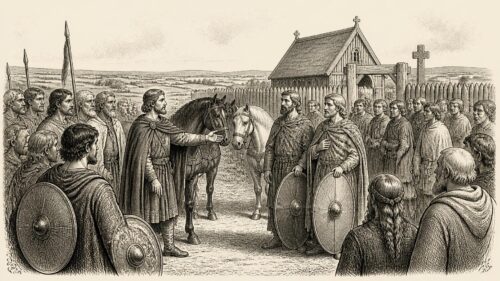
A further notice attached to the annal says that Áed, at the request of Fothad na Canóine, freed the clergy of Ireland from attending expeditions and hostings. If accepted at face value, it describes an important limit on royal demands: clergy and the tenants of churches would no longer be expected to accompany armies. This was not a small administrative matter. Hostings required food, transport, labour and people able to travel; exemption would protect the routine of churches, schools, estates and communities from a burdensome royal obligation.
But the entry needs careful handling. In the principal manuscript tradition it is a later marginal addition, and modern scholarship has warned that later writers may have connected separate material about Fothad, Áed and Dún Cuair. The exemption is therefore best presented as a strong early tradition, not as an independently secure decree whose wording and scope are known. Fothad, a bishop associated with Othain or Fahan in Donegal and remembered as a canon-law authority, is a plausible figure to whom such a judgement could be attributed. The tradition nevertheless captures a real issue of the period: church communities expected powerful rulers to respect distinctive religious rights, while rulers sought their co-operation and endorsement.
Violence Within the North
Political order was not confined to the confrontation between Tara and Leinster. The annals also record a battle among the Uí Chremthainn, an Airgialla people of the north. Echu son of Cathal, Domnall son of Echaid, Dub Róis and many others fell; Donn Clochair son of Artrí won. The bald notice offers no cause, location or wider consequence. Its value lies in its reminder that the Uí Néill world was not a unified bloc. Even as Áed led forces southward, neighbouring peoples and competing local dynasties continued to fight their own contests for authority.
The March Storm
The year’s most dramatic non-political notice concerns the night before the feast of St Patrick, conventionally 16 March in the Julian calendar. The annalist describes violent thunder with wind and fire, says that 1,010 people were destroyed in Corcu Baiscinn, and adds that the sea split the island of Fita into three parts and covered land sufficient for twelve cows with sand. Corcu Baiscinn lay in the region of later Thomond, broadly in present-day County Clare. Fita has been identified by some modern researchers with Mutton Island off the Clare coast, but that identification should remain cautious.
The report should neither be dismissed as pure marvel nor read as a modern meteorological observation. Medieval annalists could preserve unusually vivid accounts of storms, flooding, coastal change and loss of life, while also understanding extraordinary weather through Christian ideas of warning and judgement. The figure of 1,010 is an annalistic claim, not a verified demographic count. Still, the conjunction of destructive winds, casualties, sand deposition and a broken island is consistent with a severe coastal storm surge or wave event. For households dependent on livestock, small plots and vulnerable shoreline routes, even a much smaller disaster than the reported one could have had enduring consequences.
Churches, Communities and Succession
Several deaths recorded in 804 reveal the spread of influential religious institutions. Caratbran, abbot of Birr, died; Cormac son of Conall, steward of Lusk, also died; and Fáelán son of Cellach, superior of Kildare, passed away. Kildare was particularly entangled with Leinster kingship. Fáelán was a brother of Fínnechta Cetharderc, and his office shows how leading dynasties could hold both secular and ecclesiastical power through members of the same family. Such connections did not make monasteries mere royal possessions: churches had their own sacred claims, learned personnel, land and networks. They did, however, make the succession of a superior a matter of political consequence.
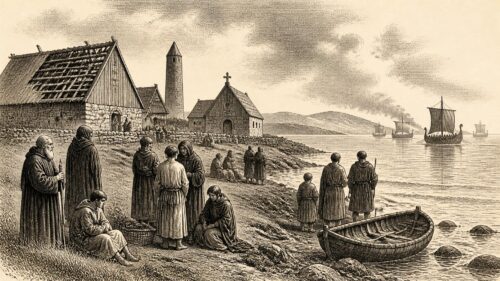
The annals close with an enigmatic but important transfer: Cenannas, later Kells, was “given without battle to the melodious Colum Cille”. The phrase means that the place or its rights passed peacefully to the Columban community, not that the sixth-century saint personally appeared. It records the extension or confirmation of Columban ecclesiastical influence in the Meath region. Nothing in the 804 notice itself proves the foundation of the famous later monastery at Kells; that development belongs to subsequent years. Yet the peaceful grant shows that religious patronage and control of land could be as consequential as a hosting, and could be achieved without fighting.
Thus 804 joined force with settlement, and danger with negotiation. Áed Oirdnide extracted Leinster’s submission, while Connmach’s synod gave ecclesiastical weight to an Uí Néill gathering at Dún Cuair. The coastal storm exposed the fragility of communities beyond the reach of royal armies. Meanwhile, deaths and a peaceful Columban acquisition show the quieter, continuous work of institutional succession. Ireland’s history in this year was not one story but several connected struggles over people, land, obligations and sacred authority.
Primary Sources
- The Annals of Ulster, Year U804
- The Annals of Ulster
- Annals of the Four Masters, Volume 1
- Chronicon Scotorum
- Annals of Inisfallen
- The Martyrology of Oengus the Culdee
- The Martyrology of Oengus the Culdee: Text
- Translated Texts at CELT
- Irish Texts at CELT
- Chronological Synchronisation of the Irish Annals
- Áed Oirdnide
- Fothad na Canóine
- Fínshnechtae Cetharderc
- Muirgius
- About Óengus – Félire Óengusso Online
- Dating Félire Óengusso: A Review of the Historical Evidence
- Exploring the Irish Annals
- Extreme Wave Events in Ireland
- Storminess in North West Europe and Volcanic Activity During the Holocene
- The Spatial Coverage of Entries in the Annals of Tigernach, Fifth to Twelfth Centuries: A Historical Climatology Perspective
- Vikings in Irish Chronicles, 794–902: Data
- History of Rathcore Golf Club