Iona’s Sixty-Eight806 CE
In 806, though annalistic dating varies, Ireland experienced pestilence, political upheaval, ecclesiastical losses and attacks on religious sites. A great mortality was recorded alongside abundant woodland mast, without identifying the disease. Áed Oirdnide promulgated Patrick’s law, reinforcing links between royal authority and Armagh, while Fínshnechtae regained Leinster and Flaithnia of Uí Fhailgi was killed. Leading churchmen died, and Tír dá Glas was burned for unknown reasons. Most notably, pagan seaborne raiders killed sixty-eight members of Iona’s Columban community. The massacre exposed monasteries’ maritime vulnerability, although Iona and its Irish-connected Columban network survived and remained influential throughout the Irish Sea world.
Dateline
The year conventionally known as 806 was marked in Ireland by a bleak conjunction of disease, political violence and seaborne attack. The surviving annals are brief, but their notices reach from Armagh and Bangor to Leinster, Offaly, Terryglass and the Irish Sea. Above all, they preserve the killing of sixty-eight people of the Columban community on Í, or Iona. The island lies off the western coast of Scotland, yet it belonged to a religious network founded by Colum Cille that was deeply embedded in Ireland. Its disaster was therefore not a distant Scottish episode, but an Irish ecclesiastical shock.
A Cautious Date
The label “806” needs a small warning. Medieval Irish annals were compiled and copied through systems of chronology that do not always correspond neatly with modern calendar years. The Annals of Ulster place this group of notices under U806 but give an internal Christian-year calculation equivalent to AD 805; Chronicon Scotorum records the same core events under 806; and the much later Annals of the Four Masters put several under 801. Modern scholarship normally refers to the slaughter on Iona as occurring in 806, following the shared annalistic tradition, but an exact day, season and sequence cannot responsibly be recovered.
That uncertainty should not reduce the force of the evidence. Several independent annalistic traditions preserve the principal facts: a serious pestilence in Ireland, the promulgation of Patrick’s law by Áed son of Niall, the death of leading churchmen, the return of Fínshnechtae son of Cellach to Leinster’s kingship, the killing of Flaithnia of Uí Fhailgi, the burning of Tír dá Glas, and the assault on Iona. The convergence makes this a remarkably dense year in an otherwise terse record.
Pestilence and Plenty
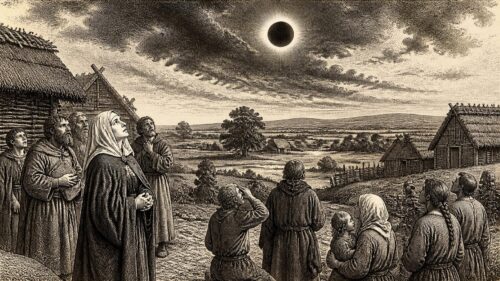
The Annals of Ulster state that “a great pestilence broke out in the island of Ireland”. Chronicon Scotorum likewise notes a great mortality in Ireland. Neither source names the illness, describes symptoms, or provides a death toll. It would therefore be misleading to diagnose plague, smallpox, influenza or any other modern disease. “Pestilence” tells us that contemporaries recognised an outbreak serious enough to be recorded at an all-Ireland scale; it does not reveal its cause.
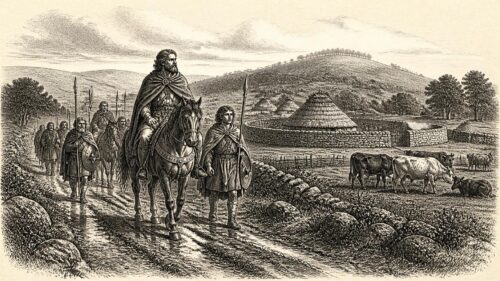
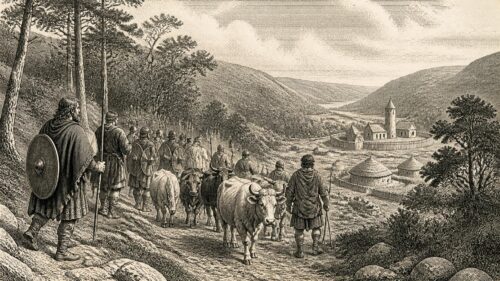
The same annal records a “great crop of mast”. Mast meant the autumnal produce of woodland trees, especially acorns and other nuts. It was valuable for people, but particularly for pigs driven into woods to feed. A plentiful mast year could strengthen household supplies and improve the condition of swine before winter. It did not cancel the danger of epidemic disease: good woodland forage and human mortality could exist together, and the annalist does not claim that one offset the other. Yet the pairing gives a rare glimpse beyond kings and churches, towards the seasonal economy on which ordinary households, estates and monasteries depended.
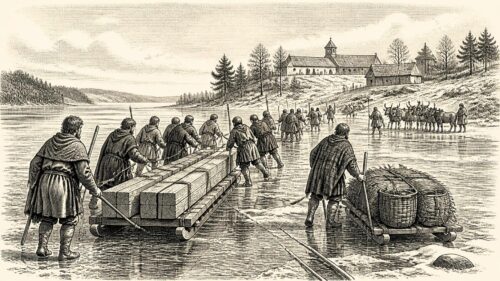
For rural communities, illness struck within a demanding agricultural cycle. Labour was needed for livestock, harvest processing, food preservation and preparation for winter. A widespread outbreak could disrupt each of these tasks, as well as obligations owed to kings, churches and local lords. The sources do not permit a map of the outbreak or an estimate of its social cost. They do show that disease had become a matter of national consequence in the annalists’ eyes.
Áed’s Law and Leinster’s Return
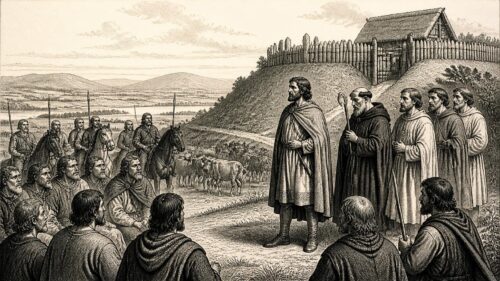
Áed son of Niall, known to historians as Áed Oirdnide, was the dominant Uí Néill ruler and king of Tara. His authority was not that of a modern monarch governing a unified state. It depended on military pressure, negotiated submission, alliances with churchmen and the capacity to intervene in regional successions. During the preceding years he had campaigned repeatedly in Leinster, deposed its overking Fínshnechtae Cetharderc in 805, and divided the province’s kingship between rival claimants.
In the annalistic year 806, however, Fínshnechtae “assumed his kingship again”. The short notice is important precisely because it gives no ceremonial detail: it records a successful recovery of power, not a peaceful constitutional restoration. Modern biographical study connects his return with victory over sons of Ruaidrí, members of a competing Leinster line. Whatever the immediate fighting, Fínshnechtae’s return demonstrated the limits of Áed’s attempt to reorder Leinster from outside. A ruler whom the king of Tara had removed was back within about a year.
Violence accompanied this reversal. Flaithnia son of Cináed, king of Uí Fhailgi, was killed at Ráith Imgáin, generally identified with Rathangan in present-day County Kildare. The annal does not name his killer. Later interpretation considers Fínshnechtae’s involvement likely, in light of his earlier hostility to Uí Fhailgi and his renewed ascendancy, but likelihood is not proof. What is firm is that a regional king died violently at a fortified place during the same politically unsettled year. Control of the midlands and northern Leinster remained contested, not settled by Áed’s earlier partition.
Patrick’s Law
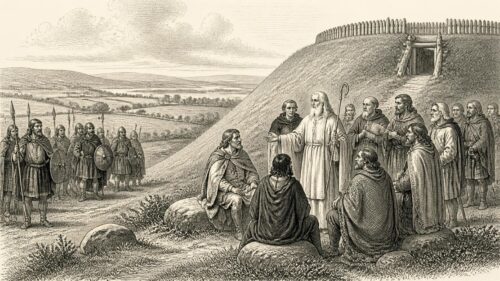
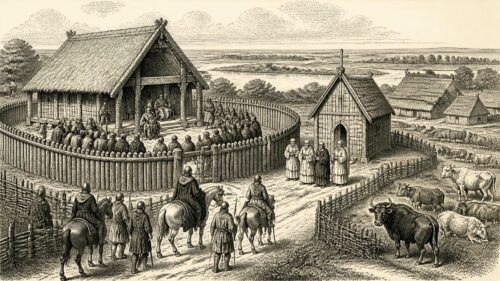
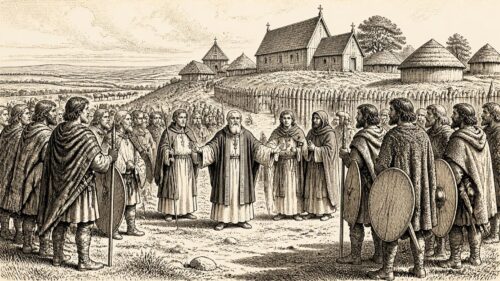
Áed’s most resonant act of 806 was the promulgation of Lex Patricii, Patrick’s law. The entry is only five words long in Latin and Irish annalistic form, but it signals a public alliance between royal power and the Patrician church centred on Armagh. Such laws were not modern statute books passed by a legislature. They were ecclesiastically backed enactments or renewals, proclaimed under powerful guarantors, with religious authority behind their enforcement. They could uphold peace, protection and the rights or revenues of a saint’s church.
The precise provisions enforced in 806 are not preserved in the annal entry, so it is unsafe to present Patrick’s law as a fully known code. Later legal and ecclesiastical evidence associates Patrician law with the protection of clerics and with Armagh’s claims, but the extent, duration and geographical reach of this particular promulgation remain uncertain. Even so, Áed’s sponsorship was politically meaningful. It displayed his capacity to act as protector of Patrick’s cult and strengthened Armagh’s standing within the competitive landscape of Irish churches.
This was not merely abstract politics. Gormgal son of Dindathach, abbot of Armagh and Clones, died in the same annalistic year. His combined offices show how major churches were connected by personnel and patronage. Congal son of Máenach, learned abbot of Sláine, also died, praised as a celibate; Loithech, teacher of Bangor, was remembered as well. These notices preserve an intellectual and religious geography spanning Ulster, Brega and the north-east coast. They also show that monasteries were institutions of teaching, landholding and regional influence, not isolated retreats.
The Iona Catastrophe
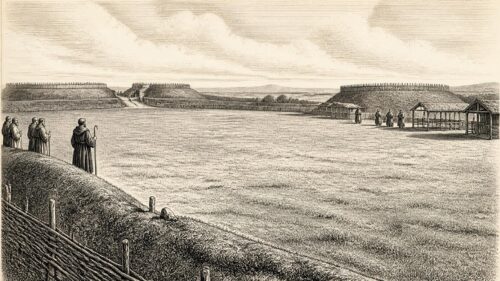
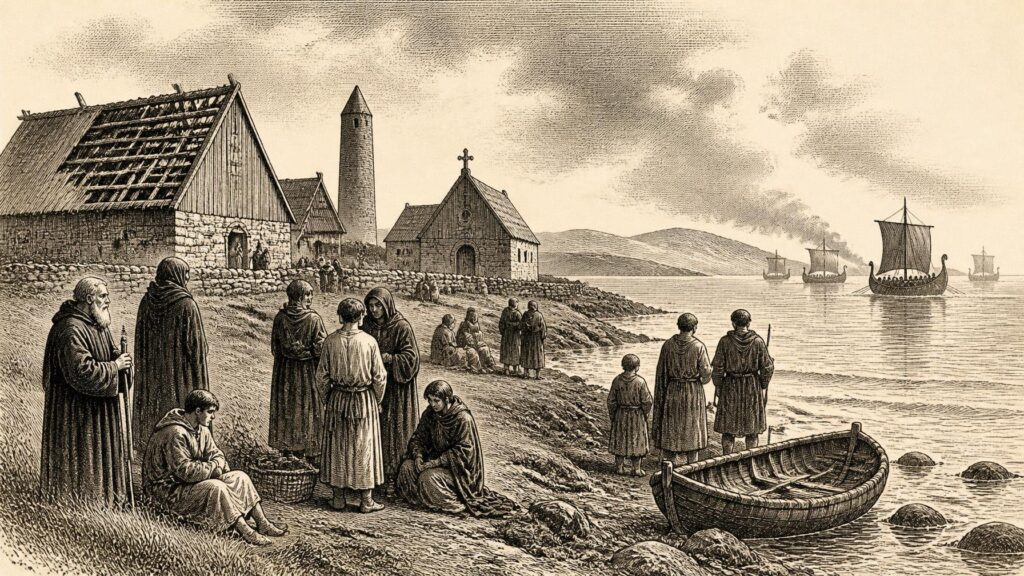
The year’s most terrible entry reads: “The community of Í, to the number of sixty-eight, was killed by the heathens.” Í was Iona, the island monastery founded by Colum Cille in 563 and head of a far-reaching Columban federation with important Irish houses. It had already been attacked in the late eighth and early ninth centuries. The assailants of 806 are called gentiles, “heathens”, by the annals: a contemporary Christian label for pagan raiders, understood in this context to mean Scandinavian seafarers.
It is crucial not to add details that the source does not supply. It does not say that all sixty-eight were monks; the Latin word familia can mean the wider monastic household, including clergy and lay dependants. It does not identify the raiders’ homeland, specify a landing place, name victims, or state that the assault happened at Christmas or in a single battle. The later tradition that locates a massacre at Port na Mairtir may preserve local memory, but it cannot furnish an exact narrative for 806.
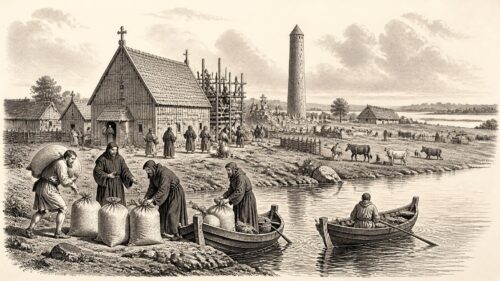
What can be said is stark enough. A community large enough to have an organised household lost sixty-eight people in one raid. Iona was attractive because an eminent monastery concentrated portable wealth, food stores, skilled people, books, vessels and prestige in a coastal location accessible by ship. The massacre revealed a new maritime vulnerability shared across the Irish Sea world. It also exposed the fragility of Columban authority at a moment when Áed was associating himself instead with Patrick’s church at Armagh.
Iona did not vanish. Its religious and scholarly life continued, and the Columban network remained influential in Ireland. But the attack belongs among the early shocks that changed how ecclesiastical communities judged island sites, stored treasures and maintained links between religious houses. In the following year, the annals record construction of a new Columban settlement at Cenannas, Kells; that is not an event of 806, nor can it be reduced to a simple refugee response, but it indicates the wider Irish setting in which Iona’s disaster was remembered.
Fire at Tír dá Glas
The annals also record that Tír dá Glas, modern Terryglass on the Shannon in County Tipperary, was burned. No perpetrator or motive is given. It must not therefore be described as a Viking raid, a royal attack or an accidental fire. Its significance lies in the place itself: Tír dá Glas was a prominent ecclesiastical settlement, situated near major inland waterways and connected to wider networks of learning and lordship. Its burning adds another vulnerable church site to a year already marked by the death of clerical leaders and the slaughter at Iona.
In 806, then, Ireland’s political and religious landscape was not defined by one event alone. Áed Oirdnide asserted Patrician authority; Fínshnechtae recovered Leinster; a king of Uí Fhailgi was killed; disease spread; woodland produced abundant mast; churches lost leaders and one major settlement burned. Yet the killing at Iona gives the year its enduring gravity. Sixty-eight unnamed members of a Columban community became the human measure of an increasingly dangerous Irish Sea.
Primary Sources
- The Annals of Ulster: U806
- The Annals of Ulster (Latin and Irish text): U806
- Chronicon Scotorum: Annal CS806
- Chronicon Scotorum: CELT edition
- Annals of Inisfallen: AI800–AI808
- Annals of the Four Masters: M801
- Annals of the Four Masters: CELT edition notes
- Vikings in Irish Chronicles, 794–902: Data
- Áed Oirdnide
- Fínshnechtae Cetharderc
- Donnchad Midi
- Cellach
- Iona and the Shrine of Columba, c. 800–1200
- Viking Raids and Iona’s Resilience
- The Practice of Irish Kingship
- The Céli Dé and Ecclesiastical Government in Ireland
- Early Christian Ireland and the Irish Laws of Saints
- From blefed to scamach: Pestilence in early medieval Ireland
- Annals of Tigernach: CELT edition notes
- The Annals of Ulster: CELT edition notes
- Iona in the Viking Age: laying a ‘zombie narrative’ to rest