Clonard and Lusk736 CE
In 736, Irish annals recorded deaths of abbots at Clonard, Lusk, Ardbraccan and Mag Bile, alongside the passing of the scholar-anchorite Duiblitir on Inis Bó Finne. Máel Fothartaig was killed by fellow Leinstermen, while Bodbthach, king of Cairpre, died, illustrating localised political authority and conflict. These terse notices reveal churches as influential economic, social and political centres, though succession details remain unknown. Across the North Channel, Pictish king Óengus devastated Dál Riata, capturing Dúnadd and imprisoning Selbach’s sons. The evidence indicates transition rather than collapse, highlighting Ireland’s ecclesiastical networks, regional rivalries and maritime connections. Dating uncertain; precise dates remain unrecorded.
Dateline
In 736 CE, Irish annals place an unusual concentration of deaths at religious centres across the island beside a killing in Leinster and a major reversal for Dál Riata across the North Channel. The surviving notices are brief, and medieval annalistic chronology is not mechanically precise: the Annals of Tigernach place these entries under 736, while the parallel sequence in the Annals of Ulster is numbered differently. Modern historians conventionally connect the cluster with 736, but no source supplies month or day. What can be said firmly is that the year registered the passing of abbots at Clonard, Lusk, Ardbraccan and Mag Bile, the death of an anchorite-scholar on Inis Bó Finne, the killing of Máel Fothartaig by fellow Leinstermen, and the death of Bodbthach, king of Cairpre.
A Year Preserved in Short Notices
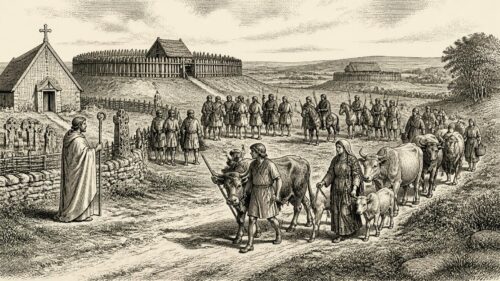
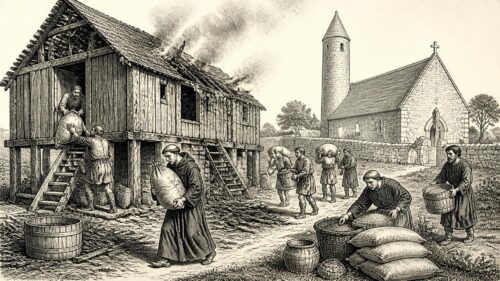
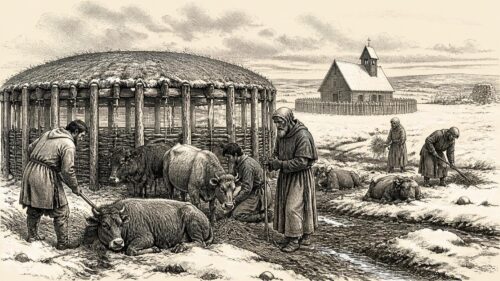
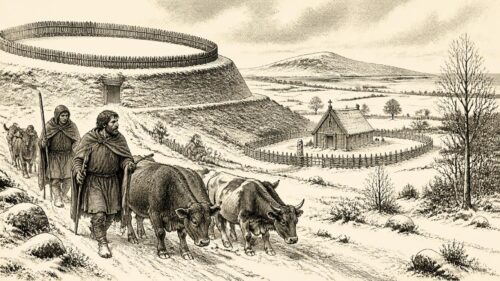
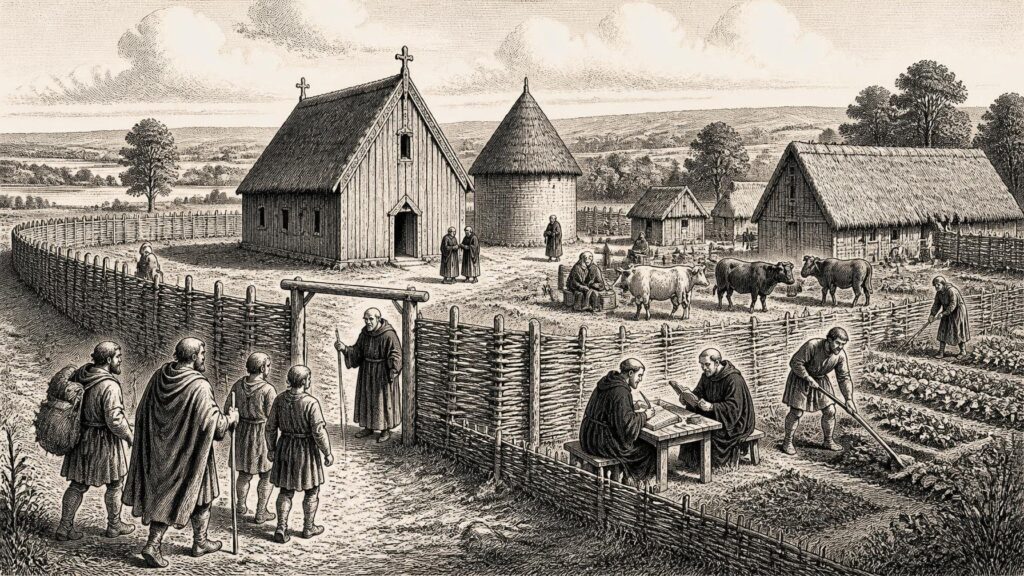
Such a list might look slight beside the great battles and famines sometimes preserved by the annals. Yet it offers a revealing cross-section of how eighth-century Ireland worked. Kingship was local and layered, not exercised through a single permanent state. Churches were not secluded institutions standing apart from society: they were communities of clergy, dependants, tenants, craftsmen, students and visitors, rooted in particular territories and sustained by land, livestock, gifts and political protection. When an abbot died, a major local office became vacant. When a king or aristocrat was killed, alliances and claims could be unsettled even when the annalist gives no explanation.
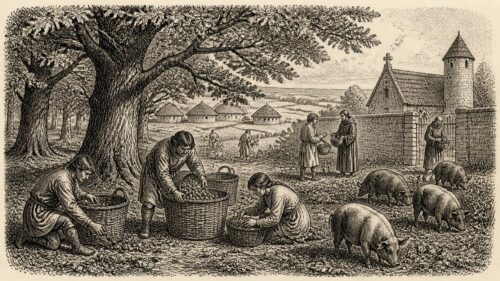
The sources also demand restraint. They do not record a harvest, weather crisis, fair, treaty, building project or overseas voyage in Ireland for this year. It would therefore be wrong to invent one. Nor do they describe the routines of individual households. The everyday Ireland behind these notices was largely rural, organised through dispersed farmsteads and small territories, but important ecclesiastical places brought people and resources together. The year’s entries illuminate those centres more clearly than they do ordinary domestic life.
Two Major Churches Lose Their Abbots
Most prominent were the deaths of Fíanamail son of Gerthinne, abbot of Clonard, and Crunnmael son of Colgu, abbot of Lusk. Their names are recorded together, but that does not mean that they died on the same day or from the same cause. The annal merely places both deaths within its yearly framework. Even so, the pairing draws attention to two long-established churches in the east of the island.
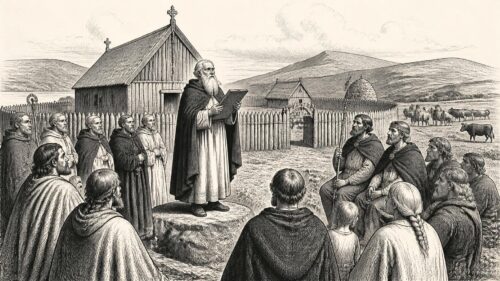
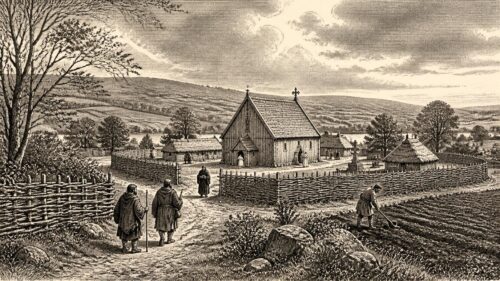
Clonard, on the Boyne in present-day County Meath, had an exceptional religious and intellectual reputation. Tradition associated it with Finnian of Clonard and with teaching; later evidence confirms that its standing as a centre of learning endured across the early medieval centuries. Archaeological survey has detected traces consistent with an extensive former monastic settlement, although little survives above ground today. In 736, Fíanamail’s abbacy represented authority over more than prayer and scholarship. An abbot could oversee church lands, receive patrons, arbitrate within the community, direct a household of clerics and labourers, and serve as a figure with whom neighbouring secular rulers had to reckon.
Lusk, in what is now north County Dublin, was likewise a substantial ecclesiastical settlement. Its surviving street pattern and later round tower preserve hints of the older enclosure, while excavation and landscape study point to a place whose religious and economic importance outlasted the early medieval period. Crunnmael’s death thus mattered in a community connected to the fertile coastal plain north of Dublin Bay. The abbacy of a church such as Lusk was a position embedded in kinship, property and local influence. The annals do not name Fíanamail’s or Crunnmael’s successors, so the process by which their offices passed on remains unknown. That silence is important: a vacancy need not have produced violence, and no conflict at either site should be presumed.
The simultaneous recording of the two deaths demonstrates the reach of annalistic memory. A chronicle compiled and recopied over centuries could preserve news from Meath and north Leinster because ecclesiastical networks linked those regions. Clerics travelled, exchanged books and letters, attended assemblies, and maintained relationships with rulers. The record was selective rather than comprehensive, but it was not merely local gossip.
Ardbraccan, Mag Bile and Island Asceticism
Two further abbots were said to have “rested”: Dainél son of Colmán of Int Eidnén, abbot of Ard Brecáin or Ardbraccan in Meath, and Colmán son of Murchú, abbot of Mag Bile, generally identified with Movilla in County Down. The formula is conventional Christian language for death, not evidence of a shared retirement or particular manner of dying. Taken with the obituaries from Clonard and Lusk, however, it makes 736 conspicuous for the turnover of ecclesiastical leadership.
Ardbraccan stood in the Boyne valley’s wider ecclesiastical landscape, not far from other influential Meath churches. Research on early medieval sites along the M3 corridor has stressed that place-names, archaeological traces and written sources must be read together: monastic communities belonged to managed landscapes of routes, fields and estates. Mag Bile, meanwhile, lay in the northern province of Ulaid. Movilla’s later reputation as an important monastery should not be projected uncritically in every detail back onto 736, but the obituary confirms that its abbacy was important enough to enter the annalistic record.
The same year brought the death of Duiblitir, described specifically as both a learned man and an anchorite of Inis Bó Finne, along with Samson grandson of Corcrán. “Anchorite” signals a life of deliberate religious withdrawal, but not necessarily complete isolation. Island ascetics depended on food, shelter, boats and contacts with others; their reputations could also draw visitors and gifts. Inis Bó Finne, off the Connacht coast, had early ecclesiastical sites and was part of a seaborne religious world connecting Irish coasts with Britain and western Scotland. The annal’s decision to call Duiblitir learned suggests that scholarship and ascetic prestige could coexist. Nothing in the notice tells us what he wrote, taught or copied, so his intellectual work cannot be reconstructed further.
Leinster’s Unexplained Killing
Political violence appears in the terse statement that Máel Fothartaig, son of Máel Túile, was killed “by the Laigin”, the people of Leinster. The wording does not identify the attackers, the location, or the dispute. It does, however, make one caution unavoidable: this was violence within Leinster, not a recorded invasion by an outside army. The name and patronymic place the victim among a society in which leading kindreds competed for rank, land, clientship and royal office.
Leinster in the 730s was under intense pressure. In the preceding years its rulers and fighting men had suffered major defeats in conflicts involving the northern Uí Néill and Munster. Those wider wars are essential background, but they must not be relabelled as events of 736. The killing of Máel Fothartaig may have reflected an aftershock of rivalry, or a more limited feud; the evidence does not decide between them. Its value lies precisely in showing that the annals could preserve a killing without converting it into a tidy narrative of national politics.
Bodbthach son of Conall of Gabair, called king of Cairpre, also died in the year. Cairpre was a smaller kingdom or people rather than one of Ireland’s great provinces. His obituary is a reminder that political authority rested at many scales. The survival of his title does not show that Cairpre was independent of stronger neighbours in every respect, only that Bodbthach’s kingship was recognised by the annalist’s source.
The North Channel in Turmoil
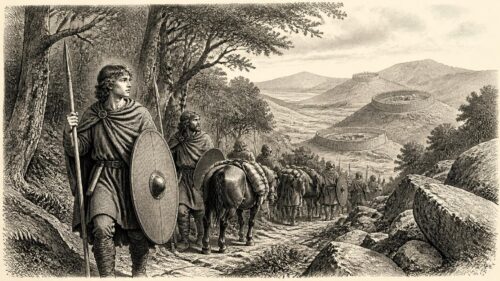
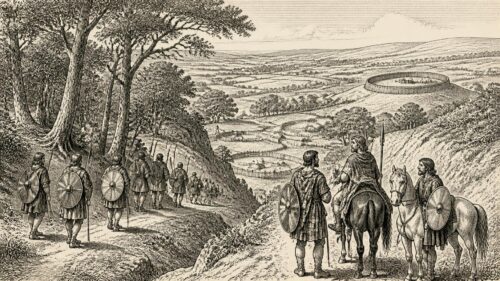
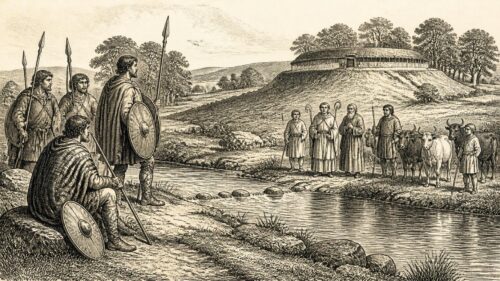
The most dramatic entry connected to 736 occurred not on the island of Ireland but in Dál Riata, the Gaelic kingdom spanning north-east Ireland and western Scotland. Óengus son of Fergus, king of the Picts, devastated Dál Riata, seized Dúnadd, burned Creic and put two sons of Selbach, Dúngal and Feradach, in chains. A battle at Cnoc Cairpri in Calathros between Dál Riata and Fortriu is also recorded, with many nobles said to have fallen. Dúnadd was a major royal stronghold in Argyll, and modern archaeological interpretation treats the campaign as a decisive assertion of Pictish power.
This was directly relevant to Irish history because Dál Riata’s population, dynasties and sea routes linked Argyll with Antrim and the wider Irish Sea. The episode shows that the channel joined political worlds as much as it separated them. Yet evidence for consequences in Ireland during 736 is absent. There is no annalistic notice of a Pictish landing in Ireland, of Irish troops joining the fighting, or of disruption to Irish trade. The responsible conclusion is narrower: people in Irish ecclesiastical and aristocratic networks could have known of the crisis, and the balance of power in a neighbouring Gaelic kingdom had changed sharply.
Continuity Through Change
For all its deaths, 736 should not be imagined as a year of collapse. The annals’ very form is evidence of continuity: churches retained enough organisation and memory for later chroniclers to preserve the names of their leaders. Clonard, Lusk, Ardbraccan, Mag Bile and Inis Bó Finne did not vanish with the men named in the entries. Their communities continued, even though the records rarely allow us to see how successions were negotiated, how food was produced, or how learning was maintained day by day.
The year is best understood as a moment of transition rather than a single dramatic turning point. In Ireland, several religious communities lost recognised leaders; Leinster saw a politically meaningful killing; and a local king’s death marked the changing personnel of small-scale rule. Across the sea, Pictish conquest struck Dál Riata, a kingdom bound to Ireland by people and passage. The evidence is fragmentary, but it is enough to show an island whose religious institutions, regional dynasties and maritime connections were all central to public life.
Primary Sources
- The Annals of Ulster
- Part 306 of The Annals of Ulster
- The Annals of Tigernach
- Part 13 of The Annals of Tigernach
- Fragmentary Annals of Ireland, Part 12
- How Ronan Slew His Son
- Fingal Rónáin: Parallel Irish, English and Modern Irish Text
- Power and Patronage in Medieval Ireland: Clonard from the Sixth to Twelfth Centuries
- Geophysical Investigation of the Site of the Former Monastic Settlement, Clonard, County Meath, Ireland
- Literature and Learning in Early Medieval Meath
- Lusk, Co. Dublin: Excavation Report 2008
- Reconstructing the Human Landscape Before, During and After the Lifespan of a Ringfort
- Early Medieval Historical Research on the M3 in County Meath: Sources, Contexts and Analyses
- Ecclesiastical Settlement in Ireland in the Early Medieval Period
- Reassessing the Irish ‘Monastic Town’
- Die irischen Triaden (nach Kuno Meyer)
- Exploring the Irish Annals
- Regnal Succession in Early Medieval Ireland
- A Hundred Years Ago – A Royal Poet
- Dunadd Hillfort: The Seat of Early Medieval Scottish Power
- Ireland, Scotland and Wales to the Early Eleventh Century
- Movilla
- Inishbofin Archaeological Guide
- Irish Islands Heritage: Inishbofin, Inishturk and Inishark