Mullaghmast and Adomnán’s Law727 CE
In 727, Ireland experienced dynastic conflict, contested succession and ecclesiastical assertion. Northern Uí Néill forces fought at Druim Fornocht, while other clashes involved Airgialla. Leinster saw the death of king Murchad son of Bran and victories by Uí Dúnlainge at Maistiu against Uí Cheinnselaig, and by Fáelán at Bairenn. Adomnán’s relics entered Ireland during renewal of Cáin Adomnáin, protecting women, children and clerics, though enforcement remains uncertain. Ailchón, abbot of Clonard, died, alongside other church figures. Later annals add traditions requiring caution. The sparse records reveal competing dynasties, church authority, rural dependencies, and sacred law shaping political life throughout Ireland.
Dateline
In 727 CE, Irish annals place the island in a year of sharp local conflict, succession pressure and ecclesiastical assertion. Battles were recorded in the north and in Leinster; a Leinster king died; senior churchmen passed away; and, most strikingly, the relics of Adomnán were brought into Ireland as his law was renewed. The surviving notices are brief, but together they show a country governed not by one uniform administration but through competing dynasties, churches and client communities. The year’s clearest theme is the overlap between force and authority: kings fought to command territories, while religious institutions used saints, law and ritual movement to make claims that could cross those territorial boundaries.
Reading a Sparse Year
The events belong to the year headings of several medieval annalistic compilations, whose texts survive in manuscripts much later than 727. Their agreement on major deaths and battles gives useful confidence, but their differences matter. The Annals of Ulster and Annals of Tigernach offer the fullest notices; the Fragmentary Annals preserve valuable Leinster detail; the Annals of Inisfallen independently record the death of Murchad son of Bran. A later compilation, the Annals of the Four Masters, assigns a northern battle at Magh Itha to 727, yet its chronology and detail do not neatly match the earlier annals. It should therefore be treated as a later historical tradition, not simply merged with the more securely attested entries.
A Northern Dynastic War
The Annals of Ulster record a battle at Druim Fornocht between Cenél Conaill and Cenél nEógain, the principal northern branches of the Uí Néill. Flann son of Aurtuile and Snedgus the Red, grandson of Mrachide, were killed. The entry gives no victor. Tigernach, however, calls it a victory for Flaithbertach son of Loingsech over Áed Allán son of Fergal, making the contest part of a struggle between the leading kindreds of north-western Ireland. The scale is impossible to reconstruct: annalists name elite casualties rather than ordinary fighters, and no contemporary account describes manoeuvres, weapons or numbers. Nevertheless, the deaths show that the conflict reached men important enough to enter political memory.
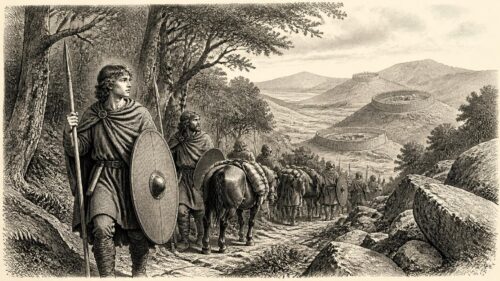
This northern warfare belonged to a larger contest for precedence among the Uí Néill, not to a modern national civil war. Cenél Conaill was centred in much of present-day Donegal, while Cenél nEógain’s strength lay farther east and north. Control of people, tribute routes and alliances mattered more than fixed frontiers. The same Ulster annal also notes a confrontation at Irros Foichne involving Selbach and the household of Eochaid grandson of Domnall, in which some Airgialla men fell. The wording is too compressed to identify every party or cause securely, but it reinforces the picture of armed politics operating through kin groups and lordly households.
Leinster Divided
Leinster’s political scene was equally unstable. Murchad son of Bran, described as king of the Laigin, died in 727. His death is independently preserved by the Annals of Ulster and the Annals of Inisfallen, and it left a kingship already contested among powerful Leinster dynasties. The annals do not portray Leinster as a united bloc. Its rulers had to deal with rivals inside the province as well as with neighbouring overkings and with the legacy of the catastrophic Uí Néill invasion defeated at Almu in 722.
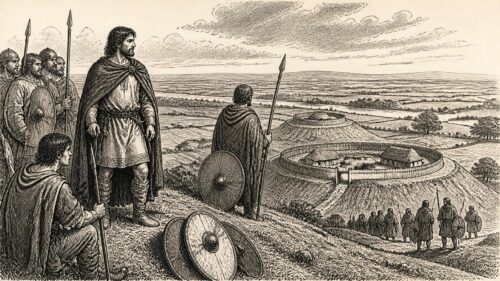
In the same year, a battle between the two Laigin was fought at Maistiu, generally identified with the Mullaghmast district in County Kildare. The Fragmentary Annals are unusually precise: Dúnchad and the Uí Dúnlainge defeated the Uí Cheinnselaig; Laidcnén son of Con Mella, king of Uí Cheinnselaig, fell, alongside Óengus son of Fáelchú and Cethernach son of Nóe ua Ceallaig. The record does not permit a simple claim that all Leinster now obeyed Dúnchad. It does show, however, that victory at Maistiu removed a southern Leinster rival and strengthened the Uí Dúnlainge position in the province’s northern heartland.
A second Leinster battle, Bairenn or Inis Bregain, brought another victory to Fáelán. Eterscél son of Cellach Cualann and Congal son of Bran were killed. The Fragmentary Annals describe the sides as the men of Life, or the Liffey, against the men of Cualu and Congal. These place-names point to rival political communities on and around the eastern Leinster plain rather than a single royal army. Warfare was a means of deciding rank, access to land and livestock, and obligations of service. But it also exacted a human cost that is visible only in the named dead; the annals are silent about displaced households, injuries, destroyed food stores or settlement disruption.
Relics and a Renewed Law
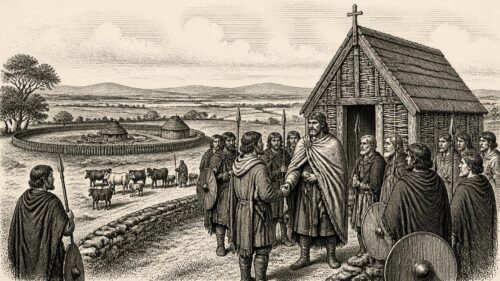
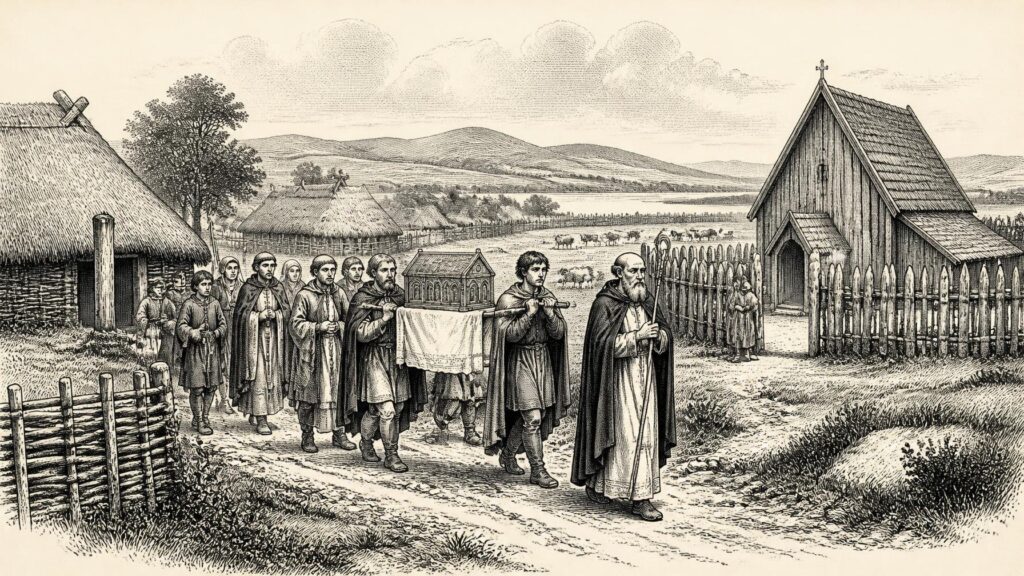
The year’s most consequential religious notice is concise: the relics of Adomnán were transferred into Ireland and “the Law” was renewed. This is widely understood as the renewal of Cáin Adomnáin, the Law of Adomnán or Law of the Innocents. Originally promulgated in 697 under Adomnán of Iona, it placed particular protection on women and also protected children and clerics from violence. Its surviving text sets severe penalties for attacks on those whom it defined as protected persons. It was not a modern humanitarian code enforced by a state, nor can its practical enforcement in 727 be measured. Yet its re-promulgation demonstrates an effort to bind rulers and communities to a recognised moral and legal order.
The relics were integral to that effort. In early medieval Ireland, saintly objects and remains could make an oath, agreement or legal claim visibly sacred. The annal does not identify the precise objects, the route taken, the communities visited or the individual kings who accepted the renewal. Nor is it certain that the relics were bodily remains rather than other sanctified objects associated with Adomnán. What can responsibly be said is that they were brought into Ireland in 727 in connection with the law. Their recorded return from Ireland three years later confirms that this was a temporary, purposeful translation rather than an unnoticed removal.
Churches, Learning and Authority
Other notices show that ecclesiastical office remained embedded in the year’s political and social fabric. Ailchón, abbot of Clonard, died. Clonard was one of the island’s important churches, with a long-standing reputation for teaching and spiritual authority. The annals also record that Conall son of Moudain was “crowned with martyrdom”, without explaining the circumstances, and note the death of Céle Críst. These terse memorials should not be expanded into invented narratives. Their inclusion nevertheless indicates that religious leadership, sanctity and learned communities were matters annalists considered worthy of preservation beside royal deaths and battles.
Life Beyond the Annals
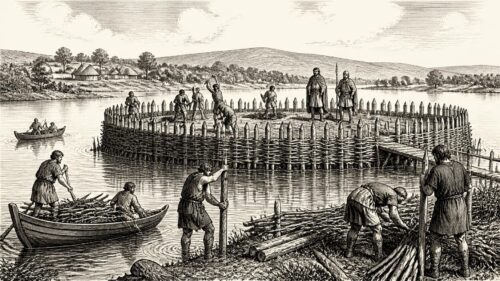
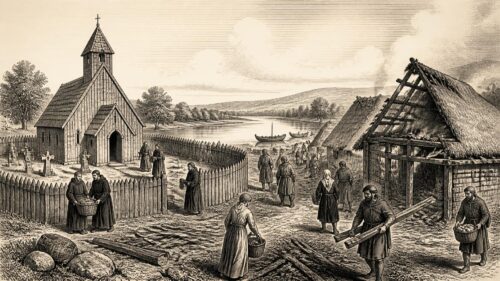
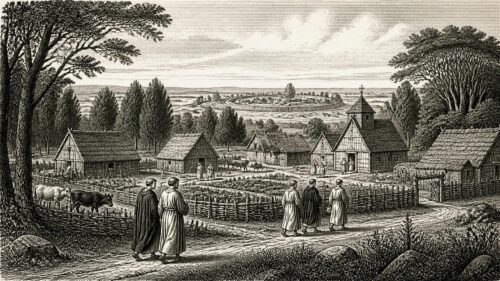
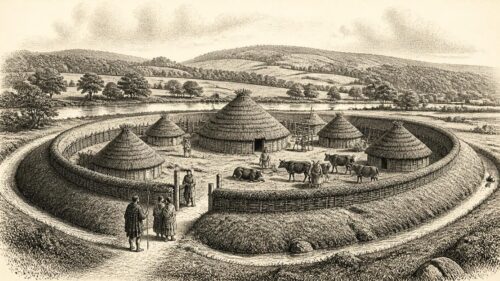
No source securely assigns a harvest failure, epidemic, climatic event, commercial expedition or major building campaign to 727. Everyday life must therefore be described as wider early medieval context, not as a sequence of events for this particular year. Most people lived in a heavily managed rural landscape of dispersed farmsteads, fields, trackways and enclosed settlements. Cattle, sheep, pigs and cereal crops underpinned subsistence and status; dairy processing, grain grinding, weaving, timber work and ironworking shaped domestic labour. Political exactions and military hosting could draw food, livestock and labour from such households, making dynastic warfare meaningful far beyond the battlefield.
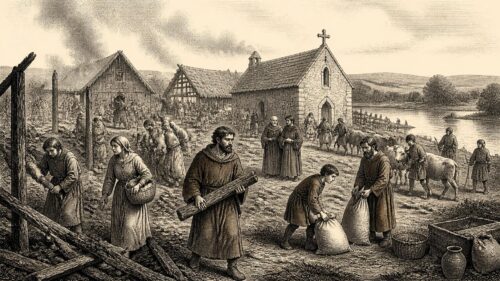
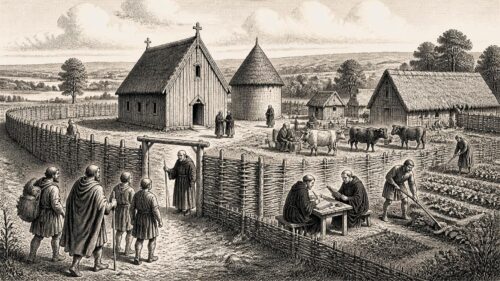
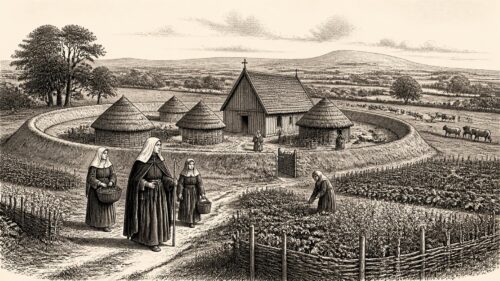
Churches were also economic institutions. They held land, received dues and depended on cultivation, craft activity and relationships of clientship. Archaeology cautions against imagining every religious site as a large monastery: early Irish ecclesiastical places ranged from substantial landed communities to smaller churches and out-farms. The movement of Adomnán’s relics in 727 thus travelled through a landscape where religious authority had material foundations. A law proclaimed with saintly power could reinforce moral protection, but it could also strengthen links between church communities and the secular rulers whose support made its enforcement possible.
Memory, Marvel and Restraint
The Annals of the Four Masters add an extraordinary report of a many-limbed cow at Delgany in Cualu, supposedly milked and seen by numerous people. It is a revealing example of how later annals could preserve marvels alongside political information. It cannot be used as evidence for agricultural abundance, animal breeding or conditions in 727. Its value lies instead in the culture of record-making: chroniclers regarded prodigies as potentially meaningful signs, while modern readers must separate that literary outlook from demonstrable events.
727 therefore stands out less for a single island-wide turning point than for the way its records expose several layers of Irish life at once. At Druim Fornocht and Maistiu, rival kindreds fought for dominance. In eastern Leinster, another victory altered local balances of power. At Clonard, an abbot’s death marked institutional continuity and change. Across a wider religious network, Adomnán’s relics accompanied the renewal of a law intended to restrain violence against protected people. That combination of conflict, succession and sacred law is the most historically secure portrait of Ireland in this year.
Primary Sources
- The Annals of Ulster: Year U727
- The Annals of Tigernach: Annal T727
- Fragmentary Annals of Ireland: Annals FA 201–203
- Annals of the Four Masters: Annal M727
- Annals of Inisfallen: Annal AI727
- Annals of Inisfallen: Text and Editorial Information
- Book of Leinster, Formerly Lebar na Núachongbála
- CELT Project: Book of Leinster, Formerly Lebar na Núachongbála
- Irish Texts at CELT
- Kronos: Synchronisms of the Irish Annals, 723–740
- Cáin Adomnáin and Canones Adomnani
- Adomnán’s Law of the Innocents
- Lex Innocentium (697 AD): Adomnán of Iona – Father of Western Jus in Bello
- Innovation and Experimentation in Late Seventh-Century Law: the Case of Theodore, Hlothhere, Wihtræd and Ine
- The Archaeology of Ecclesiastical Estates in Early Medieval Ireland: A Case Study of the Kingdom of Fir Maige
- How Did Early Church Sites Differ from One Another? A Comparative Approach within the Kingdom of Fir Maige, Ireland
- Land Tenure and Farming in Early Medieval Kerry: A Survey of Field Systems in the Lough Currane Basin
- Early Medieval Archaeology Project: Early Medieval Dwellings, Settlements and Landscapes
- The Archaeology of Livestock and Cereal Production in Early Medieval Ireland, AD 400–1100
- The Economy of Early Medieval Ireland
- Early Medieval Ireland: Archaeological Excavations 1930–2009