Belach Lice and Maíne726 CE
In 726, Irish annals record conflict linking Leinster, Brega and Mide. Cináed son of Írgalach of the Síl nÁedo Sláine fought the Leinstermen at Maíne, demonstrating continuing rivalry after Leinster’s victory at Allen. Crimthann, son of former Leinster king Cellach Cualann, was killed young at Belach Lice; Inisfallen names Muiredach as victor. Ailill son of Badbchad was slain in Mide. The deaths of Da Chonda of Connor, Mainchín of Leighlin and Cillíne Long of Iona underline ecclesiastical importance. Sparse, differing annalistic notices reveal clearly local dynastic violence, regional ambition and interconnected church networks, but not island-wide crisis or settled overlordship.
Dateline
In 726 CE, the surviving Irish annals preserve a small cluster of deaths, killings and political notices that illuminate a year of pressure in Leinster and the midlands. None supplies a continuous narrative, and several details appear in only one annalistic tradition. Yet the entries agree on one striking loss: Crimthann, son of Cellach Cualann, was killed while still inmatura aetate—at an ‘unripe age’—at the battle of Belach Lice. The Annals of Inisfallen add a detail absent from the Annals of Tigernach: Muiredach was victorious. This was not a remote incident. Crimthann belonged to the ruling kindred of Cualu, the coastal and upland territory south of Dublin, and his death belonged to the unsettled politics of Leinster after its great victory over the Uí Néill at Allen four years earlier.
A Leinster Campaign
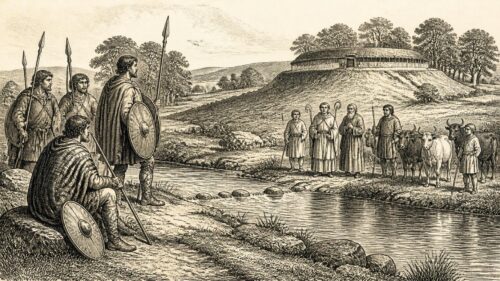
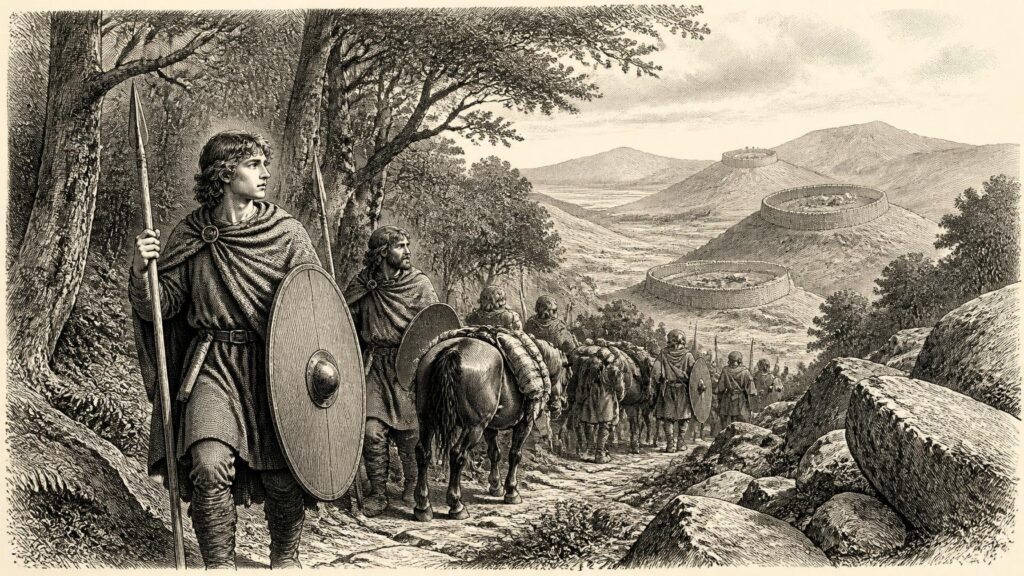
The most consequential political entry for the calendar year is preserved in the Annals of Tigernach: a battle of Maíne was fought by Cináed son of Írgalach against the Leinstermen. The terse wording does not name the battlefield, list the dead, or state terms of peace. It does, however, place Cináed in open conflict with Leinster. Cináed was a member of the Síl nÁedo Sláine, an important southern Uí Néill dynasty rooted in Brega, the fertile region around the lower Boyne and the approaches to Tara. He had recently emerged from a violent contest within Brega: in 724, annalistic records associate him with the defeat and death of Fogartach son of Niall at Cenn Delgden.
It would be unsafe to turn the battle of Maíne into a fully described conquest. The surviving entry says only that Cináed fought the Leinstermen. Later historical reconstructions have read it as an assertion of overlordship after Leinster’s defeat of Fergal son of Máel Dúin at Allen in 722, but the annal itself does not preserve tribute, hostages or a settlement. Its value lies precisely in its restraint. It shows that the contest between Brega and Leinster had not ended with Allen: royal households could still gather armed followings and carry war across the frontier between the Liffey basin and the political heartlands of the southern Uí Néill.
Leinster was then ruled by Murchad son of Bran of the Uí Dúnlainge. His position was strong enough to have outlasted the disaster inflicted on Fergal’s northern Uí Néill army, but Leinster was no united modern province. It consisted of several powerful dynastic groupings, linked by kinship, rivalry and periodic military co-operation. Crimthann’s death at Belach Lice makes that point sharply. He was a son of Cellach Cualann, a former king of Leinster, and thus represented another princely line within the province. The fighting that killed him may have concerned Leinster’s internal balance as much as any external war; the annals do not identify the opposing forces. Belach Lice itself is not securely located, beyond being in or close to Leinster.
The Death of Crimthann
The phrase used for Crimthann—killed at an unripe age—deserves notice. Annalists normally named the dead without comment. Here, the qualification marks his youth and the wasted expectation attached to a royal son. It may mean that he had not reached full adulthood, or more broadly that he died before achieving the standing anticipated for him. The record supplies no age, no account of his personal role in the battle and no evidence that he was king. What it does show is that dynastic violence reached directly into the family of the former ruler of Cualu.
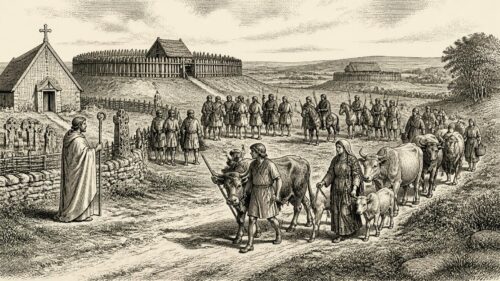
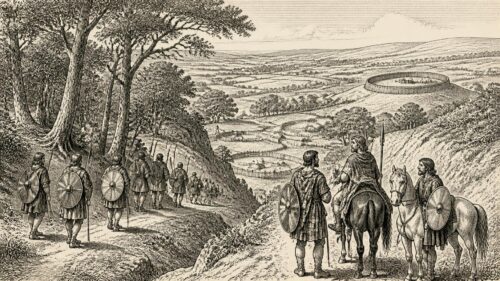
For people outside royal households, such a clash meant more than the fate of a prince. Early medieval armies depended upon food, cattle, horses, retainers and local routes. A campaign could disrupt grazing, harvest work and movement between settlements even when no annal chose to record plunder. That consequence is an inference from the nature of early medieval warfare, not a specific event reported for 726. There is no surviving entry for famine, exceptional weather, epidemic or a nationwide economic crisis in Ireland during this year. The responsible picture is therefore localised conflict, rather than a claim that the entire island was in upheaval.
Mide and Brega
Another brief notice records the killing of Ailill son of Badbchad in Mide. It does not call him king, identify his killer or connect his death explicitly with Cináed’s campaign. Nevertheless, the location matters. Mide lay between Brega and Leinster and included landscapes of exceptional political and agricultural importance, notably the wider Tara region. The death of a named man there in the same annal as the battle of Maíne hints at an atmosphere in which regional competition was expressed through lethal attacks as well as set battles. It cannot prove that Ailill was one of Cináed’s opponents, supporters or kinsmen; the evidence simply does not permit that conclusion.
The notice of the battle of Maíne also helps explain why claims to an ‘overkingship of Ireland’ must be handled with care. Irish annals sometimes attach expansive royal titles to successful rulers, but practical authority rested on relationships among many kingdoms. A ruler in Brega could project power into Leinster, while a Leinster king retained his own followers and while Munster, Connacht, the northern Uí Néill, Ulster and the Irish Sea world pursued separate interests. In 726, Cináed’s campaigning demonstrates ambition and capacity, not the creation of a stable island-wide state.
Churches Marking Time
Alongside killings and warfare, the annals record the deaths of churchmen. Da Chonda ‘the Devout’, bishop of Connere Mór, died; the Annals of Ulster preserve this notice as well. Mainchín of Leighlin ‘rested’, using the conventional Christian language for death. The Annals of Tigernach also record the passing of Cillíne Long, abbot of Iona. These entries do not provide biographies, but their inclusion shows the significance of ecclesiastical offices and communities to the annalists’ understanding of public life.
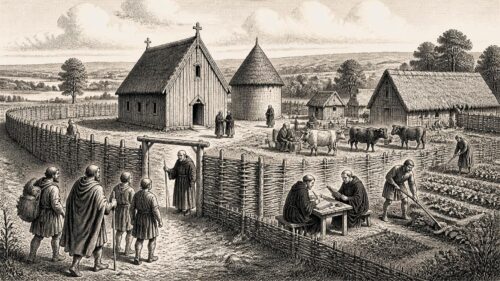
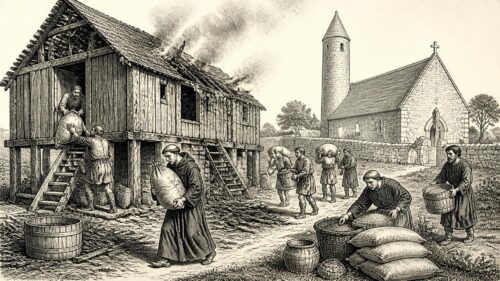
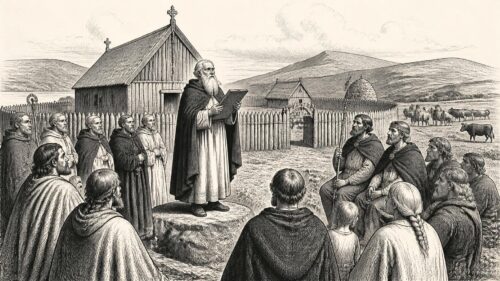
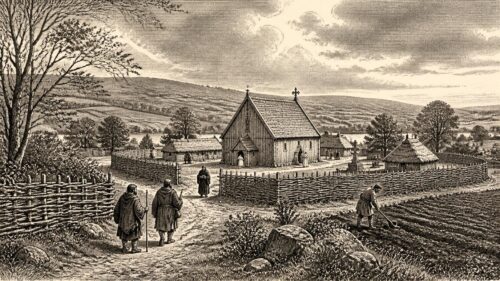
Connor and Leighlin were not simply isolated places of prayer. Early Irish churches and monasteries could be centres of worship, teaching, hospitality, craft production, landholding and political negotiation. Their enclosures incorporated churches, dwellings, workshops, fields and livestock; their leaders belonged to networks that crossed regional boundaries. Mainchín’s association with Leighlin in the Barrow valley is especially relevant to a year of Leinster conflict, though the annals do not say that his death was caused by war or that his community took a political side. Da Chonda’s episcopal title likewise reminds us that bishops remained important within a church whose organisation was strongly shaped by monastic communities and their federations.
Cillíne’s death at Iona brings the sea lanes into view. Iona was situated off the west coast of Scotland, but its Columban community was deeply connected with Ireland through personnel, learning, patronage and religious authority. The same year’s notices of Pictish rulers—Nechtan’s imprisonment, the removal of Dúngal and Drust, and Elphin’s accession—belong principally to northern Britain. Their presence beside Irish events in the annals reflects the insular horizon of ecclesiastical record-keeping. It does not show Irish intervention in the Pictish political crisis, but it does show that Irish chroniclers regarded events across the water as relevant to their historical world.
Settlement, Work and Record
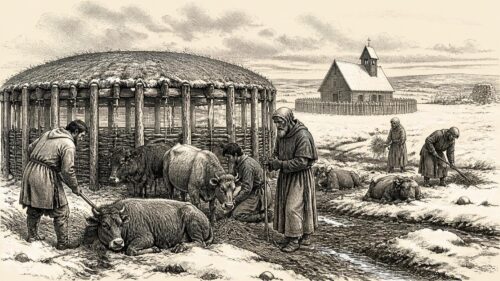
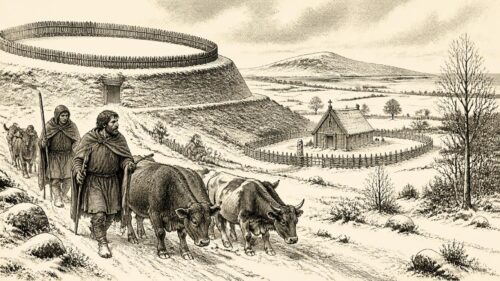
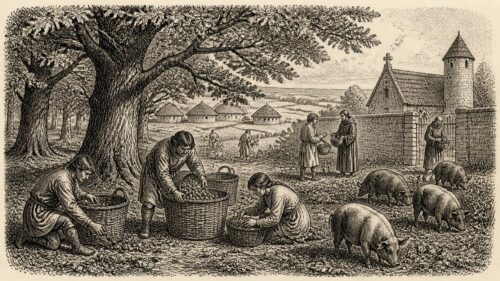
Most people in 726 lived not in monasteries or royal centres but in dispersed farming settlements, often enclosed by earthen banks and ditches. Households managed cattle, crops and seasonal labour, while local elites drew food-renders and service from dependent communities. Cattle mattered both as productive wealth and as a recognised measure of value; disputes over livestock and obligations could become political disputes. Such conditions give practical meaning to campaigns between Leinster and Brega, but they should not be mistaken for an annual census of life. The evidence does not allow us to name the harvest, prices, trade routes or population movements of 726.
The year’s documentary survival is itself culturally important. Annalistic writing reduced complex events to formulae: a killing, a battle, a repose, an accession. That compression preserves names otherwise lost—Crimthann of Cualu, Ailill of Mide, Da Chonda of Connor and Mainchín of Leighlin—while withholding the stories a modern reader most wants to know. The Annals of Tigernach and Annals of Inisfallen agree over Belach Lice but differ in the amount of detail they retain; other compilations preserve different clusters of notices. Rather than a defect, that variation is evidence of how medieval Irish historical memory was assembled, transmitted and revised.
A Year of Limited Certainties
The securely dated core of 726 is therefore modest but meaningful: Cináed son of Írgalach fought the Leinstermen at Maíne; Crimthann son of Cellach Cualann was killed at Belach Lice, with Muiredach named as victor in one annal; Ailill son of Badbchad was slain in Mide; and notable churchmen died at Connor, Leighlin and Iona. These were not disconnected entries. Together they reveal a society in which dynastic competition, local warfare and ecclesiastical institutions were interwoven. The year did not settle the struggle for power. Within two years Cináed himself would fall in battle. In 726, however, the record catches him still pressing southwards, while Leinster paid for its contested independence in the death of one of its young princely men.
Primary Sources
- Part 12 of Annals of Tigernach
- The Annals of Tigernach
- Annals of Tigernach: Source Description
- Part 296 of The Annals of Ulster
- The Annals of Ulster
- Part 28 of Annals of Inisfallen
- Annals of Inisfallen
- Annals of the Four Masters
- Annals of the Four Masters: Source Description
- Chronicon Scotorum
- The Annals Attributed to Tigernach
- Ua Bráein, Tigernach
- The Annals of Tigernach /
- Early Christian Monasteries
- Churches and Ecclesiastical Enclosures / Shéipéil agus Ráthanna
- Ordinary People in Early Christian Ireland
- The Earthen Rath or Lios
- Patrician and Early Christian Architecture
- Life in Glendalough
- Clonmacnoise Monastic Site
- Monasteries and Abbeys
- Background: Sceilg Mhichíl Visitor Guide