Cummian Fota661 CE
In 661, Irish annals record ecclesiastical, dynastic and royal change across a politically fragmented but connected island. Cummian Fota of Clonfert, a learned churchman of aristocratic Munster ancestry and probable author of a major Easter treatise, died aged seventy-one or seventy-two. Abbot Cumméne Find of Iona visited Ireland, illustrating active Irish Sea monastic networks. At Ogaman, conflict within the Brega-based Síl nÁedo Sláine dynasty saw Blathmac defeated by followers of his brother Diarmait. Máenach son of Fíngen, king of Munster, also died. Together, these events reveal the importance of contested kingship, ecclesiastical authority and scholarship.
Dateline
In 661 CE, Ireland’s annals preserve an unusually revealing cluster of deaths, a journey across the Irish Sea, a dynastic battle in the midlands and the passing of a Munster king. None makes a complete national narrative by itself. Together, however, they show how power, learning and religious authority were distributed across a landscape of competing kindreds and ecclesiastical communities. The year is especially associated with Cummian or Cuimíne Fota, ‘Cummian the Tall’, the celebrated scholar linked with Clonfert on the Shannon. His death was commemorated not merely as the loss of a churchman but as the removal of a figure whose learning, pedigree and public standing mattered across Ireland.
A Year with Difficult Dates
Early Irish annals are indispensable but not simple calendars. Their surviving manuscripts were copied centuries after the events they record, and their year-headings do not always align exactly with a modern CE chronology. The death of Cummian Fota appears under 661 in the Annals of Tigernach and Annals of Inisfallen, while the Annals of Ulster place it in an annal whose heading corresponds to 661 CE. The battle of Ogaman is similarly associated with the same sequence of events, although some editions and reference works number it 662. Modern chronological work allows the principal developments discussed here to be connected responsibly with 661 CE, but the differing annal numbers should warn against claiming a precise day or season where the evidence gives none.
This caution is not pedantry. Annalists recorded memorable occurrences rather than offering a full account of every year. Their notices privilege kings, clerics, battles and exceptional deaths. They tell us little directly about the sowing of crops, the work of households, ordinary disputes or the movement of goods. Yet the pattern of what they chose to record reveals the institutions that gave early medieval Ireland its structure: royal kindreds, client populations, churches, monasteries and networks of scholars whose influence reached well beyond their own settlements.
Cummian Fota of Clonfert
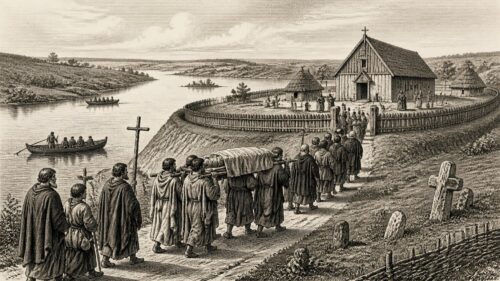
Cummian Fota’s obituary is the clearest focal point for the year. The Annals of Ulster state that he died in the seventy-second year of his life, and a verse preserved with the notice groups him with Máel Dúin, Béc son of Fergus and Conaing among the notable dead. A longer commemorative poem in the Fragmentary Annals praises him as both bishop and kingly man, a beacon of Irish wisdom. Such language is literary and idealising, but it is still significant evidence of reputation: Cummian was remembered as a learned ecclesiastic of exceptional stature, not simply as a local abbot.
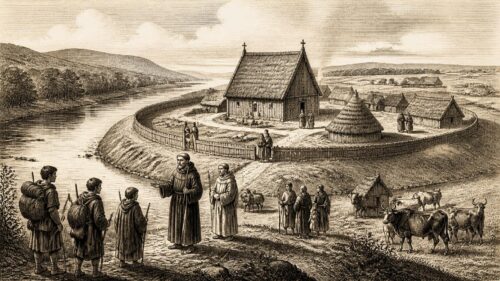
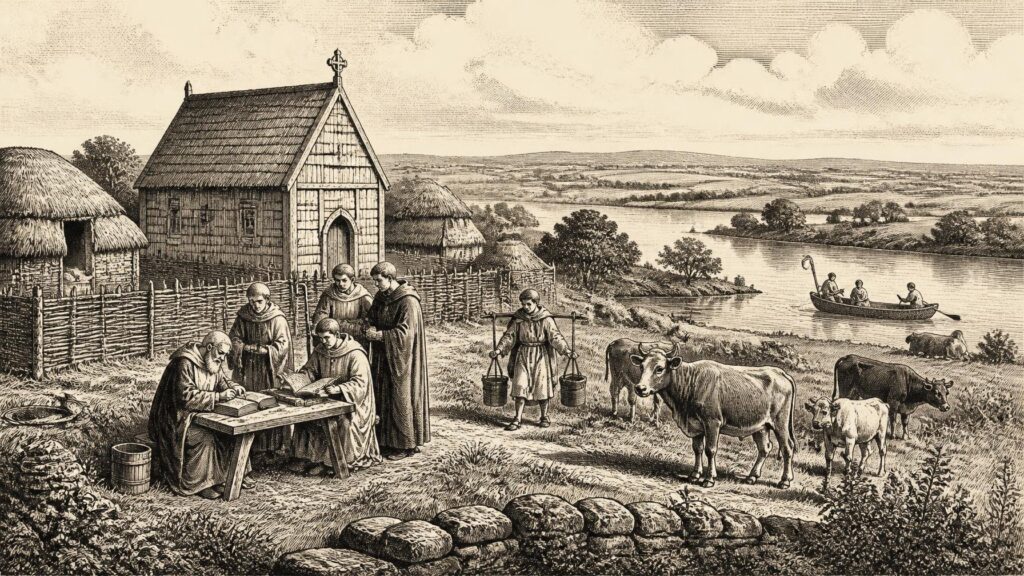
He was associated with Cluain Ferta Brénainn, modern Clonfert in County Galway, and was designated comarba Brénaind, successor of St Brendan. That title expressed more than devotional continuity. A successor inherited claims to the prestige, property, dependants and wider ecclesiastical connections attached to a saint’s foundation. Clonfert stood in the Shannon world, where river communication linked Connacht, the midlands and Munster. A church based there could draw support from local rulers while participating in religious and intellectual exchanges extending across Ireland and the Irish Sea.
Cummian’s origins also joined church and aristocracy. Genealogical tradition places him among the Éoganacht Locha Léin of Munster, while the praise-poem calls attention to descent from Cairpre and Corc. Such pedigrees must not be read as modern biography, but aristocratic affiliation was politically meaningful. In seventh-century Ireland, prominent churches and ruling families were frequently interwoven through kinship, patronage and claims of saintly succession. Religious office did not remove a man from the social world of kingship; it could give him another, powerful position within it.
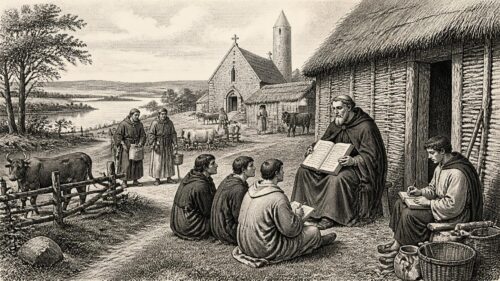
His intellectual legacy was equally important. Cummian is probably the author of the Latin letter De controversia paschali, written around 632 during the dispute over the calculation of Easter. The attribution is not absolutely certain, so it should remain a probability rather than an unquestioned fact. If correct, it shows a scholar drawing upon Scripture, patristic writers, church history, canon law and several systems of calendrical calculation in order to urge agreement with wider western Christian practice. The letter addressed the abbot Ségéne of Iona and the hermit Béccán, demonstrating that Irish debates were not provincial quarrels but arguments conducted through books, correspondence and authority claimed from Rome to the islands at Europe’s north-western edge.
By 661, therefore, Cummian’s death marked the disappearance of a man who embodied a mature learned culture. The surviving letter speaks of reading, comparing authorities and examining computistical cycles. Its very existence implies access to books and the skilled Latin literacy needed to use them. This was not learning detached from daily discipline. Correct observance of Easter ordered communal worship, fasting and feast days; penitential teaching, also associated with Cummian, set out rules for repairing moral and social breaches. Monastic scholarship supplied practical frameworks for Christian life as well as prestige for the communities that cultivated it.
An Abbot Crosses the Sea
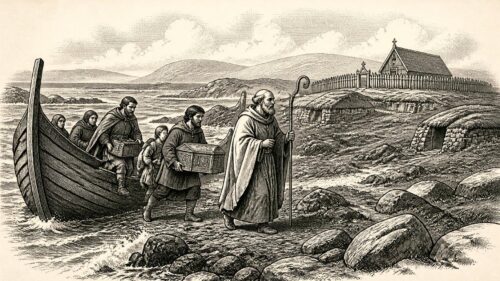
The year also records that Abbot Cumméne Find, head of Iona from 657 to 669, came to Ireland. He must be kept distinct from Cummian Fota. Cumméne Find, ‘the White’, belonged to the Columban community centred on Iona, the island monastery founded by Colum Cille off the west coast of what is now Scotland. The annal supplies no itinerary, purpose or duration for his visit. Later scholarly assessment suggests that he may have stayed at the Columban foundation on Rathlin Island, but this remains a possibility, not a recorded fact.
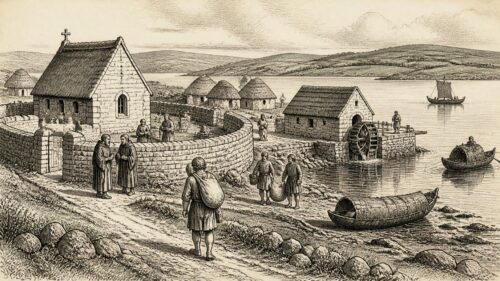
Even the brief notice matters. It confirms that sea travel was a normal means of connection for ecclesiastical leaders, not an extraordinary adventure. Iona’s religious federation bound communities in Ireland, Dál Riata, Pictland and Northumbria through personnel, memory, books and the cult of Colum Cille. Cumméne’s visit came before the Synod of Whitby in 664, when the Northumbrian church adopted Roman Easter observance and Columban clerics withdrew from Lindisfarne. Nothing in the 661 entry allows that later rupture to be projected backwards. But the visit does show an Irish Sea network already active, one in which monasteries were centres of travel, diplomacy and shared religious identity.
Ogaman and the Brega Dynasty
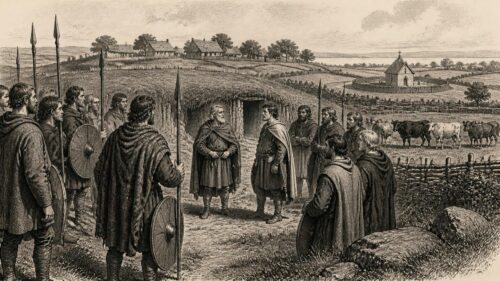
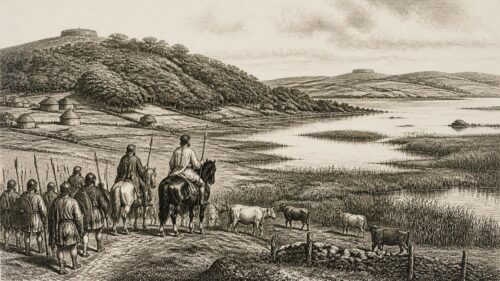
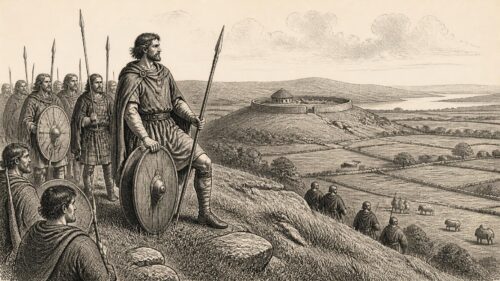
The year’s principal political violence was the battle of Ogaman, fought at Cenn Corbadan. The location cannot be identified securely, and the annals do not describe tactics, numbers or the battle’s immediate cause. They are clearer about its dynastic character. Blathmac son of Áed Sláine was defeated by men described as the allies or followers of his brother Diarmait. Among the dead were Conaing son of Congal, Ultán son of Ernán, king of Cianachta, and Cenn Fáelad son of Gertide, king of Ard Cianachta. Another casualty was Faelchú son of Máel Uma.
This was not simply a quarrel between two brothers. Blathmac and Diarmait belonged to Síl nÁedo Sláine, a leading Uí Néill lineage rooted in Brega, the rich region north of the River Liffey and east of the central plain. Their claims were bound to the kingship of Tara, an overkingship whose practical authority depended on alliances, military success and the recognition of subordinate rulers. The deaths of Cianachta kings and of Conaing, Blathmac’s nephew, show that the conflict drew in associated kindreds rather than remaining confined to the immediate royal household.
One annalistic version says that Ogaman ended Blathmac’s rule and began Diarmait’s; importantly, it adds ‘as others say’. That qualification should govern interpretation. Later king lists portray the brothers as joint rulers, but historians have questioned how literally such joint reigns should be understood. Ogaman may represent the high point of an internal struggle in which Diarmait displaced or eclipsed Blathmac. It does not justify a confident declaration that one brother became sole ruler on a known date. What can be said is that a battle in 661 exposed serious fractures within the dynasty that dominated Brega and sought primacy in the Irish midlands.
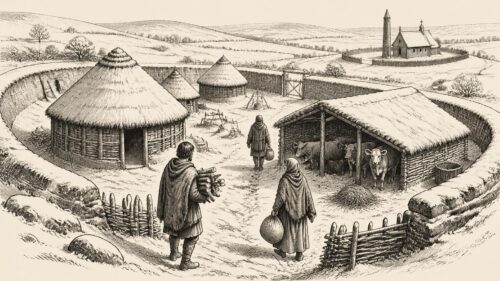
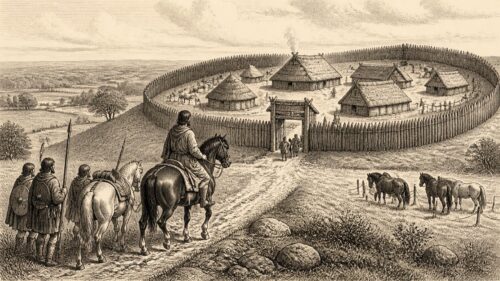
For people living under these rulers, such contests had material consequences. Armies required food, livestock, transport and the service of clients; defeats brought deaths among elite households and could alter obligations owed by lesser communities. Most families nevertheless lived in dispersed rural settlements, often in enclosed homesteads now known as ringforts or raths. These were places of residence, storage and stock management as much as of defence. Cattle remained central to wealth, food and exchange, while grain cultivation and seasonal labour sustained households. The annals do not report a harvest or famine for 661, so no particular environmental crisis should be imagined; Ogaman was a political shock within an overwhelmingly agrarian society.
A Munster Succession
Another firmly connected event was the death of Máenach son of Fíngen, king of Munster and king of Caisel in the annalistic terminology. His passing ended a reign conventionally placed from about 641. The sources preserve no detailed narrative of his rule, an absence that limits any judgement of his policies or personality. His death nevertheless mattered because Munster was not a unitary kingdom in the modern sense. Its overkingship depended on the balance among branches of the Éoganachta and other powerful regional peoples. A royal death invited negotiation, competition and renewed displays of status, even where no battle was recorded.
Cummian Fota’s Munster connections give this event added resonance. His ecclesiastical standing at Clonfert and aristocratic ties to the south illustrate how regional kingship and church patronage could overlap without being identical. The Shannon corridor linked the western church settlement with Munster and the midlands; political change in one region could affect the security and benefaction available to another. Still, the evidence does not permit a direct causal link between Máenach’s death and Cummian’s commemoration, nor between the Munster succession and Ogaman. They are best understood as parallel developments within a politically fragmented island.
Loss, Learning and Connection
Seen together, the notices for 661 reveal Ireland as a society connected by rivers, sea routes, kinship and religious institutions, while remaining divided among many rulers. Ogaman demonstrated the volatility of elite politics in Brega. Máenach’s death opened a change in Munster’s royal order. Cumméne Find’s arrival from Iona showed the ease with which leading churchmen crossed the sea. Above all, the death of Cummian Fota brought public recognition of scholarship as a source of authority. His memorial verse fused sanctity, learning and noble descent into one ideal of leadership.
That combination is the year’s most enduring historical significance. Ireland in 661 was neither isolated nor politically unified. Its local farming communities, royal territories and monasteries formed an interdependent world. Kings fought for precedence, but churches preserved texts, organised worship and connected distant regions. The annals leave many silences; they do not give us the voices of ordinary households or a full map of events. Yet their concentrated record for this year allows a rare glimpse of the forces that shaped early medieval Ireland: contested kingship, mobile ecclesiastical networks and a learned Christian culture capable of making one scholar’s death a matter of island-wide memory.
Primary Sources
- The Annals of Ulster, Year U662 (AD 661)
- The Annals of Tigernach, Annals T660–T664
- Annals of Inisfallen, entries AI660–AI666
- Chronicon Scotorum, Annals CS659–CS663
- Fragmentary Annals of Ireland, Annals FA19–FA20
- Chronological Synchonisation of the Irish Annals, 488–722
- Cummian (Cummíne, Cumméne) Foto
- Cumméne (Cummíne, Cummian) Find
- Blathmac
- Írgalach
- Áed Sláine
- Cummian’s Letter: De controversia Paschali
- De controversia Paschali (Latin text)
- CELT Project: The Annals of Tigernach
- CELT Project: Chronicon Scotorum
- CELT Project: Annals of Inisfallen
- Irish Script on Screen: Chronicon Scotorum
- Annals of Tigernach, National Library of Wales Archives and Manuscripts
- Ringforts / Ráthanna
- Early Christian Monasteries
- Archaeological Survey, National Monuments Service
- Early Medieval Ireland, AD 400–1100: The Evidence from Archaeological Excavations