Ogaman Battle660 CE
Around 660, the battle of Ogaman at Cenn Corbadáin exposed conflict within the southern Uí Néill. Although annals date it variously to 660–662, they agree that Diarmait’s followers defeated those of his co-ruler and brother Blathmac, killing leaders linked to the Ciannachta and Ard Ciannachta of Brega. Blathmac survived, suggesting a shift in power rather than deposition. The same chronological horizon includes deaths among Munster’s elite and leading churchmen, notably Tóiméne, bishop of Armagh. These events reflected Ireland’s fragmented political order, where dynastic alliances, local rulers and ecclesiastical centres shaped authority amid a predominantly rural society.
Dateline
In 660 CE, Ireland’s annals associate the year above all with a battle at Ogaman, at a place called Cenn Corbadáin, and with a striking rupture within the ruling dynasty of the southern Uí Néill. The event is conventionally assigned to 660 by the Annals of the Four Masters and the Annals of Tigernach, but early Irish annalistic chronologies do not align perfectly: the Annals of Ulster place the same fighting under their entry for 661, while the Fragmentary Annals give 662. This is not evidence for several separate battles. Rather, it is a reminder that the modern calendar labels attached to seventh-century notices require care. What can responsibly be said is that, around 660, Diarmait and Blathmac, sons of Áed Sláine and joint holders of a wider kingship, were no longer acting in visible harmony.
A Victory Within the Dynasty
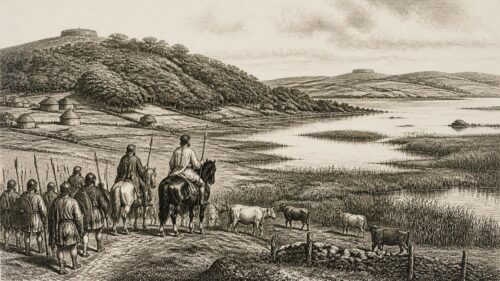
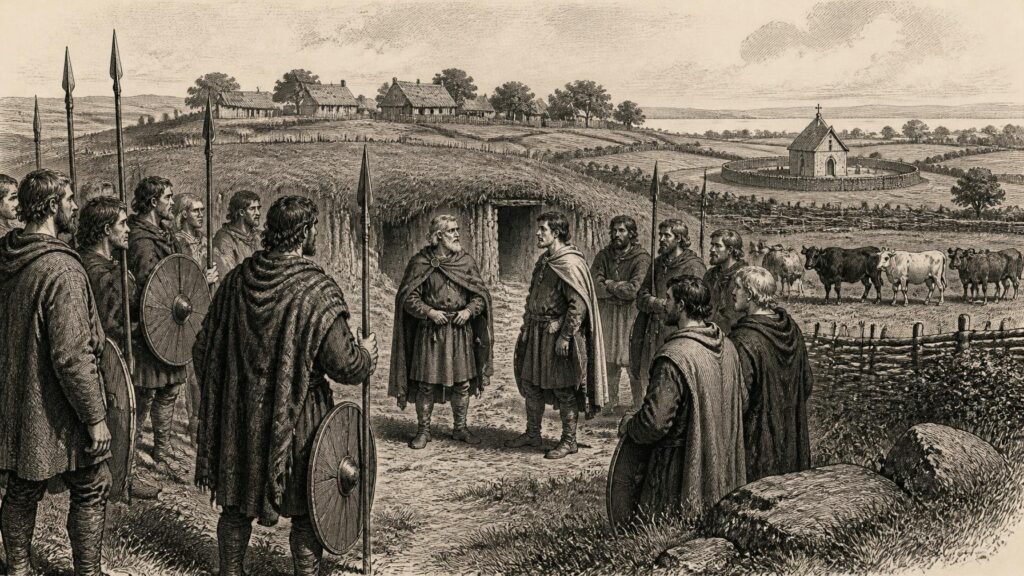
The accounts describe Diarmait’s followers defeating Blathmac. They name three of Diarmait’s men: Onchú son of Sárán, Máel Mílchon, and Cathasach son of Éimíne. The casualty list is unusually revealing. Conaing, a member of the wider kindred of Áed Sláine, died; so did Ultán son of Ernáine, styled king of the Ciannachta, Cenn Fáelad son of Gertide, styled king of Ard Ciannachta, and Faelchú son of Máel Uma. The sources do not preserve a speech, treaty or formal explanation. They do, however, make clear that this was not a chance clash between unrelated local groups. It was an armed contest in which the adherents of one co-ruler overcame the other and in which leaders from important populations of the Brega region were killed.
That point matters because the joint rule of Diarmait and Blathmac has often been presented too smoothly. The annals and later king-lists could call both men rulers of Ireland, yet such language did not mean that either controlled a unified state with fixed borders, standing institutions or automatic obedience. Power rested on personal followings, kinship, hostages, tribute, church alliances and the ability to assemble fighters. Kingship was layered: a ruler might dominate his own people, compete for Brega, and claim a wider superiority, while other provincial dynasties retained their own kings and interests. Ogaman exposed the fragility beneath a partnership that had begun only a few years earlier.
Brega and the Ciannachta
The named dead point towards the political landscape east and north-east of the River Boyne. Brega was a wealthy and contested central plain, a region whose pasture, grain-producing land, routes and proximity to major royal and ecclesiastical sites made it crucial to the ambitions of the Síl nÁedo Sláine, the descendants of Áed Sláine. The Ciannachta were among the peoples whose territories lay in or beside this world. Ard Ciannachta is generally connected with the raised country later remembered in the Ferrard area of County Louth. Such identifications help to place the conflict broadly in the north-eastern midlands, but Cenn Corbadáin itself cannot be pinned down with confidence. The annals preserve a battlefield name, not a modern map reference.
The deaths of Ultán and Cenn Fáelad nevertheless show that local rulers were not incidental spectators. Their participation suggests that the contest drew in communities whose support could strengthen a claimant’s position in Brega. It is tempting to turn the battle into a simple struggle between Diarmait and Blathmac for a single “high kingship”; the evidence is thinner than that. Blathmac survived the defeat and continued to be named alongside Diarmait in traditions of their rule. Ogaman therefore appears less as a final deposition than as a hard-fought correction in the balance of power, a warning that joint supremacy depended on continuing consent and force.
Losses Beyond the Battlefield
The annalistic material conventionally associated with 660 also records a cluster of prominent deaths. Móenach son of Fíngen, styled king of Mumu or Munster, died; so did Máel Dúin son of Áed Bennán, a member of a leading Munster lineage, and Máel Dúin son of Furudrán, chief of Durlas. The sources differ over the year-labels for some of these notices, so they should not be treated as securely dated to a particular day or season. Still, their association with the same narrow chronological horizon underlines how succession and political recalculation could occur simultaneously in several regions. A king’s death did not merely alter a pedigree: it opened questions about tribute, military service, clientship and the protection of churches and dependants.
In 660, then, Ireland was not a kingdom moving to the orders of one court. It was an island of many túatha, or small political communities, linked into wider networks by powerful kindreds. Munster, Leinster, Connacht, Ulaid and the northern Uí Néill each had their own political fields, while Brega remained especially important because rival branches of the Uí Néill competed there. The notices from Ogaman should be read in that setting. A local battle involving named chiefs could have consequences well beyond its immediate ground, because the losers’ kin, clients and ecclesiastical associates would have to decide where their allegiance now lay.
Armagh and Ecclesiastical Authority
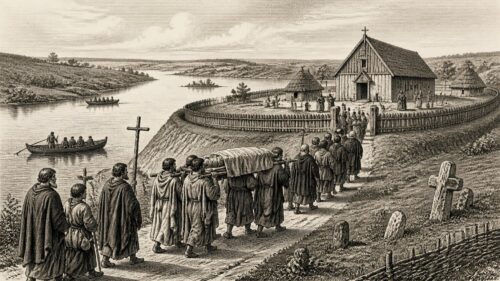
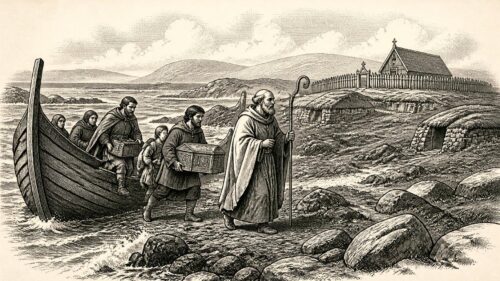
The year was also marked by the death of Tóiméne son of Rónán, bishop of Armagh, according to the chronological tradition represented by the Annals of Ulster, Annals of Tigernach, Annals of Inisfallen and Four Masters. The record does not allow a full biography to be reconstructed from 660 alone, but Tóiméne’s passing mattered. Armagh was already a major Patrician church and a centre of learning, liturgical practice, patronage and claims to religious precedence. Its leader operated in a landscape where bishops, abbots, saints’ cults and dynasties overlapped rather than fitting neatly into later diocesan structures.
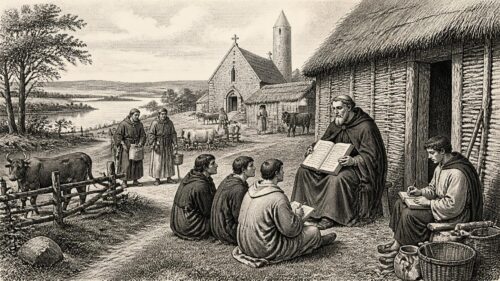
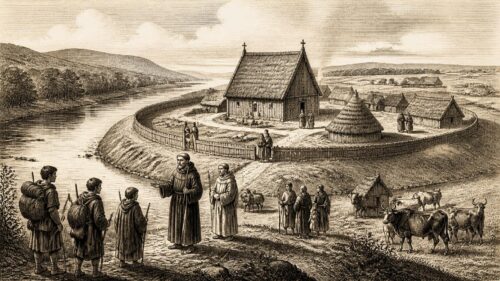
Other ecclesiastical obits attached to this year include Conaing, abbot of Imlech Ibuir, and Laidcenn son of Báeth Bánnach, described as a sage. Their notices offer a glimpse of the social importance of churches. Monasteries were communities of prayer and study, but they were also landholders, producers, consumers, hosts, places of refuge and nodes in networks of travel. Their learned members copied and interpreted Latin texts while working within an Irish-speaking society; their leaders could be connected to powerful families and their settlements drew labour, food-renders and gifts from surrounding populations. The death of an abbot or celebrated scholar could therefore affect religious authority as well as local resources and political relationships.
Life Beyond the Annals
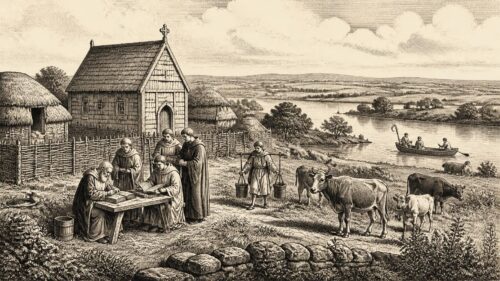
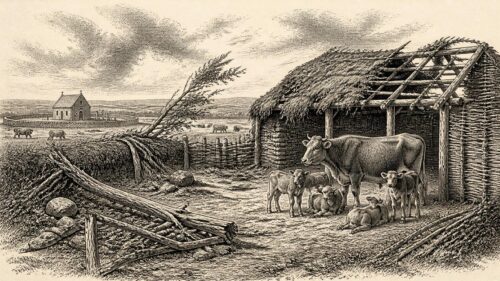
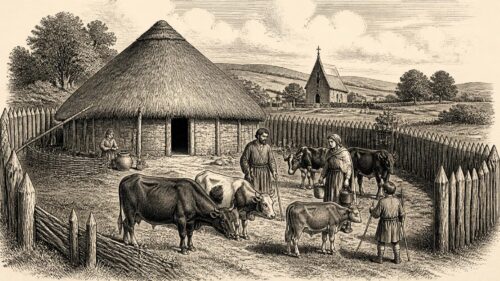
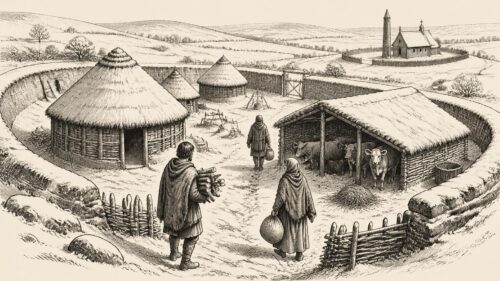
The annals record kings, clerics and killings because these were events worth entering in elite chronicles. They tell us much less directly about the majority who lived through 660. Archaeology and early Irish legal material supply the wider setting. Most people inhabited a strongly rural landscape of dispersed farmsteads, enclosed settlements, fields, trackways and occasional crannogs. Cattle were central to wealth and status, but households also depended on dairying, pigs, sheep, cereal cultivation, milling, weaving, wood-gathering and seasonal repair of houses, fences and field boundaries. Some people were free landholders; others were dependants, tenants, captives or enslaved people. A battle among rulers could bring levies, requisitioned food and disrupted grazing to these households even when no chronicler recorded their names.
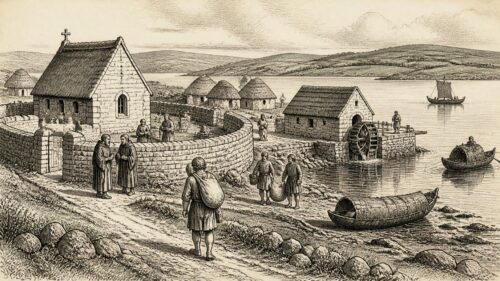
It would be misleading to claim that every ringfort visible today was occupied in 660, or that a particular monastery was founded that year without direct evidence. Yet the material record makes clear that these forms of settlement belonged to the broader early medieval landscape in which the battle occurred. Many smaller ringforts were farmsteads, while more elaborate enclosures could express higher status. Ecclesiastical sites varied enormously, from modest religious communities to large and influential centres. In a society without towns in the later medieval sense, royal sites and monasteries could concentrate people, craft skills, exchange and authority more intensely than the countryside around them.
A Year of Uneasy Continuity
660 CE is therefore best understood not as a turning point created by one decisive battle, but as a sharply illuminated moment in a continuing struggle over authority. At Ogaman, the followers of Diarmait overcame Blathmac and killed leaders tied to the Ciannachta and Ard Ciannachta. At the same time, deaths in Munster and at leading churches exposed the ordinary vulnerability of political and religious leadership. Beneath those terse notices lay a society whose daily survival depended on livestock, grain, kinship and labour, and whose rulers depended on alliances that could be tested violently. The conflicting annal dates counsel precision and restraint; the convergence of the narratives leaves little doubt about the larger reality: around 660, the coalition sustaining the sons of Áed Sláine had come under open strain.
Primary Sources
- The Annals of Tigernach, Part 9
- The Annals of Ulster
- Annals of Inisfallen
- Annals of the Four Masters, Part 49
- Fragmentary Annals of Ireland, Part 1
- Chronicon Scotorum
- Chronological Synchronisation of the Irish Annals
- On Reconstructing Medieval Irish Chronicles
- Ireland in the Seventh Century: A Tour
- Ireland To 1170 (with Andrew Woods)
- Religion and Society in Ireland
- The Church and the World in Early Christian Ireland
- The Archaeology of Livestock and Cereal Production in Early Medieval Ireland, AD 400–1100
- Early Medieval Ireland: Archaeological Excavations 1930–2009
- Land Tenure and Farming in Early Medieval Kerry: A Survey of Field Systems in the Lough Currane Basin
- How Did Early Church Sites Differ from One Another? A Comparative Approach Within the Kingdom of Fir Maige, Ireland
- A Major Monastic Centre? Rethinking Lismore’s Place in the Ecclesiastical Landscapes of Early Medieval Britain
- The Idea of the Three Orders of Society and Social Stratification in Early Medieval Ireland
- Carron Ringfort
- Grianán of Aileach
- Innisfallen Augustinian Abbey
- Cianachta, Placenames Database and Historical Reference Material