Raids and Reckonings1056 CE
In 1056, Ireland remained divided among competing provincial rulers, as Diarmait of Leinster, Donnchad of Munster, Áed of Connacht and Conchobar of Mide pursued fragile power. Annals record dynastic killings, disputed raids and major cattle seizures, including captives, while a Christmas raid ended in drownings. Churches were influential communities, marked by deaths of prominent clergy, notably Armagh’s Áed Ua Forréid. Scholar Flann Mainistrech of Monasterboice died, whereas Marianus Scotus joined Cologne’s Irish monastery, illustrating international learned links. Rural farming supported cattle wealth, while Dublin’s trade underpinned Leinster. Lightning deaths and storm-related disaster underscored life’s vulnerability. Sources vary in reliability, dating.
Dateline
The surviving record of 1056 is unusually revealing, though far from complete. Irish annals identify raids, killings, clerical deaths, a destructive lightning strike and the passing of one of the age’s greatest scholars. They also expose the structures beneath such events: rival provincial kings, cattle-based wealth, powerful ecclesiastical communities and learned networks extending far beyond Ireland. The year was a leap year in the Julian calendar, beginning on a Monday according to the Annals of Ulster, Tigernach and Inisfallen. Exact dates are nevertheless rare, and some details occur only in later compilations. Where the sources disagree or stand alone, their testimony must be treated with appropriate caution.
A Divided Political Landscape
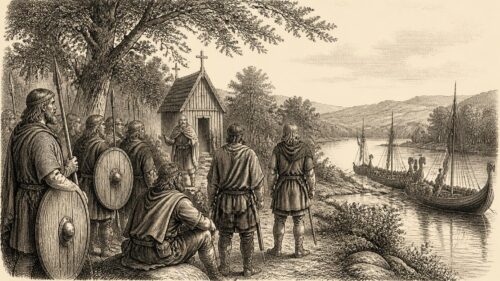
Ireland had no monarch exercising consistent authority over the whole island. Diarmait mac Máel na mBó, king of Leinster and head of Uí Chennselaig, was among its most formidable rulers. His control of Dublin, exercised through his son and lieutenant Murchad, gave his dynasty access to ships, silver, warriors and the resources of Ireland’s leading port. In Munster, Donnchad mac Briain, a son of Brian Bóruma, still held the provincial kingship, but his authority was being undermined by internal Dál gCais rivalry. His nephew Toirdelbach Ua Briain had found a valuable patron in Diarmait. Their alliance would eventually overthrow Donnchad, although no decisive transfer of power can securely be assigned to 1056 itself.
Connacht was ruled by Áed in Gaí Bernaig Ua Conchobair, while Conchobar Ua Máelshechlainn maintained a long and often ruthless kingship in Mide. The Annals of Tigernach place two dynastic killings in 1056: Conchobar killed a son of Cernachán ‘the Stammerer’ and Domnall, another member of the same collateral line. These were not random crimes but part of a sustained struggle within Clann Cholmáin. Conchobar had gained power after years of disputed succession and repeatedly removed relatives who might challenge him. His position remained strong, yet Mide’s central location left it exposed to Leinster, Connacht, Brega and the northern Uí Néill.
The later Annals of the Four Masters add that Murchad son of Diarmait raided the Uí Laegaire around Tara, but was overtaken by their lord and suffered heavy losses. The same compilation assigns a plundering expedition by Diarmait into Munster to 1056. Because these notices lack clear confirmation in the more nearly contemporary annalistic traditions, they are best regarded as events placed in this year by the Four Masters rather than unquestionable fixed points. Even so, they fit the wider political pattern: Diarmait and Murchad were applying pressure northwards into the old Uí Néill heartlands and westwards against Donnchad’s Munster.
Cattle Raids and Captives
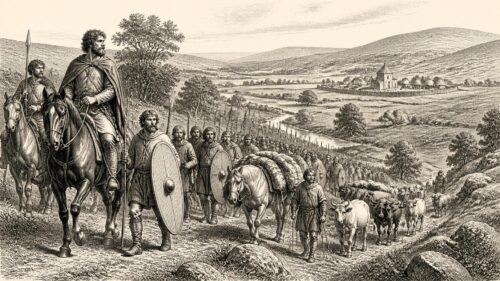
The most striking military entry concerns Niall son of Máel Sechnaill, who raided Dál Araidi in north-eastern Ireland. He reportedly carried away 2,000 cows and sixty captives. Such numbers may have been rounded, but the form of the operation is entirely credible. Cattle were mobile wealth, providing dairy produce, status, rents, tribute and a recognised measure of value. A successful raid could impoverish an opponent while feeding and rewarding the victor’s followers. The seizure of people was equally serious. The annals do not record what became of these sixty captives: they might face ransom, redistribution, servitude or sale.
Violence also disturbed Connacht. Tadc, identified as the son of ‘the Cleric’ Ua Conchobair, was killed by the Uí Maine, a major population group of eastern Connacht. Tigernach and the Chronicon Scotorum also record the killing of Odar son of Flann, king of the Calraige. These terse notices conceal local contests over land, succession and tribute. Annalists generally named rulers and churchmen rather than ordinary casualties, so a single recorded death may represent a confrontation involving a wider following.
A final raid ended in disaster. On Christmas night, Eochaid Ua Flaithéin entered Mag Ítha, the fertile Finn valley region of the north-west, and drove away 500 cows. At a river in Mag Uatha the captured herd was abandoned, and forty-eight people drowned together with Cuilennán son of Dergán. The source does not explain whether floodwater, darkness, pursuit or panic caused the catastrophe. The choice of Christmas night may have offered tactical surprise, but it also made the act especially shocking to clerical chroniclers. The episode illustrates the practical hazards of moving a frightened herd and a raiding party through winter terrain.
Churches and Communities
Ecclesiastical obituaries occupy much of the record. On 18 June, Áed Ua Forréid, eminent lector and bishop of Armagh, died aged seventy-five. A lector directed advanced teaching and represented a church’s intellectual standing; Áed’s age, combined titles and verse obituary suggest exceptional prestige. Armagh was both a religious centre associated with Patrick and a political institution whose relics, personnel and claims connected it with rulers across Ireland.
Cétfaid of Lismore also died during the year. The Annals of Inisfallen call him an anchorite, while other chronicles describe him as a bishop or the head of Munster’s piety. These descriptions are compatible with an admired ascetic holding broad spiritual authority. Lismore was already one of southern Ireland’s major religious settlements, supporting worship, scholarship, craft activity and the administration of church lands. Other deaths included Cathasach son of Gerr Garbáin, successor of Cainnech among the Cianachta; Gormgal, chief confessor of Inis Darcairgrenn; and Étrú son of Labraid, chief of the Monaig and a celebrated figure among the Ulaid. The Four Masters preserve further obituaries for church officers connected with Termonfeckin, Clonmacnoise and Glendalough.
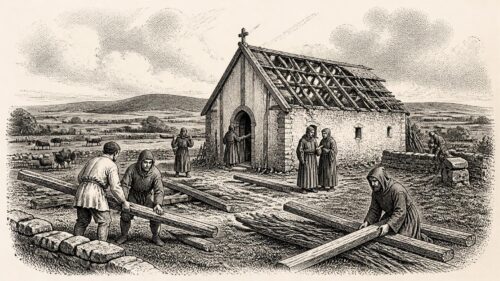
Such titles demonstrate that the Irish Church was not composed simply of isolated monks. Major foundations were communities of prayer, education, production and lordship. Their senior offices could be associated with particular learned or hereditary families, while bishops, lectors, confessors, anchorites, successors of saints and administrators performed overlapping functions. Church settlements owned livestock and land, received gifts and tribute, sheltered dependants and maintained relationships with kings. Their prominence also made them prizes in political disputes.
The Death of Flann
The year’s greatest cultural loss was Flann Mainistrech, lector of Monasterboice and an outstanding historian and poet. The Annals of Tigernach date his death to 25 November; the Four Masters preserve a variant corresponding to 18 November. Modern scholarship generally accepts 25 November, but the disagreement should not be hidden. Other chronicles agree on his exceptional stature, praising his command of Latin learning, poetry and Ireland’s traditional historical lore.
Flann belonged to a scholarly culture that sought to organise dynastic memory, genealogy, biblical chronology and classical history within a Christian vision of time. Nearly fifty texts or fragments were later attributed to him, although not every attribution is equally secure. His surviving verse includes accounts of kings, Uí Néill dynasties, Tara, legendary peoples and universal history. Such learning was politically useful: a poem establishing a dynasty’s antiquity or rightful place in the succession could strengthen contemporary claims. Yet Flann’s importance exceeded patronage. His work helped transmit names, traditions and chronological schemes into manuscripts compiled generations after his death.
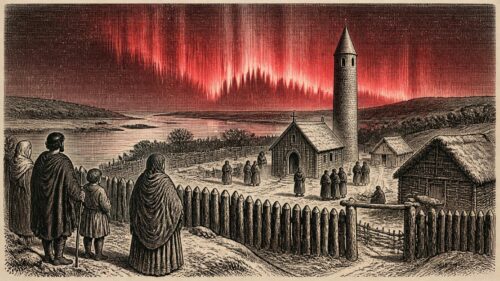
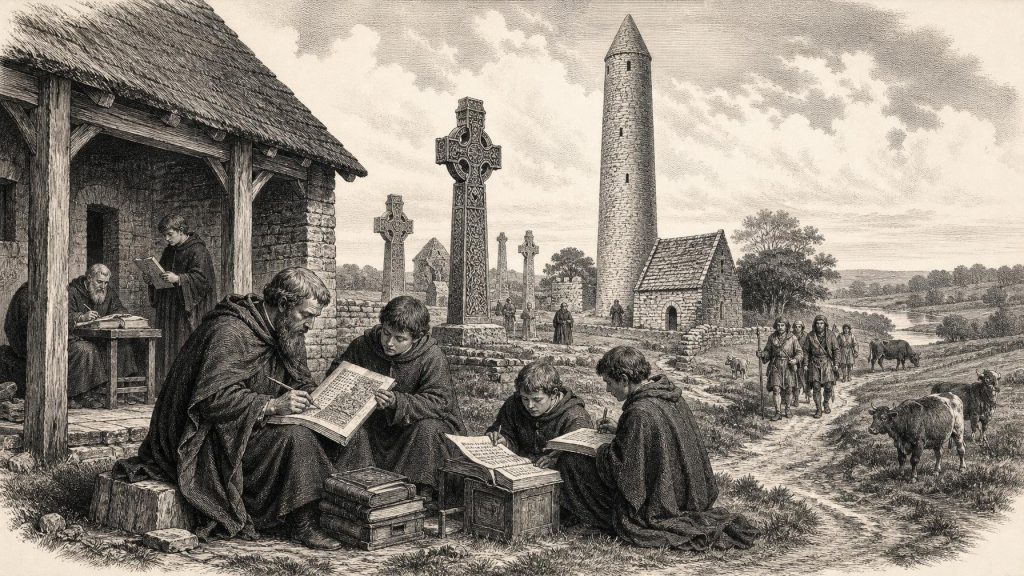
Monasterboice in County Louth was an appropriate centre for this activity. Its churches, round tower and monumental crosses belonged to a prosperous religious landscape close to Brega, Armagh, Dublin and the routes of the Boyne valley. Students there encountered Latin scripture and computus alongside Irish poetry, genealogy and history. Flann’s obituary therefore marks more than the death of an individual: it records the passing of a recognised master of Ireland’s collective memory.
An Irish Scholar Abroad
While Flann’s career ended, another Irish scholar entered continental religious life. Marianus Scotus, originally named Máel Brigte, later recorded that he joined the Irish monastery of St Martin at Cologne on 1 August 1056. He had become a monk in Ireland in 1052, probably at Mag Bile, or Movilla. Marianus later lived at Fulda and Mainz and composed an influential universal chronicle. His journey shows that Irish learning was not confined to the island. Monks, books and chronological ideas travelled through ecclesiastical networks linking Ireland with Britain and continental Europe.
Work, Trade and the Natural World
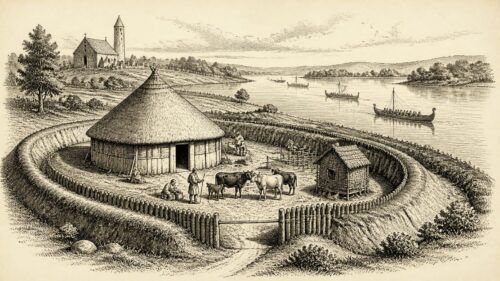
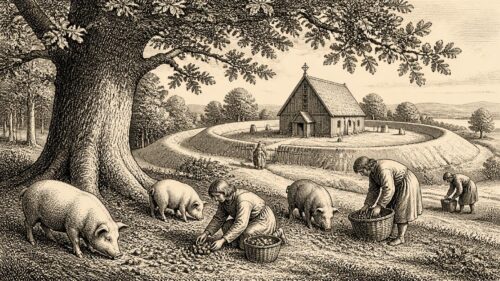
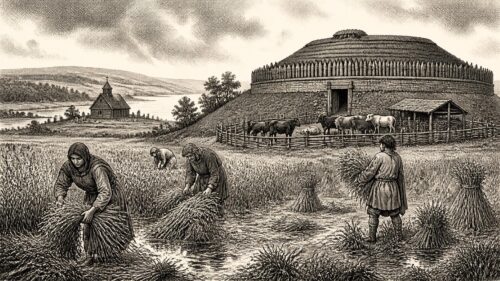
For most inhabitants, 1056 passed not in royal camps or scriptoria but on dispersed farms. Archaeology indicates a mixed economy of cattle, sheep, pigs and cereals, with dairying especially important. People ploughed and harvested, repaired enclosures, ground grain, preserved food and spun or wove textiles. Ringforts, open settlements, crannogs and church sites remained the principal centres of rural life. The enormous herds mentioned in the annals make sense only against this laborious agricultural background.
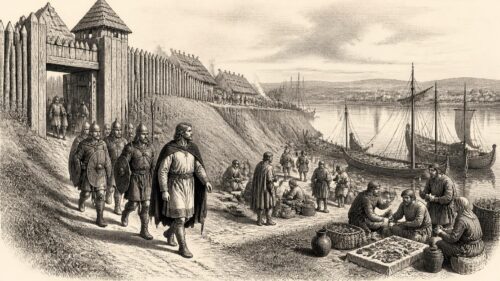
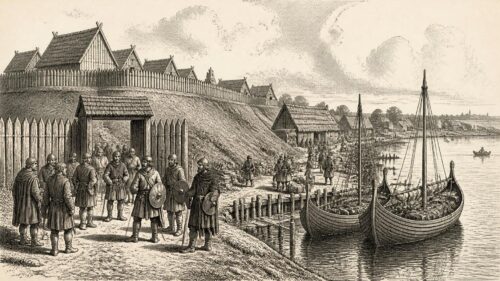
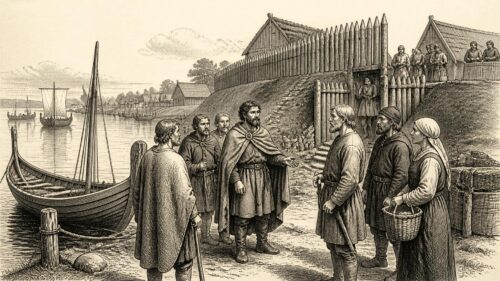
Dublin and the other Hiberno-Norse ports formed a contrasting urban world of timber houses, workshops, quays and markets. Dublin craftsmen worked wood, iron, leather, textiles, amber, bone and precious metals. Silver pennies had been minted there since the reign of Sitriuc Silkbeard, and trade connected the town with Britain, Scandinavia and continental Europe. Under Diarmait and Murchad, this commercial and maritime centre became a foundation of Leinster power.
The Annals of Ulster close their record of the year with nature’s violence. Lightning killed three people at Dísert Tola and a student at Swords, where it also broke an ancient tree. No exact day is given. To the annalist, the human deaths, the loss of a student and the destruction of a venerable landmark all deserved remembrance. Together with the drowned Christmas raiders, the notice brings an unpredictable physical world into a record otherwise dominated by elites. In 1056, political ambition, scholarship, faith and ordinary labour all remained vulnerable to storm, water and sudden death.
Primary Sources
- The Annals of Ulster — Year U1056
- Annals of the Four Masters — Entries for 1056
- The Annals of Tigernach — Annal T1056
- Chronicon Scotorum
- Annals of Inisfallen — Annal AI1056
- Flann Mainistrech
- Reception and Use of Flann Mainistrech and His Work in Medieval Gaelic Manuscript Culture
- The Reception and Use of Flann Mainistrech and His Work
- Twelve Poems Attributed to Fland Manistrech from the Book of Leinster
- Diarmait (Diarmait mac Maíl na mBó)
- Donnchad
- Ua Máelshechlainn, Conchobar
- Biographies A–Z: Ua Conchobair, Áed in Gaí Bernaig
- Agriculture, Settlement and Society in Early Medieval Ireland
- The Archaeology of Livestock and Cereal Production in Early Medieval Ireland, AD 400–1100
- Early Medieval Ireland: Archaeological Excavations, 1930–2009
- Viking
- Dublin City Urban Archaeology Survey
- County Waterford and Waterford City Urban Archaeology Survey
- Monasterboice Monastic Site
- Monasterboice Conservation Study
- Marianus Scotus
- Deutsche Biographie — Marianus Scottus
- Mariani Scotti Chronicon
- The Erenagh in the Monastic Irish Church