De Burgh’s Scottish Muster1303 CE
In 1303, Ireland contributed significantly to Edward I’s Scottish campaign under Richard de Burgh, earl of Ulster, who led an estimated 3,000 Gaelic and Anglo-Irish troops. Their service demonstrated cross-channel aristocratic connections and required continued Irish administration, including replacement of absent officials and financial management. In Tír Conaill, Áed Ó Domnaill killed his brother Toirrdelbach after prolonged conflict, becoming lord amid widespread devastation. Church leadership also changed: Archbishop Nicholas Mac Maoil Íosa of Armagh and Bishop Máel Sechlainn Mac Briain of Elphin died, prompting succession processes. Despite uncertain annalistic dating, records portray Ireland as politically divided yet engaged with Britain.
Dateline
In 1303, Ireland was drawn conspicuously into a war being fought across the North Channel. Edward I of England’s renewed campaign to conquer Scotland required men, money, shipping, command and political co-operation from the lordship of Ireland. Its most important Irish participant was Richard de Burgh, earl of Ulster and lord of Connacht, whose power stretched across much of the north and west. Yet the year was not defined only by an overseas expedition. In Tír Conaill, a violent dynastic overthrow changed the kingship; in Armagh and Elphin, major ecclesiastical vacancies opened; and the surviving records show an Irish administration still collecting revenue and replacing officers while prominent men left for Scotland.
An Irish Force for Edward I
The Scottish war mattered directly to Ireland because the Irish Sea was a route of movement rather than a hard frontier. De Burgh had estates, alliances and family connections extending into the Scottish world. His sister had married James Stewart, high steward of Scotland, while in 1302 his daughter Elizabeth married Robert Bruce, then still aligned with Edward I. Such ties did not prevent de Burgh from serving the English king. They demonstrate instead the overlapping loyalties of aristocrats whose lands and kin crossed the waters between Ireland, Scotland, England and Wales.
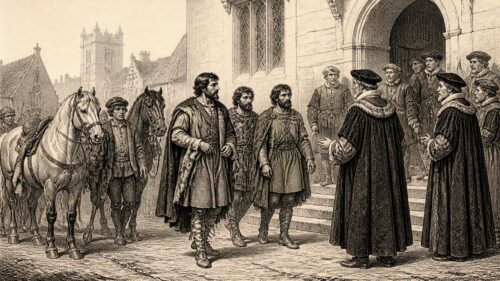
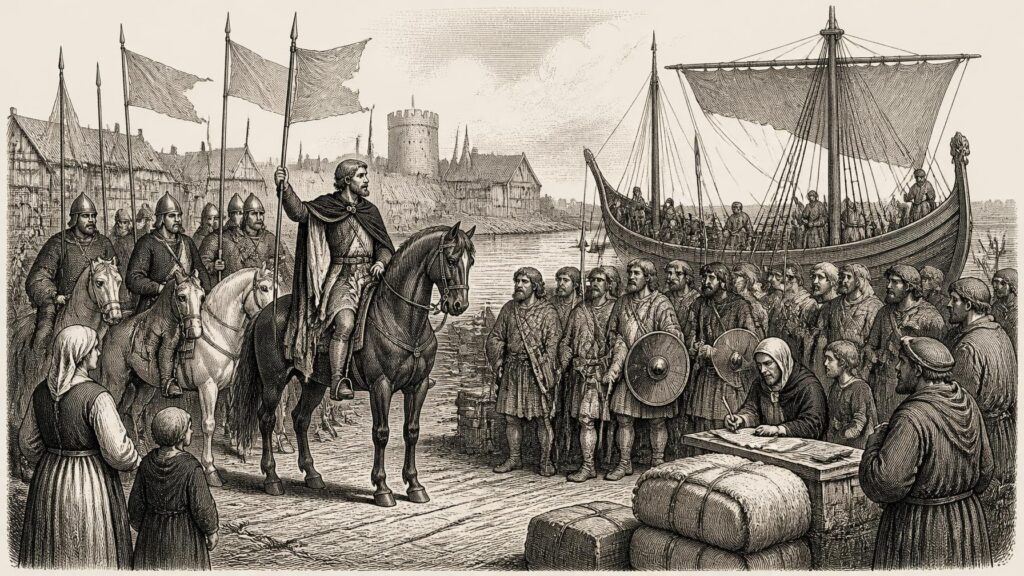
Edward’s need for help became acute after the English position in Scotland suffered reverses. In July 1303 he placed de Burgh in command of the Irish contingent, passing over John Wogan, the king’s justiciar in Ireland. This was an exceptional recognition of the earl’s standing. Before departure from Dublin, de Burgh knighted thirty-three followers in a ceremonial display of rank, military patronage and readiness for service. Modern reconstruction puts his force at roughly 3,000 men, formidable in Irish terms, and notes that it included several Irish kings from Ulster as well as Anglo-Irish lords and retainers.
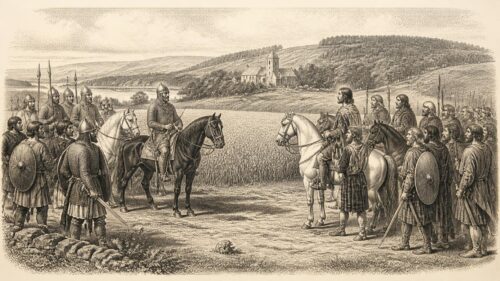
The force was therefore not a simple ‘English’ army transplanted from Ireland. It brought together men of varied language, legal status and political allegiance. The Irish annals themselves describe the expedition in terms of both Galls and Gaels: settlers and people identified as foreign on the one hand, Irish political communities on the other. Their participation did not erase local rivalries, but it shows that royal service could offer a means of advancement, protection, payment and favour to Gaelic rulers as well as to colonial magnates. For de Burgh, commanding them reinforced his authority in Ulster at precisely the moment when he was becoming indispensable to Edward I.
The campaign had consequences at home even before the army crossed the sea. On 4 May, a royal letter issued at Kilkenny recorded that John fitz Thomas, keeper of the peace in County Kerry, was leaving for the Scottish expedition. Maurice fitz Thomas was appointed to perform the office until further order. The document is a small but revealing piece of evidence: the departure of one magnate required an official substitute so that peacekeeping and royal authority did not lapse in a distant county. Scotland drew men away, but it did not suspend the daily obligations of government in Ireland.
From Dublin to Perth
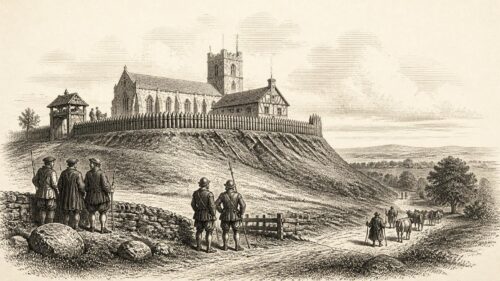
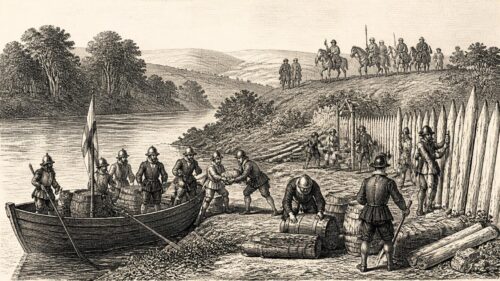
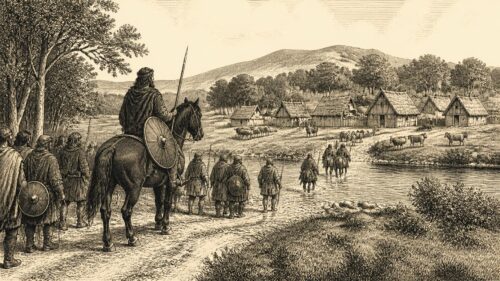
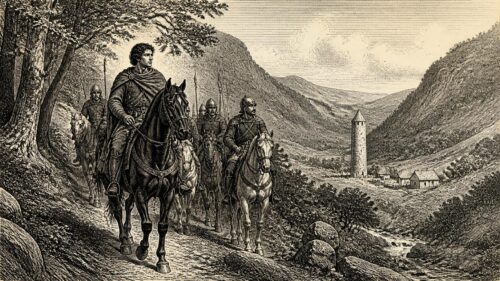
De Burgh’s troops joined Edward I in Scotland during the summer campaign. The king had advanced northwards through Perth and beyond, seeking to break the remaining Scottish resistance by sustained occupation rather than a single decisive battle. For soldiers from Ireland, the expedition meant a long and demanding movement through unfamiliar country, with supplies, horses, wages and discipline all becoming urgent concerns. The evidence does not permit a detailed reconstruction of every ship, landing place or unit. It does, however, establish that Ireland supplied a substantial force and that de Burgh himself held the foremost Irish command.
By Christmas Day, de Burgh was at Perth and dined with Edward I. That apparently courtly detail signals real political proximity. The earl was not merely a subordinate at the edge of the king’s armies: he belonged among the magnates with whom Edward marked a major religious feast while wintering in occupied Scotland. The campaign continued into 1304, when de Burgh took part in negotiations leading to John Comyn’s submission and attended the siege of Stirling. Those later events should not be folded into 1303, but they underline the importance of the commitment made during this year.
Service in Scotland also imposed financial pressures. The Irish exchequer, based in Dublin, remained part of a wider Plantagenet fiscal system, while Irish magnates carried debts, recognisances and claims across jurisdictions. A royal order of 1 August 1303 concerning Geoffrey de Geneville’s repayments to the Dublin exchequer, issued while Edward was at Arbroath, illustrates the administrative traffic linking Scotland, England and Ireland. Warfare depended not only on men in armour but on clerks, sheriffs, treasurers, loans, estates and the ability to move instructions over long distances.
A Killing in Tír Conaill
While de Burgh’s military reputation was being enlarged abroad, the kingship of Tír Conaill was violently remade at home. The annals place the death of Toirrdelbach Ó Domnaill, lord of Tír Conaill, in 1303. He was killed by his brother, Áed, after a prolonged conflict that had devastated their country. The record names a strikingly broad body of casualties and associates: Muirchertach Mag Lochlainn, Donnchad Ó Catháin, Donnchad Mac Menman of the learned Ó Domnaill family, Niall Ó Baegill, Mac Úgosa with close kinsmen, Adam Cendal, and many other Gaels and Galls.
This was not an isolated private murder. The scale of the reported losses, and the involvement of northern Gaelic and settler figures, indicate a contest for lordship with consequences beyond one household. Tír Conaill occupied a strategically important position in the north-west, connected by sea to western Scotland and by land to the competing powers of Ulster. Áed succeeded to the lordship after his brother’s death. But the annalistic stress on long warfare and devastation offers a reminder that political succession could consume farms, livestock, food stores and the security of ordinary households long before a new ruler was securely established.
Such local warfare formed the background against which de Burgh assembled support for the Scottish war. His lordship was powerful, but not uniform or uncontested. De Burgh’s earlier interventions in Tír Conaill, and his ability to bring Irish rulers into royal service, reveal a politics of negotiated dominance rather than straightforward control. Men could be de Burgh’s allies in one setting, rivals in another, and participants in the king of England’s war across the sea when circumstances made that advantageous.
Armagh and Elphin
The year also brought significant changes in the Irish church. Nicholas Mac Maoil Íosa, archbishop of Armagh, died on 10 May 1303. His death removed one of the most forceful churchmen of his generation. Nicholas had spent more than three decades defending the liberties and revenues of Armagh. He resisted encroachment by royal officials, opposed lay taxation of the Irish church, and was prepared to use both church sanctions and English common-law litigation in defence of his see. His career cannot sensibly be reduced to modern national labels: he could confront the crown, co-operate with English officeholders, and challenge Gaelic rulers when ecclesiastical rights were at stake.
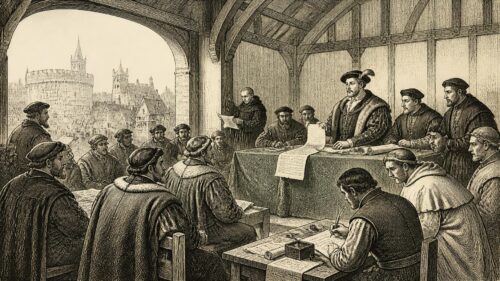
The vacancy immediately exposed the close interweaving of cathedral election, royal approval and papal jurisdiction. On 31 August the dean and chapter of Armagh sought royal assent for their choice of the Franciscan lector Mícheál Mac Lochlainn. On 17 October Edward granted him safe-conduct for a year to travel to the papal court with his household; on 20 October royal assent to the election was communicated to Pope Boniface VIII. The process would not produce a settled archbishop that year, but the surviving notices show the practical machinery of a medieval Irish metropolitan see at work.
In Connacht, Máel Sechlainn Mac Briain, bishop of Elphin, also died in 1303. He had been a Cistercian, or ‘Grey Monk’, and previously abbot of Boyle. Annála Connacht records that Donnchad Ó Flannacáin, abbot of Boyle, took the bishopric after him. The succession linked a diocesan office with one of Connacht’s leading monastic houses. It also demonstrates that, amid warfare and overseas campaigning, ecclesiastical institutions continued to provide learned personnel, landholding structures, hospitality and local authority.
Reading a Difficult Year
1303 must be handled with particular care because the annals do not always preserve events under their modern calendar year. The Annals of Ulster section labelled 1303 contains Edward I’s death, which happened on 7 July 1307, plainly demonstrating chronological displacement in that sequence. Likewise, later compilations can place the death of Domnall Óc Mac Carthaigh under 1303 although independent evidence places his violent death in 1306. Those notices are valuable evidence of historical memory, but they should not be treated as securely dated events of 1303.
The firmer picture is nevertheless substantial. Ireland supplied a large and socially mixed force to Edward I’s Scottish war under Richard de Burgh; administrative offices were maintained as men departed; Toirrdelbach Ó Domnaill was killed in a devastating northern succession struggle; and two important ecclesiastical careers ended, opening contested processes of replacement. The year shows an Ireland neither detached from neighbouring affairs nor politically unified: a landscape of lordships, churches and communities whose connections reached from Kerry and Dublin to Armagh, Tír Conaill, Perth and the Scottish battlefield.
Primary Sources
- Annála Connacht: Annal 1303
- Annála Connacht: Irish Text, Annal 1303
- Annals of the Four Masters: Annal M1303
- The Annals of Ulster: Year U1303
- Annales Breves Hiberniae
- Burgh, Richard de | Dictionary of Irish Biography
- Mac Maoil Íosa, Nicholas (Nicol) | Dictionary of Irish Biography
- O'Donnell, Toirrdelbach | Dictionary of Irish Biography
- Materials for the History of the Franciscan Province of Ireland, A.D. 1230–1450
- Patent Roll 31 Edward I (1302–1303), Item 20
- Calendar of Documents Relating to Ireland, Volume 5, Item 241 (1 August 1303)
- English Pipe Roll 33 Edward I: Richard de Bereford, Treasurer of Ireland
- Close Roll 32 Edward I (1303–1304), Item 18
- Close Rolls: 10 July 1303
- The Scottish Campaign of Edward I, 1303–4
- What Was the Distribution of Wealth in Ireland c.1300?
- Sefraid Ó Fearghail and Anghaile, 1271–1318
- MacCarthy (Mac Carthaig), Domnall Máel | Dictionary of Irish Biography
- Mac Carthaigh's Book: Annal MCB1306
- Archdiocese of Armagh: Historical Archbishops
- Merchants and Mariners: Abbreviations and Source Guide