Carrickfergus: medieval port, fortress town, and county capital
Dateline
Origins and early settlement
Carrickfergus is securely identifiable as the historic settlement on the north shore of Belfast Lough, long treated in scholarship and reference works as a place of major antiquity and strategic importance. The Irish Historic Towns Atlas reconstructs the early town around the castle, harbour, St Nicholas’s Church, and St Francis’s Friary, arguing that the first medieval core likely developed around the market place before the High Street area became dominant. It notes that Carrickfergus was already being described by seventeenth-century observers as “one of the most ancient in the kingdom,” and that much of the medieval street pattern survived into the modern period 1. The Department for Communities’ Gazetteer likewise classifies Carrickfergus among the well-known settlements of historic origin whose roots lie in earlier centuries, confirming that the place is recognised in official heritage work as a historic nucleated urban settlement rather than a later expansion of the nineteenth century 2.
The name itself is historically stable in meaning even where its spelling varied. The place-name authority Logainm gives the standard Irish form as Carraig Fhearghais alongside the English Carrickfergus, and places it within County Antrim in both the barony and civil parish hierarchy 3. That form is consistent with the long-standing interpretation, repeated in older topographical literature, that the name means “the rock of Fergus.” In this way, the settlement’s identity is anchored by both linguistic continuity and topographical reality: a rock-defended shore settlement that became an urban centre because of the castle, anchorage, and later market functions 4.
Medieval foundation and Anglo-Norman power
Historically, Carrickfergus emerged as the principal Anglo-Norman strongpoint in eastern Ulster. Lewis’s topographical dictionary describes it as a “sea-port, borough, market- and post-town, and parish, and a county of itself,” while also emphasising that it was the ancient capital and county town of Antrim 4. Although Lewis wrote in the nineteenth century, his entry preserves an older historical memory: Carrickfergus was not merely a local town but a political centre whose castle and harbour anchored English power in Ulster. The same source records that John de Courcy’s conquest made the castle central to the town’s development, and that the structure remained one of the great fortresses of its period 4.
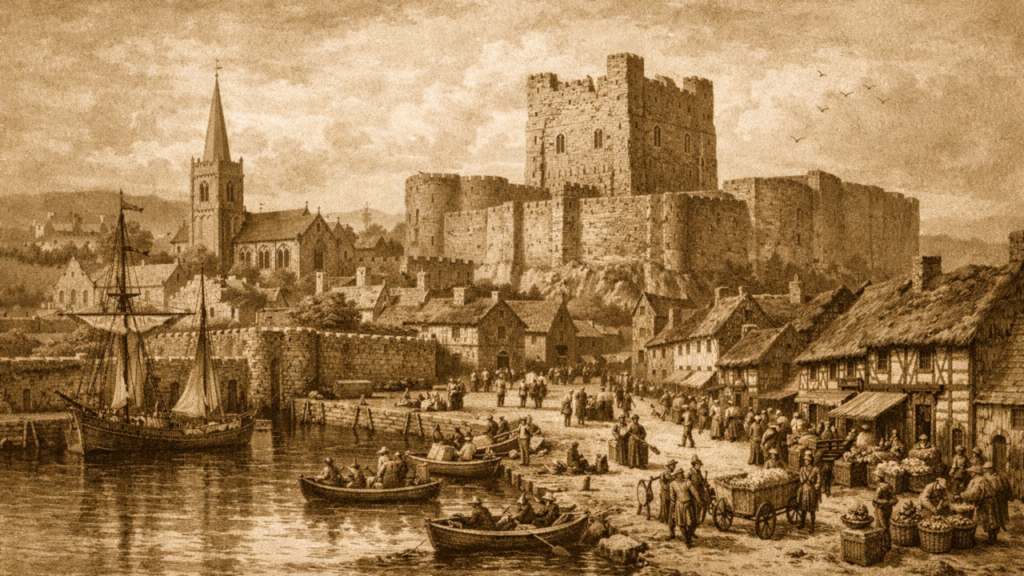
The Irish Historic Towns Atlas places the origin of the urban core in the thirteenth century, when the castle, church, friary, and street system together produced a recognisable town. The atlas shows that St Francis’s Friary, built in the 1230s, helped shift the settlement’s centre of gravity toward High Street, and that the medieval layout included a market place linked to the friary by the main street. It also records the town’s role in the 1316 siege by Edward Bruce, when the principal street formed part of the military approach into the fortified town 1. Carrickfergus was therefore not just a seafront stronghold; it was already a shaped urban community with market, ecclesiastical, and defensive functions by the thirteenth and early fourteenth centuries.
Conflict, damage, and resilience
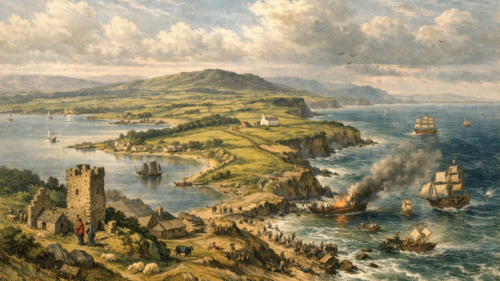
Medieval and early modern Carrickfergus was repeatedly damaged by warfare, but it repeatedly recovered because its castle, harbour, and county importance made it too valuable to abandon. Lewis summarises a long sequence of siege, devastation, and reconquest: Bruce’s assault in 1315, the town’s later burning in 1386 and 1400, and further ruin in the sixteenth century 4. The atlas similarly notes that seventeenth-century visitors saw a town whose ancient core survived despite the pressures of war and shifting commerce 1. This pattern matters historically because Carrickfergus was never simply a town that rose and declined once; it was a fortified node continually re-used by successive regimes.
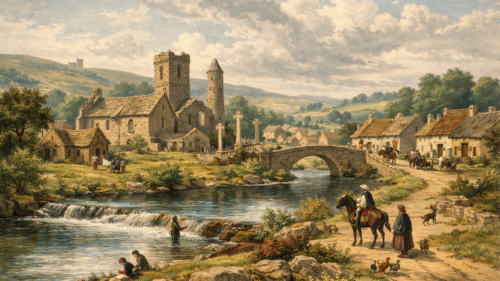
That resilience is also visible in the built fabric. The atlas points to surviving medieval and early post-medieval remains, including the castle, the church, the harbour pier, the town walls, and tower-house fragments 1. The town’s endurance was therefore materially visible, not only textual. The castle remained a symbol of authority, but the urban settlement around it retained a civic life shaped by customs, trade, and repair after repeated destruction.
County assignment and administrative status
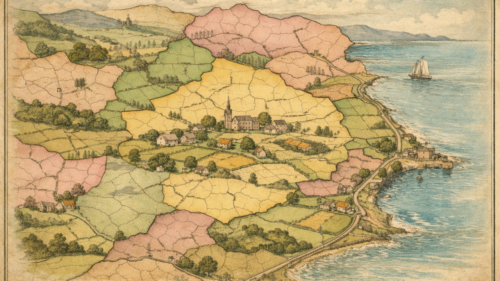
The historical county assignment of Carrickfergus needs careful statement because the place had a status more complex than an ordinary county-town. Lewis explicitly says that Carrickfergus was “a county of itself, locally in the county of Antrim,” while also calling it the ancient capital and county town of Antrim 4. This accurately reflects the older corporate and administrative exceptionalism of the place: Carrickfergus was associated with its own county-style jurisdiction while also lying geographically within the wider Antrim framework. The place-name authority independently confirms the broader Antrim affiliation in its county hierarchy, listing Carrickfergus under County Antrim and identifying the same name across barony and parish levels 3.
That duality is important for historical interpretation. Carrickfergus was not merely “in Antrim”; it functioned as a special corporate settlement with a long civic and jurisdictional history. The IHO bibliographic record for Samuel McSkimin’s The history and antiquities of the county of the town of Carrickfergus confirms that this unusual county-town identity was a recognised historical subject in its own right and continued to be treated that way in later scholarship and republication [5].
Spellings, Irish form, and historical memory
The settlement’s spelling history is well documented. The Irish Historic Towns Atlas lists early forms including Cracfergus, Karcf’gus, Crafferg, Cnocfergus, Cragfergus, and later Carifargus, showing both instability and persistence in medieval and early modern orthography 1. These forms matter because they demonstrate that the English spelling “Carrickfergus” was not a fixed medieval fossil but the end result of a long documentary evolution. The same atlas also records historical references to the Irish place-name tradition in the town’s records, and its discussion of the urban core emphasises that the town was bilingual in practice, with Irish continuing as a living local language alongside English in administration 1.
Logainm’s authority is decisive for the modern Irish form: Carraig Fhearghais 3. That form is the one that should be used in historical discussion when giving the Irish-language equivalent of the settlement name. Taken together, the atlas and Logainm show both the documentary variability of the name in historical records and the standardised Irish form accepted by a national place-name authority.
Later urban significance
By the seventeenth century Carrickfergus was perceived as an old and important borough, though observers already remarked on signs of decay. The atlas quotes visitors who described it as a strong and ancient town, and also notes the continuing survival of the castle, church, and walls 1. Even as political power moved elsewhere, Carrickfergus remained a county centre and an urban place with historic continuity. Its later history cannot be understood apart from the medieval foundations established by conquest, trade, and fortification. The town’s significance lies precisely in that continuity: a settlement whose name, form, and county role survived multiple layers of conquest and recovery, while its medieval streets and monuments remained legible into the modern era 124.