Clough: a manorial village in Dunaghy, County Antrim
Clough was a real historical settlement in the parish of Dunaghy, barony of Kilconway, County Antrim. Samuel Lewis’s Topographical Dictionary of Ireland places it there explicitly as “CLOGH, or CLOUGH,” describing a village about six miles from Broughshane, on the road network near the Ravel water and identifying it as the head of the manor of Old Stone 1. Later directory evidence also treats it as “CLOUGH, CO. ANTRIM,” confirming the county assignment and showing that the place continued to be recognized as a distinct village into the twentieth century 3. The name history is unusually well documented.
Dateline
Settlement and name
Clough was a real historical settlement in the parish of Dunaghy, barony of Kilconway, County Antrim. Samuel Lewis’s Topographical Dictionary of Ireland places it there explicitly as “CLOGH, or CLOUGH,” describing a village about six miles from Broughshane, on the road network near the Ravel water and identifying it as the head of the manor of Old Stone 1. Later directory evidence also treats it as “CLOUGH, CO. ANTRIM,” confirming the county assignment and showing that the place continued to be recognized as a distinct village into the twentieth century 3.
The name history is unusually well documented. Logainm records the standardized Irish form as An Chloch and preserves nineteenth-century spellings including “Claugh,” “Clough,” and “Clogh” from Ordnance Survey and related records 2. The same place-name evidence also preserves an O’Donovan gloss, “Baile na Cloiche,” meaning “town of the stone,” which is important because it shows that the name was understood locally and by surveyors as a stone-associated place-name rather than an arbitrary label 2. Those forms are historically significant because they show how the settlement moved between Irish, anglicized, and survey spellings while remaining the same place 2.
The manor, castle, and court-house
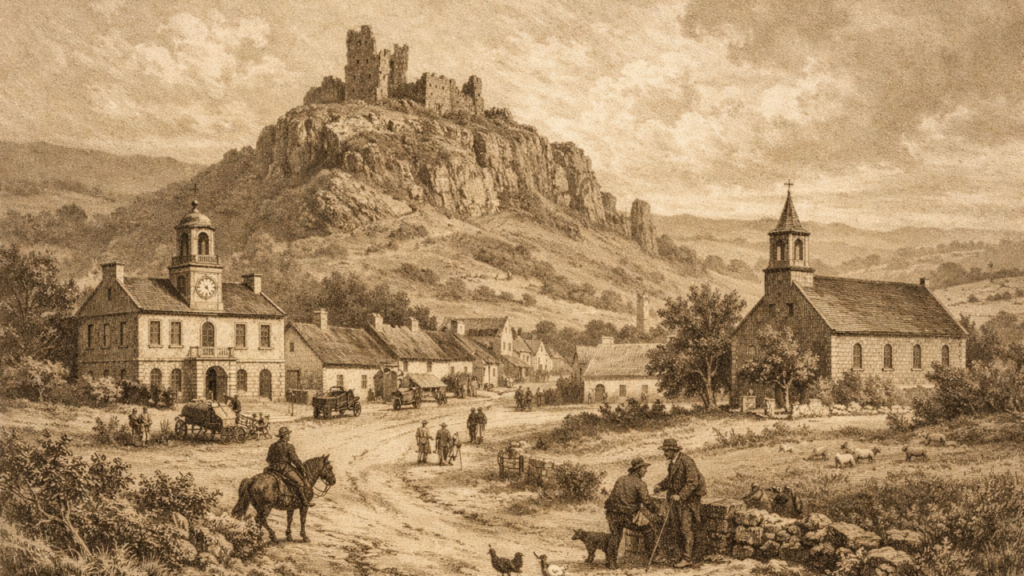
Lewis’s description gives Clough a much denser institutional history than a simple village entry would imply. He says it was the head of the manor of Old Stone and that it contained a manorial court-house where the court had formerly sat every three weeks 1. That detail points to a settlement with legal and administrative importance, not just a roadside cluster of houses. The court-room, jury-room, and debtor rooms described by Lewis suggest a functioning local manorial jurisdiction whose built form still mattered in the early nineteenth century 1.
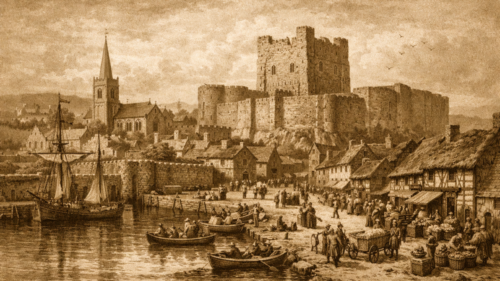
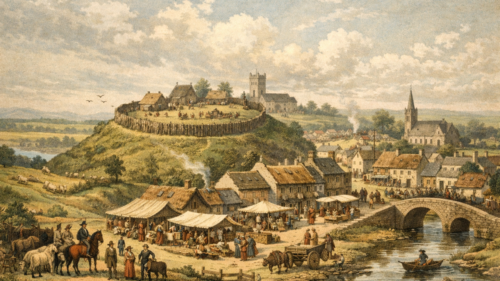
Equally important is Lewis’s account of the rock above the village. He reports that a castle once stood there and that substantial remnants remained, including part of a gateway, a draw-well, a fosse, and traces of building foundations 1. He also records local tradition that the site had belonged to the MacQuillans before passing to the MacDonnells after a battle on Slievenahera, and that a nunnery was said to have existed there in an earlier period 1. Whether every element of that tradition is equally secure, the fact that Lewis included it shows that Clough’s history was remembered through a combination of visible ruins and oral tradition. In other words, the settlement’s past was literally inscribed in the rock above it 1.
Early modern settlement and Presbyterian memory
The best narrative source for Clough’s social history is the Glens of Antrim Historical Society’s account of the local church. That article places the origins of the congregation in the early days of the Scottish Plantation, when the first Presbyterians settled in the lands of Dunaghy around Clough or Oldstone Castle 4. The article stresses that Lord Antrim’s policy of settlement was driven by economic as much as religious motives, and that the village and parish became part of a wider seventeenth-century process of plantation and tenant resettlement 4.
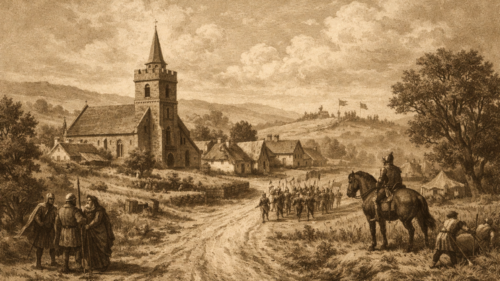
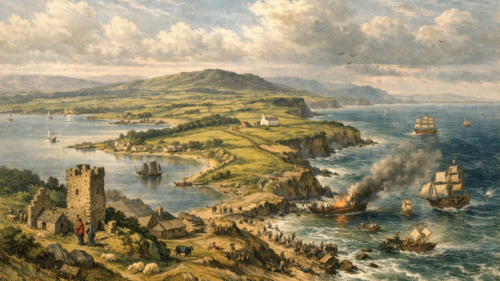
The same source connects Clough to the upheavals of 1641. It states that Presbyterian settlers witnessed the rebellion, the surrender of their stronghold at Clough Castle by Walter Kennedy, and the massacre at the Ravel river of women and children on their way to Scotland 4. That is a stark reminder that Clough’s local history cannot be separated from the violence that reshaped north Antrim in the mid-seventeenth century. The village’s castle, church, and surrounding lands were not passive landmarks: they were part of the defensive and confessional landscape of the plantation period 4.
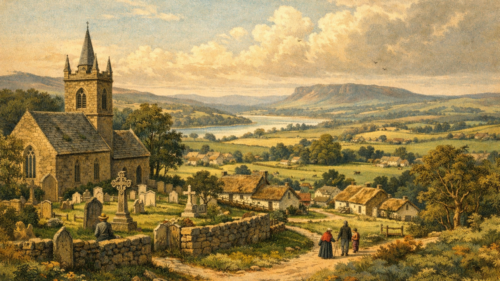
The church article also notes that on 14 February 1656 the Clough congregation petitioned the first presbytery of the Presbyterian Church in Ireland, then meeting at Carrickfergus, to provide a minister 4. This is a valuable clue to the settlement’s religious life. It shows that Clough was not merely a manorial site but also a place where one of Ireland’s oldest Presbyterian communities took institutional shape. The congregation’s continuity helps explain why later local memory treated the church near Clough as a historic landmark rather than simply a parish building 4.
Nineteenth-century continuity
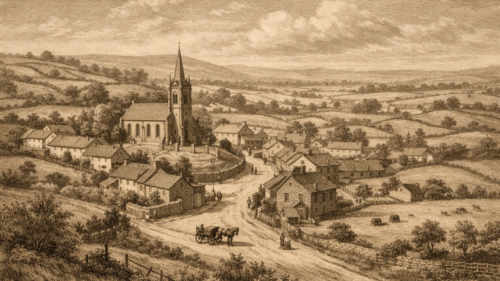
By the nineteenth century Clough remained a small but recognized village with a clear civic profile. Lewis describes it as a village of 121 inhabitants and 20 houses 1, while the 1910 Ulster Towns Directory gives it a population of about 100 and lists a post office, fair days, and places of worship 3. The reduction from a manorial center to a modest village did not erase its administrative role; instead, it marks the transition from a feudal or seignorial locality to a small market and service settlement 13.
The fair days are particularly revealing. Lewis lists several annual fairs, and the 1910 directory gives a slightly updated sequence of market days 13. Such fairs mattered because they tied Clough to the agricultural economy of north Antrim: cattle sales, seasonal gatherings, and service to surrounding townlands were the practical functions that sustained the village after the older castle and court-house system had declined. The village thus survived as a local node of exchange even as its medieval and early modern political functions faded 13.
Clough’s history, then, is one of persistence through changing forms: prehistoric or early stone associations in the name, a medieval or early post-medieval stronghold on the rock, a manorial court-house in the eighteenth and nineteenth centuries, and a Presbyterian congregation rooted in plantation-era settlement 124. The settlement’s historical county assignment is secure throughout these records: it is consistently placed in County Antrim, not merely by modern maps but by historical gazetteer, place-name authority, and directory evidence 123.