Connor: historical settlement, parish, and place-name evidence
Connor is firmly identifiable as a settlement and civil parish in County Antrim: the authoritative Irish place-name record places both the civil parish and the townland of Connor in county Aontroim/Antrim, within the barony of Antrim Lower, and gives the Irish form Coinnire with the English form Connor. That hierarchy matters historically, because it shows that Connor is not merely a modern village label but a long-standing territorial name attached to both parish and townland. The same record also preserves the genitive form Choinnire, which confirms the Irish-language inflection used in local documentation rather than a speculative modern back-formation.
Dateline
Settlement and historical setting
Connor is firmly identifiable as a settlement and civil parish in County Antrim: the authoritative Irish place-name record places both the civil parish and the townland of Connor in county Aontroim/Antrim, within the barony of Antrim Lower, and gives the Irish form Coinnire with the English form Connor. That hierarchy matters historically, because it shows that Connor is not merely a modern village label but a long-standing territorial name attached to both parish and townland. The same record also preserves the genitive form Choinnire, which confirms the Irish-language inflection used in local documentation rather than a speculative modern back-formation. 1
The 1901 Census of Ireland further confirms the settlement as a named town in the county. In the county tables, the census notes that “the town of Connor stands on the townland of the same name,” and that its area and valuation were counted with the townland, estimated at 23 acres. The census also places Connor in the Connor District Electoral Division, which shows that by the later nineteenth century the settlement had a recognised administrative presence as a compact town embedded in the older land-unit structure. 2
Medieval importance and the Bruce campaign
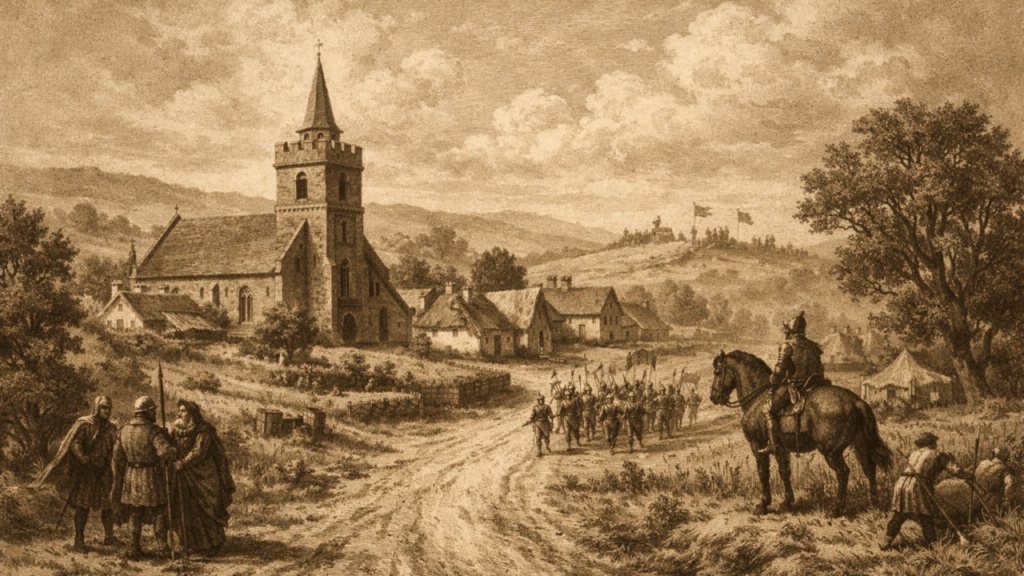
Connor’s best-known historical prominence comes from the early fourteenth century, when it became associated with Edward Bruce’s invasion of Ulster. A modern historical study of the campaign published by Discover Ulster-Scots describes how Bruce’s forces entered Connor during the fighting in September 1315, seized stores there, and used the town as part of the momentum that made him, for a time, master of much of northern Ireland. The same account underscores that the place was already “of some importance” in the early 1300s. That is an important point for Connor’s history: the settlement was not only a battlefield location but also a place with enough local significance to be repeatedly named in the campaign narrative. 3
That same source connects the battle to a longer memory of the place’s identity. It cites the nineteenth-century historian George Benn, who treated Connor as notable for both its antiquity and ecclesiastical character, and it notes that the site had once been the location of a cathedral. While the cathedral itself does not survive as a medieval structure, the reference demonstrates that Connor’s importance was not invented after the Bruce episode; rather, the battle attached itself to a pre-existing ecclesiastical centre. In historical terms, Connor’s name therefore stands at the intersection of church history and war history, which explains why later writers kept returning to it. 3
Ecclesiastical character and long memory of the place
The ecclesiastical identity of Connor is central to understanding its history. The parish framework preserved in the Irish place-name authority indicates a place-name that continued to function at the level of parish, townland, and district, a pattern typical of settlements with deep medieval roots. The survival of both the English and Irish forms in modern authority records also suggests continuity rather than replacement: Coinnire/Connor is treated as a stable historical unit, not a recently standardised label. 1
The Bruce-study account strengthens that reading by stating explicitly that Connor had once been the location of a cathedral and that this ecclesiastical status was one of the reasons it was considered important. The implication is that the settlement’s medieval profile was shaped by religious administration as much as by military events. In other words, Connor’s significance in the historical record comes from being a church site with an attached settlement, not simply from being a crossroads or market village. 3
That combination helps explain why the name was retained in administrative and narrative sources across centuries. Once a place becomes a parish centre and a remembered cathedral site, it tends to survive in local memory even when its built medieval fabric is reduced. Connor’s historical profile is therefore one of continuity in name and function, but discontinuity in monumentality: the settlement remained identifiable, even as the medieval church setting largely passed from view. 13
Names, spellings, and Irish forms
The place-name evidence is especially valuable because it preserves both modern and historical forms. The Irish place-name authority gives Coinnire as the Irish-language main form and Connor as the English form, while also giving Choinnire as the genitive. That makes the Irish-language form precise and verifiable rather than approximate. It also establishes the correct modern civil-parish spelling as Connor, while allowing the article to recognise the older Gaelic structure behind the anglicised name. 1
The historical spelling record cited in the Bruce study adds another layer. It states that in Barbour’s The Brus, Connor is spelled “Coigneris.” That spelling is especially useful because it is a genuine medieval literary attestation, not a retrospective antiquarian guess. It shows how the name circulated in fourteenth-century narrative sources and how its sound could be rendered in Middle Scots orthography. The same passage notes that older residents pronounced the name as “Conyer,” which is not the same thing as a documentary spelling, but it does show the local persistence of a pronunciation tradition distinct from the modern written form. 3
Taken together, these forms show a clear evolution: medieval textual spellings such as Coigneris; Irish authority forms Coinnire and Choinnire; and the modern English Connor. The value of the evidence is that it does not flatten the history into a single standardised label. Instead, it reveals a settlement whose identity passed through several linguistic registers while remaining recognisably the same place. 13
Later historical visibility
By the later nineteenth and early twentieth centuries, Connor remained a small but distinct town within County Antrim’s settlement pattern. The 1901 census treats it as a town standing on its own townland and records its population separately in the county tables. That is important because it demonstrates that Connor was not absorbed into a larger urban area; rather, it retained its own identity as a named place in the county’s rural-urban geography. The census note also confirms that town and townland shared the same name, a frequent but historically meaningful feature in Irish local geography. 2
This persistence of a compact settlement is consistent with Connor’s deeper history. A place with medieval ecclesiastical standing, a remembered cathedral site, and a major episode in the Bruce campaign would naturally remain anchored in local historical consciousness. Even when its role diminished, the settlement continued to be mapped, counted, and named. The evidence therefore supports a simple conclusion: Connor is a historically enduring settlement in County Antrim, with a documented Irish form, a medieval spellings trail, and a clear place in the historical geography of north-east Ulster. 123