Cogry: a mill settlement in historic County Antrim
Cogry is securely identifiable as a small settlement in historic County Antrim, now usually described as a village within the townland of Coggrey, civil parish of Grange of Doagh. The Gazetteer of British Place Names records Cogry as a village in County Antrim and explicitly gives its historic county as Antrim, while locating it in Coggrey townland and Grange of Doagh parish 1. That same source also notes that the settlement grew around Cogry Mill and the associated mill village, which is important because Cogry’s history is not that of an old market town but of an industrial place created by flax-spinning and the housing built around it 1.
Dateline
Settlement and name
Cogry is securely identifiable as a small settlement in historic County Antrim, now usually described as a village within the townland of Coggrey, civil parish of Grange of Doagh. The Gazetteer of British Place Names records Cogry as a village in County Antrim and explicitly gives its historic county as Antrim, while locating it in Coggrey townland and Grange of Doagh parish 1. That same source also notes that the settlement grew around Cogry Mill and the associated mill village, which is important because Cogry’s history is not that of an old market town but of an industrial place created by flax-spinning and the housing built around it 1.
The spelling history is clearer than the Irish-language form. The modern settlement name is Cogry, but the townland spelling appears as Coggrey in the historical record and in modern place-name databases 13. In the Hearth Money Rolls compiled for Antrim in 1669, the townland is entered as “Coggrey,” while the same place is standardised as “Cogry” in the modern transcription column, showing that the older spelling was already in use in the seventeenth century 3. The consulted historical references do not provide a securely attested Irish-language form for the settlement itself, so the safest conclusion is that Cogry’s established historical evidence is primarily Anglicised and documentary rather than Gaelic in surviving printed form 13.
Seventeenth-century references
The earliest strong evidence located for the place is in the 1669 Hearth Money Rolls for County Antrim. Those rolls place a number of households in the townland of Coggrey, within the parish of Doagh Grange and the barony of Antrim Upper 3. This matters because it shows that Cogry was not an invented nineteenth-century label: a named rural locality existed there long before the industrial village emerged. The rolls also place Cogry within the older administrative geography of the county, confirming its historic county assignment by documentary evidence, not by later local tradition 3.
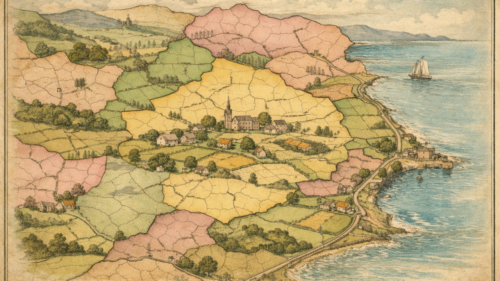
What the seventeenth-century evidence does not show is a compact village. Instead, it points to a scattered rural townland with named tenants. That pattern is typical of Antrim townlands before industrialisation, and it is consistent with Cogry’s later transformation from a dispersed rural district into a mill-centred settlement 3. In other words, the place-name precedes the village, but the village as a recognisable built community belongs to the industrial era 13.
Flax spinning and the making of a mill village
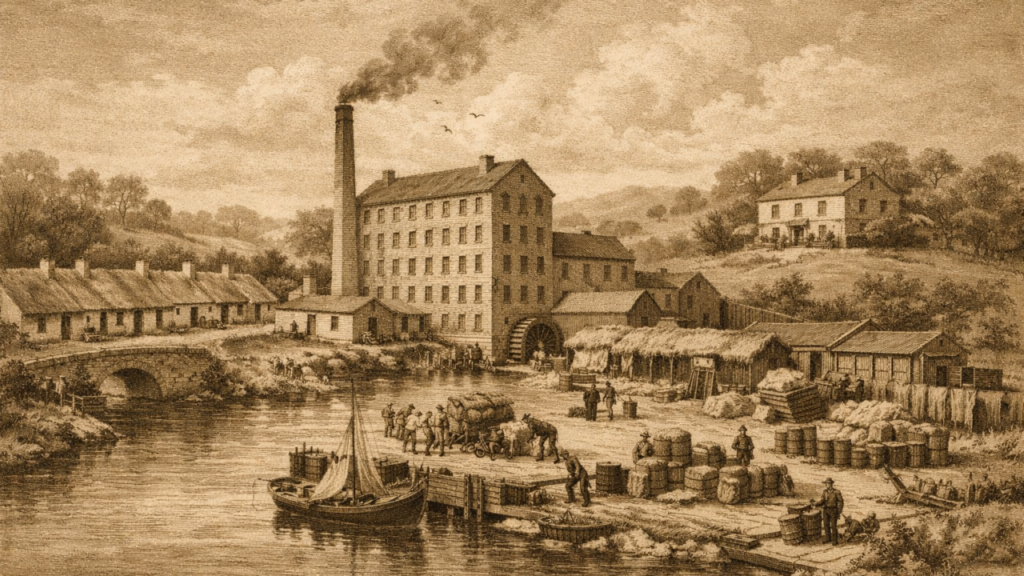
Cogry’s decisive historical change came with flax spinning. The Ulster Historical Foundation states that Cogry Flax Spinning Mill was established in 1845 and became particularly associated with the McMeekin family 2. This beginning places Cogry squarely within the nineteenth-century linen economy of north-east Ulster, when small rural sites were converted into industrial settlements through water power, later steam and engine-driven machinery, and worker housing 2. The same source explains that William McMeekin acquired the business around 1879 and was followed by his younger brother Adam, indicating continuity of family ownership through the second half of the century 2.
The mill did more than create employment. It structured the settlement itself. UHF’s account notes that many workers lived in houses belonging to the concern, and that the mill owners provided a National School as part of the site’s social infrastructure 2. That combination of production, housing, and education is the classic form of the planned mill village in County Antrim: work, domestic life, and institutional patronage were tied together. The built environment of Cogry therefore developed around industrial discipline as much as around commerce 2.
A later description quoted by the Foundation, drawn from Bassett’s Directory of County Antrim of 1888, is especially valuable because it gives a contemporary industrial profile rather than a retrospective summary. It says flax spinning began at Cogry about 1845, that the premises comprised about 30 statute acres, that the buildings had been “remodelled and extended,” and that about 400 people were employed there 2. The same description identifies the workers’ housing and the employer’s residence within the mill complex, showing that Cogry had become a large industrial estate rather than a loose cluster of cottages 2.
Late nineteenth- and early twentieth-century life
By the later nineteenth century Cogry had become one of the better-known industrial communities in the Doagh district. The directory account quoted by UHF indicates that the site was substantial enough to include ornamental grounds and a private residence as well as production buildings 2. That scale suggests a place where the social geography of the village was controlled by the mill owners and where the identity of the locality was inseparable from the factory. The mill’s reported use of renewed machinery and its rebuilding also suggest a business that adapted technologically rather than standing still, which helps explain why Cogry survived into the twentieth century as an active industrial centre 2.
The twentieth-century memory of the place still reflects that industrial origin. UHF’s South Antrim material notes that Cogry had become a recognised community in its own right and that the mill village remained distinct enough to require a replacement school elsewhere in 1937, when Kilbride Central replaced earlier schools at Kilbride and Cogry 4. This shows that Cogry had not simply been an industrial workplace; it had produced a durable local population with its own institutional needs. Even after the height of linen manufacture passed, the settlement retained a sense of separate community based on the older mill pattern 4.
The closure of the mill in the later twentieth century is part of Cogry’s history too, but it should be understood as the end of an industrial phase rather than the beginning of the place. The settlement existed first as Coggrey townland, then as a flax-spinning locality, and only later as a post-industrial village whose shape had already been fixed by the mill era 123. The most important historical fact about Cogry is therefore not simply that it was once a mill site, but that its modern village identity was built on a much older rural locality whose name survives in documentary spelling, county records, and industrial description 123.