Broughshane
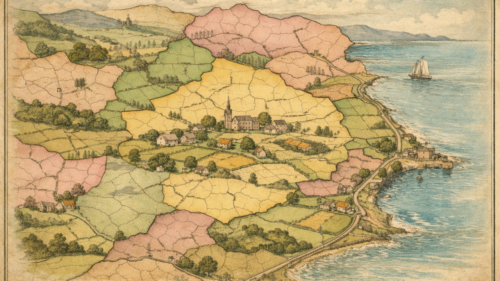
Broughshane is securely identifiable as the village described in nineteenth-century historical references as a small town or village in the parish of Racavan (Rathcavan), County Antrim. Samuel Lewis’s Topographical Dictionary of Ireland places “the post-town of Broughshane” in the parish of Racavan, county of Antrim, and notes its market and fair activity 1. This confirms both the settlement identity and its historical county assignment in the standard pre-partition Irish county system. A later county-level historical source also places the town within County Antrim and notes that Broughshane stood on the townland of Broughshane Upper 2.
Dateline
Settlement and county identity
Broughshane is securely identifiable as the village described in nineteenth-century historical references as a small town or village in the parish of Racavan (Rathcavan), County Antrim. Samuel Lewis’s Topographical Dictionary of Ireland places “the post-town of Broughshane” in the parish of Racavan, county of Antrim, and notes its market and fair activity 1. This confirms both the settlement identity and its historical county assignment in the standard pre-partition Irish county system. A later county-level historical source also places the town within County Antrim and notes that Broughshane stood on the townland of Broughshane Upper 2.
Name forms and Irish-language evidence
The Irish-language place-name authority Logainm records the standardized Irish form as Bruach Sheáin for Broughshane 3. That same authority preserves historical spelling evidence from nineteenth-century archival and survey material, including forms such as Brooghaun and Broughane in Ordnance Survey and valuation-related records 3. Lewis likewise prints the English settlement name as Broughshane, while the older county history materials attach it to Racavan parish in Antrim 12. Together these sources establish that Broughshane is the settled English form, with historically attested variant spellings and a well-defined Irish-language equivalent 3.
Historical character
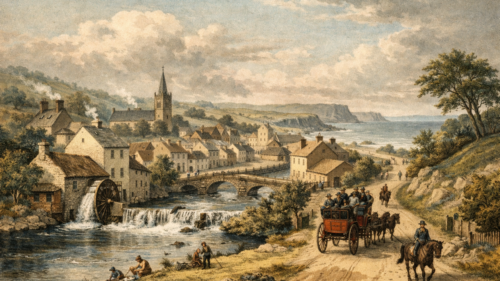
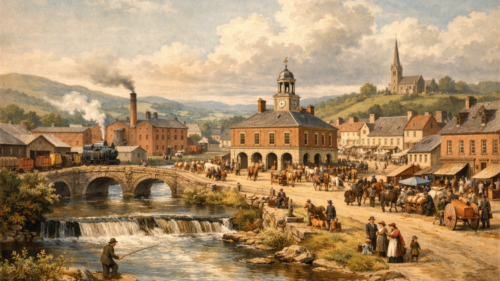
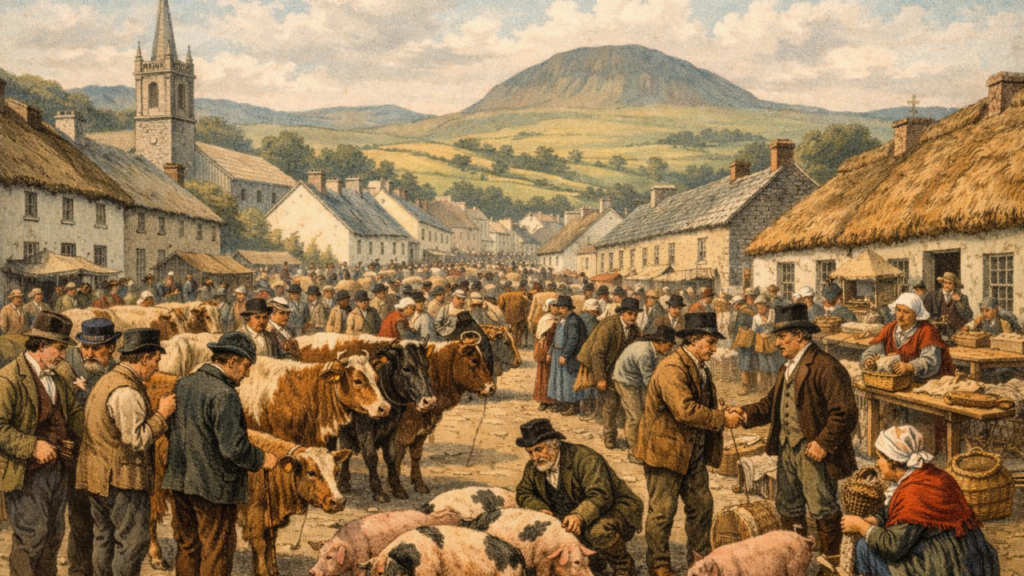
The historical record that survives in these sources presents Broughshane as a small but economically active settlement rather than an isolated hamlet. Lewis describes a local economy rooted in linen production in the wider parish and states that “a large fair is held at Broughshane on the 17th of August,” with pigs sold in quantity at the weekly market 1. The same source notes the parish church at Broughshane as comparatively recent in construction, indicating an organised village centre with ecclesiastical and commercial functions by the early nineteenth century 1. A separate historical description of Racavan adds that the parish had an old, well-walled churchyard used as a Presbyterian burial place, showing the depth of local religious and burial history around the Broughshane area 2.
In short, the historical evidence places Broughshane firmly in County Antrim, documents its long-standing settlement status, and preserves both the Irish form Bruach Sheáin and earlier written spellings from archival sources 123.