Glenavy
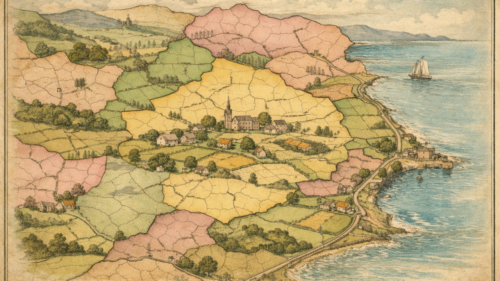
Glenavy is securely identifiable as the village and parish in east County Antrim. A modern gazetteer describes it as a village on the Glenavy River in County Antrim, and gives the historic county as Antrim, while noting the civil parish and townland of Glenavy. The Irish place-name authority likewise records the civil parish as Lann Abhaigh/Glenavy within county Aontroim/Antrim and the barony of Mása Ríona Uachtarach/Massereene Upper 12. The settlement was known historically under variant anglicised spellings. Samuel Lewis’s 19th-century topographical dictionary gives the entry as “GLENAVY, or LYNAVY,” making clear that the place circulated under more than one English spelling in print.
Dateline
Historical settlement identity
Glenavy is securely identifiable as the village and parish in east County Antrim. A modern gazetteer describes it as a village on the Glenavy River in County Antrim, and gives the historic county as Antrim, while noting the civil parish and townland of Glenavy. The Irish place-name authority likewise records the civil parish as Lann Abhaigh/Glenavy within county Aontroim/Antrim and the barony of Mása Ríona Uachtarach/Massereene Upper 12.
The settlement was known historically under variant anglicised spellings. Samuel Lewis’s 19th-century topographical dictionary gives the entry as “GLENAVY, or LYNAVY,” making clear that the place circulated under more than one English spelling in print. That same source identifies it as a post-town and parish in the barony of Upper Massareene, County Antrim 3.
Historical county and administrative setting
The county assignment is straightforward in the historical record: Lewis places Glenavy in County Antrim, and the Irish place-name authority’s hierarchy also places Lann Abhaigh/Glenavy in county Aontroim/Antrim 23. This is important because Glenavy is not merely a village name but also the name of the civil parish, and the official Irish-language record keeps that parish structure intact 2.
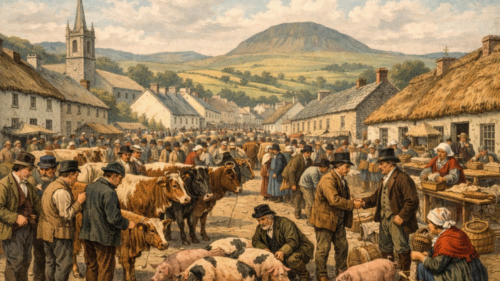
Lewis’s description shows Glenavy as part of a landed and agrarian district in early nineteenth-century Antrim. He notes a parish with substantial acreage, a town divided by the river Glenavy, quarterly fairs, a cotton-mill, flax spinning and weaving in cottages, and several named seats or residences. This is evidence of a settled rural-industrial community rather than a purely ecclesiastical or estate landscape 3.
Irish-language form and place-name history
The best current authority for the Irish form is Logainm, which records the validated form Lann Abhaigh for the parish and townland entry, paired with Glenavy in English 2. The form is historically meaningful: “lann” is a church-related element, and the name is widely understood as referring to an early church site, which matches the settlement’s long parish identity. Logainm’s page preserves the bilingual form and the wider administrative context, so it is the strongest reference for the modern standardized Irish spelling 2.
Older English spellings are also preserved in the historical literature. Lewis’s “Glenavy, or Lynavy” shows that the settlement’s name was not fixed in a single orthography in the nineteenth century 3. In combination with the official Irish record, this allows the history of the name to be read as a settlement whose English spelling stabilized around Glenavy, while the Irish form survived in authoritative modern scholarship and place-name work as Lann Abhaigh 23.
Historical character
What emerges from the historical record is a parish village rooted in church, agriculture, and local trade. Its village core sat on the river, its parish stretched across a large area, and by the early nineteenth century it supported fairs, textile work, and estate residences. The place-name evidence points to a much older ecclesiastical origin behind the settlement name, while the printed historical sources show a community that remained important enough to be described in county gazetteers and topographical surveys 23.