Bushmills
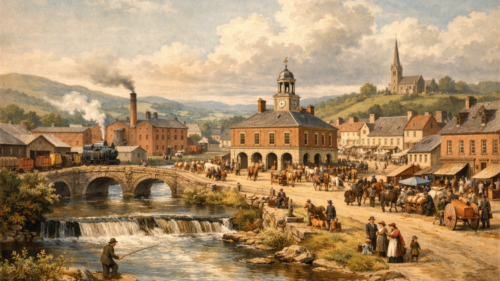
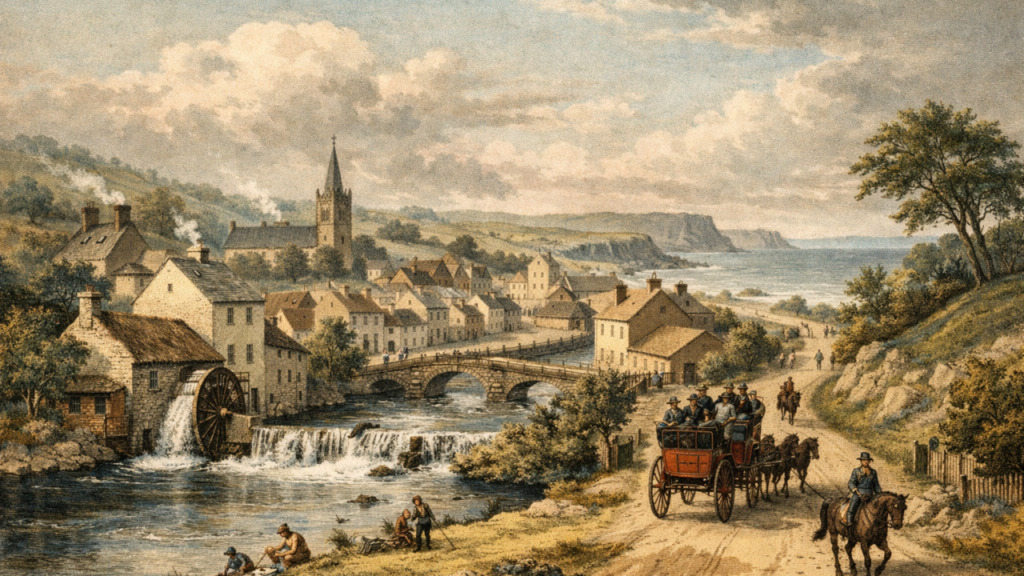
Bushmills is securely identifiable as a historic settlement in north Antrim. Samuel Lewis’s Topographical Dictionary of Ireland describes it as “a market and post-town” in the parish of Billy, barony of Carey, county of Antrim, province of Ulster, and gives its distance from Coleraine and Dublin, confirming both its settlement status and its county assignment in a contemporary nineteenth-century reference work 1. Lewis also notes that the place was already a local service centre: it had houses and inhabitants, a weekly market, a constabulary station, and mills and manufactures tied to the River Bush 1. The place-name evidence agrees with that identification.
Dateline
Historical settlement
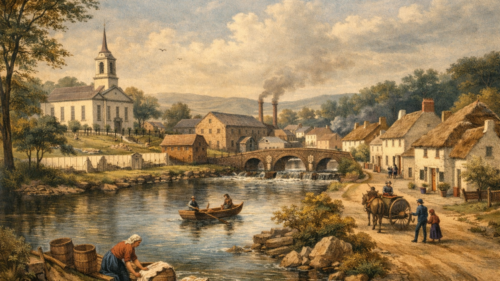
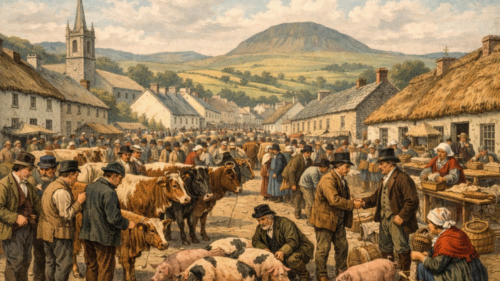
Bushmills is securely identifiable as a historic settlement in north Antrim. Samuel Lewis’s Topographical Dictionary of Ireland describes it as “a market and post-town” in the parish of Billy, barony of Carey, county of Antrim, province of Ulster, and gives its distance from Coleraine and Dublin, confirming both its settlement status and its county assignment in a contemporary nineteenth-century reference work 1. Lewis also notes that the place was already a local service centre: it had houses and inhabitants, a weekly market, a constabulary station, and mills and manufactures tied to the River Bush 1.
The place-name evidence agrees with that identification. The Placenames Database of Ireland gives the Irish-language form as Muileann na Buaise, literally “mill of the Bush,” and records Bushmills as the English form 2. That matches the historical explanation in Lewis, who states that the town derived its name from the River Bush 1. The Irish form therefore preserves the same mill-and-river meaning that the English name implies, while also showing that Bushmills belongs to the older Ulster place-name tradition rather than being a recent coined name 2.
The historical record thus places Bushmills firmly in County Antrim, specifically in the Billy/ Carey district of north Antrim, and shows it developing as a market settlement around water-powered industry and road traffic to the Giant’s Causeway long before modern tourism dominated its image 12.