Archived: 10 November 2026
Abstract
The annals preserve only a narrow and uneven picture of Ireland in 613 CE. For that year, one tradition records the death of Mael Coba son of Aed in battle and the succession of Suibne Menn, while another tradition records the death of Aed Allain, the accession of Mael Coba, and the repose of Colman abbot of Cluain. Nearby notices are explicitly dated to adjacent years, and several later compilations attach 613-year headings to material that appears elsewhere under different regnal schemes. This account distinguishes securely dated notices from broader contextual entries and refrains from filling annal gaps with conjecture.
Read Article
Archived: 10 November 2026
Abstract
Year BoundsThe evidence for 614 CE is narrow, and the surviving notices do not create a continuous narrative. In one annalistic sequence, the year marker for 614 is followed only by the burning of Bennchor. In another tradition, a 614 entry concerns a battle in Britain. A fragmentary sequence also places a star sighting under 614. These notices are separate, brief, and differently framed, so any account of the year has to stay close to each entry’s own wording.The immediate surrounding years help define the limits of the record, but they do not enlarge 614 itself. In the same Tigernach
Read Article
Archived: 10 November 2026
Abstract
Year MarkersThe surviving record for 615 must begin with chronology, because the relevant annals do not present the year in exactly the same way. In the Annals of Ulster, the notices grouped here appear after a heading that reads AD 614, followed by the year marker and then the brief entries. In the Annals of Tigernach, the comparable material appears under T615. The difference is plain in the text and requires caution in any modern summary.That caution is strengthened by Inisfallen, which does not simply repeat the same wording but cross-references the battle of Sliab Tuath to AU 615. Its
Read Article
Archived: 10 November 2026
Abstract
This study examines the evidence for Ireland in 616 CE as preserved in a small group of annalistic entries. It separates notices securely placed in that year from nearby material assigned differently in other annals. The year is marked by clerical deaths, a murder, the death of Fergus son of Colmán Mór, a ravaging of Armagh, and an earthquake in Gaul in Tigernach, while Inisfallen and Chronicon Scotorum provide partially overlapping but not identical chronologies. The result is a careful year-by-year account that preserves what is directly stated and leaves gaps unfilled within the limits of the surviving annal entries.
Read Article
Archived: 10 November 2026
Abstract
Year MarkersThe surviving notices for 617 CE are brief and uneven. In the Annals of Inisfallen, the year is represented by the burning of Bennchor of Ulaid and by associated death notices. In Chronicon Scotorum, the year opens with the burning of Donnán of Aig on 17 April, the laying waste of Torach, and a death notice for Fergus son of Colmán Mór. The excerpts preserve only these named entries.The year is also visible through cross-reference, but not in a single uniform pattern. One Inisfallen notice for Bennchor points to AU 616, while the separate Donnán notice is cross-referenced to
Read Article
Archived: 10 November 2026
Abstract
Year FrameThe annal compilers mark 618 CE as a distinct year inside their own chronological sequences. In the Annals of Ulster, the year opens with the Kalends of January and then gives notices under U618. Tigernach and Chronicon Scotorum also place their material under annual headings. That shared framing lets the year be identified securely, but it does not authorize adding events that the entries do not actually name.The year headings also show that 618 is part of a continuing sequence rather than a stand-alone story. Ulster’s notices are arranged after earlier annual items and then continue into later ones,
Read Article
Archived: 10 November 2026
Abstract
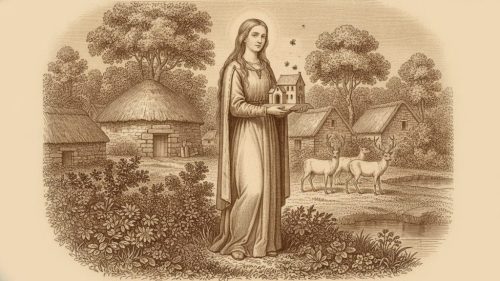
Early LifeSaint Gobnait is a figure of significant devotion within the religious landscape of Ireland, particularly within the county of Cork. While her precise historical origins are shrouded in the passage of time, tradition suggests she may have lived during the seventh century. Because her life is documented primarily through hagiography and local lore rather than contemporary administrative records, the specific dates of her birth and death remain uncertain. She is traditionally remembered as a woman of spiritual strength and leadership, eventually establishing herself as a focal point of monastic life in the region of Ballyvourney.Monastic FoundationAccording to tradition, Saint
Read Article
Archived: 10 November 2026
Abstract
Year ScopeThe surviving notices for 619 CE are brief and uneven, but they are not empty. Across the excerpts, the year is represented by deaths, a destruction notice, and an earthquake, rather than by a connected narrative. The safest reading stays close to the wording of each annal and resists turning the material into a fuller account than the passages allow.The witnesses also show that chronology must be handled separately for each annal. Inisfallen and Ulster place material under their 619 entries, while Tigernach places some comparable notices under T618 and others in its T619 sequence. That visible mismatch matters,
Read Article
Archived: 10 November 2026
Abstract
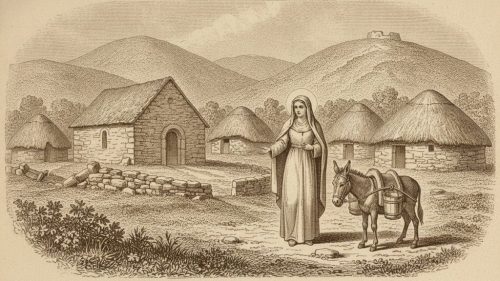
Saint Ita, also known as Ita of Killeedy, remains one of the most venerated figures in early Irish Christianity. Born in County Waterford during the sixth century, tradition identifies her as the daughter of Cenn-fáelad of the Déissi, suggesting she originated from a noble background. Her life is characterised by a transition from her native Waterford to the plains of Limerick, where she established a lasting spiritual legacy. Religious Foundation Ita is most renowned for founding a significant church and school at Killeedy in West Limerick. The location, known in Irish as Cell Ídde, literally translates to the church of
Read Article
Archived: 9 November 2026
Abstract
Year RecordThe strongest evidence for 620 CE comes from the annalistic entry that explicitly labels the year and then lists several deaths. It gives the tenth year of Suibhne and records Seanach Garbh, abbot of Cluain Fearta Breanainn Clonfert; Colman son of Coimgellan; Aedh son of Cumascach; Ronan son of Tuathal, lord of the Airtheara; and Cormac Caemh with Illann son of Fiachra. On this wording alone, 620 survives as a compact year of named deaths.The same entry continues with two more notices securely tied to the year by the surrounding annal rubric. One says that Mongan son of Fiachra
Read Article
