Archived: 12 November 2026
Abstract
Year DatingThe evidence for 607 CE is not arranged identically across the annals. In the Annals of Tigernach, the entry numbered T607 records the slaying of Sechnusach son of Garbán by Domnall son of Aod and the death of Conall Redspear son of Daimine, with the rest of Lugaid following in the same entry. In Inisfallen, AI607 records the slaying of Aed Sláine, Aed Rón, and Aed Buide, then notes that Aed Allain held the kingship. The Ulster text places related material under a different year label.The notices around 607 are deaths and killings, but the year labels differ from
Read Article
Archived: 12 November 2026
Abstract
Saint Munchin is a shadowy early Irish saint whose historical outline is difficult to recover with confidence. The surviving evidence does not provide a secure contemporary biography, and no firm dates for his birth or death can be established from the sources available. What can be said with caution is that he belongs to the devotional history of Limerick, where his name has long been preserved in parish and institutional traditions.Historical MemoryIn the later history of Limerick, Saint Munchin became one of the city’s most familiar local saints. A parish in medieval Limerick bore his name, and the dedication continued
Read Article
Archived: 12 November 2026
Abstract
Saint Comgall of Bangor is remembered as an early Irish monastic founder associated with Bangor, in what is now County Down. The surviving evidence in the supplied sources places him in the sixth and early seventh centuries and links him especially with the monastery of Bangor, his death or repose being recorded in the annals. Because the evidence comes through annalistic notices, later saintly texts, and modern summaries, it is best to keep to what the sources directly support: Comgall was a monk, abbot, and founder remembered in connection with Bangor and with a wider network of Irish ecclesiastical memory.
Read Article
Archived: 11 November 2026
Abstract
Saint Ruadhán of Lorrha, also rendered Ruadhán or Ruadhan, is remembered in Irish ecclesiastical tradition as a saint associated with Lorrha in County Tipperary. The surviving evidence presents him through a combination of liturgical memory, later historical writing, and the devotional life of the site that bears his name. The record is not a full contemporary biography, but it does preserve several points that recur in the sources: his association with Lorrha, his links with early Irish ecclesiastical tradition, and the commemoration of his death on 5 April.Early TraditionThe Catholic Encyclopedia describes Ruadhán as one of the twelve “Apostles of
Read Article
Archived: 11 November 2026
Abstract
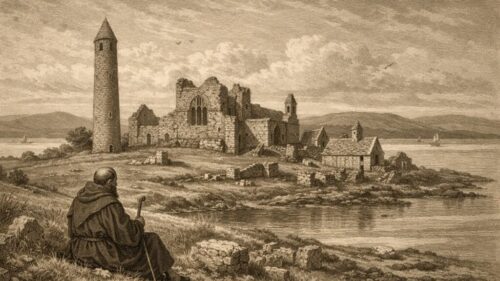
Saint Senan is remembered in Irish religious tradition as the saint most closely associated with Scattery Island in the Shannon estuary. The evidence supplied for his life is not a contemporary biography, but a mix of later medieval miracle literature, antiquarian description, and modern heritage interpretation. For that reason, only a limited historical outline can be stated with confidence: Scattery was a major monastic site linked with Senan, the island’s sacred identity remained tied to his name, and later writers continued to present it as a place of devotion and antiquity.The strongest evidence in the supplied sources concerns Scattery itself.
Read Article
Archived: 11 November 2026
Abstract
Dating FrameThe surviving notices place 611 CE inside annalistic year markers rather than a developed narrative. In the Annals of the Four Masters, the year appears as the Age of Christ 611 and the first year of Suibhne Meann in the sovereignty of Ireland. In the Annals of Inisfallen, the same year is represented by an entry labeled AI611.1, so the excerpt preserves a dated notice rather than a gap.This frame matters because it separates what is securely dated from what is only adjacent context. The Four Masters give 611 as a named year and add one church burning. Inisfallen
Read Article
Archived: 11 November 2026
Abstract
Year LimitsThe surviving evidence for 612 CE is sparse and brief, but it is explicitly year-marked in several annalistic sequences. The Fragmentary Annals begin their 612 material with the beginning of Mael Coba’s reign and add that he reigned three years. Tigernach also has a 612 entry, but its contents are different: To-Lua the Tall rests, and a star is seen at the seventh hour of the day. The year is visible, yet never expanded into a continuous narrative.Inisfallen likewise preserves a 612 sequence, but its notices are different again. It records the repose of Sillán and Aedán, the burial
Read Article
Archived: 11 November 2026
Abstract
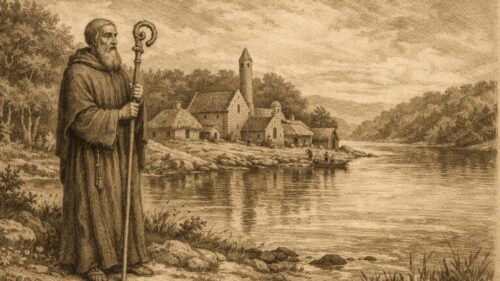
Saint Moling, also known in Irish tradition as Mo Ling and sometimes identified with the name Dairchilla, belongs to the early medieval world of Irish monastic saints. The historical record for his life is limited and much of what survives comes from later hagiography rather than from contemporary seventh-century documentation. For that reason, the safest way to describe him is as a saint remembered in tradition as an abbot and bishop associated with south-eastern Ireland, especially the monastery of Tech Moling, later St Mullins, on the River Barrow.Early OriginsLater biographical tradition places his birth in County Wexford, but the exact
Read Article
Archived: 10 November 2026
Abstract
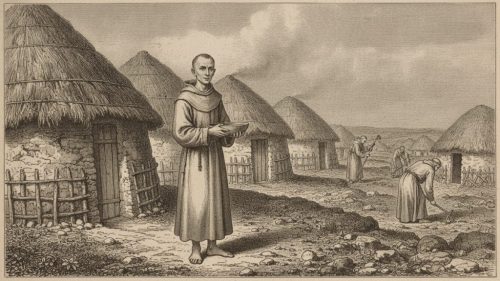
Early FormationSaint Fintan of Clonenagh was a sixth-century monk born in the province of Leinster. His early religious development took place in Terryglass, County Tipperary, where he received formation under the guidance of the abbot Colum. This period of education was pivotal, as Colum was known for a rigorous Rule and stringent penitential practices. The severity of this discipline left a lasting impression on Fintan, shaping his personal spiritual outlook and his subsequent approach to monastic leadership. He internalised the virtues of asceticism and self-denial, which would later define the character of the community he established.Monastic FoundationFintan eventually founded his
Read Article
Archived: 10 November 2026
Abstract
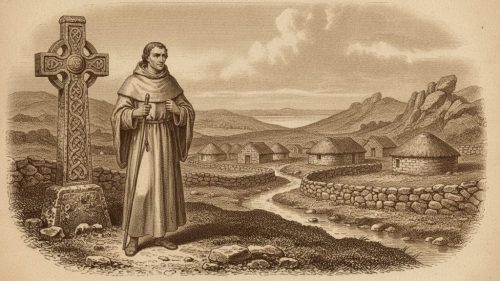
Colmán of Cloyne, also known as Colmán mac Léníne, was a sixth-century monk and the founder of the monastic settlement of Cluain Uama, which is the modern town of Cloyne in County Cork. While historical records from the early medieval period are often sparse, Colmán is recognised as an important figure in the early Irish church and is the patron saint of the Diocese of Cloyne. His life and work bridge the transition from the secular courts of Munster to the establishment of enduring ecclesiastical centres in East Cork. Early Life The dates of Colmán's life vary across different sources,
Read Article
