Start Exploring
Choose a route into Ireland’s past: follow the newest additions, find a particular year or subject, or browse every available period.

Day By Day
Welcome to Emerald Archives, where Ireland’s past awaits discovery. Our homepage brings you the latest additions to our growing collection, from remarkable people and historic places to pivotal events and forgotten traditions. Browse our newest discoveries and follow the archive’s progress day by day.
Deep Research
When you ask, we listen and respond. Enter a question about any aspect of Irish history in our search box (above) to initiate Deep Research. Give us a few moments, and we’ll prepare a detailed, illustrated article with sources and citations to answer your question. Your article becomes a permanent part of Emerald Archives.
Editorial — Echoes of Irish Literary and Historical Legacy
Archived: 27 November 2026
Welcome to the Emerald Archives Gazette for Friday, 27 November 2026. Today, we delve into the rich tapestry of Irish cultural and historical heritage, weaving together the lives of some of Ireland’s most celebrated literary figures alongside the enduring significance of historical settlements and events. From the evocative writings of Lady Gregory and Brendan Behan to the ancient chronicles of the Annals of the Four Masters, we explore how Ireland’s past continues to shape its identity and storytelling tradition. Join us as we traverse the landscapes of literature and history, uncovering the threads that connect the creative spirit and the roots of place.
Connor: historical settlement, parish, and place-name evidence
Archived: 27 November 2026
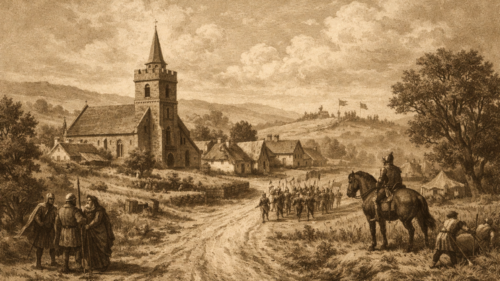
Connor is firmly identifiable as a settlement and civil parish in County Antrim: the authoritative Irish place-name record places both the civil parish and the townland of Connor in county Aontroim/Antrim, within the barony of Antrim Lower, and gives the Irish form Coinnire with the English form Connor. That hierarchy matters historically, because it shows that Connor is not merely a modern village label but a long-standing territorial name attached to both parish and townland. The same record also preserves the genitive form Choinnire, which confirms the Irish-language inflection used in local documentation rather than a speculative modern back-formation.
Cogry: a mill settlement in historic County Antrim
Archived: 27 November 2026
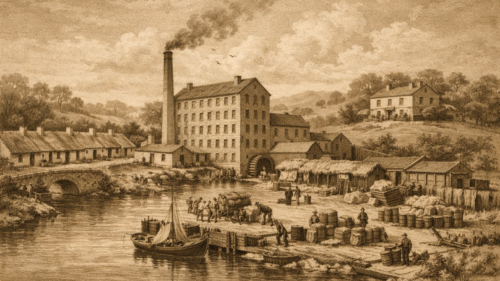
Cogry is securely identifiable as a small settlement in historic County Antrim, now usually described as a village within the townland of Coggrey, civil parish of Grange of Doagh. The Gazetteer of British Place Names records Cogry as a village in County Antrim and explicitly gives its historic county as Antrim, while locating it in Coggrey townland and Grange of Doagh parish 1. That same source also notes that the settlement grew around Cogry Mill and the associated mill village, which is important because Cogry’s history is not that of an old market town but of an industrial place created by flax-spinning and the housing built around it 1.
Clough: a manorial village in Dunaghy, County Antrim
Archived: 27 November 2026
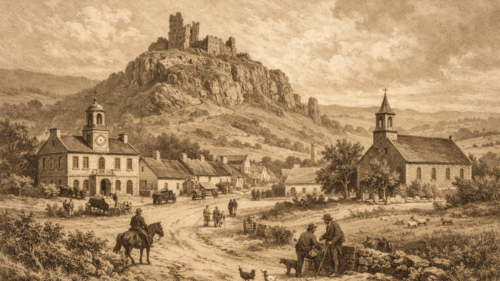
Clough was a real historical settlement in the parish of Dunaghy, barony of Kilconway, County Antrim. Samuel Lewis’s Topographical Dictionary of Ireland places it there explicitly as “CLOGH, or CLOUGH,” describing a village about six miles from Broughshane, on the road network near the Ravel water and identifying it as the head of the manor of Old Stone 1. Later directory evidence also treats it as “CLOUGH, CO. ANTRIM,” confirming the county assignment and showing that the place continued to be recognized as a distinct village into the twentieth century 3. The name history is unusually well documented.
Carrickfergus: medieval port, fortress town, and county capital
Archived: 27 November 2026
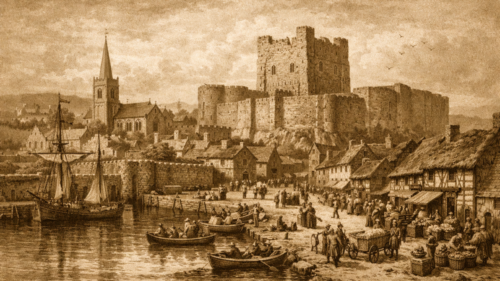
Carrickfergus is securely identifiable as the historic settlement on the north shore of Belfast Lough, long treated in scholarship and reference works as a place of major antiquity and strategic importance. The Irish Historic Towns Atlas reconstructs the early town around the castle, harbour, St Nicholas’s Church, and St Francis’s Friary, arguing that the first medieval core likely developed around the market place before the High Street area became dominant. It notes that Carrickfergus was already being described by seventeenth-century observers as “one of the most ancient in the kingdom,” and that much of the medieval street pattern survived into the modern period 1.
Archived: 27th November 2026
Land Commission
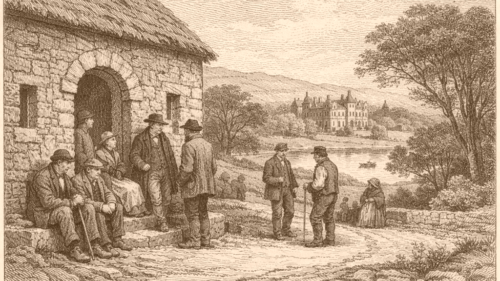
The Irish Land Commission was created in 1881 during the Land War. It was set up under Gladstone to address tenant grievances by fixing rents and, in time, by enabling the purchase of estates for transfer to tenant farmers.
Archived: 27th November 2026
Easter Rising — Death Toll
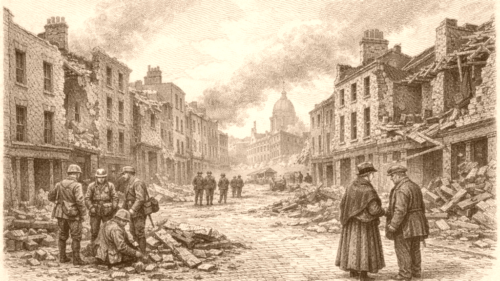
The death toll attributed to Easter Week 1916 varies by what is counted. One reference gives 429 killed in the Dublin Metropolitan Police report, while another estimates about 426 fatalities from insurgents, soldiers, police, and civilians during the Rising. A broader later tally for the whole rebellion gives 485 deaths, including many people who died after Easter Week.
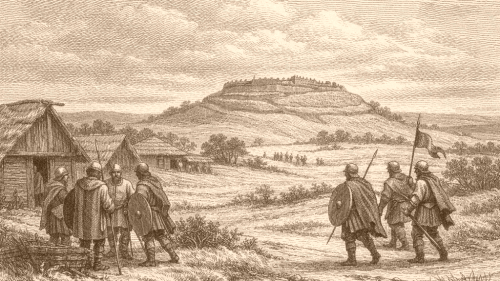
Dubhchomar Battle
Archived: 27 November 2026
The surviving notice tied to 322 in the cited annals records the slaying of Fiacha Sraibhtine by the Collas at Dubhchomar in Crioch Rois, Breagh. The same source also presents a separate internal label for 322 and an explicit heading “The Age of Christ, 322,” while a nearby entry for 323 shows that the compiler sometimes paired internal labels with printed AD headings. The evidence allows description of the notice and its internal dating, but not a stronger claim that the event is independently fixed beyond the annal form itself.
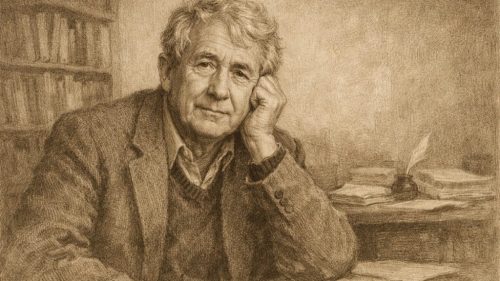
Frank McCourt
Archived: 27 November 2026
Frank McCourt was an Irish-American teacher and writer. Born in Brooklyn, New York, in 1930, he later became known for memoirs shaped by his childhood in the United States and in Limerick. McCourt was born in New York City’s Brooklyn borough and was the eldest child of Irish Catholic immigrants. In 1934, his family moved back to Ireland and settled in Limerick. He later wrote about a childhood marked by poverty, and his formal education in Limerick ended when he was 13. After leaving school, McCourt worked for the post office delivering telegrams from age 14 to 16 and later for Eason’s delivering magazines and newspapers.
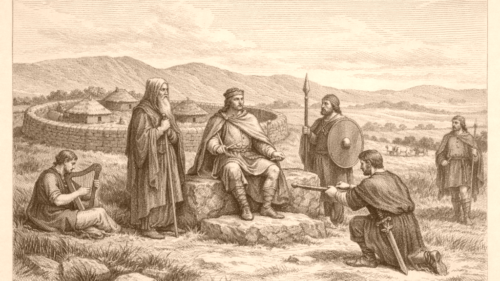
Colla Uais — Dubhchomar
Archived: 27 November 2026
The excerpted chronology table for the Annals of the Four Masters gives a 323 heading and then a regnal notice for Colla Uais. It also shows the immediately preceding 322 entry for Fiacha Sraibhtine, allowing a narrow comparison between adjacent notices without filling the 323 entry with unrecorded events.
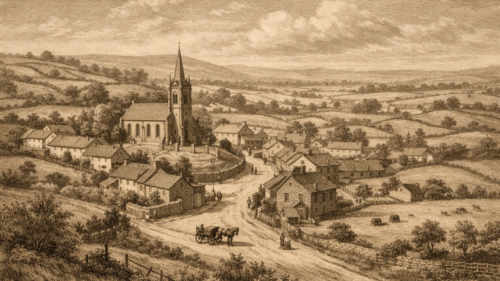
Ballyeaston: historical settlement in County Antrim
Archived: 27 November 2026
Ballyeaston is securely established as a small village and associated townland in County Antrim, Northern Ireland. Modern gazetteer treatment places the village within the townland of Ballyeaston and the civil parish of Ballycor, describing it as a settlement centred on a junction of three main routes beside the ruins of a medieval parish church 1. That matches the older nineteenth-century description in Bassett’s Book of Antrim, which places Ballyeaston on the side of a hill, in a parish of the same name, just north of Ballyclare 2.
Anne Enright
Archived: 27 November 2026
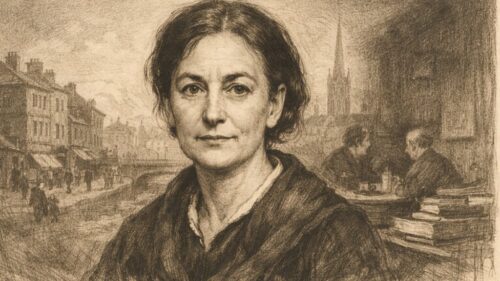
Anne Teresa Enright was born in Dublin, Ireland, on 11 October 1962. She was educated at St Louis High School, Rathmines, studied at Trinity College Dublin, and also studied at the University of East Anglia. Her later biographical summaries also note that she won a Chevening Scholarship for the University of East Anglia’s creative writing course. Enright’s first published book was The Portable Virgin in 1991. Her first novel, The Wig My Father Wore, appeared in 1995, followed by What Are You Like? in 2000. Her non-fiction book Making Babies: Stumbling into Motherhood was published in 2004.
Colla Uais
Archived: 27 November 2026
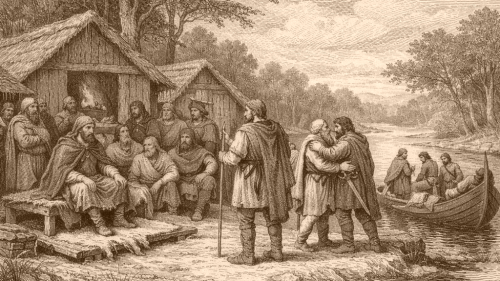
The Four Masters preserve a sparse and internally dated notice for 326, alongside a neighboring 327 sequence. The entry records Muireadhach Tireach expelling Colla Uais and his brothers into Alba Scotland; the year placement rests on the compilation’s own labels and printed AD heading, not on independent external dating.
Ballee: historical townland, naming, and settlement growth
Archived: 27 November 2026
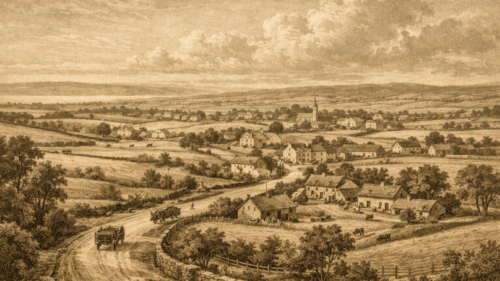
Ballee is securely identifiable as a townland in the civil parish of Connor, barony of Antrim Lower, in County Antrim, with the modern indexed place record also placing it in the electoral division of Kells. The townland reference is not a loose local usage but a standard administrative unit, and the place-name evidence aligns across modern gazetteer-style listings and county townland schedules. Townlands.ie explicitly places Ballee in County Antrim and gives the Irish form as Baile Aodha 1. The Gazetteer of British Place Names likewise treats Ballee as a named place within Ballymena, while noting that it remains a distinct townland rather than merely an informal suburb label 2.
Maeve Binchy
Archived: 27 November 2026
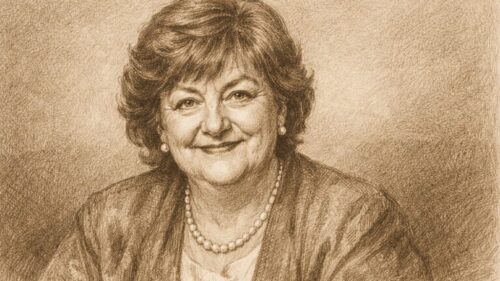
Maeve Binchy (1939–2012) was an Irish novelist, playwright, short story writer, columnist, and speaker. Her work was known for sympathetic and often humorous portrayals of small-town life in Ireland, with surprise endings. Her novels were translated into 37 languages and sold more than 40 million copies worldwide. She was born in Dublin and studied at University College Dublin, where she earned a bachelor’s degree in history. She later worked as a teacher and then as a journalist at The Irish Times. Those early years preceded her career as a writer of novels, short stories, and dramatic works.
Muireadhach Dating
Archived: 27 November 2026
The surviving notice set for this year is sparse and mostly chronological rather than narrative. In the Annals of the Four Masters chronology table, one label has no printed AD heading, while the next entries carry a printed heading of 331 and give both an absolute-style label and an internal regnal label. The evidence supports a careful distinction between printed date, internal identifier, and uncertainty about how securely any label maps onto 331 CE.
Flann O’Brien
Archived: 27 November 2026
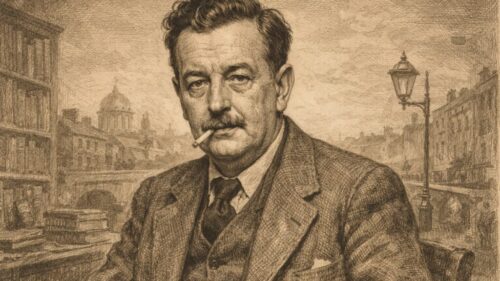
Flann O'Brien was the pen name of Brian O'Nolan. He was born in Strahan and educated in Dublin. One source gives his life dates as 1911 to 1966, and another gives his birth and death as 5 October 1911 and 1 April 1966. The archival record also notes that his papers preserve material connected with his health, death, and funeral. Brian O'Nolan created comic fiction as Flann O'Brien and Myles na gCopaleen. Under the name Flann O'Brien, he wrote At Swim Two Birds. He published his first novel in 1939. He also wrote in both Irish and English.
Brendan Behan
Archived: 27 November 2026
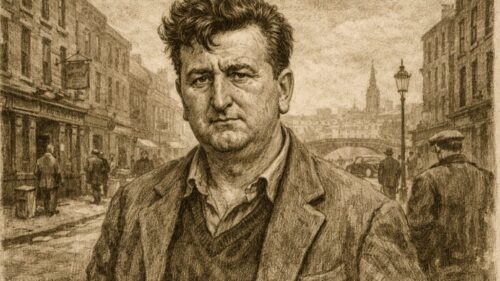
Brendan Behan was born on 9 February 1923 in Dublin and was raised at 13 Russell Street in the city’s north inner city. He was educated by the Sisters of Charity and the Christian Brothers. He had already joined Fianna Éireann at the age of fourteen. In 1939, he was arrested in Liverpool for IRA bomb activity and served time in a borstal institution in England and later in prison in Ireland. He was released from prison as part of a general amnesty in 1946. After his release, Behan moved between Dublin, Kerry and Connemara, and spent time in Paris.
Seán O’Casey
Archived: 27 November 2026
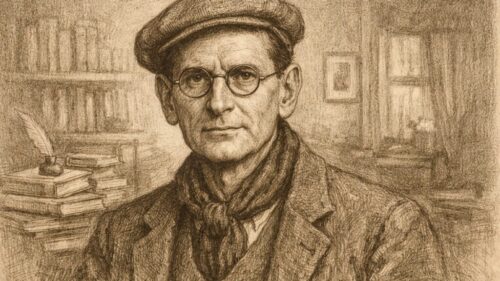
Seán O'Casey (1880–1964) was an Irish dramatist and memoirist, also known as Seán Ó Cathasaigh. He was born and brought up in north inner city Dublin. The record also shows him living in East Wall as a young man, where he began collecting books. Among the volumes preserved in his library were gifts from friends and second-hand purchases made from his worker's salary. O'Casey produced over twenty five plays and six volumes of autobiography, as well as essays. Three of his best-known plays, often grouped as the Dublin trilogy, premiered at the Abbey Theatre: The Shadow of a Gunman in 1923, Juno and the Paycock in 1924, and The Plough and the Stars in 1926.
J. M. Synge
Archived: 27 November 2026
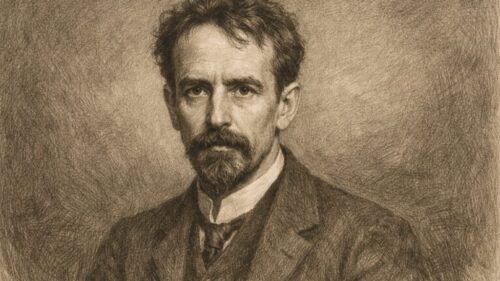
John Millington Synge is identified in archival material as having lived from 1871 to 1909. While a student at Trinity College Dublin, he devoted a great deal of time to musical studies at the Royal Irish Academy of Music. A commonplace book from just after his time at Trinity contains analyses of works by Mozart, Schubert, and Beethoven. The same Trinity material also preserves a photograph taken by Synge around 1900. It shows the range of his surviving papers, which include the musical commonplace book and other items associated with his student years and later writing.
Lady Gregory
Archived: 27 November 2026
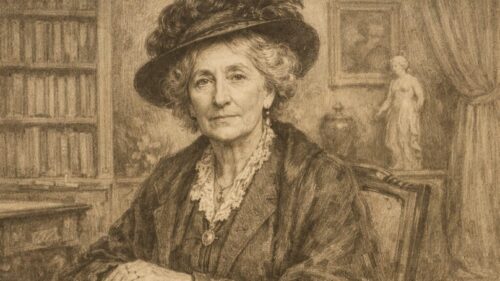
Early Life Lady Gregory was born Isabella Augusta Persse on 15 March 1852 at Roxborough, near Kilchreest, in south County Galway. In 1880 she married her near neighbour, Sir William Gregory of Coole. She was then aged 28 and he was 63. Their only son, Robert, was born in 1881. Writing Life Following Sir William Gregory’s death in 1892, Lady Gregory devoted much of her time to writing, beginning with transcribing her late husband’s memoirs. She learned Irish, first from some of her tenants and then by spending time in the Aran Islands.
